

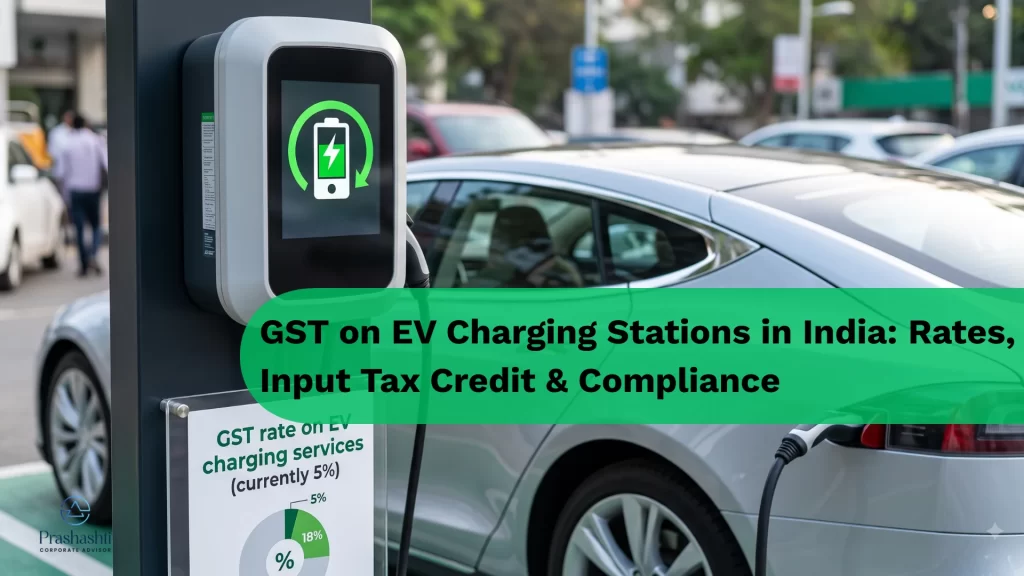
Imagine the CPO constructing its first EV charging station. So the charging station gets placed, people start using it, and now the question is should the company charge 5% GST or 18% GST. This is where things start getting messy. Most people assume there’s one simple answer, but GST on EV charging stations in India doesn’t work that way.
The charger itself may attract less than 5% GST, although the actual act of charging an EV is normally taxed at 18%. Moreover, electricity, installation works, civil construction and maintenance services are also taxed differently under GST. Getting them wrong might lead to improper invoicing, denied input tax credit and compliance issues later on.
The good part is that once you break each part of the setup separately, the system becomes much easier to understand. For a broader overview of setting up charging infrastructure, see our guide to an EV charging station in India. In this blog, we’ll walk through GST rates, HSN/SAC codes, ITC rules, registration requirements, returns, and the common mistakes EV charging operators should avoid.
What Is GST on EV Charging Stations in India?
When people talk about GST on EV charging stations in India, they often assume it’s one simple rate. It isn’t.
In reality, an EV charging business deals with different kinds of supplies, and each one can fall under a different GST treatment. The charger itself, the installation work, the electricity used, the software, maintenance, and the actual charging service are all treated separately.
The current split, per the CBIC’s GST rate schedule and Notification No. 12/2019-Central Tax (Rate):
Supply | GST treatment |
EV charger / charging station equipment | 5% |
Public EV charging service | 18% |
Electricity from licensed distributor | Generally exempt |
Installation / electrical work | Depends on nature of supply |
Civil work | Depends on classification + ITC rules |
Maintenance / AMC | Service-based GST rate |
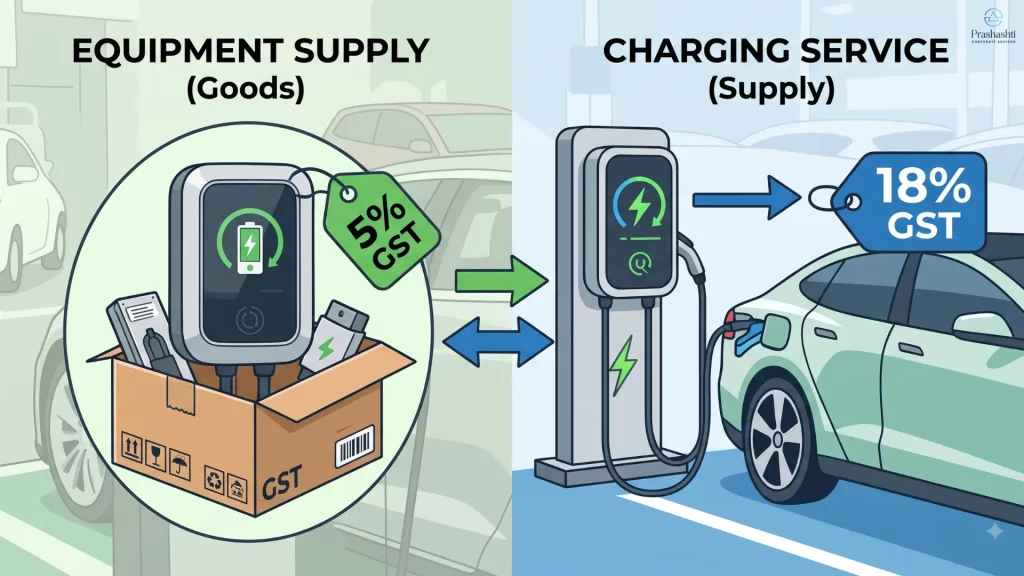
EV charger vs EV charging service
A simple way to understand it:
- When a CPO buys a charger → it is buying equipment.
- When it charges a customer → it is providing a service.
So the same business ends up dealing with both 5% and 18% GST, depending on what it’s actually doing at that moment.
What is The GST Rate on EV Charging Services in India?
GST on EV charging services – 18%
For most EV charging businesses, the key point is simple: the GST rate for EV charging = 18% on the service side.
So if a customer is charged ₹1,000 for a charging session, GST will be:
- GST @ 18% = ₹180
- Total bill = ₹1,180
A CPO should not treat this ₹1,000 as an “electricity sale” just because electricity is involved. What the customer is actually paying for is access to the charging infrastructure, equipment, and service experience. That’s why it is treated as a taxable service.
Several appeals have been made to the administration to bring down threshold to 5%. At the 56th meeting of the GST Council (September 2025), which gave the “GST 2.0” two-slab rationalization, the Fitment Committee turned down requests to bring EV charging and battery-swapping services under the 5% goods rate or consider them as energy. You can read the Council’s official press material here: GST Council – 56th Meeting Press Release (PDF) and the PIB press note on the two-slab GST 2.0 structure. So, as of today, the 5% rate cannot be used for charging service invoices.
GST on EV chargers and charging stations – 5%
On the other hand, the GST rate on EV chargers is 5% when the product fits the concessional entry.
CBIC’s rate schedule includes “charger or charging station for electrically operated vehicles” under HSN 8504 at 5%.
Example:
- EV charger: ₹5,00,000
- GST @ 5%: ₹25,000
- Invoice value: ₹5,25,000
Important Tip: Not every item under HSN 8504 automatically gets 5%. The description must match the concessional entry exactly.
Is Electricity Supplied For EV Charging Exempt From Gst?
Yes, electricity supplied by licensed electricity distributors is generally exempt from GST. But that does not mean a charging operator becomes an “electricity supplier” just because electricity is involved in charging.
In a typical public charging setup, the CPO buys electricity and uses it to provide a charging service. The customer is paying the CPO for the service, not directly buying electricity from the grid.
GST Council records clearly indicate that exemption for EV charging at public charging stations was not recommended.
So the practical split is:
- Electricity distributor → separate GST treatment (generally exempt)
- CPO charging service → taxable at 18%
CGST + SGST vs IGST on EV charging
The tax split depends on whether the supply is intra-State or inter-State.
- For an intra-State taxable supply, GST is normally divided between CGST and SGST.
- For an inter-State supply, IGST is charged.
For example, on a taxable chargeable service of ₹1,000 given within the same State:
- CGST @ 9% = 90
- SGST @ 9% = Rs 90
- Total GST = 180
IGST at 18% on an inter-State supply of similar taxable value would be ₹180.
HSN/SAC Code for EV Charging Service
Classification is more than the paperwork. It impacts on GST rate, reporting and ITC eligibility.
What Is The Sac Code For Ev Charging Services?
The Karnataka AAR has ruled that EV battery charging at public stations as a service under SAC 998714, taxed at 18%.
But this should not be blindly applied to every EV-related business model. The SAC depends on the exact nature of the supply and contract structure.
HSN code for EV charging equipment
The CBIC considers the qualified EV chargers and charging stations under HSN 8504 at 5% as per the Notification No. 12/2019-Central Tax (Rate) for the equipment. Again, the key term is “eligible”. Not every item that fits within 8504 qualifies.
How To Determine The Correct Classification?
Start with the actual supply. Ask:
- Is the business selling a charger?
- Is it providing a charging service?
- Is it installing equipment?
- Is it providing maintenance?
- Is it supplying software or networking services?
Once the nature of the supply is clear, the relevant HSN or SAC can be determined.
Can EV Charging Stations Claim Input Tax Credit?
The ITC EV charging station question is one of the most important parts of this entire structure, because setup costs are usually high.
However, as per Section 16 of the CGST Act, the ITC shall usually be available in case of use of such goods or services in the business process, under certain conditions and limitations.
Basic Conditions for Availment of ITC
The CPO should have:
- Valid tax invoices.
- Possession of goods/services.
- Use in business activity.
- Compliance with GST conditions.
ITC On EV Charging Equipment
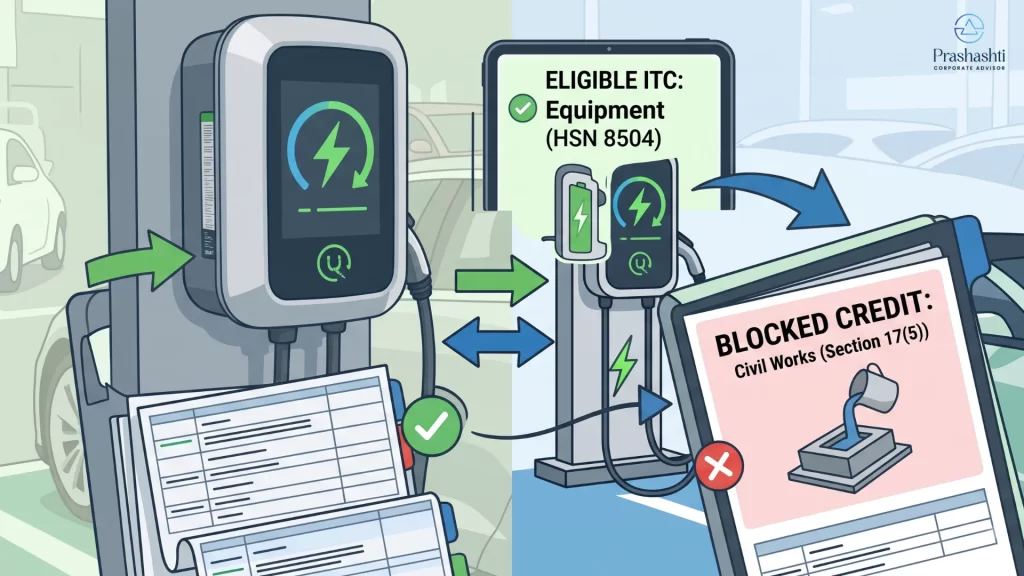
GST paid on eligible chargers and charging equipment can generally be claimed as ITC if used for taxable output services.
Example:
- Charger GST: ₹25,000
- This may be accessible as ITC (if criteria is met).
ITC On Electrical Work
Transformers, cabling, electrical panels, switchgear and other electrical infrastructure may be required for a charging station.
GST on eligible electrical goods or services used for the taxable business may be available as ITC. However, the nature of the expenditure matters.
ITC on Civil Work
Civil expenditure needs more caution.
Foundations, concrete buildings, sheds and other construction related activity may raise immovable property problems. Section 17(5) of the CGST Act places restrictions on certain credits relating to the construction of immovable property.
So, saying “ITC is not available on civil work” is too broad. The correct treatment depends on what was constructed, how the expenditure is classified, and whether the statutory blocked-credit provisions apply.
ITC On Installation, Software And Maintenance
Installation services, professional services, charging-management software, networking, and maintenance can potentially qualify where they are used for taxable business activities and do not fall under a blocked category.
Practical tip: Keep cost-head records separately for equipment, installation, electrical infrastructure, civil work, software and recurring services. The main reason CPOs lose defensible ITC at assessment is putting them all on one “capex” line.
The CPO's 4-Bucket GST Framework
Every EV charging business, regardless of size, is really four separate supplies stitched together. Treat each bucket on its own terms, and most GST mistakes disappear on their own:
Bucket | What it covers | GST logic |
1. Equipment | Charger / charging station hardware. | Goods – 5% if it fits HSN 8504’s concessional entry |
2. Charging output | What you sell the customer when they charge | Service – 18%, one composite supply (not split by energy vs. service charge). |
3. Infrastructure | Electrical work, transformers, cabling, civil construction. | Mixed – rate depends on the exact supply; ITC depends on Section 17(5). |
4. Digital & recurring services | Software, networking, AMC, payment systems. | Service — taxed on its own classification, not the charger’s rate. |
Ministry of Power EV Charging Guidelines Every CPO Should Know
GST compliance is now more consistent as your GST invoicing, registration timeframe and pricing structure is shaped by the Ministry of Power’s Revised Consolidated Guidelines & Standards for Charging Infrastructure for Electric Vehicles (14 January 2022). Along with the Karnataka EV Policy 2026 for operators in Karnataka.
- If it meets the Ministry of Power, Bureau of Energy Efficiency (BEE), and Central Electricity Authority’s technical, safety, and performance regulations, anyone can set up a Public Charging Station (PCS), subject to applicable EV charging station guidelines in Bangalore. The PCS Central Nodal Agency is BEE. Source: PIB, Ministry of Power.
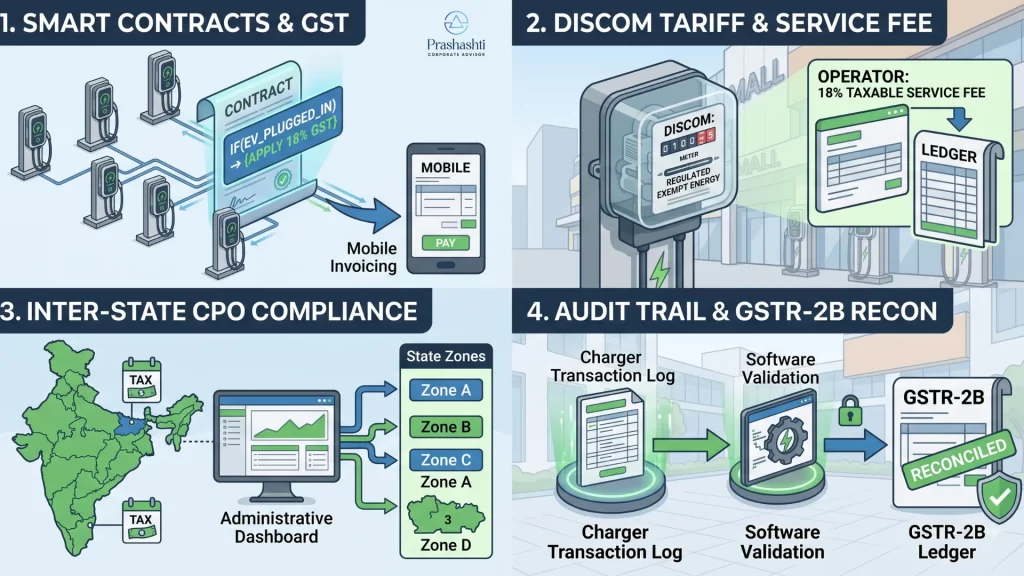
- The Ministry’s recommendations limit PCS power tariffs to a single-part tariff and the “Average Cost of Supply.” The AAR rule above interprets ‘energy charge’ and’service fee’ as one composite 18% taxable service, not two separately priced leg; therefore, a CPO should structure its client invoice accordingly.
- DISCOMs must supply a new PCS connection within 7 days in metro cities, 15 days elsewhere, and 30 days in rural areas.
Why this matters for your GST position: Because charging is legally structured as a service (not electricity resale) and the underlying electricity tariff is regulated separately from what you can charge the end customer, your GST-taxable “service charge” and regulated “energy charge” must be documented as separate cost components internally, even tho they’re taxed together as one 18% supply. DISCOM tariff audits and GST assessments often trouble CPOs that confuse this distinction in their internal accounting.
Expert Insight: EV charging is one of the few GST categories where the tax treatment, sectoral regulation (Ministry of Power / BEE / DISCOM rules), and one Advance Ruling must be read together to get the invoicing right, and the business setup people don’t always cross-reference those three sources.
Our compliance advisory work with growing businesses shows that operators treat the charger purchase, site construction, and ongoing charging service as one undifferentiated “EV charging business” cost bucket instead of as separate supplies requiring their own classification, invoice line, and ITC evaluation. Getting the cost-head split straight in bookkeeping before the first invoice eliminates a GST notification 18 months later.
GST Registration for EV Charging Station Operators
Is GST registration mandatory?
If the CPO’s turnover exceeds the threshold or if compulsory registration regulations apply, the CPO could need to register for GST and obtain the relevant EV charging station license in Bangalore where applicable.
General Threshold Section 22:
- ₹20 lakh (other than special category States)
- ₹10 lakh (special category States)
However, some circumstances may fall under Section 24 compulsory registration laws.
GST Registration Threshold for EV Charging Operators
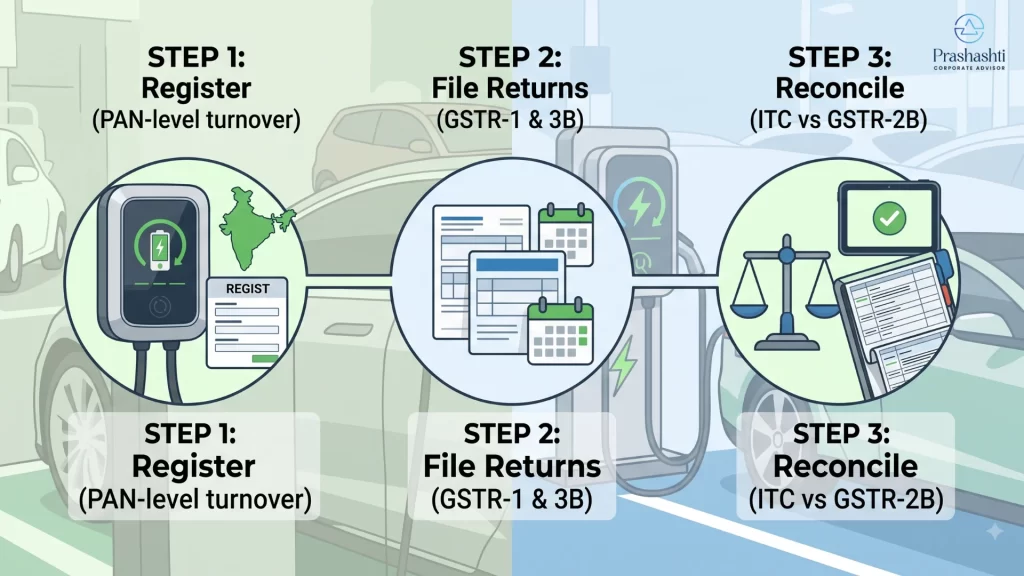
The turnover is calculated at PAN level and enterprises working across the States need to evaluate the registration carefully. Voluntary registration is also allowed.
When Should a CPO Voluntarily Register?
It often makes sense when:
- There are significant input purchases and ITC benefits.
- Business is B2B or corporate-focused.
- Expansion across locations is planned.
- GST invoices are required for contracts.
- A structured billing system is needed.
GST Returns for EV Charging Operators and CPOs
For GST compliance in India, return filing depends on the registration type.
Regular taxpayers file:
- GSTR-1 (outward supplies)
- GSTR-3B (summary + tax payment)
Smaller taxpayers can opt for the QRMP scheme (up to ₹5 crore turnover), where:
- GSTR-1 and GSTR-3B are quarterly
- Tax is paid monthly for the first two months of the quarter
ITC must be reconciled with GSTR-2B, especially for CPOs dealing with multiple vendors.
GST Compliance Checklist for EV Charging Station in India
A CPO should regularly make sure:
- GST registration is active.
- The correct HSN/SAC is used.
- The correct GST rate is applied.
- Proper tax invoices are issued.
- Output GST is correctly calculated.
- Purchase invoices are complete.
- ITC eligibility is verified.
- GSTR-2B is reconciled.
- GSTR-1 is filed on time.
- GSTR-3B is filed on time.
- GST payment is made.
- Accounting matches charging platform data.
- ITC records are properly maintained.
GST Treatment for Different EV Charging Business Models
Business model | Key GST considerations |
Public EV charging station | Charging service + ITC |
CPO | Output GST + ITC |
Mall charging station | Charging + rental/cost structure |
Hotel charging station | Bundled services possible |
Workplace charging | Internal business use structure |
Fleet charging | Captive/commercial use |
Home charging | Ownership + usage model |
Installation provider | Equipment vs service split |
GST on EV Charger Installation, Electrical Work & Maintenance
GST on EV Charger Installation
Installation is a separate service. Just because the charger is taxed at 5% does not mean installation automatically gets the same rate.
GST on Electrical Infrastructure
Transformers, cabling, panels, and switchgear must be classified based on actual supply. Rates may differ from EV charger equipment.
GST on Civil Construction Work
Civil work may have both GST and ITC implications. Section 17(5) must be checked carefully.
GST on EV Charger AMC
AMC is a service and is taxed based on its own classification, not the original equipment rate.
GST on Repairs And Maintenance
Repairs are separate services and should not be bundled with equipment supply.
GST On Charging-Management Software
Software, monitoring tools, and payment systems are separate taxable services and must be invoiced accordingly.
Common GST Errors EV Charging Operators Make
There are a few things that go wrong again and again:
- Applying 5% GST to charging services
- Applying 18% GST to eligible EV charger equipment
- Treating electricity exemption as charging exemption
- Using wrong HSN/SAC
- Claiming ITC on blocked civil work
- Not reconciling ITC with GSTR-2B
- Wrong CGST/SGST/IGST application
- Bundling all supplies under one GST rate
- Missing return deadlines
- Poor documentation for ITC claims
GST on EV Charging Station in India: Always Stay Compliant with Prashasthi Corporate
Understanding GST on EV charging stations in India becomes much easier when the charger, charging service, electricity, and related expenses are treated separately. But the real problem arises in keeping GST rates, ITC claims, invoices, and returns in sync while expanding the business operations.
If you’re a CPO launching a new site or expanding across States, the cheapest time to fix a GST classification error is before your first invoice, not after a notice. Prashasthi Corporate can review your GST registration, equipment vs. service classification, invoice structure, ITC eligibility across cost heads, and GSTR-2B reconciliation process through its corporate advisory services in India, so your charging business is billing correctly from day one.
Disclaimer: This article is for general informational purposes and reflects the regulatory position as publicly available in 2026. It does not constitute legal, tax, or financial advice.