

A few years ago, launching an EV business in Karnataka felt like an easy task. With solid government incentives, road tax exemptions and a clear push to electric mobility. It really did look like the appropriate moment to get in early.
But by 2026 things started looking a little different. New tax rules came in, incentives were reshaped, and suddenly a lot of people like business owners, investors, even regular EV buyers, were left trying to figure out what had actually changed. Is it still worth investing? Are the benefits the same as before? Or has the window of opportunity started to close?
The reality is, the Karnataka EV Policy 2026 hasn’t slowed things down. If anything, it has just redirected the focus. The old incentives may have seen changes in their structure, but there are also new incentives that have come into existence in sectors such as manufacturing, charging infrastructure, batteries, and EV startups.
In this blog, we’ll go through what has actually changed, what incentives are still available and how businesses may still take advantage of Karnataka’s burgeoning EV ecosystem.
What Are The Key Changes Introduced from April 1, 2026?
If you’ve been following Karnataka’s EV journey, you probably noticed a pretty important shift:
The state is still moving ahead with its Karnataka Clean Mobility Policy 2025-30, but a few rules have been tweaked, and these changes matter for buyers, businesses, and anyone planning to invest in the EV space.
The biggest talking point is the updated lifetime tax EV Karnataka structure. Through the Karnataka Motor Vehicles Taxation (Amendment) Act, 2026, notified on 10 April 2026 after the Governor’s approval, the state withdrew the 100% lifetime road tax exemption that electric four-wheelers had enjoyed since 2016. You can read the actual bill on the Karnataka DPAL (Directorate of Parliamentary Affairs & Legislation) portal.
Tiered Lifetime Road Tax Structure
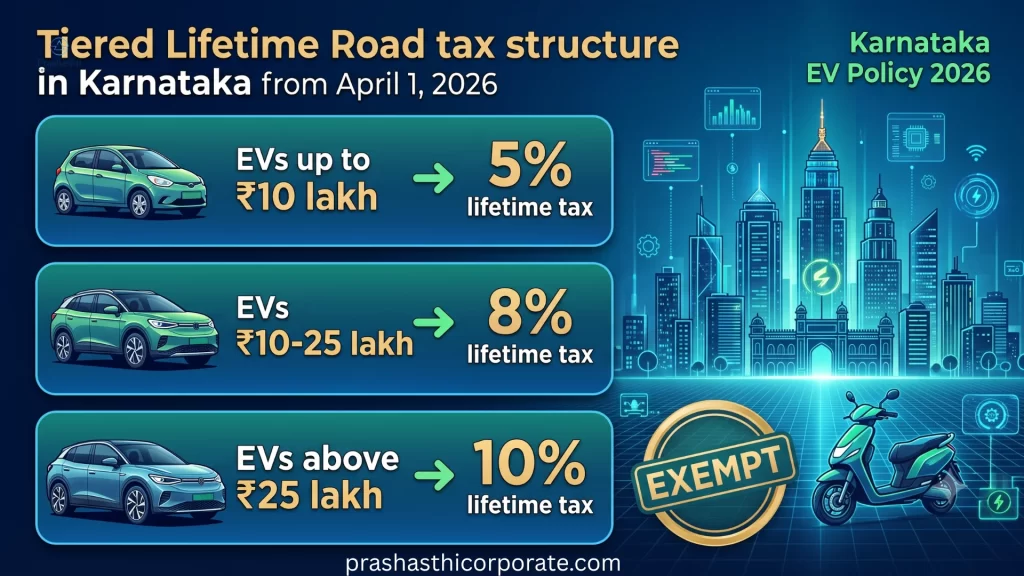
Instead of treating all EVs the same, Karnataka now links tax to the price of the vehicle.
- EVs priced up to ₹10 lakh → 5% lifetime tax
- EVs priced ₹10-25 lakh → 8% lifetime tax
- EVs priced above ₹25 lakh → 10% lifetime tax
Electric two-wheelers continue to be fully exempt, so the change mainly affects individual buyers in the premium segment and companies running corporate fleets of higher-end EVs. Vehicles registered before 10 April 2026 are unaffected, and existing EV owners re-registering pay a proportionate lifetime tax based on the vehicle’s age.
According to the Transport Department’s own figures, the state had missed its FY 2025-26 collection target by roughly ₹2,100 crore, and the new slabs are expected to add close to ₹250-259 crore a year; this was, by the government’s own account, a revenue-correction move rather than an anti-EV one.
Policy Timeline
Karnataka has actually been ahead of the curve when it comes to electric mobility. Its earlier EV policies helped bring in manufacturers, suppliers, and early-stage investments into the state. That foundation is what made the current ecosystem possible.
Then came the Karnataka Clean Mobility Policy 2025-30, unveiled by Energy Minister K.J. George at Invest Karnataka 2025 and issued by the Commerce and Industries Department, effective 11 February 2025 for five years. It expanded the focus well beyond vehicles, into batteries, hydrogen, charging networks, R&D, and future mobility technologies, and targets ₹50,000 crore in investment and around 1 lakh jobs across the value chain.
The April 2026 update didn’t rewrite the policy. It mainly adjusted the tax structure while keeping the rest of the ecosystem support intact.
Policy Area | 2026 Update |
Road Tax | Tiered lifetime tax introduced |
Manufacturing | Incentives continue |
Charging Infrastructure | Expansion support continues |
Commercial Mobility | Permit benefits remain |
Battery Ecosystem | Strong focus continues |
If you want to install a charging station, read our comprehensive EV Charging Station License Bangalore guide, which explains approvals from BESCOM, CEIG, fire safety authorities, and other regulatory requirements in a step-by-step manner.
Planning to set up an EV charging station in Karnataka?
Understanding The Karnataka EV Policy 2026
Even though people often search for “Karnataka EV Policy 2026”, the actual framework is the Karnataka Clean Mobility Policy 2025-30. It covers the entire ecosystem, from vehicle manufacturing to batteries, charging stations, recycling, software, and even future mobility solutions.
Key Objectives of Karnataka EV Policy 2026
The policy is built around a few long-term goals that go beyond just selling electric vehicles.
Increase EV Adoption
The idea is simple: make EVs easier to buy, easier to use, and easier to trust. That includes private users, businesses, and public transport systems.
Attract Manufacturing Investment
Karnataka wants more factories, not just assembly units, but full-scale manufacturing for EVs, batteries, and components.
Expand Charging Infrastructure
Range anxiety is still real. So the focus is on building enough charging stations across cities, highways, and industrial zones.
Strengthen Battery Manufacturing
Batteries are the most costly element of an EV. Local manufacturing reduces import dependence and cuts long-term costs.
Create New Jobs
The EV ecosystem can provide jobs from factory workers to engineers, software developers and technicians.
Reduced Emissions
At the end of the day the goal is cleaner air and lower carbon emissions.
What Are The Major Incentives Under Karnataka EV Policy 2026?
Policies only work when there’s real financial support behind them. Karnataka seems to understand that well. So instead of just announcements, the state has built a mix of incentives to actually push investment.
Manufacturing Incentives
Companies setting up EV-related manufacturing units can access a range of benefits depending on the size and type of project.
One of the key supports is the EV subsidy in Karnataka, which helps reduce initial setup costs.
There’s also SGST reimbursement for eligible projects, which improves cash flow in the early years, something every manufacturer cares about.
On top of that, stamp duty concessions and land support in industrial zones make it easier to get projects off the ground.
Battery, Component Manufacturing & Innovation
Karnataka isn’t just chasing big EV brands. It’s also trying to build the supply chain behind them.
That includes battery makers, motor manufacturers, electronics suppliers, and software developers.
Startups and MSMEs also play a big role here. Many of them supply parts or build niche technologies that larger companies depend on.
The policy also supports R&D, especially in areas like battery chemistry, charging systems, and mobility software.
Charging Infrastructure Incentives
Without charging stations, EV adoption simply doesn’t scale. That’s why this part of the policy is getting a lot of attention.
- One of the biggest incentives is a 25% subsidy for the first 500 public charging stations. That alone makes entry into this space much more attractive for new players.
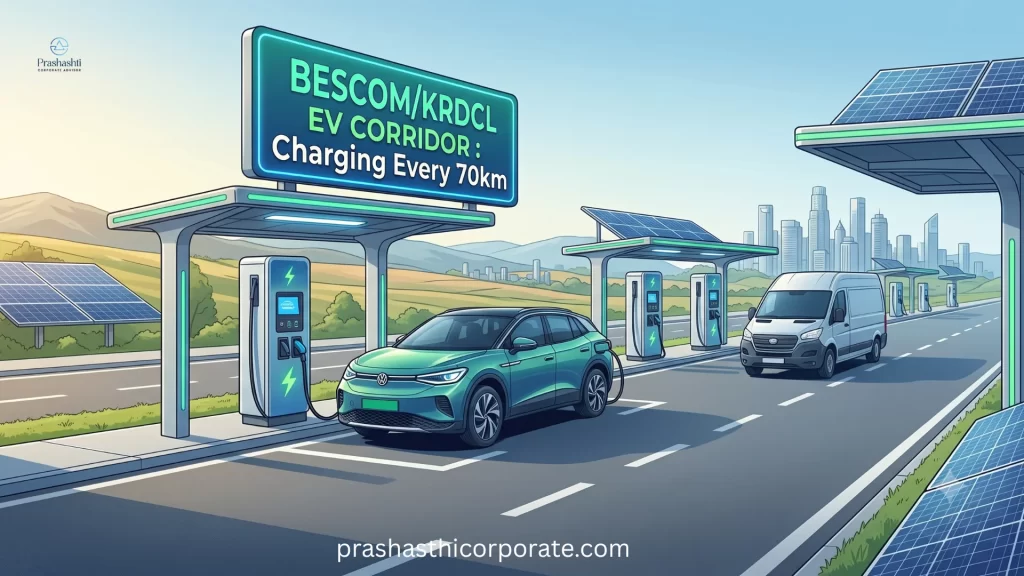
- There’s also a broader plan to build charging points along highways, roughly every 60 to 70 km under the BESCOM and KRDCL corridor network. Along with the EV charging station subsidy in Karnataka, companies can also explore partnerships with malls, offices, fleet operators, and highway developers through the Land Aggregator Portal run by BESCOM.
If you’re planning to establish a charging station in Karnataka, our detailed EV Charging Station Guidelines in Bangalore explain the technical standards, compliance requirements, and operational best practices for setting up a compliant charging facility.; you don’t need a distribution license, but you do need to meet the technical and safety standards laid down by the Ministry of Power / e-AMRIT (NITI Aayog), the Bureau of Energy Efficiency, and the Central Electricity Authority.
How Karnataka's Battery Swapping Policy Supports EV Growth?
Charging stations are important, but Karnataka isn’t stopping there. The state is also pushing battery swapping, especially for vehicles that are always on the road like delivery bikes, autos, and fleet vehicles.
Instead of waiting for a battery to charge, you just swap it with a fully charged one in a few minutes and move on. For businesses, that time saved is a big deal.
To support this, the policy offers subsidies for battery swapping stations. These are meant for companies setting up swapping networks, battery service providers, and anyone building battery-as-a-service models.
This model is expected to grow fastest in:
- Electric two-wheelers.
- Three-wheelers.
- Delivery and logistics vehicles.
- E-commerce fleets.
- Shared mobility services.
For entrepreneurs, this is actually a bigger opportunity than it looks at first. You’re not just selling batteries or stations; you will be building a system. Subscription models, fleet tie-ups, swapping networks… all of that becomes possible. Businesses looking to expand beyond Karnataka can also explore our complete guide on EV Charging Station in India, which covers licensing, approvals, investment requirements, and regulatory considerations across the country.
Commercial EV Benefits Under Karnataka EV Policy 2026
Commercial EVs are where the real impact happens. They run more, pollute more, and consume more fuel, so switching them to electric makes a huge difference.
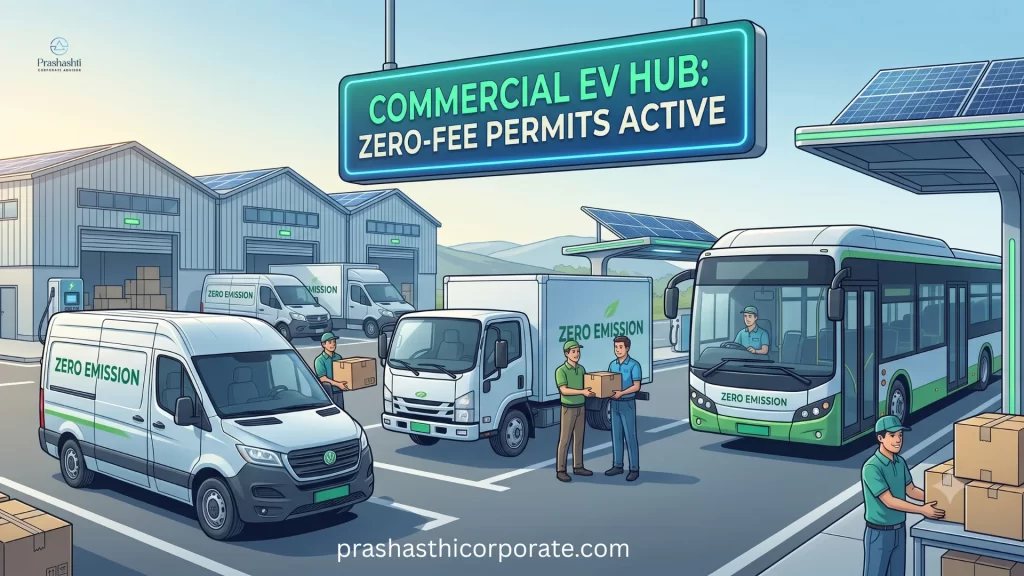
One of the most practical benefits here is zero-fee commercial permits for EVs. That might sound small, but for transport businesses, it actually reduces recurring costs quite a bit.
This helps:
- Logistics companies.
- Fleet Operators
- Public Transportation
- Ride-Hailing and Cab Aggregators
Let us consider an example of a logistics company. If they replace diesel vehicles with EVs, they’re not just saving on fuel and maintenance. They’re also cutting down permit costs.
Business Opportunities Created by Karnataka EV Policy 2026
If you’re a startup or even an established business, there are multiple entry points.
EV Manufacturing
EV manufacturers, whether cars, bikes, buses, or commercial vehicles, can benefit from incentives, suppliers, and skilled talent.
Battery Manufacturing
Companies making cells, packs, or storage systems will see steady long-term demand.
Battery Recycling
This is one of those sectors people ignore at first, but it’s going to be huge. As batteries age out, recycling and material recovery will become essential and profitable.
Charging Station Business
Charging is still one of the fastest-growing opportunities. With EV charging station subsidies in Karnataka, setting up stations can become a solid long-term business model, especially in cities and on highways.
Fleet Electrification
Delivery providers and business transportation and logistics players are slowly switching to EVs. Businesses that help them manage fleets, charging or maintenance will be in significant demand.
EV Software & Telematics
Modern EVs run heavily on software. Things like route planning, battery tracking, and predictive maintenance. All of this needs tech platforms.
Energy Management Systems
As the need for charging increases, careful management of electricity becomes vital. Then, there will be a need for load balancing, cost reduction and charging scheduling software.
Integration of Renewable Energy
Combining solar and EV charging can save businesses money in the long run and boost their sustainability.
EV Financing Platforms
EVs still cost more upfront. That opens up space for financing companies, NBFCs, and fintech startups offering loans, leasing, or subscription models.
Investment Opportunities for EV Investors in Karnataka
From an investor’s point of view, this policy is basically a signal that the EV market in Karnataka is going to scale fast.
- Manufacturing is still the biggest bet. EVs, batteries, motors, electronics, all of it.
- Charging infrastructure is another strong area. It needs continuous capital, and returns are usually stable over time.
- Battery gigafactories are also expected to attract large investments as India tries to reduce import dependence.
- And then there are startups. Especially in software, energy storage, and fleet tech.
Karnataka vs Other State EV Policies
Every state is trying to attract EV investment, but Karnataka has a slightly different advantage:
State | Manufacturing | Charging | Tax Benefits | Battery Focus | Startup Ecosystem |
Karnataka | Strong | Strong | Moderate | Strong | Excellent |
Tamil Nadu | Strong | Moderate | Moderate | Strong | Good |
Maharashtra | Strong | Good | Moderate | Moderate | Good |
Gujarat | Strong | Moderate | Good | Moderate | Moderate |
Telangana | Moderate | Moderate | Moderate | Emerging | Good |
Your Charging Business's Electricity Rate Will Rise Later – Plan for It Now
Here’s how it works. Charging stations in Karnataka buy power at a special commercial rate called LT-6(c), fixed by the Karnataka Electricity Regulatory Commission (KERC). Right now, this rate is kept deliberately low, about 49% cheaper than what it actually costs the utility to supply that power. It’s essentially a discount designed to make EV charging attractive.
But that discount has a built-in expiry. By law, this kind of gap between the discounted rate and the real cost isn’t allowed to stay this wide forever, and a Karnataka High Court order has pushed the regulator to fix a timeline. KERC has already published that timeline: starting FY 2028-29, the rate will climb by roughly 5% every year until it’s much closer to the real cost of power.
What this means for you: if you’re building a five-year business plan around today’s cheap electricity rate, your margins on paper won’t match your margins in real life a few years from now. Whether you’re pitching investors, writing a franchise deal, or just budgeting your own station, build in a yearly cost increase from 2028-29 onward instead of assuming today’s rate holds forever.
Expert insight: EV startups in Bangalore often base their pricing and subsidy plan on a tax rate, charging tariff, or subsidy percentage they read in a blog post or vendor pitch deck. Most of these numbers: LT-6(c) tariff, lifetime tax slabs, permit fee waivers, are regulator-notified and updated. Instead of last year’s article, check the source’s current number before investing. Building a compliance schedule from the start helps since most breakdowns occur 12–18 months after establishment when a renewal or filing lapses silently.
Industries That Will Benefit the Most
A lot of sectors will feel the impact:
- EV manufacturers
- Charging operators
- Battery companies
- Recycling businesses
- Logistics and fleet operators
- Renewable energy companies
- Software and telematics startups
- Component manufacturers
- Industrial developers
- EV financing companies
How Businesses Can Leverage Karnataka EV Policy 2026?
If you’re planning to enter this space, don’t just start with subsidies.
- First, figure out where you fit: manufacturing, services, software, infrastructure, or something else.
- Then check what incentives actually apply to you. Not everything will.
- Location also matters a lot. Being in the right industrial cluster can make operations much easier.
- And finally, partnerships matter more than people think. Very few companies succeed alone in this ecosystem.
Karnataka EV Policy 2026: Key Insights from Prashasthi Corporate
The Karnataka EV Policy 2026 still keeps Karnataka in a strong position for anyone looking at the EV space.
For most entrepreneurs and investors, the real takeaway is simple: the opportunity is not just in selling electric vehicles, but in building everything around them. That’s where the real growth is expected to happen.
If you’re planning to enter this space, get the setup and compliance part right from the beginning. That’s where firms like Prashasthi Corporate can make things easier and help you move forward without getting stuck in the paperwork.
Disclaimer: This article is for general informational purposes and reflects the regulatory position as publicly available in 2026. It does not constitute legal, tax, or financial advice. Businesses should verify current eligibility criteria and consult a qualified professional before making investment or compliance decisions.




Pingback: GST on EV Charging Station India: Rates, ITC & Rules