

A small café owner spends years slowly building a regular crowd. People start recognising the name, they recommend it to friends, and the café even begins getting good reviews online. Everything feels like it’s finally working. Then, out of nowhere, another café opens just a few streets away with a very similar name and almost the same branding. Customers get confused. Some even walk into the wrong place without realizing it.
When the owner thinks about taking legal action, they hit a roadblock: the trademark was never registered.
This is where Section 27 of the Trademark Act actually comes into the picture. A lot of business owners assume that if a trademark isn’t registered, there’s no protection at all. That’s not entirely true. It’s true that you can’t file a standard infringement case without registration, but the law still doesn’t leave you helpless. You can still protect your brand through something called a passing off action.
In this blog, we’ll tell you about what Section 27 really means, how it works in real situations, when it can be used, and what every business owner should understand to avoid losing the identity they’ve worked so hard to build,while ensuring their overall business compliance, including a BBMP Trade License where applicable.
What Is Section 27 of the Trademark Act?
A lot of business owners assume that if they haven’t registered their trademark, they have no legal protection at all. That’s not true.
Section 27 clears this confusion. Basically, it says two things:
- First, if your mark is not registered you cannot sue for trademark infringement under the Act.
- Second, you are not helpless even if it is not registered. You can still take action through a passing off claim.
The full statutory text is publicly available on the Government of India’s official legislative repository, India Code – Legislative Department.
Need help with trademark protection? Speak with our legal experts.
Key Provisions of Section 27 of the Trademark Act
To really understand how this section works, it helps to break it into two simple parts.
Section 27(1): No Infringement Without Registration
This part is quite clear.
In case your trademark is not registered, then you can not seek remedy for trademark infringement under the Trade Marks Act, 1999.
Why? Because infringement is a statutory right. It only exists when the law formally recognises your trademark through registration.
So if you haven’t registered it, the law doesn’t treat it as an “infringement right” yet.
Section 27(2): Passing Off Still Applies
This is the more important and more practical part of Section 27.
It says even if your trade mark is not registered you can initiate an action against any misrepresentation of the said products or services as yours. This is called passing off.
Passing off is not about paperwork or registration. It is about reputation.
The court basically asks:
- Did you build goodwill in the market?
- Are customers associating your brand with your business?
- Is the other party creating confusion?
If it is then you may still have a solid case.
For example, if tiny apparel brand called “Urban Thread” has been in business for a long time and another vendor begins to use “Urban Threads” with similar logos and packaging, people could say that they are connected.
Even if there is no registration, the original business may nevertheless act in terms of section 27(2).
This is especially important for:
- small businesses
- local brands
- startups still building their identity
- businesses waiting for trademark approval
Businesses should also ensure they maintain other statutory compliances, such as Trade License Renewal, alongside protecting their brand identity.
Expert Insight: We regularly see founders wait for their registration certificate before doing anything about a copycat. That delay is often the costliest mistake in a passing off dispute, courts weigh how quickly a business acted once it noticed the infringement. If you notice a lookalike brand, document it and consult a professional immediately; don’t wait for TM-A to clear examination.

Section 27 Isn't Standing Still: What 2025–2026 Has Changed
Law in India is not static, courts have been actively altering it over the past year.
- In July 2026, the Delhi High Court banned a company by the name of Havai from using a mark similar to HAVELLS, regardless of whether Havai had its own registration. Takeaway: You won’t be protected for changing the look of a registered mark to take advantage of someone else’s reputation. (Delhi High Court case portal)
- The Supreme Court ruled against Pernod Ricard in the battle of “Blenders Pride” vs “London Pride” in August 2025, saying that common phrases like “Pride” cannot be monopolized without strong evidence of misunderstanding. Reputation alone is no longer enough. (See Judgment)
Courts have enabled firms to tack on an infringement claim to an ongoing passing off suit once their registration comes through, so there is no need to start over.
The CGPDTM Annual Report mentions that more than 5.5 lakh trademark applications were filed in FY 2024-25 alone. That means there are more companies than ever in the “applied but not yet registered” zone. This is when section 27(2) comes into play.
Why Section 27 Matters for Businesses?
In real life, most businesses don’t think about trademarks on day one. They think about sales, customers, marketing, survival. That’s why Section 27 of the Trademark Act is so important. It acts like a safety net.
It means: even if you have not yet registered your brand, the law takes notice of the efforts that you did in establishing it.
But there’s a catch. A passing off case is not easy. Unlike registered trademark cases, where ownership is already proven, here you have to prove everything:
- That you used the brand first.
- That customers recognise it.
- That it has goodwill in the market.
- That confusion is actually happening.
Things like:
- invoices and bills
- GST records
- advertisements
- packaging designs
- website history
- social media pages
- customer feedback
Without this, it becomes very difficult to succeed in court.
That’s why most legal experts still recommend not relying only on common law trademark protection.
Registered vs Unregistered Trademark Rights Under Section 27
A lot of business owners assume that once they start using a brand name, they automatically “own” it in the legal sense.
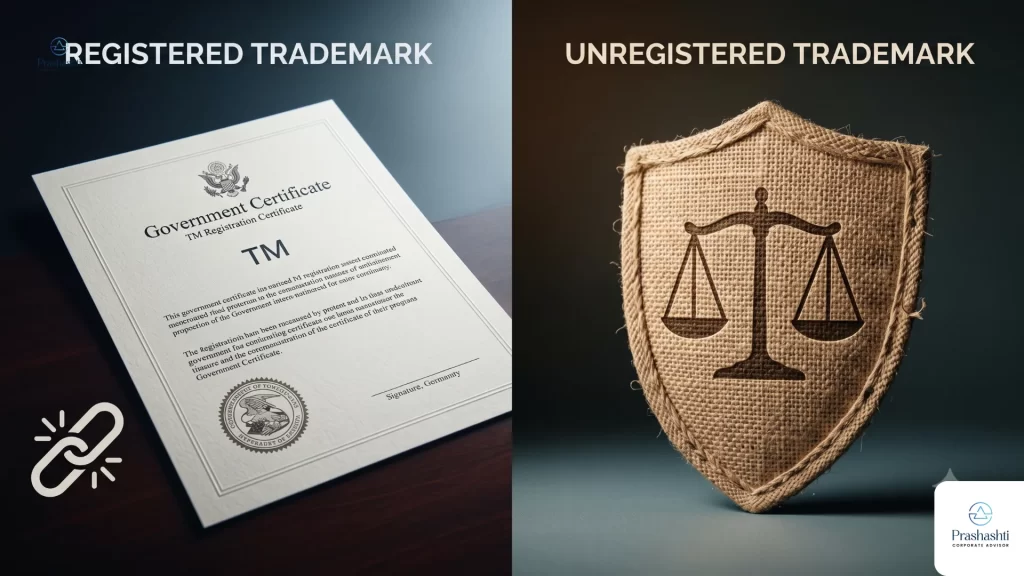
Yes, you do get some protection by using a brand. However, the level of protection will depend on whether your brand is registered or not.
To make it simple, here’s a comparison:
Registered Trademark | Unregistered Trademark |
Protected under the Trade Marks Act, 1999 | Protected through passing off |
You can file infringement cases | You must file passing off cases |
Easier to enforce | Harder to prove |
Rights are automatic after registration | Rights depend on use and reputation |
Registration certificate is strong proof | You must show evidence of use |

Difference Between Trademark Infringement vs Passing Off
People often mix these two up, but they are not the same thing.
Trademark infringement only applies when your trademark is registered. If someone copies or uses a confusingly similar mark, you can directly sue them under the Act.
Passing off is more about reputation. It protects the goodwill you’ve built over time, even if you never registered your trademark.
Let’s make it simple.
If you have a registered brand and someone copies it, you go for infringement.
If you don’t have registration but someone still copies your brand and confuses your customers, you go for passing off.
The biggest difference is proof. In infringement, your registration already gives you a head start. In passing off, you have to build the entire story, use, reputation, confusion, all of that from scratch.
How Well Is Your Unregistered Brand Protected in India? Check Your Score
Most companies don’t know where they genuinely stand until they get involved in a conflict. We created this quick self-assessment so you can figure out your standing before this happens.
- I have been using this brand name or logo regularly and consistently for at least 1-2 years.
- I have dated invoices, GST filings or bills showing the use of this brand name.
- I have advertising, packaging or website records dating back to when I first started using the name.
- The brand is mentioned in social media posts, customer reviews, or press mentions.
- My brand name or logo has not much altered since I started to use it.
- I am careful about similar names or logos coming into my market.
- I did not delay more than 6 months to file a trademark application after I decided to register it.
Your score:
6-7: Good passing-off position: If someone is copying your brand, you probably have enough evidence to act. But you are also well placed to register immediately and turn that strength into legislative protection.
3–5: Middle position: You have some evidence, but holes in your paper trail could undermine a claim. Begin collecting records today. Treat registration as urgent.
0–2: Exposed position: At the moment, if someone replicates your brand, proof of passing off would be difficult. Here is where registration is required.
Section 27 vs Section 28 vs Section 29
These three sections of the Trade Marks Act actually work like a system, not separate rules.
- Section 27 talks about unregistered trademarks.
- Section 28 deals with rights of registered owners.
- Section 29 explains what counts as infringement.
When you read them together, the structure becomes much clearer.
Section | What it means | Who it applies to | Remedy |
Section 27 | Unregistered trademarks | Prior users | Passing off |
Section 28 | Rights after registration | Registered owners | Statutory protection |
Section 29 | Infringement rules | Registered owners | Infringement action |
Why Trademark Registration Still Matters?
Even though Section 27 gives some protection, registration is still the safer and smarter route.
You get clear ownership rights
Once your trademark is registered, the law recognises you as the exclusive owner for that category of goods or services.
It’s much easier to enforce
You don’t have to spend time proving ownership from scratch. The registration itself becomes strong evidence.
Protection across India
Your rights are not limited to one city or region. They apply nationwide.
It adds value to your business
A registered trademark is an asset. It will help add value to your brand name and make your business more appealing to investors.
Helps in Franchising and Licensing
In case there comes a time when you need to franchise or license, registering will definitely make things easier.
Builds trust
Customers and investors generally trust registered brands more because it shows seriousness about protecting identity.
You can check the status of a pending application, or search existing marks before adopting a new one, on the government’s official trademark portal: IP India – Trademark e-Filing & Public Search.
How to Protect an Unregistered Brand in India?
Not every business registers its trademark right away. This is really normal, especially in the beginning.
But if you are using an unregistered brand, you have to be careful.
- The first thing is to be consistent. Don’t keep changing your logo, name, or branding. Courts look at consistency when deciding goodwill.
- Second, keep records. This is extremely important. Save invoices, ads, packaging, GST records, website screenshots, social media posts, anything that shows you’ve been using the brand.
- Third, keep an eye on the market. If someone starts using a similar name, don’t ignore it. Early action can save a lot of trouble later.
- And finally, don’t delay registration for too long. Passing off protection exists, but it is always harder than having a registered trademark.
Important Case Laws on Section 27 of the Trademark Act
Indian courts have been very clear on one thing: goodwill matters, even without registration.
S. Syed Mohideen v. P. Sulochana Bai
The Supreme Court held that the person who uses a trademark first can sometimes have stronger rights than a later registered owner.
Laxmikant V. Patel v. Chetanbhai Shah
The Court said that no one should be allowed to mislead customers or take unfair advantage of another business’s reputation.
Cadila Healthcare Ltd. v. Cadila Pharmaceuticals Ltd.
That’s why the Court brought up the fact that even a little misunderstanding about similar marks could be dangerous, especially in medicine.
N.R. Dongre v. Whirlpool Corporation
This case recognised that a brand’s reputation can exist even before it has strong physical presence in India.
Expert Insight: The Havells ruling is the one to watch. We keep meeting founders who think ‘I registered my mark’ ends the conversation; it doesn’t. Courts are now looking at how a mark is actually displayed, not just what’s on the certificate. If your packaging or branding drifts even slightly toward a competitor’s look, that drift is now litigable.
Common Misconceptions About Section 27 of the Trademark Act
There are a few myths that keep coming up.
- One is that unregistered trademarks have no protection. That’s not true; passing off exists exactly for that reason.
- Another is that registration is optional and not very important. In reality, registration makes enforcement much easier.
- Some people also think passing off and infringement are the same. They are not. One is based on reputation, the other on statutory rights.
- And finally, company registration or GST registration does not protect your brand name. Only trademark registration does that.
A Simple Example of Section 27 in Real Life
Let’s say there is a small café called Bean Bliss. They’ve been using this name since 2018. People in the area know them, and they’ve built a decent local reputation. But they never registered the trademark.
Now in 2025, another café opens nearby called Bean Blizz. The branding looks similar, the colours are similar, and even the menu style feels copied. Customers start getting confused.
Since Bean Bliss never registered its trademark, it cannot file an infringement case.
But it can still go to court for passing off.
To win, they will need to show:
- They used the name first.
- The customers relate to the name.
- The new café is creating confusion.
Things like bills, Instagram posts, reviews, and photos of their shop can all help prove this.

Section 27 of the Trademark Act: Protect Your Brand with Support from Prashasthi Corporate
When you look at Section 27 of the Trademark Act, one thing becomes clear. You can still take action through what’s called a passing off claim to protect the brand you’ve built over time.
If you are trying to build your brand, or even just want to make sure that everything is safe from a legal standpoint, then getting some help will definitely come in handy. This is where experts like Prashasthi Corporate can help out by making everything much easier for you.
Disclaimer: This article is intended for general informational purposes only and does not constitute legal advice.