

You’re filling in your tax details and stop at one question: Is this income taxable or not? Your salary has HRA, you may have received gratuity or leave encashment, and there could be other allowances on your payslip. It’s easy to assume that anything marked as an exemption is simply tax-free. But that’s not how Section 10 of the Income Tax Act works. Different clauses cover different types of income, and each one comes with its own limit or conditions. There’s another thing to watch in 2026. The Income-tax Act, 2025 has replaced the 1961 Act from April 2026, so the way these exemptions are referenced has changed too. Here, we’ll look at the important Section 10 exemptions, their limits, who can claim them, and what changed in 2026.
What Is Section 10 of the Income Tax Act?
Section 10 isn’t one blanket exemption. It’s a long list of independently conditioned clauses (10(1), 10(5), 10(10), 10(13A), and so on). Some are fully exempt with no cap (agricultural income); others are exempt only up to a ceiling (gratuity, leave encashment); a few need conditions met before they qualify at all (life insurance).
Definition: Section 10 of the Income-tax Act, 1961 lists income not included in total income, either fully or up to a prescribed limit, subject to the conditions in that clause. Income Tax Department
Quick distinction: an exemption removes income before total income is computed. A deduction (Section 80C, for instance) reduces taxable income after it’s already been counted.
Which Section 10 Exemption Applies to You?
- Salaried, paying rent, in the old regime? → HRA (10(13A)), check your city’s current metro/non-metro status first, since this changed in 2026.
- Retiring or resigning? → Gratuity (10(10)) and leave encashment (10(10AA)), both depend on your employee category.
- Life insurance nearing maturity? → Check the premium-to-sum-assured ratio and, for policies after Feb 2021/Apr 2023, the ₹2.5 lakh/₹5 lakh caps under 10(10D).
- An NRI with an NRE account? → 10(4), and separately confirm your FEMA residential status, which is a different test from your income-tax residential status.
- Earning from farmland? → 10(1); remember partial integration still applies if you have other taxable income.
Is Section 10 Still Around in 2026? Here's What Actually Changed
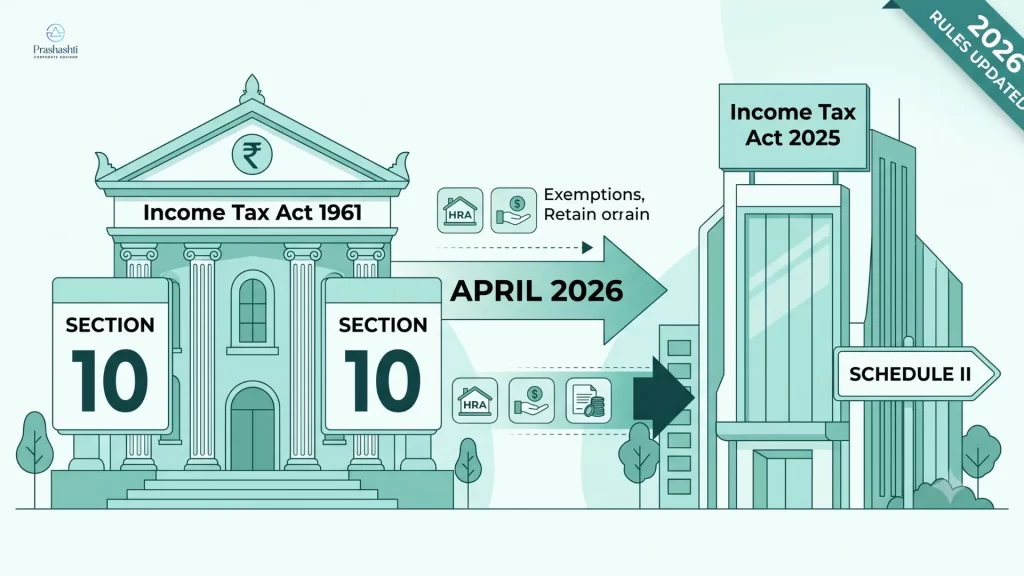
The Income Tax Act, 2025 replaced the Income Tax Act, 1961 from 1 April 2026. The exemptions previously contained in Section 10 of the Income-tax Act, 1961 have been reorganised into six schedules under the Income-tax Act, 2025. Schedule II covers income not included in total income, while other exemption provisions appear in the other schedules.
Here’s the part that actually matters to you right now: if you’re filing your return for FY 2025-26 (AY 2026-27) in 2026, you’re still working under the old 1961 Act. You’ll use Section 10(13A), Section 10(10), and every other subsection by its old number, exactly as before. The new Schedule II numbering only applies from Tax Year 2026-27 onward, with returns for that year filed starting July 2027.
So for anyone filing taxes right now, Section 10 of the Income Tax Act, 1961 is still the correct reference to use. Keep that in mind before any calculator or anyone tells you otherwise. CBDT Press Release, 1 April 2026
Issue | FY 2025-26 / AY 2026-27 | Tax Year 2026-27 onward |
Governing framework | Income-tax Act, 1961 | Income-tax Act, 2025 |
Exemption references | Section 10 clauses | New Act provisions/schedules |
HRA location rule | Existing Section 10(13A)/Rule 2A framework | New framework under 2026 rules |
50% HRA locations | Mumbai, Kolkata, Delhi, Chennai | Eight specified cities under Rule 279 |
Filing relevance | Returns filed in 2026 | Returns for this tax year filed subsequently |
Need help understanding which tax exemptions apply to you? Talk to our tax consultants in Bangalore.
What Is the Section 10 Exemptions List?
Clause | Income | Key condition | 2026 location |
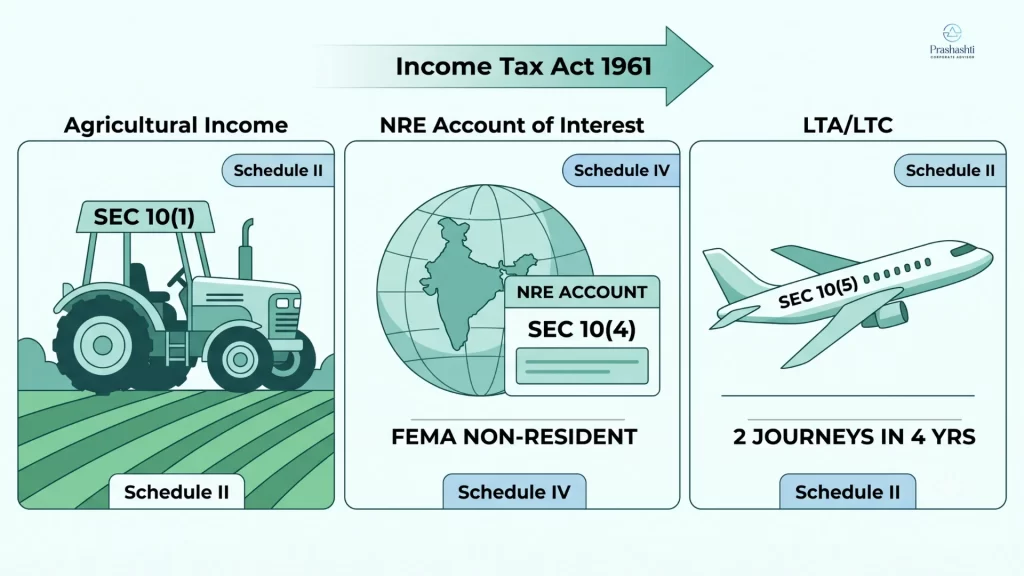
10(1) | Agricultural income | Land/income conditions under Sec 2(1A) | Schedule II |
10(2A) | Partner’s share of firm’s profit | Firm/LLP taxed separately | Schedule II |
10(4) | NRE account interest | Must qualify as FEMA non-resident | Schedule IV |
10(5) | LTA/LTC | Prescribed travel and block-period conditions | Schedule II |
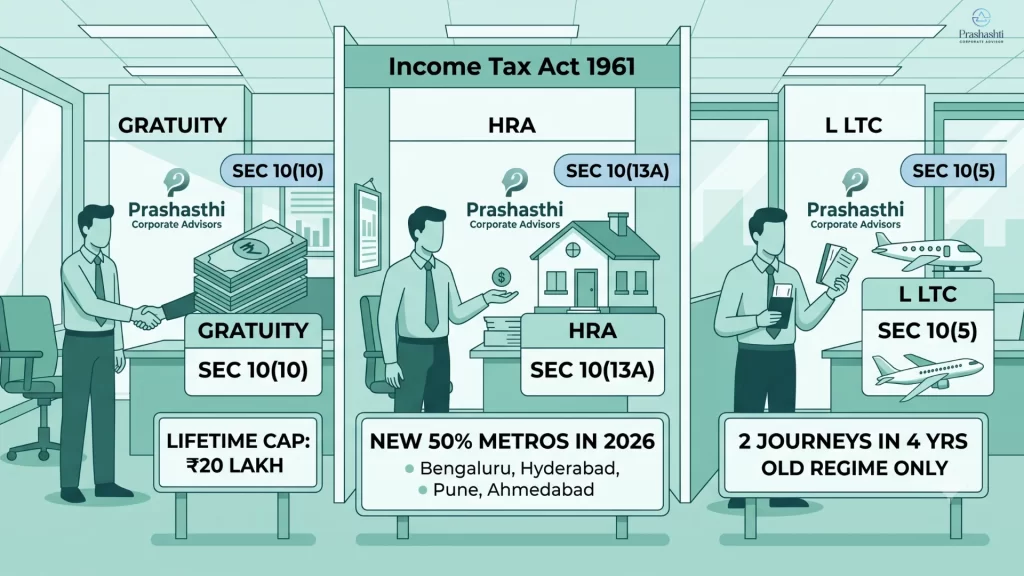
10(10) | Gratuity | Employee category and prescribed limits | Schedule II |
10(10AA) | Leave encashment | Employee category and prescribed limits | Schedule II |
10(10D) | Life insurance proceeds | Policy-specific conditions and premium thresholds | Schedule II |
10(11)/10(12) | PPF/EPF-related income | Scheme-specific conditions | Schedule II |
10(13A) | HRA | Rent, salary and location-based formula | Schedule II |
10(16) | Scholarships | Must meet the provision’s conditions | Schedule II |
Which Section 10 Exemptions Under the Income Tax Act Matter Most?
Section 10(1): Agricultural income
Agricultural income earned from land situated in India is fully exempt under Section 10(1). This exists because agriculture falls under state jurisdiction, and the central government can’t tax it directly. There’s a catch most people miss, though: if your agricultural income crosses ₹5,000 in a year and you also have non-agricultural income above the basic exemption limit, the agricultural income still gets added back when calculating your applicable tax rate, even though it stays untaxed itself. This is called partial integration.
Section 10(4): Section 10 exemptions for NRIs
Interest on an eligible NRE account is exempt from Indian income tax under Section 10(4)(ii), subject to the applicable FEMA/RBI conditions. Income Tax Department FAQ
The part people get wrong: income-tax residential status and FEMA residential status are two separate tests, even though this exemption depends on the FEMA one. You can be FEMA-resident (182+ days in India in the preceding financial year) while your income-tax residential status is worked out under an entirely different day-count rule.
Pattern we flag in FY 2025-26 reviews: Consider someone who returns to India mid-year for a new job after years of being an NRI. The important distinction is that Section 10(4)(ii) links the exemption to the FEMA definition of a person resident outside India, not simply to residential status under the Income-tax Act. The two tests should therefore be considered separately.
Section 10(5): LTA
LTA covers eligible travel within India for you and your family. The exemption is available for two journeys in a block of four calendar years, subject to the prescribed conditions and fare limits. It covers eligible travel fare, not hotel, food or sightseeing expenses. If the taxpayer has opted for the new tax regime under Section 115BAC for the relevant year, the Section 10(5) LTA exemption is not available.
Section 10(10): Gratuity
Splits into three categories:
Employee category | Exemption |
Government employee | Fully exempt, no ceiling |
Covered by Payment of Gratuity Act, 1972 | Least of: actual gratuity, 15 days’ salary × years of service, ₹20 lakh |
Not covered by the Act | Least of: actual gratuity, half a month’s average salary × years of service, ₹20 lakh |
The lifetime cap of ₹20 lakh applies to all employers and is not reset with every job. Income Tax Department FAQ
Illustrative scenario: Someone who claimed ₹10 lakh of gratuity exemption at a previous employer under the older ceiling has only ₹10 lakh of headroom left (₹20 lakh minus what’s already been used) when gratuity is paid out again at a later employer, not a fresh ₹20 lakh.
Section 10(14): Allowances Exempt Under Section 10
Section 10(14) provides for certain allowances given to employees toward certain personal or business expenses. Exemption is subject to the nature of the allowance and criteria established under the Income tax Rules.
- Children education allowance: Rs.100 per month per child, maximum two children.
- Hostel spending allowance: Up to Rs. 300 per month per child for a maximum of two children.
- Transport allowance in respect of certain handicapped employees: Up to Rs.3,200 per month on defined circumstances.
- Transport allowance to employees in a transport business: Exempt up to the lower of 70% of allowance or ₹10,000 per month, if the conditions as applicable are satisfied.
- Transport, travel, daily, helper, research and uniform allowances: Exempt to the extent of expenditure incurred for the official purpose and is eligible for deduction.
The exemption is not automatic just because an allowance is shown on a wage slip. The employee must satisfy the terms of that particular allowance and, where required, actually incur the qualifying expense.
Section 10(13A): HRA Exemption: What Changed in 2026
House Rent Allowance is the most commonly claimed exemption under Section 10, and it just got a real update.
HRA exemption is calculated as the lowest of three amounts: actual HRA received, rent paid minus 10% of basic salary plus DA, or 50%/40% of basic salary plus DA, depending on whether you live in a metro city.
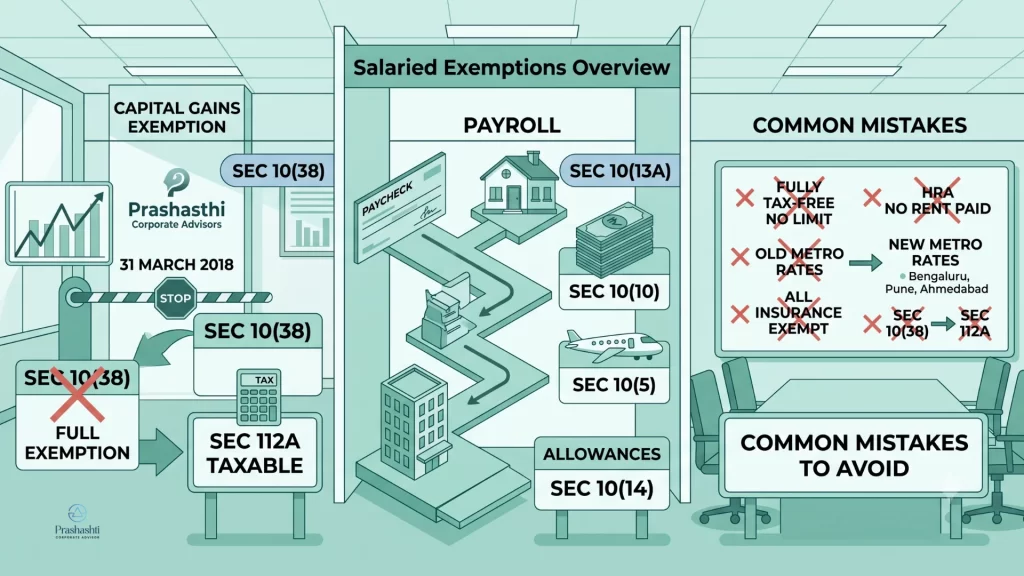
Until FY 2025-26, only four cities counted as “metro” for the 50% rate: Delhi, Mumbai, Kolkata, and Chennai. Every other city, including Bengaluru, Hyderabad, Pune, and Ahmedabad, was capped at 40%, even though rents there often match or beat the original four.
From FY 2026-27, under Rule 279 of the Income Tax Rules, 2026, that changes. Bengaluru, Hyderabad, Pune, and Ahmedabad now join the 50% category, taking the metro list to eight cities. If you’re a salaried renter in any of these four cities, your HRA exemption gets noticeably bigger starting this financial year. One condition doesn’t change: HRA exemption is only available if you stay on the old tax regime.
Worked example: basic salary ₹40,000/month, HRA ₹18,000/month, rent ₹20,000/month, based in Pune (a metro city for this purpose from FY 2026-27):
- Actual HRA: ₹18,000
- 50% of salary: ₹20,000
- Rent − 10% of salary: ₹20,000 − ₹4,000 = ₹16,000
Exempt amount: ₹16,000/month, the lowest of the three. Under the pre-2026 rule, the same employee in Pune was capped at the 40% test instead, a lower ceiling.
One condition people skip: HRA exemption requires actual rent expenditure. Receiving the HRA component on a payslip creates nothing on its own: no rent paid, no exemption.
Section 10(38): Does the Capital Gains Exemption Still Apply?
Short answer: no, not anymore. Section 10(38) used to provide exemption from long term capital gains on listed equities shares and equity mutual funds, although it was applicable only for transfers made on or before 31 March 2018. From FY 2018-19 onward, these gains are taxed under Section 112A instead, at a concessional rate over a defined level. If you are looking at Section 10(38) in the hope that it relates to a stock transaction in 2026, it doesn’t. You’re looking for Section 112A now.
Section 10 Exemptions for Salaried Employees
For salaried employees, the Section 10 exemptions that you are most likely to come across include HRA, LTA, gratuity, leave encashment and certain allowances. Whether you can claim them depends on your income structure, the purpose for the payment and the tax regime you chose.
For example, HRA under section 10(13A) and LTA under section 10(5) are available under the previous regime but not under the new regime. For gratuity and leave encashment the exemption limits and requirements are different.
How Is a Section 10 Exemption Different From a Section 80C Deduction?
Section 10 exemption | Section 80C deduction | |
What happens | Income excluded before total income is computed | Amount subtracted from income after it’s included |
Example | HRA, gratuity | ELSS, PPF contribution, life insurance premium |
Limit | Depends on the specific exemption | ₹1.5 lakh combined with specified provisions such as 80CCC and 80CCD(1) |
Regime | Depends on exemption | Old regime only |
Expert Insight from Prashasthi Corporate Advisors: In nine out of ten salaried consultations this year, HRA and gratuity are the first two questions, and the mistake we catch most often isn’t the math. It’s an outdated assumption carried forward from an earlier tax year. Before claiming any Section 10 exemption, confirm the year it applies to and the current limit; don’t assume last year’s rule still holds.
Common Mistakes to Avoid With Section 10 of the Income Tax Act
- Assuming every Section 10 income is fully tax-free with no limit.
- Claiming HRA without a rent agreement or actual rent payment.
- From FY 2026-27 onward, using the existing 40% HRA rate for Bengaluru, Pune, Hyderabad or Ahmedabad.
- Treating all insurance maturity proceeds as automatically exempt, without regard to premium thresholds.
- Citing Section 10(38) as if it’s still active.
- Mixing up “Section 10” of the 1961 Act with “Section 11” of the 2025 Act.
Final Thoughts on Section 10 of the Income Tax Act
HRA, gratuity, leave encashment, and other exemptions have their own limits and conditions, and those rules can change with the tax year. The 2026 changes make checking the current rules even more important. As Prashasthi Corporate Advisors sees in day-to-day tax work, many mistakes happen simply because an old limit or rule is carried forward. Before you claim an exemption, check what applies to your income, the relevant year, and your tax regime. It can save you an unnecessary correction later.