


Two friends decide to begin a new business venture. They contribute some amount of money to it, split the work between them and agree that they will share any profit made by the business venture. Everything seems quite easy and fun at first.
But later on, certain practical issues come up. What if one of them decides to leave the business venture after a few months? What if the venture starts losing money? And what if they never clearly decided how long this partnership is even supposed to last?
This is why understanding the types of partnership firms is so important. A partnership is more than two people launching something together or putting their name on a firm. The type of partnership they chose to establish truly dictates how the business will be operated, who will share whose tasks, and what will happen if things go wrong.
In this blog, we’ll go through the different types of partnerships in a simple way, like partnership at will, particular partnership, registered and unregistered firms, partnership deeds, the rights and liabilities of partners, how dissolution works, and also how a traditional partnership is different from an LLP.

What Is a Partnership Firm?
A partnership firm is a type of business structure where two or more persons come together and agree to carry on a business and share the profits. This association is formed by an agreement between the partners under the Indian Partnership Act, 1932. The business might be done by all partners together or even one partner for all.
And this part is really important. A partner is not just someone who invests money. In a traditional partnership, every partner acts as an agent of the firm within the scope of the business. Because of this mutual agency, one partner’s decisions can legally bind the firm, and sometimes even the other partners.
Usually, partners write everything down in a partnership deed. The meaning of a partnership deed is simple: it is the written agreement that explains how the partners will run the business together.
Key Features of a Partnership Firm
A partnership firm has several basic qualities including an agreement between the partners, sharing of earnings, mutual agency and common liability in the business.
A partner’s rights and duties are mostly derived from the agreement itself, provided it complies with the rules of the Partnership Act.
Another very important point is liability. In a traditional partnership, partners usually have unlimited liability. This means personal financial risk is not limited as it is in an LLP. Also, the continuity of the firm depends on the agreement and situation.

What Are the Types of Partnership Firms in India?
The Indian Partnership Act mainly recognises partnership at will and a particular partnership. Apart from that, firms can also be classified as registered or unregistered. So one partnership can actually fall into more than one category at the same time.
Type or classification | Basis | Main characteristic |
Partnership at Will | Duration | No fixed duration |
Particular Partnership | Purpose | Created for a specific undertaking. |
Registered Partnership | Registration | Registered with the Registrar of Firms. |
Unregistered Partnership | Registration | Not registered with the Registrar. |
General/Traditional Partnership | Structure | Traditional partnership with generally unlimited partner liability. |
For example, a partnership at will can also be a registered partnership. So these are not completely separate “types” in isolation.
Planning to start a partnership firm?
Partnership at Will
A partnership at will is a partnership where there is no fixed duration and no clear condition that decides when it will end.
Key Features of Partnership at Will
The best part about it is the flexibility. There is no set termination date thus the business can continue as long as the partners agree.
But the same flexibility also means it is easier to leave. A partner can dissolve the firm by giving notice in writing to the other partners under Section 43. The dissolution takes effect as from the date stated in the notice or, if no date is stated, from the date of receipt of the notice.
Example of Partnership at Will
A and B start a digital marketing agency. Their deed doesn’t mention a fixed term or a specific project. Five years in, A wants out. If A and B agree that B will carry on the business alone or bring in a new partner, that’s a reconstitution; the firm continues. But if A instead serves formal notice under Section 43 to end the partnership altogether, that’s a dissolution; the firm itself winds up. Same starting point, two very different outcomes depending on what the partners actually choose.
When Is a Partnership Will Suitable?
This type is good if partners want a long-term business but don’t want to bind themselves into a set time frame. But then, even at that, the deed should clearly include the notice period, settlement process, and exit rules so that there is no uncertainty afterward.
Particular Partnership
A particular partnership is formed for a specific project or business task. Section 8 of the Partnership Act covers this type of arrangement. The idea is simple: the partnership exists for a specific purpose.
Examples of Particular Partnership
This type is common in:
- Construction projects.
- Infrastructure work.
- Event-based businesses.
- One-time business ventures.
The important thing is clarity. Everyone should know exactly what “completion” means; otherwise, disputes can arise about whether the partnership should continue or end.
When Does a Particular Partnership End?
Usually, it stops after the specific project is finished. Section 42 further provides circumstances in which a partnership is dissolved, such as completion of the undertaking or expiry of a set term (if any is specified in the agreement).
Partnership at Will vs Particular Partnership
Factor | Partnership at Will | Particular Partnership |
Main basis | Ongoing relationship | Specific undertaking |
Duration | No fixed term | Linked to project |
Business | Continuous | Project-based |
Ending | By notice | On completion |
Registered vs Unregistered Partnership Firm
A registered partnership firm is one that has been registered with the registrar of firms. Sections 58 and 59 of the Partnership Act deal with registration. The details usually include firm name, address, partner details, and duration (if any). The process can differ from state to state.
A correction worth making: The Ministry of Corporate Affairs does not register partnership firms. A typical partnership firm, no matter how well registered, won’t appear in an MCA master-data search. General partnership firms are registered with each state’s Registrar of Firms (RoF), not the MCA. If a vendor, supplier, or prospective partner is a partnership firm rather than an LLP or private corporation, an MCA search will return empty even for a valid, registered firm. You’d require the state’s RoF instead. Mistaking the two is a tiny but costly due-diligence error.
Partnership Firm Registration Process
The partnership firm registration process is fairly simple:
- Prepare a partnership deed.
- Fill out the application form.
- Submit documents to the Registrar of Firms.
- Pay the required state fee, including the applicable partnership firm registration cost in Bangalore
- Get the firm registered in the official records.
If you’re registering in Karnataka, for example, this is now done through the state government’s own Department of Stamps and Registration portal, which routes applications to the correct district Registrar of Firms office. For businesses seeking professional assistance with partnership firm registration in Bangalore, the process can be handled with appropriate documentation and state-level requirements.
But one important thing: registration does not “create” the partnership. The partnership exists even without registration. However, registration has legal benefits.
What Is an Unregistered Partnership Firm?
An unregistered partnership firm is simply a firm that has not been registered.
Even then, there are certain limitations created by Section 69. For instance, an unregistered business may experience some limitations while trying to sue for breach of contract.
Registered vs Unregistered Partnership
Factor | Registered | Unregistered |
Firm recorded with Registrar | Yes | No |
Legal existence | Valid | Valid |
Legal suits | Fewer restrictions | Section 69 restrictions |
Practical use | More secure | More limited legally |
Partnership Deed: Meaning, Importance and Drafting
A partnership deed is the written agreement that explains how the business will run. A typical partnership deed format includes:
- Firm name and address
- Nature of business
- Partner details
- Capital contribution
- Profit-sharing ratio
- Rules for management
What Should a Partnership Deed Include?
A good deed should cover:
- Capital contribution
- Profit and loss sharing
- Roles and responsibilities
- Partner salary/drawings
- Banking rules
- Admission of new partners
- Exit or retirement rules
- Death or incapacity clauses
- Dispute resolution
- Dissolution process
Good partnership deed drafting does not use unclear words and clearly states authority and responsibilities.
Expert Insight from Prashasthi Corporate Advisors: Most partnership disputes we’re asked to step into don’t start with the business failing; they start with a deed that was never updated. Two founders write a two-page agreement in year one, and by year five, there are new partners, real cash flow, and TDS obligations the original deed never anticipated. Our advice is always the same: revisit your deed every time your business changes shape, not just when a dispute forces you to.
What Are The Rights and Liabilities of Partners?
The rights & liabilities of partners are the foundation of any partnership.
Rights of Partners
Partners usually have the right to:
- Take part in business decisions.
- Access accounts.
- Share profits.
- Participate in management.
Duties and Liabilities of Partners
Partners are required to act honestly and in the best interest of the firm. They are charged for maintaining good conduct and trust. The importance of liability in a traditional partnership lies in the fact that partners might be personally liable for business obligations.
Unlimited Liability in a Traditional Partnership
Unlimited liability means that if needed, you might use your personal assets to pay off business debts. This is one of the biggest risks in a partnership, particularly in the setting of an LLP.
Dissolution Of Partnership Firm
Dissolution occurs when the partnership has completely ended and all its affairs have been settled. That’s different from reconstitution when the partners change but the business stays on.
How Can a Partnership Firm Be Dissolved?
A firm can be dissolved:
- By mutual agreement
- By law
- By court order
- By notice (in partnership at will)
Partnership Firm Dissolution Process
The dissolution process includes:
- Selling assets
- Paying liabilities
- Settling partner accounts
- Distributing the remaining balance
Section 48 explains how accounts are settled after dissolution.
General or Traditional Partnership Firm
A general partnership is simply the traditional partnership model as described throughout this guide. It’s a descriptive term, not a separate statutory category, the Act itself only names partnership at will and particular partnership as classifications, with registration handled separately. All partners participate in running the business and share in the profits, mutual agency applies, and liability is generally unlimited. It’s flexible and easy to set up, but the trade-off is that the risk sits higher than it would in an LLP.
2026 Update: How Section 194T Changes Partner Remuneration?
This is something that most partnership guides have not caught up with yet. From 1st April 2025, Section 194T of the Income-tax Act, 1961 compels every partnership business and LLP to deduct TDS @10% on salary, remuneration, commission, bonus, and interest to the partners, once the aggregate of such payments or credits made to a partner during the year exceeds ₹20,000. No turnover exemption; this covers every firm, big or small.
A couple of things worth knowing: TDS kicks in the moment the amount is credited to a partner’s account, even before it’s actually paid out. And once you cross ₹20,000, TDS applies to the full amount, not just the excess.
One more thing to flag: from 1 April 2026, this same rule shifts to Section 393(3) of the new Income-tax Act, 2025. Same rule, new section number.
If your deed hasn’t been reviewed since before April 2025, it’s worth checking that your remuneration clauses account for this.
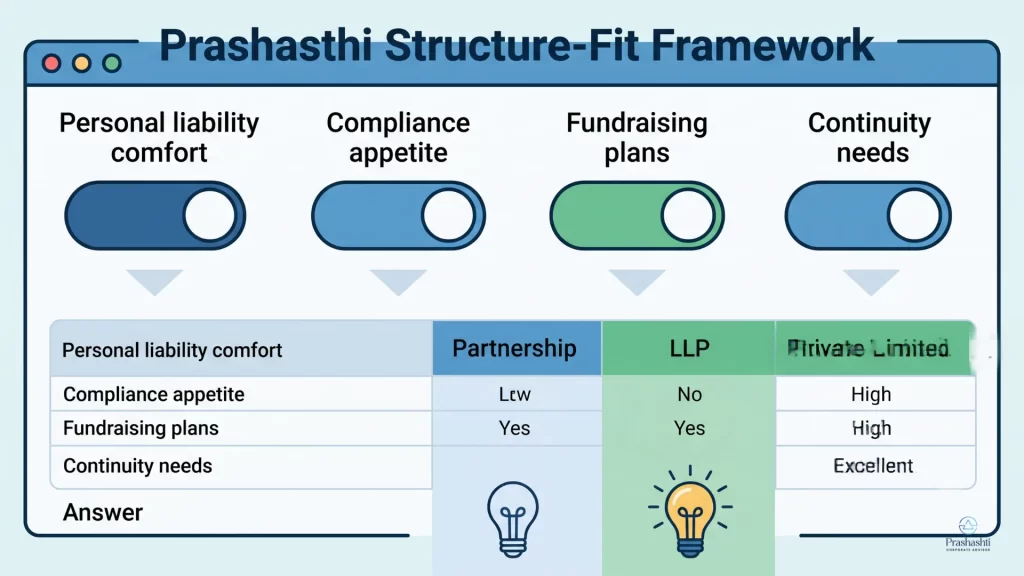
The Prashasthi Structure-Fit Framework
The harder question founders actually ask is: given our situation, which one fits? Prashasthi Corporate Advisors uses a simple four-factor check when a client is choosing between a traditional partnership, an LLP, and a private limited company. Score each factor as it applies to your business.
Factor | Leans Partnership | Leans LLP | Leans Private Limited |
Personal liability comfort | High comfort with unlimited liability | Wants a shield without a full corporate shell. | Wants maximum separation from personal assets. |
Compliance appetite | Minimal filings preferred. | Willing to file Form 11 / Form 8 annually | Ready for board resolutions, ROC filings, audits. |
Fundraising plans | None — self-funded / family-run | Occasional partner buy-ins, no external equity. | Plans to raise equity from investors |
Continuity needs | Fine with the firm ending if a partner exits. | Wants perpetual succession. | Wants perpetual succession plus share transferability. |
If three or more factors point the same direction, that’s usually your answer.
Partnership Firm vs LLP Under the LLP Act, 2008
What Is an LLP?
An LLP is a different corporate form that is controlled by the Limited Liability Partnership Act, 2008.
Under Section 3 of the LLP Act, an LLP is a body corporate and is a distinct entity from its partners. It also has perpetual succession. Section 4 states that the Indian Partnership Act, 1932, generally does not apply to an LLP.
Founders are actually choosing LLPs more often. This isn’t just a theoretical comparison anymore. MCA incorporation data, tracked on the Corporate Data Management portal, shows LLP registrations climbing as a share of new business entities through 2026, alongside private limited companies. The pattern reflects what we see with clients directly: founders increasingly want the liability protection of a corporate structure without taking on the full compliance load of a private limited company, and a traditional partnership, with its unlimited liability, is a harder sell than it was a decade ago for anything beyond a small, trust-based, family-run business.
LLP vs Partnership Firm
Factor | Partnership Firm | LLP |
Governing law | Indian Partnership Act, 1932 | LLP Act, 2008 |
Legal identity | Traditional partnership structure | Separate legal entity |
Liability | Generally unlimited | Generally limited, subject to law. |
Continuity | Depends on partnership terms | Perpetual succession |
Management | Partners | Partners and designated partners. |
Compliance | Generally simpler | More statutory compliance |
This LLP Act 2008 comparison shows why an LLP should not simply be added to a list of traditional partnership types.
In an LLP vs partnership firm comparison, liability and legal identity are two of the biggest differences. The MCA also notes that an LLP provides limited liability while allowing internal arrangements to be structured through an LLP agreement.
Is an LLP a Type of Partnership Firm?
No. An LLP is run like a partnership on the inside but is a different legal organization.
That’s a key difference to note when comparing a general partnership vs an LLP. The typical partnership is controlled by the Partnership Act while the LLP is constituted under the LLP Act and has a separate legal entity.
When Should You Consider an LLP Instead?
An LLP may be worth considering when partners want the flexibility of a partnership model but also want a separate legal entity and generally limited liability.
The choice should depend on business risk, compliance requirements, growth plans and how much legal separation the partners want between themselves and the business.
Partnership Firm vs LLP vs Private Limited Company
Factor | Partnership | LLP | Private Limited Company |
Liability | Generally unlimited | Generally limited | Generally limited |
Legal identity | Traditional structure | Separate entity | Separate entity |
Compliance | Generally lower | Moderate | Higher |
Management | Partners | Partners/designated partners | Directors |
Fundraising | More limited | More limited than a company | Better suited to equity fundraising |
Suitable for | Partner-led businesses | Businesses wanting liability protection | Businesses focused on structured growth |
What Are The Advantages and Disadvantages of Partnership Firms?
Advantages
- Easy to start
- Flexible structure
- Shared responsibility
- Combined skills and resources
Disadvantages
- Unlimited liability
- Risk of disputes
- Dependence on partners
- Legal restrictions if unregistered
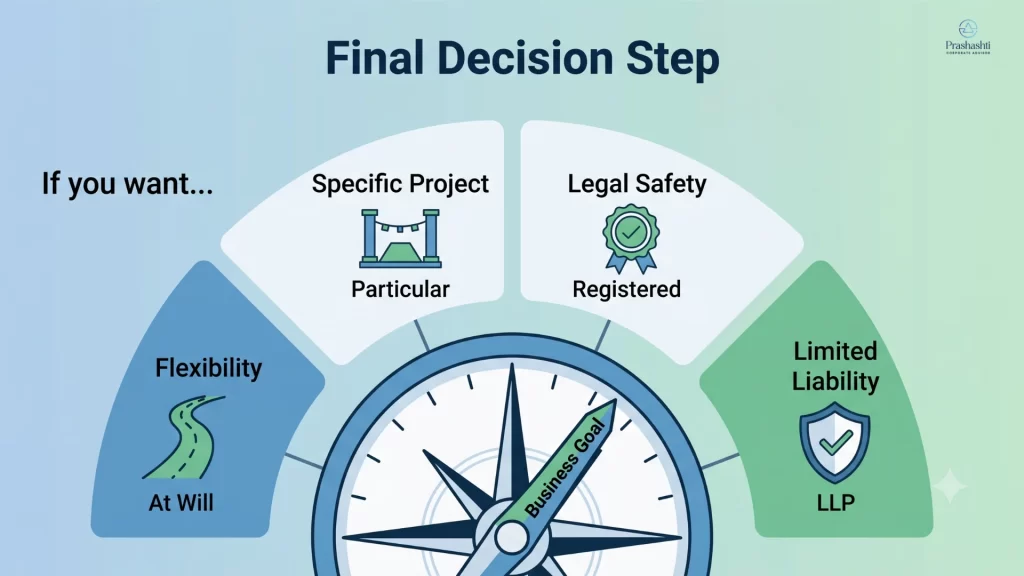
Which Type of Partnership Firm Is Right for You?
It really depends on your goal.
- If you want flexibility → Partnership at Will
- If it’s a specific project → Particular Partnership
- If you want legal safety → Registered Partnership
- If you want limited liability → LLP
Just to clarify, registering the partnership firm can remove the Section 69 disability applicable to an unregistered firm in relevant circumstances; it does not create limited liability for the partners. Intended limited liability is an LLP conversation, not a registration one. Avoid surprises by settling structure, deed, liability, and exit rules beforehand.
Common Mistakes Founders Make When Choosing a Partnership Structure
A few patterns come up again and again in practice, and most of them are avoidable with a bit of upfront planning:
- Treating the partnership deed as a formality rather than the document that will actually govern a dispute.
- Leaving the firm unregistered indefinitely, only to discover the Section 69 restrictions when it’s time to sue a client or vendor over unpaid dues.
- Never updating the deed as the business grows, the same document written for a two-person venture rarely still fits once there are five partners and real revenue.
- Assuming remuneration and interest to partners can still be settled informally after year-end, without accounting for Section 194T TDS timelines.
- Defaulting to a partnership out of habit, without ever comparing the liability trade-off against an LLP.
Choosing the Right Partnership Structure with Prashasthi Corporate Advisors
Starting a partnership is often more than just a handshake between two or more people. It’s really about how you plan to run the business together, how much responsibility each person takes, and what happens if someone wants to leave later on.
If you’re unsure about registration, compliance, or even which structure fits your business idea, Prashasthi Corporate Advisors can help you sort it out. They help with business registration and advisory services, so you don’t just create a partnership, but you build it in a way that genuinely works in the long term.
Disclaimer: This article is for general informational purposes only and does not constitute legal, tax, or financial advice.