
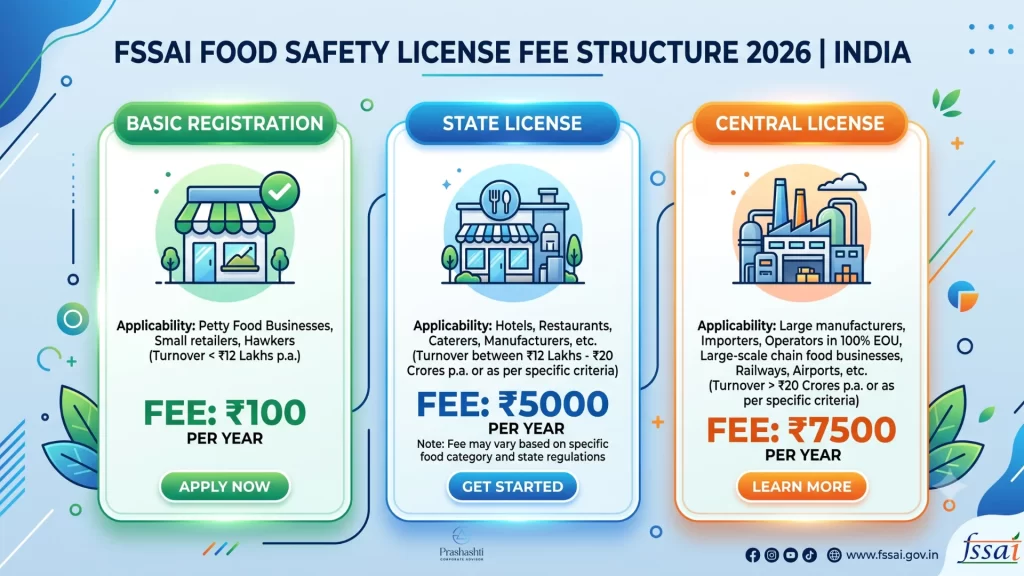
You’re applying for an FSSAI license and just want to know how much it will cost. In 2026, the FSSAI license fee is ₹100 a year for Basic Registration, ₹5,000 for a State license, and ₹7,500 for a Central license. Basic Registration generally covers eligible businesses with turnover up to ₹1.5 crore, while the State license applies above ₹1.5 crore up to ₹50 crore, and the Central license above ₹50 crore. But it isn’t quite that simple.
Say you run a small food business with a turnover of ₹30 lakh. You might assume you qualify for the ₹100 registration. You could be wrong if your Kind of Business (KoB) requires a Central or State license. This is where most of the confusion starts, especially after the 2026 rule changes.
So, what should you actually pay? Let’s break down the new fee structure, turnover limits, KoB exceptions, multi-year payments, and other charges you need to know before paying.
FSSAI License Fee 2026 at a Glance
License type | Annual turnover | Government fee per year |
Basic Registration | Up to ₹1.5 crore | ₹100 |
State license | Above ₹1.5 crore, up to ₹50 crore | ₹5,000 |
Central license | Above ₹50 crore | ₹7,500 |
Certain railway-station and Central Government catering businesses (license) | Above ₹1.5 crore | ₹2,000 |
The April 2026 FoSCoS KoB sheet lists ₹5,000 for the State-license categories covered by the revised schedule. Your exact eligibility still depends on your KoB. Many older sites quote ₹2,000–₹3,000, which comes from the earlier fee bands.
New FSSAI License Rules and Fees From April 2026
Before April 2026 | From 1 April 2026 | |
Registration | Up to ₹12 lakh | Up to ₹1.5 crore |
State license | ₹12 lakh to ₹20 crore | ₹1.5 crore to ₹50 crore |
Central license | Above ₹20 crore | Above ₹50 crore |
Validity / fee period | 1–5 years chosen under the old system | Perpetual validity. The fee can be paid for any number of years |
Old vs New FSSAI License Fee
This table explains why other sites still quote ₹2,000–₹3,000.
Category | Old fee (Schedule 3, 2011 Regulations) | Fee now (April 2026 KoB sheet) |
Registration | ₹100 | ₹100 |
State: restaurants, caterers, other businesses | ₹2,000 | ₹5,000 |
State: manufacturing below 1 MT a day | ₹3,000 | ₹5,000 |
State: manufacturing above 1 MT a day, hotels (3-star and above) | ₹5,000 | ₹5,000 |
Central | ₹7,500 | ₹7,500 |
So the State fee is no longer split into three bands. The revised sheet shows ₹5,000 across the board.
Street vendors registered under the Street Vendors Act, 2014 are now deemed registered under the 10 March 2026 Gazette notification. FSSAI’s 27 March 2026 FAQ order also says more than 98% of food businesses now fall under State authorities.
The biggest 2026 change isn’t the fee. It’s the classification. A business with ₹1 crore turnover can now stay on a ₹100 registration instead of moving into the State-license band.
FSSAI Basic Registration Fee 2026: ₹100 Per Year
The FSSAI basic registration fee is ₹100 a year. You qualify when turnover is up to ₹1.5 crore, and your KoB allows registration. Tea stalls, small retailers and petty food businesses often fit here.
Some people pay ₹0. The KoB sheet lists hawkers (fee waived from 28 September 2024) and Anganwadi centres (waived from 12 March 2025).
FSSAI License Fee For Home Kitchen
“Home kitchen” isn’t an official FoSCoS category. The closest match is Home Based Canteens / Dabba Wallas. If your home food business fits an eligible registration-level KoB and turnover is up to ₹1.5 crore, the FSSAI license fee for a home kitchen is ₹100 a year. Above ₹1.5 crore, you usually move to a State license.
Running a cloud kitchen instead? You’re usually treated as a food-service business, so the same bands apply. That means ₹100 up to ₹1.5 crore if your KoB allows registration, and ₹5,000 above that, up to ₹50 crore. Pick the KoB that matches how you actually operate, and check it on FoSCoS.
These FSSAI registration charges are the government fee only. A consultant’s fee comes on top.
FSSAI State License Fee: ₹5,000
The FSSAI state license fee is ₹5,000 a year in the revised 2026 schedule. You need it when turnover is above ₹1.5 crore and up to ₹50 crore.
Some businesses need a State license, regardless of their turnover. Grain, cereal and pulses milling units are one example. Hotels rated up to four stars also pay ₹5,000. Caterers go straight to a State license up to ₹50 crore, so they have no ₹100 registration option.
FSSAI Central License Fee: ₹7,500
The FSSAI central license fee is ₹7,500 a year. You need it if your turnover is above ₹ 50 crore. You also need it at any turnover if you are:
- An importer.
- An e-commerce food business.
- An exporter, or a 100% export-oriented unit.
- A maker of proprietary food, nutraceuticals, or Ayurveda Aahara.
- A food business at an airport or seaport.
- A business operating in two or more states (Head Office license).
Central Government categories are different: Certain railway-station food businesses and food catering services in Central Government establishments pay a special ₹2,000 Central License fee when turnover is above ₹1.5 crore. Departmental canteens up to ₹1.5 crore can have a ₹100 Central Registration fee. Other Central Government food businesses can have different eligibility and fees, so check your KoB on FoSCoS.
FSSAI Fee for Restaurant 2026: Registration and License Cost
The FSSAI fee for restaurant owners follows turnover:
- Up to ₹1.5 crore: Registration, ₹100
- ₹1.5 crore to ₹50 crore: State license, ₹5,000
- Above ₹50 crore: Central license, ₹7,500
Hotels follow star ratings. Five-star and above need a Central license. Up to four stars need a State license.
Example: An ₹80 lakh restaurant. Before April 2026, this restaurant sat in the State bracket. Now it sits in Basic Registration at ₹100 a year. FoSCoS migrates the license automatically. The owner pays no modification fee, and the license number stays the same.
Which FSSAI License and Fee Applies to Your Business in 2026?
Your situation | License | Fee per year |
Home-based canteen, ₹8 lakh turnover | Registration | ₹100 |
Restaurant, ₹4 crore turnover | State | ₹5,000 |
Caterer, ₹30 lakh turnover | State | ₹5,000 |
Manufacturer (general), ₹75 crore | Central | ₹7,500 |
Importer, ₹30 lakh turnover | Central | ₹7,500 |
E-commerce food seller, any turnover | Central | ₹7,500 |
Look at the importer row. Its turnover is below ₹1.5 crore, yet it can’t use the ₹100 registration. FoSCoS places importers under a Central license. So KoB decides the license, not turnover alone.
One License Per Premises: What It Means for Your Fee ?
FSSAI licenses are premises-based. Each outlet, kitchen or unit needs its own license, and each one pays its own fee, according to the FoSCoS FAQs. Say you run three restaurants on State licenses. You pay 3 × ₹5,000 = ₹15,000 a year.
A business with units in two or more states also needs a Central license for its head office. That comes on top of the license for each unit. If you run a franchise or multi-outlet business, budget per outlet, not per brand.
FSSAI License Fee for 1 Year vs 5 Years
Here is the FSSAI license fee for 1 year:
- Registration: ₹100
- State license: ₹5,000
- Central license: ₹7,500
A food business operator can pay for any number of years at once. However, the FoSCoS fee page currently displays a maximum application period of five years. Because the live portal controls the payment flow, confirm the available payment period shown in FoSCoS when you apply.
License | 1 year | 5 years |
Registration | ₹100 | ₹500 |
State | ₹5,000 | ₹25,000 |
Central | ₹7,500 | ₹37,500 |
This is a prepayment, not a validity period. The license itself has no end date.
Should you prepay? It saves you from chasing an annual payment, and a missed payment is what triggers suspension. The catch is cash tied up today. For ₹100, prepaying is easy. For ₹7,500 a year, a small business may prefer paying yearly.
Here’s one more catch: If you close the business, you must tell the authority within 30 days and surrender the license. FSSAI doesn’t refund fees paid, so a prepaid five years is gone. This comes from the 10 March 2026 Gazette.
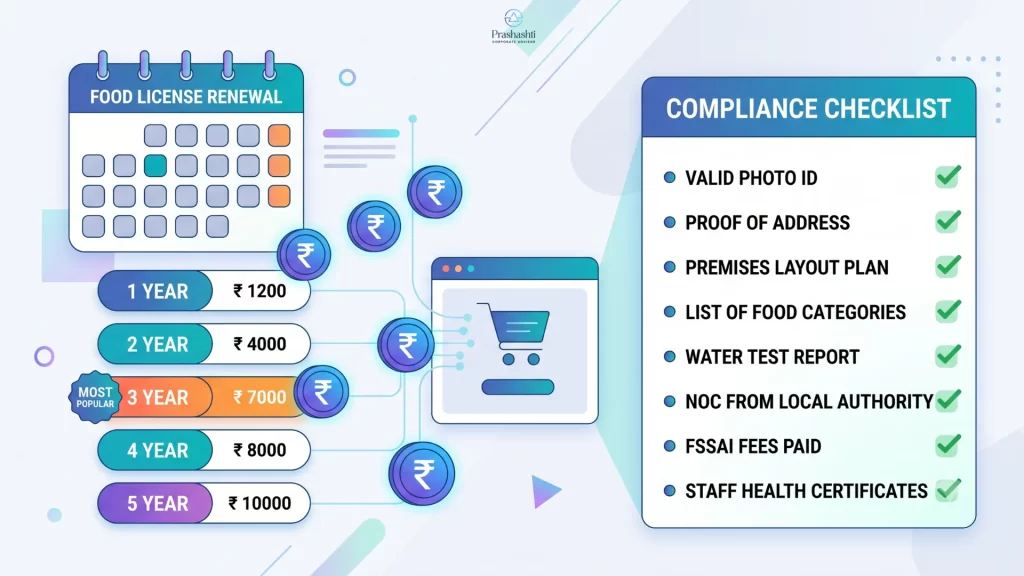
FSSAI Annual Fee, Renewal Fee and Late Fee
“Perpetual” doesn’t mean “free forever.” Here’s how each charge works.
- FSSAI annual fee: You still pay it. If you skip it, the license is deemed suspended. You can’t run the business until you clear the dues.
- FSSAI license renewal fee: Licenses issued on or after 1 April 2026 don’t need renewal, so there’s no renewal fee. If your older license still shows an expiry date, check its status on FoSCoS.
- FSSAI late fee: The old ₹100-a-day renewal penalty belonged to the old system. Late fees now mostly apply to annual returns. Under Regulation 2.1.13 of the FSS (Licensing and Registration) Regulations, 2011, manufacturers and importers file Form D-1 by 31 May each year. A late fee of ₹100 a day applies after that. The statutory deadline is 31 May. For FY 2025–26, FoSCoS extended the deadline to 15 June 2026. Check FoSCoS for any extension announced for the relevant financial year. (FY 2025–26 got one, up to 15 June 2026.) Other categories may have return rules too, so check FoSCoS for yours.
How to Calculate Your FSSAI Fee?
Follow three steps:
- Find your KoB: Restaurant, manufacturer, retailer, importer? FoSCoS lists them all.
- Check your turnover: Compare it with the ₹1.5 crore and ₹50 crore limits.
- Match the fee, then multiply: Annual fee × number of years.
Or skip the maths and use our FSSAI fee calculator below. Pick your business, enter your turnover and years, and get an estimate.
Government Fee vs Your Total FSSAI License Cost
The government fee is one part of your FSSAI license cost. You may also pay for:
- A consultant or filing help.
- Food and water testing (for manufacturers).
- Layout plans and documents.
- NOCs your local body asks for.
Did an agency quote ₹3,000 or ₹5,000? That isn’t automatically the government fee. Ask for the break-up and keep your FoSCoS receipt.
If you’re starting a new food business in Bengaluru, you may also need to complete your business incorporation and related registrations. See our guide to Company Registration in Bangalore for more information.
GST and Other FSSAI Charges
- GST: GST treatment depends on the application. FoSCoS states that GST applies to Central, Railway, Airport and Seaport applications, while State license and registration applications are subject to GST under reverse charge. Check the FoSCoS payment screen for the amount applicable to your application.
- Other charges: A duplicate certificate costs 10% of the applicable fee. Modification and transfer charges vary by application, so check the fee shown by FoSCoS before submitting.
If you need help understanding the GST or broader tax implications of your food business, you can also consult Tax Consultants in Bangalore for business-specific tax guidance.
Practical Tips from Prashasthi Corporate Advisors
These are the habits that save most FBOs from fee trouble. They come from the compliance desk at Prashasthi Corporate Advisors:
- Pick your KoB first, then check turnover: An importer with ₹30 lakh turnover can’t use the ₹100 registration. FoSCoS places importers under Central.
- Write your turnover down before you apply: Use last year’s books. One clear figure saves you queries later.
- Give one person the annual fee and return: Put both on a shared calendar. A missed fee means suspension.
- Keep every FoSCoS receipt: It proves what you paid the government.
- Check the fee on FoSCoS before you pay anyone: Compare it with your consultant’s quote.
How to Pay the FoSCoS Fee Online?
Every FoSCoS fee is paid on FoSCoS website:
- Log in or create an account.
- Choose registration or license.
- Select your correct KoB.
- Fill in the application and upload documents.
- Pay the fee online and track your application.
How to Pay the FoSCoS Fee Online?
What Happens If You Pick the Wrong Category?
You may get queries, delays, or a wrong fee. Fixing a wrong KoB means a modification request, so fix it early.
Running without a license is worse. Section 63 of the Food Safety and Standards Act now allows a penalty of up to ₹10 lakh. The Jan Vishwas Act, 2023 replaced the earlier jail term and ₹5 lakh fine. Against that, a ₹100 registration is cheap.
Common FSSAI Registration and License Mistakes to Avoid
- Using the old ₹12 lakh and ₹20 crore limits.
- Assuming every business pays ₹5,000 or ₹7,500.
- Picking the wrong KoB.
- Believing “perpetual” means no annual fee.
- Missing the annual return date.
- Mixing up consultant charges with government fees.
Final Thoughts on FSSAI License Fee 2026
By now, the FSSAI license fee 2026 should be a lot less confusing. The amount you pay depends on your license and, just as importantly, your Kind of Business. That small detail is where many applications go off track.
Prashasthi Corporate Advisors often helps businesses sort through these compliance requirements, especially when the rules or categories have changed. Before you make a payment, check your KoB, turnover and the current fee on FoSCoS. Keep the receipt too. It may seem like a small step, but it can save you a lot of trouble later.