
Reviewed by: Arun Bhandary, Co-Founder, Prashasthi Corporate Advisors | Last updated: October 2026
How we checked this guide: the steps were reviewed against the live MCA, GST, and Udyam services, and the legal points against the Companies Act, 2013, and ICSI material.
Someone sends you a company registration certificate. It has a government seal, a CIN, and a signature. Then comes the ask: pay an advance. How do you know the document is genuine?
Before you transfer money, verify the company registration certificate in India against official records from the Ministry of Corporate Affairs (MCA). A certificate can look perfect and still carry wrong details. Or the sender may have no right to use it.
The check is free and takes about ten minutes. You match the CIN, name, and incorporation date. You look at the current status. Then you confirm the person asking for money really is the company on the certificate. This guide shows each step, the warning signs, and what to do when something doesn’t match.
The Prashasthi Corporate Advisors Five-Layer Check: Quick Answer
To verify a company registration certificate in India, search the CIN on the MCA and compare the record with the certificate. Then check the status and confirm that the person and the bank account belong to that company.
Layer | Question | Check it here |
1. Identity | Does the CIN match the company named on the certificate? | MCA master data |
2. Status | What is the company’s registered status today? | MCA master data |
3. Documents | Do the certificate and the official record agree? | MCA View Public Documents |
4. Representation | Is the person talking to you authorised to act for the company? | Contact details you find yourself, plus an authorisation letter for big deals |
5. Payment | Does the bank account belong to the entity on the invoice? | Invoice, contract, GST record |
This is an advisory framework, not an official MCA standard. Most people stop at layer one. Fraud often happens at layers four and five.
What Is a Company Registration Certificate in India?
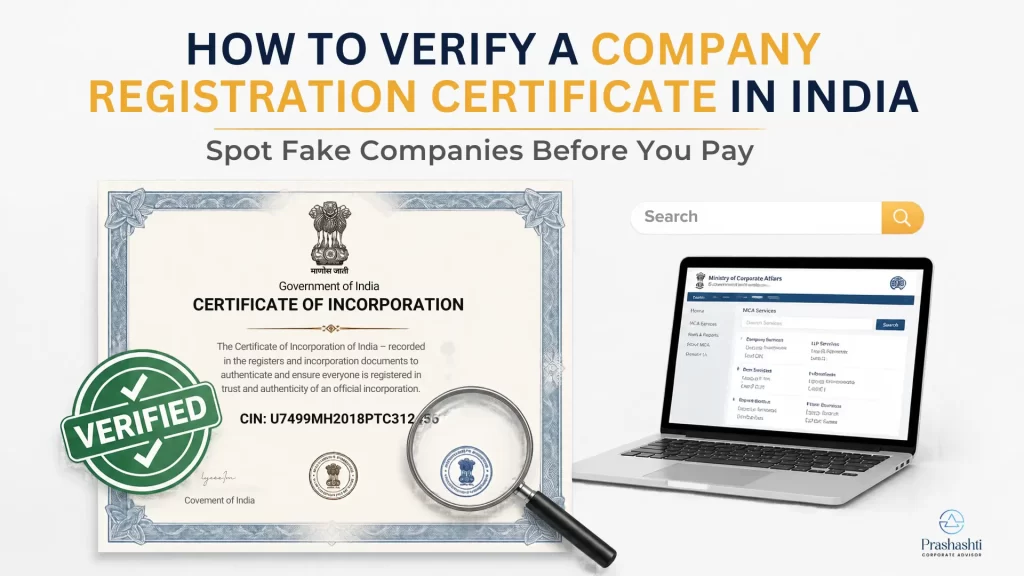
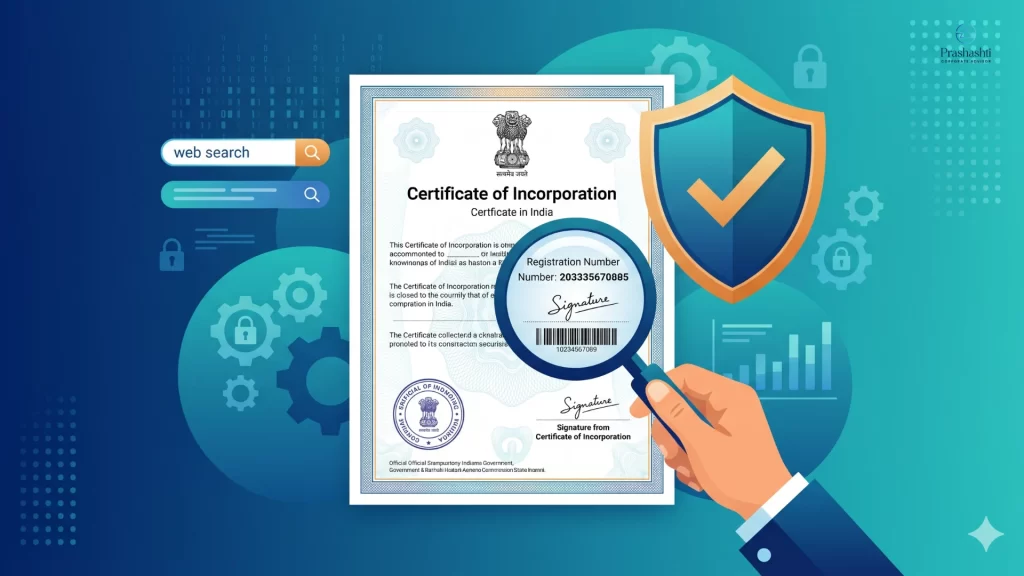
If you’re wondering what a company registration certificate is, it’s the Certificate of Incorporation (COI). The Registrar of Companies (ROC) issues it when a company is formed under the Companies Act, 2013. Think of it as the company’s birth certificate.
It shows the company name, CIN, and incorporation date. Certificates issued through the SPICe+ route in recent years usually also show the PAN and TAN. Older ones don’t, so a missing PAN isn’t a red flag by itself.
The certificate is digitally signed and comes through MCA21, the ministry’s online system, now on its V3 portal. It tells you the company was born. It can’t tell you what happened afterwards. That’s why you check the live record.
How to Verify a Company Registration Certificate in India Online
This is the simplest way to see if a company is registered in India. Keep the CIN from the certificate handy.
Step 1: Open the official MCA site.
Type mca.gov.in into your browser yourself. Don’t click links from WhatsApp or email.
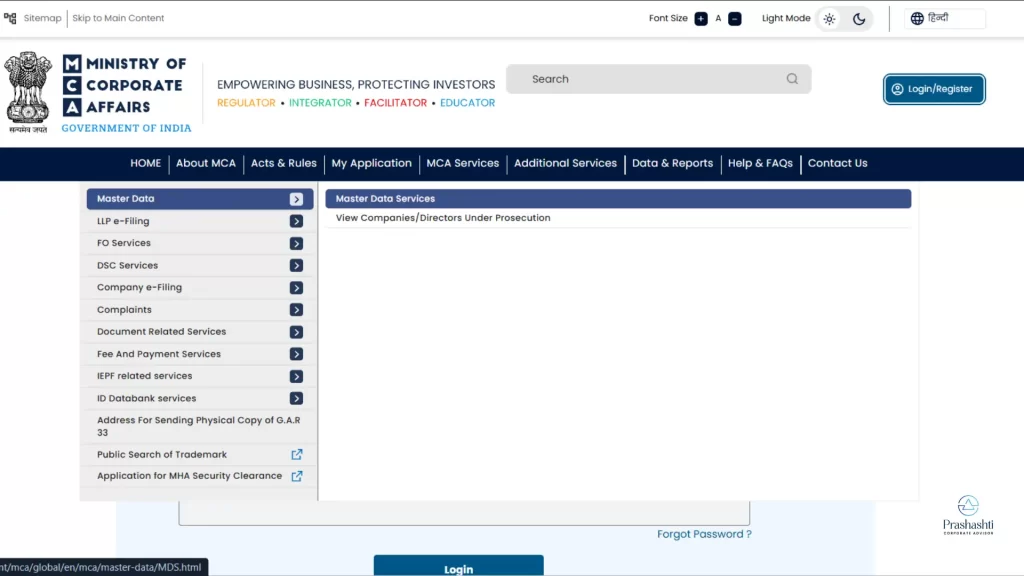
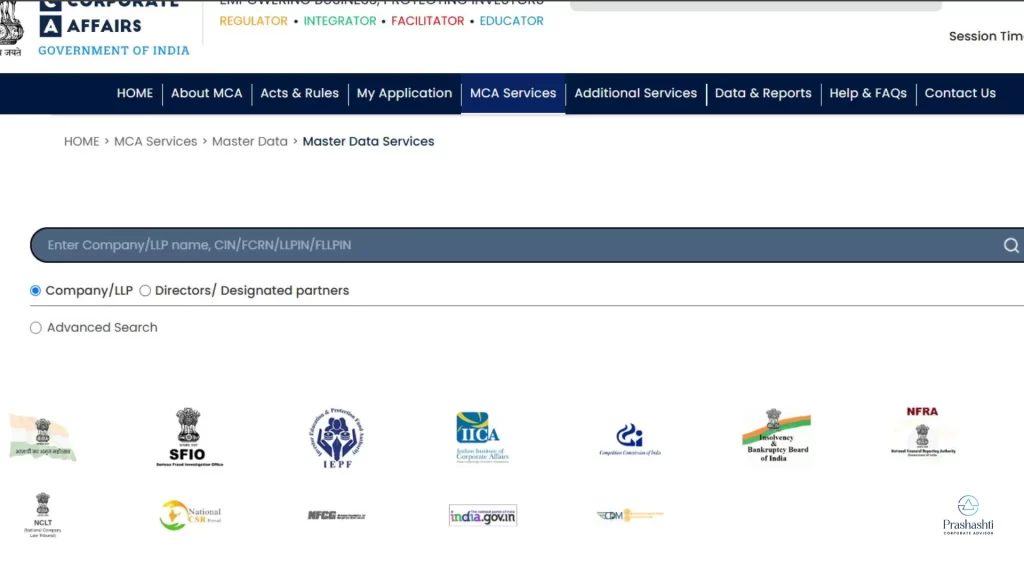
Step 2: Find The Master Data Service.
Go to MCA Services, then Master Data, then View Company/LLP Master Data. Menu labels change sometimes, so look for “Master Data.”
Step 3: Search by CIN.
Enter the CIN and the CAPTCHA. Use the company name only if you don’t have a CIN, because similar names are common. The portal may ask you to log in. A free registered user account is enough.
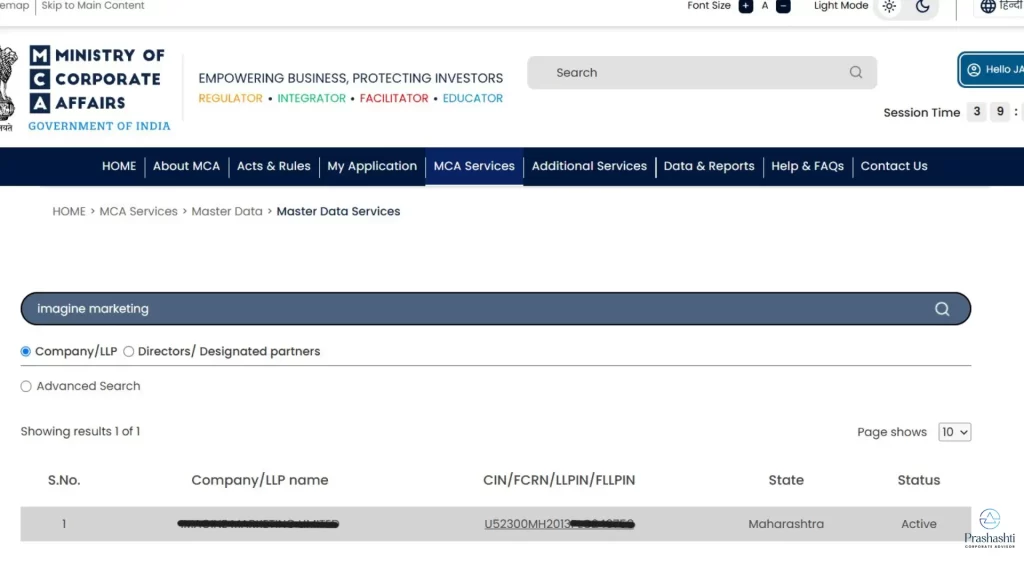
Step 4: Read the record.
The MCA firm master data is a one-page profile of the company. It provides the legal name, CIN, incorporation date, registration address, status, capital, and directors. Compare each line to the certificate.
Step 5: Check the filing dates.
Look at the last AGM and balance sheet dates. Old dates deserve a question.
Where does all this data come from? Companies file forms with their Registrar. Those filings are the ROC records, and master data is the summary. New filings can take a few days to appear.
How to Read a CIN and Verify a Company’s Registration Number
A CIN has 21 characters. The example below is made up for teaching. It is not a real company’s CIN: U74999MH2018PTC312456.
Part | Example | What it tells you |
Listing status | U | U means unlisted; L means listed |
Industry code | 74999 | Principal business activity declared at incorporation (NIC code) |
State code | MH | State of registration |
Year | 2018 | Year of incorporation |
Company type | PTC | Private company |
Registration number | 312456 | Number given by the ROC |
To verify CIN number details, search it on the MCA. Then check that the name, year, and state match the certificate. This is the core of CIN verification.
Two warnings: First, a CIN is an identifier, not proof of honesty. A valid-looking number can belong to a different company. Second, a CIN can change, for example, when a company’s listing status changes, or it moves states. An older CIN isn’t automatically fake. Ask for the change documents.
How to Check Company Registration Status on the MCA Portal
Next, check company registration status. Find the status field on the master data page. Depending on the company, you may see active, under process of striking off, struck off, dormant, under liquidation, or amalgamated.
Why Struck Off Matters
Under Section 248 of the Companies Act, 2013, the ROC can remove a company’s name on specific grounds. These include not starting business within a year of incorporation. They also include not carrying on any business or operation for two preceding financial years without applying for dormant status under Section 455. ICSI’s journal lists the grounds. A filing default alone isn’t an automatic trigger.
A struck-off company is generally treated as dissolved. But Section 252 lets an aggrieved person apply to the NCLT for restoration, so the position can change. If you meet a struck-off entity, get professional advice before you sign or pay anything.
“Active” versus “ACTIVE compliant”
Is a company status of “Active” enough to trust a company? No. It confirms only part of the picture.
Here’s a detail most people don’t know. Companies incorporated on or before 31 December 2017 had to file Form INC-22A (the ACTIVE form), which verifies the registered office. Master data can show whether such a company is “ACTIVE compliant” or “ACTIVE non-compliant.” Check that line if you see it.
What Does Company Registration Verification Actually Prove?
Check | A match tells you | It does not prove |
CIN | The number belongs to the record you found | That the document is unaltered, or that the sender represents that company |
Legal name | The name matches the official record | That the business is trustworthy |
Incorporation date | The date is consistent with the registry | That the company has operated continuously |
Current status | The registry shows this status today | That the company is profitable or safe to pay |
Registered address | It agrees with the official record | That the business operates there |
GST record | The taxpayer details match | That every transaction is legitimate |
Payment beneficiary | The bank account holder is the expected legal entity | That the deal itself is risk-free |
Fake Company Registration Certificate: Red Flags and Shell Company Risks
The Companies Act, 2013 doesn’t define a shell company. The government has told Parliament the term usually means a company with no real business or assets, and some are misused for tax evasion or money laundering. Not every dormant company is a shell. But a shell can hide behind a nice certificate.
Use these red flags for a quick fake company check:
- The CIN returns a different company name.
- The incorporation date or address doesn’t match, and nobody explains why.
- The status shows struck off or under process of striking off.
- The certificate is a photo or scan, with odd fonts or spacing.
- The invoice or bank account is in another name.
- The company hasn’t filed accounts for years.
- Someone pressures you to pay fast and resists your checks.
A virtual or shared office isn’t proof of fraud. Plenty of genuine companies use them. Check that the address matches the official record. Then, where the deal is large, ask the company to show how it operates.
How to Verify a Company's GST, Udyam and Court Records
MCA covers companies and LLPs only. A sole proprietorship or ordinary partnership won’t appear there, and that doesn’t make it fake.
- GST: Use Search Taxpayer on the GST portal. Compare the legal name, status, and address with the invoice.
- Udyam: If the business claims MSME status, check Udyam Registration.
- Court cases: Search the company name on eCourts.
A trade name can differ from the legal name. What matters is that every record points to the same legal entity.
Company Registration Certificate Download: How to Get Official MCA Documents
Master data is free to view. Documents filed with the ROC are different. Viewing them needs a login and a fee, which shows in your cart before you pay. Fees can change, so check the live service on mca.gov.in.
For your own company, log in to MCA V3 and open My Workspace. For another company, use View Public Documents under MCA Services. This company registration certificate download route gives you the official record. Compare it with the copy you received.
Who Should Verify a Company’s Registration Certificate in India?
- Investors: Check status, directors, capital, and the latest balance sheet date before you wire money.
- Vendors and buyers: Match the CIN, legal name, and bank account holder on the invoice. All three must be one entity.
- Job seekers: Fake offer letters often come with real-looking certificates. If a “ten-year-old company” was incorporated last month, walk away. Never pay a “registration” or “training” fee to get a job.
Explore our guide to company registration in Bangalore to understand the company incorporation process and the steps involved in setting up your business.
What to Do If Company Registration Details Don't Match MCA Records
Here’s a hypothetical example. A supplier offers a big discount for an advance. The certificate says ABC Technologies Private Limited. You search the CIN, and MCA shows a different legal name. The invoice carries a third name.
That doesn’t prove fraud. It does mean you stop and sort it out. Here’s what to do:
- Pause the payment.
- Ask for a written explanation and updated documents.
- Verify independently through MCA, not through screenshots the company sends.
- Keep everything: certificate, emails, invoices, chats.
- Get expert help for big deals: Talk to a company secretary, chartered accountant, or lawyer.
- Report fraud: If you’ve lost money, call 1930 or file at cybercrime.gov.in, and inform your local police.
Also, not every mismatch means the same thing:
- Outdated document: The company legally changed its name or its address. Ask for the updated filing.
- Status concern: MCA shows struck off or ACTIVE non-compliant. Treat it as a compliance risk and get advice.
- Possible impersonation: The CIN is real, but the person, email, or bank account isn’t linked to that company. Stop and verify through contacts you found yourself.
- Unverifiable payment request: You can’t connect the account to the entity. Don’t pay.
Don’t accuse anyone in public based on one mismatch.
If you need help interpreting MCA records, reviewing compliance concerns, or assessing discrepancies before a significant business transaction, explore our corporate advisory services in India.
Company Registration Verification Tips from Prashasthi Corporate Advisors
Prashasthi Corporate Advisors has handled company registrations, audits, and ROC compliance from Bangalore and Mangalore since 2014, including 80+ audits in 2024. Their team shares three habits worth copying:
- Verify the entity, not the paper: Take the CIN from the certificate and search it on MCA yourself. A PDF can’t vouch for itself.
- Read the filing trail: A company that files its annual returns and accounts on time usually runs a tidy business. Long gaps deserve a question.
- Treat a mismatch as a conversation, not a verdict: Real companies change names and addresses, and they can show the filings that prove it.
Setting up your own company? See Prashasthi’s company registration services.
Check Before You Pay: A Ten-Minute Habit That Can Save Lakhs
A certificate is where verification starts, not where it ends. Search the CIN on MCA, read the current status, and make sure the invoice and bank account belong to the same legal entity. It costs nothing and takes minutes.
Found a mismatch, or about to pay a large advance? Talk to Prashasthi Corporate Advisors. We’ll help you read the company’s records and flag what needs a professional’s eye. We can’t certify a deal as safe, but we can help you ask the right questions. Setting up your own company? See our company registration services.
Disclaimer: This article gives general information, not legal advice. For high-value deals, consult a qualified professional.