

You’ve finally got your startup ready to launch. The name is decided, the logo is done, and your product is almost ready for customers. Then a question comes up: what if someone copies your brand or uses the idea you’ve spent months working on? For a budgeted startup, it’s not always possible to protect everything at once. You need to know what matters most and where to start with the right corporate advisory services in India.
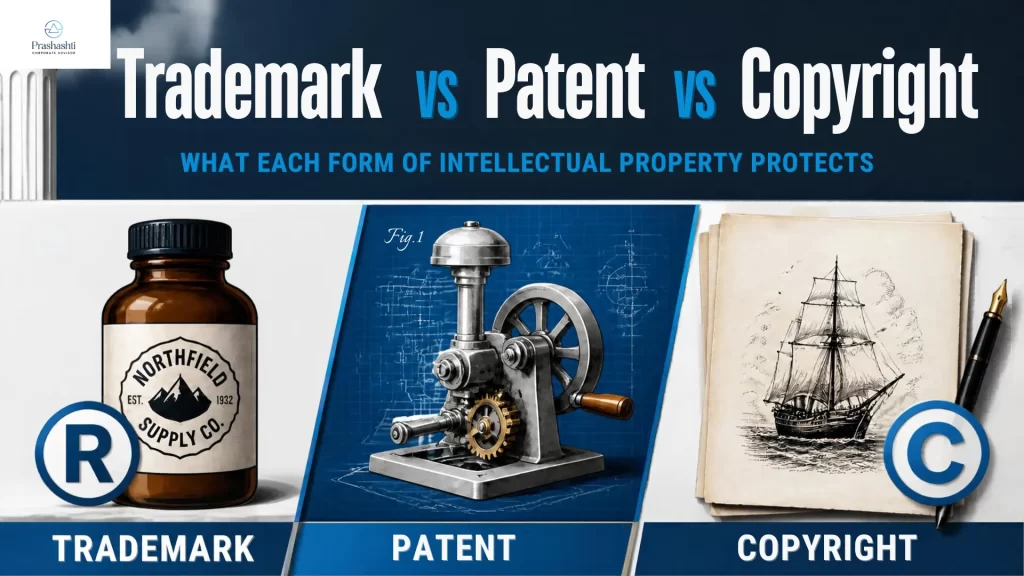
That’s where intellectual property rights come in. A trademark protects your brand. A patent protects an invention. Copyright protects original work, like code, content and graphics. That’s the core difference between trademark, patent and copyright.
In this guide, we’ll look at how each works in India, the fees involved, what you should protect first, and why making sure your company owns its intellectual property matters just as much as filing for protection.
What are the differences between trademark, patent and copyright?
A trademark protects brand identity, a patent protects inventions, and copyright protects original creative work. A startup may need all three, but each covers a different asset.
Feature | Trademark ™ | Patent | Copyright © |
Protects | Brand identity (Name, logo, tagline, slogans, shapes). | Inventions, new products, novel hardware, or industrial processes. | Original creative work (Source code, website content, photos, videos). |
Primary Goal | Prevents marketplace confusion and brand impersonation. | Prevents competitors from making, using, or selling your invention. | Prevents unauthorized copying, distribution, or reproduction of your work. |
Applicable Indian Law | Trade Marks Act, 1999 | Patents Act, 1970 | Copyright Act, 1957 |
When Protection Starts | Common law rights may be acquired by use. Registration gives clear statutory rights. | Filing date gives priority. Enforceable rights start only on grant | Automatically the moment the work is created in a tangible form. |
Validity / Duration | 10 years, but can be renewed indefinitely every 10 years. | 20 years max from the date of filing (non-renewable). | Author’s lifetime + 60 years (for most original works). |
Registration Status | Optional (but highly recommended for legal enforcement). | Mandatory (You have no patent rights without a grant). | Optional (but register entries count as prima facie evidence under Section 48). |
Startup Example | The company name “Zomato” and its red logo. | A new drone mechanism or technical process they invented. | The UI design, app source code, and promotional videos. |
Which IP do you need? Three quick questions.
- Will customers recognise you by a name or logo? That’s a trademark.
- Did you build a new technical method or product? Check patent options before you show it to anyone.
- Did you write, design, or code it yourself? Copyright covers it automatically.
Most founders say yes to more than one, and one asset can need two types. That’s normal.
What Is A Trademark?
A trademark is what customers use to recognise you: your name, logo, tagline or pack shape. It stops others from using a look-alike mark that confuses buyers.
You can use a mark without registering it. Courts can still protect it through “passing off” if you’ve built a reputation. But that’s harder to prove. Registration gives you clear statutory rights. It lasts 10 years and renews again and again.
You file in a class (goods or services), and protection applies to that class. So pick classes carefully. The e-filing fee for an individual, startup or small enterprise is ₹4,500 per class. Everyone else pays ₹9,000. You can find other fees on IP India’s trademark fee page.
A trademark does not protect your code, features, or idea. And owning a domain name gives you no brand rights. Search the trademark database using a trademark checker in India before you pay for a logo.A similar mark in your class can bring an objection or an opposition.
What Is A Patent?
A patent protects a new invention: a product, machine, process, or technical method. In return, you must explain how it works. It lasts 20 years from the filing date. Your invention must be new, involve an inventive step, and be useful in industry.
- Disclosure is the big risk: If you demo, publish, or pitch the invention before filing, you can lose the right to patent it. India has no general grace period. Section 31 covers only narrow cases: a display at a government-notified exhibition, or a paper read before a learned society. You must file within 12 months. The official text of Section 31 lists them. A provisional application gives you an early filing date. You then have 12 months to file the complete specification.
- Software is more nuanced than “no software patents”: Section 3(k) blocks a “computer programme per se,” plus algorithms and business methods. It doesn’t block every software-based invention. On 29 July 2025, the Patent Office issued revised guidelines for computer-related inventions.
They add a step-by-step test and worked examples, including for AI and machine learning. You can read the official public notice. In plain terms: a plain app idea won’t pass, while a real technical solution to a technical problem might. A patent professional should judge that call.
What Is Copyright?
Copyright protects original work, not ideas. That covers code, website copy, blogs, photos, videos, music, app screens, and graphics. It starts the moment you create the work, and software counts as a literary work in India.
Registration is optional. But it helps prove ownership, which helps in a dispute or an investor review. Fees start at ₹500 per work, and the Copyright Office’s FAQ page explains how software is registered. Confirm the fee for your category before you file.
Copyright does not protect your app idea or how your product works. A rival can build a similar app with fresh code and not break your copyright.
Other Intellectual Property Protection Options for Startups
Design registration (Designs Act, 2000) protects the new look of a product: its shape, pattern or surface. It lasts 10 years and can be extended by 5 years. It doesn’t cover how the product works.
Trade secrets cover confidential know-how like formulas, customer lists, and pricing logic. You can’t register them. You protect them with NDAs, contracts and access limits, and the protection lasts only while the secret holds.
Which IP Protection Do I Need for My Startup?
Your startup | File first | Add next | Don’t assume |
Mobile app | Trademark on name and logo | Copyright on code, UI, graphics. Patent only for a real technical invention | Copyright protects the app idea |
Logo | Trademark | Copyright, if original (get the designer’s written assignment) | A new logo has registered rights |
Hardware invention | Patent check, then a provisional | Trademark, design registration, copyright on manuals | A public demo is safe |
Content or media | Dated records of your work; trademark the brand | Copyright registration for key works | Facts and ideas are protected |
SaaS | Trademark + IP assignment agreements | Copyright on code and docs; trade secrets for algorithms and pricing | Copyright protects functionality |
Difference between trademark, patent, and copyright with example: Imagine GreenCrate, a Bengaluru startup selling reusable packaging with an ordering app. Its name and logo get a trademark. A new locking mechanism gets a provisional patent, filed before any trade show. The app code and product photos are covered by copyright. The crate’s shape can go for design registration. Supplier prices stay a trade secret. One startup, five rights, five different assets.
Which IP Should You File First? A Startup Filing Priority Roadmap
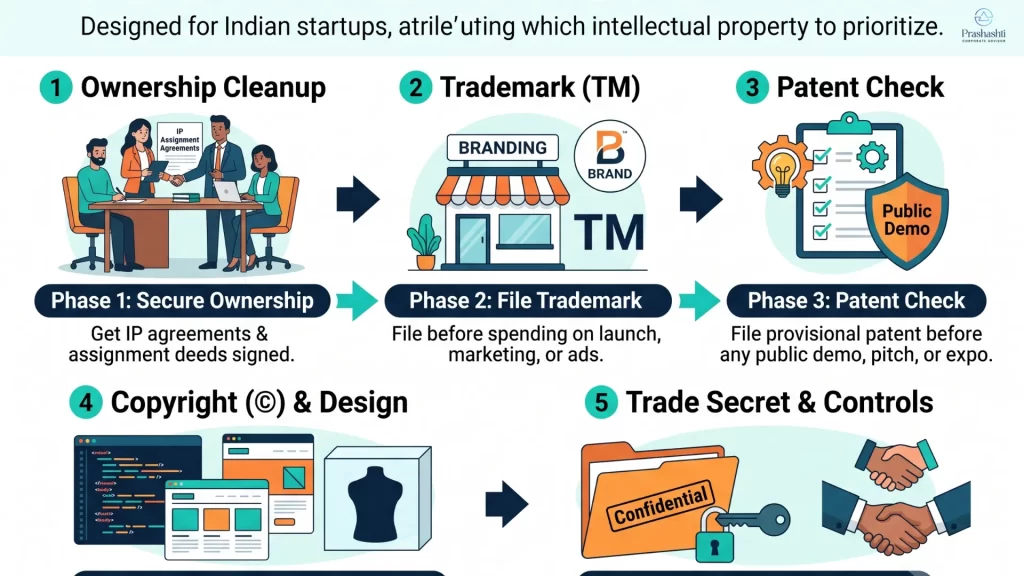
There’s no single rule, but this order works for most Indian startups:
- Ownership cleanup: Make sure the company owns everything it uses (more on this below).
- Trademark: File before you spend on launch, ads, or packaging.
- Patent check: Do this before any public demo, if your edge is technical.
- Copyright: Keep dated records now. Register your most valuable work.
- Trade secret controls: NDAs cost very little.
The order flips for invention-led startups. If your edge is a technical invention and a demo or investor pitch is coming, the patent check goes first.
Here’s how that looks over time: Before launch, list your assets and sign IP assignments. At launch, file your trademarks and, if needed, a provisional patent. After traction, file the complete patent, register key copyrights, and add trademark classes.
Someone Copied Your Brand, App or Content: What To Do First
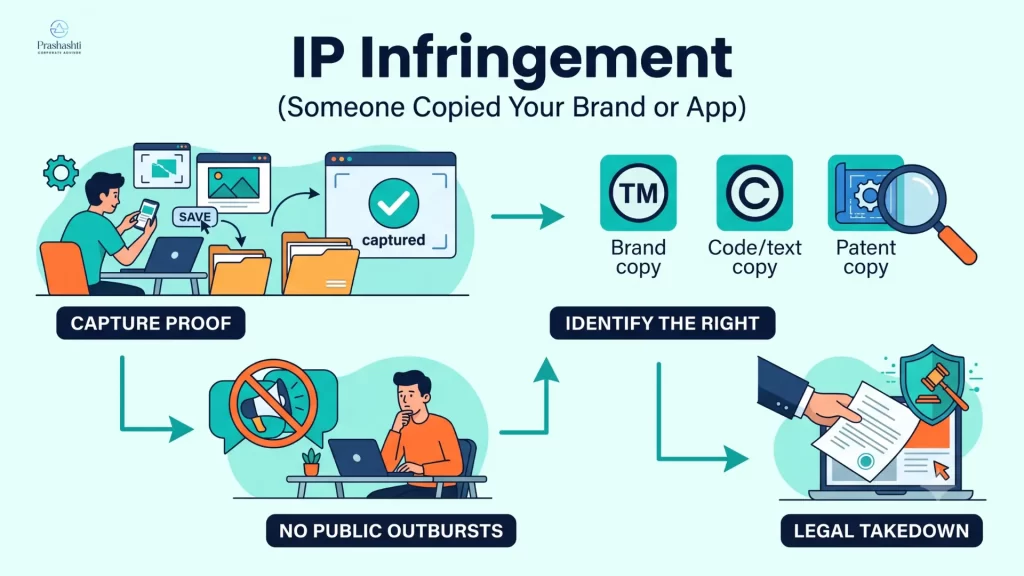
Filing creates the right. But what you do in the first few days after a copy shows up decides how strong your case is.
- Start with proof. Take screenshots, save URLs, note dates, and archive the pages. Do it fast, because posts and listings get deleted. Keep your own invoices, sales records and launch dates too, since they show you came first.
- Next, work out which right is involved. A copied name points to trademark. Copied code, text or images point to copyright. A copied invention is a patent matter. Then ask: is this really infringement, or just similar? Plenty of look-alikes aren’t.
- Don’t post a public accusation. Instead, have an IP professional send a cease-and-desist notice, and use the takedown tools on app stores, marketplaces, social platforms and search engines. Your options depend on the right involved. Opposition, cancellation, injunctions or damages come later, and only with legal advice.
Takeaway: a registration is only as strong as your records and your follow-through.
IP Registration Cost and Timelines in India
These are e-filing government fees at startup, small-entity and individual rates. Professional fees come on top, and patents cost the most.
IP type | Government fee | Typical timeline | Term |
Trademark | ₹4,500 per class (₹9,000 others). | 8 to 18 months (unopposed) | 10 years, renewable |
Patent | ₹1,600 (Filing) + ₹4,000 (Examination) (Others: ₹8,000 + ₹20,000) | Often several years to grant | 20 years from filing |
Copyright | From ₹500 per work | Usually a few months | Life + 60 years (most works) |
Design | ₹1,000 for startups (Others: ₹4,000) | Usually a few months | 10 + 5 years |
Trade secret | None | Not applicable | While secret |
DPIIT-recognised startups pay less in government fees: 80% off patent fees and 50% off trademark fees, per Startup India. Patents also need Form 28. The discount covers government fees only, not your lawyer’s bill.
Startups can also ask for expedited examination (Form 18A, Rule 24C). It’s e-filing only and costs ₹8,000, against ₹4,000 for the standard request (Form 18). Others pay ₹60,000. The standard request is due within 31 months of your filing or priority date. Check the figures in IP India’s fee schedule before you file.
Recent Changes to Startup IP Rules in India
- July 2025: Revised Patent Office guidelines for computer-related inventions.
- Since 2024: The examination request window shrank from 48 to 31 months, and Form 31 was added for the Section 31 grace period.
- 31 March 2026: The SIPP scheme (government-paid facilitator fees for startups) ended. No extension had been announced as of May 2026, so check IP India’s SIPP page before you budget.
IP Protection Tips From Prashasthi Corporate Advisors
Prashasthi is a Bangalore firm that has handled company registrations and compliance since 2014 across India, offering industry-specific services Here’s what they tell founders to sort out around IP:
- A company name isn’t a trademark: Getting your company name approved doesn’t give you brand rights. Do a trademark search separately, before you register the company.
- Get DPIIT recognition before you file: The lower fees apply only if you claim them at filing.
- Put IP on the compliance calendar: Track trademark renewals, yearly patent renewal fees and trade license renewal like any other deadline.
- Keep a clean paper trail: Agreements, receipts, and dated records should sit in one folder. Investors will ask for them.
For the filings themselves, work with a registered trademark or patent agent.
“Expert Insight from Arun Bhandary, Founder of Prashasthi Corporate: Founders often file the trademark in their own name, then raise money through a company. Investors then ask for an assignment. Incorporate first, file in the company’s name, and keep every agreement in one folder.”
What Are The Common IP Mistakes Startups Should Avoid?
- Filing a trademark after you’ve spent heavily on branding.
- Thinking of a domain name or company name gives brand rights.
- Using freelancers with no written IP assignment.
- Demoing an invention before checking patent options.
- Assuming one patent covers the whole startup.
- Ignoring open-source licence terms in your code.

Final Thoughts on the Difference Between Trademark, Patent and Copyright
Trademarks protect your brand. Patent protects your invention. Copyright protects your creative work. Trade secrets protect what you keep confidential. Protect first whatever rivals could copy, block or misuse fastest.
Start with an IP audit: list your brand, code, content, designs and inventions, then check who owns each one and match it to the right protection and filing order.
Need help organising your startup’s IP? Book an IP audit with Prashasthi Corporate Advisors: we’ll list what you own, flag ownership gaps, and plan your filing and renewal dates. For patentability opinions or disputes, consult a qualified IP professional.
Disclaimer: This guide is general information, not legal advice.