

You have a cause in mind. Maybe you want to start a small education centre, support women in your community, or run a food programme.
You start looking into how to register it, perhaps even searching for company registration in Bangalore, and almost immediately you run into the same question: what is the difference between NGOs and NPOs? One website calls it an NGO. Another talks about an NPO. Before long, you’re wondering if you’re supposed to choose one over the other.
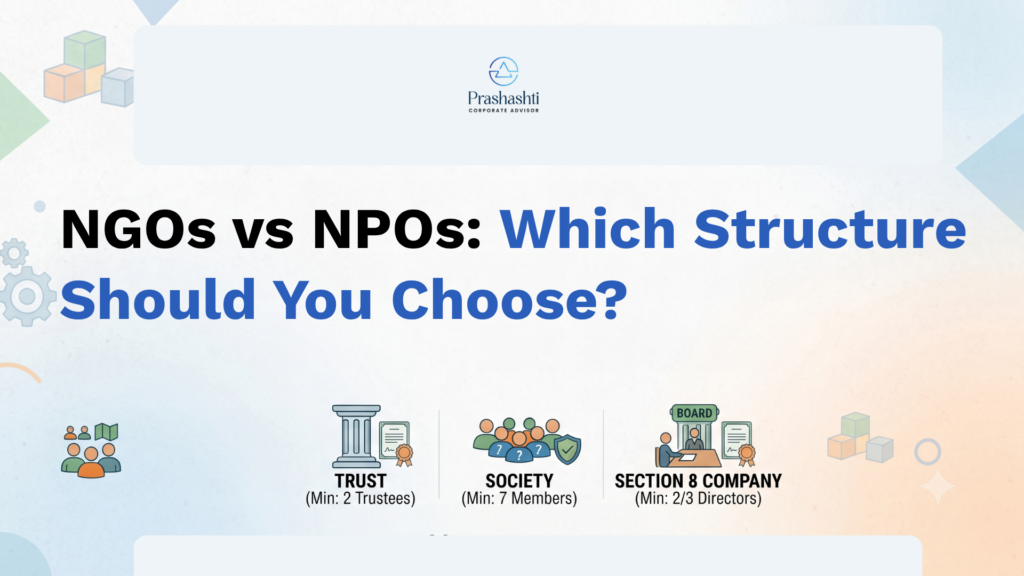
The confusing part is that you actually don’t register as an NGO or an NPO in India. These are terms used to describe organisations, not legal structures. What you choose is a trust, society, or Section 8 company. That choice matters because it affects how your organisation is governed, funded, and managed later.
So before you start filling out forms, let’s clear up the difference between NGOs and NPOs in India, look at the legal structures available in India, and see which one may actually fit what you’re planning to build.
What Are The Differences Between NGOs and NPOs?
An NGO is an organisation that works for the public good independently of the government. An NPO is any organisation that doesn’t distribute its surplus to owners or members. In India, neither is a legal structure; you register as a trust, society or Section 8 company.
Factor | NGO | NPO |
Full form | Non-governmental organisation | Non-profit organisation |
What the word emphasises | Independence from government | Where the surplus goes |
The question it answers | “Who controls us?” | “Who profits?” |
Typical scope | Any size, from a village group to an international body | Any size, including local clubs, schools and hospitals |
Typical work | Development, advocacy, relief, rights, environment, health, education | Wider: education, healthcare, religion, culture, sports, professional associations |
Where the term is common | Development sector, media, government schemes, international bodies | Tax, accounting and legal contexts, especially the US and Canada |
If you’re starting an organisation in India, don’t choose between “NGO” and “NPO.” Choose the legal structure that fits your plans: a trust, a society or a Section 8 company.

What Is a Non-Governmental Organisation (NGO)?
A non-governmental organisation works for the public good and stays independent of the government. Independent doesn’t mean “never takes government money.” Many NGOs run on government grants and still decide their own programmes.
NGOs usually work on education, health, child welfare, women’s empowerment, the environment, or disaster relief. Some stay local. Some work across states or countries.
What Is a Non-Profit Organisation (NPO)?
A non-profit organisation can earn money. It can charge fees, sell products, run events. What it can’t do is hand the surplus to owners or members. Every rupee goes back into the mission.
The label is wider than NGOs. Schools, hospitals, temples, clubs, and cultural groups can all be non-profits.
Most Indian NGOs are also non-profits. Not every non-profit calls itself an NGO.
The Prashasthi 3-Layer NGO Framework (Read This Before You Register)
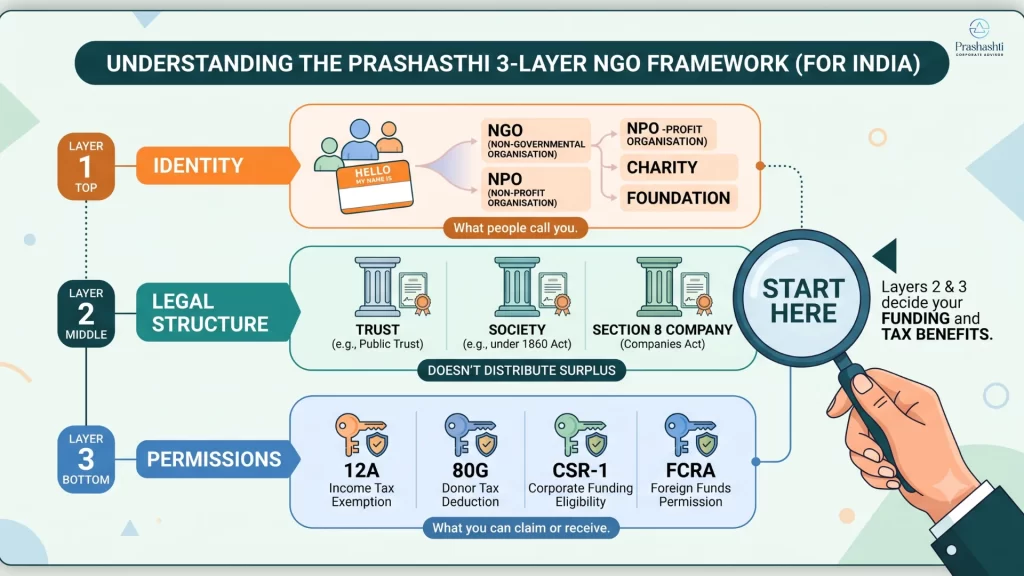
This is the simplest way to think about it. Your organisation has three layers:
- Identity: What people call you: NGO, NPO, charity, foundation.
- Legal structure: What you’re registered as: trust, society, or Section 8 company.
- Permissions: What you can claim or receive: 12A, 80G, CSR-1, FCRA.
Most founders spend months on layer one. Layers two and three decide whether you get tax benefits and funding. Start there.
Types of NGO Registration in India: Trust, Society and Section 8 Company
People often want to know about “types of NGO in India.” Strictly speaking, these are legal structures an NGO can use. There are three.
- Public charitable trust: Run by trustees under a trust deed. Private trusts follow the Indian Trusts Act, 1882. Public charitable trusts are also shaped by state-level laws, which differ from state to state. A trust can be fairly simple for a founder-led charitable project, though cost and process vary by state.
- Society: it is registered under the Societies Registration Act, 1860, and state rules. Members elect a governing body. That is good for community groups and membership work. Usually, society registration requires a minimum of seven members.
- Section 8 company: This is a non-profit company under Section 8 of the Companies Act, 2013, licensed through the Ministry of Corporate Affairs. It has the most formal governance. Some institutional funders like that structure. Others are fine with any properly registered entity. Check what your funders ask for.
Difference Between Trust vs Society vs Section 8 Company
Factor | Trust | Society | Section 8 Company |
Main law | Indian Trusts Act 1882 / state trust laws | Societies Registration Act 1860 / state laws | Companies Act 2013 |
Usual minimum | 2 trustees | 7 members | 2 (private) / 3 (public)” |
Who controls it | Trustees | Elected managing committee | Board of directors |
Setup effort | Varies by state | Moderate | More involved |
Ongoing compliance | Generally lighter | Moderate | Generally heavier |
Often fits | Founder-led charitable work | Community or member-driven work | Larger, formally governed organisations |
Minimums and processes differ by state, so confirm with your local Registrar or the Ministry of Corporate Affairs before you draft anything. The Acts themselves are available on India Code.
Expert tip from Prashasthi Corporate Advisors: Founders often choose a structure because it’s the cheapest to register, and then find out two years later that their funder wants something else. Write down who will fund you in year one and year three before you pick. Changing structures later costs time and, often, tax approvals.
Tax Exemption for NGOs: What Changed on 1 April 2026?
The Income-tax Act, 2025 came into force on 1 April 2026 and replaced the 1961 Act. You can read the text on the Income Tax Department’s website. Here’s what matters for non-profits:
- For eligible charitable and religious organisations, Section 332 now provides the registration framework that replaced the old 12A/12AB route.
- Section 354 now governs approval for donation deductions, replacing the earlier 80G approval framework.
- Form 104 is used for provisional registration or approval. Form 105 is used for regular registration or approval. You file them through the Income Tax e-filing portal.
- Organisations that already held valid registrations are generally carried forward under the new Act. Check the transition provisions for your registration’s validity date.
So 12A registration and 80G registration are still how people talk, even if the section numbers changed.
Here’s the part to remember: tax exemption for NGOs is not automatic. Registering as a trust, society or company doesn’t give it to you. You have to apply, get approved, and keep meeting the conditions every year.
And the two approvals do different jobs:
- 12A / Section 332 helps the organisation. Qualifying income gets an exemption.
- 80G / Section 354 helps the donor. Donors can claim a deduction on eligible donations.
Which Registrations Do You Actually Need? Start With Your Funding
The registrations you require will depend very much on where the money is going to come from. A small organization funded by local donations won’t have the same standards as an organization intending to acquire CSR money or foreign contributions.
First, consider your financial strategy. Then you can pick which registrations are really important to your organization.
Where your money comes from | What to look at |
Small donations from friends and locals | PAN, bank account, and 12A for the organisation’s own tax position |
Donors who want tax deductions | 12A (Section 332) and 80G (Section 354) approvals |
Government grants and schemes | NITI Aayog Darpan registration, which many schemes ask for |
Corporate CSR money | CSR-1 registration on the MCA portal |
Money from outside India | FCRA registration, or prior permission for a specific contribution |
A few details on each.
- NITI Aayog Darpan registration: It’s free. You register on the NGO Darpan portal and get a unique ID. The law doesn’t force every NGO to have one. But government grant forms often ask for it, and FCRA applicants need it too.
- CSR-1 registration: Since 1 April 2021, entities that want to carry out CSR projects for companies must file Form CSR-1 with the MCA and get a CSR registration number. The form is on the MCA website. A revised version of CSR-1 was introduced in 2025, so always download the latest one from the MCA, not from an old PDF. Companies also check that you hold 12A and 80G.
Expert tip from Prashasthi Corporate Advisors: Apply for Darpan early. It’s free, and it often becomes the thing that blocks a grant application at the last minute. Nobody remembers it until a form asks for it.
FCRA Rules for NGOs in 2026: What Has Changed?
If you want foreign money, FCRA registration is the biggest thing to understand this year. The best source is the Press Information Bureau’s FCRA factsheet from July 2026 and the FCRA portal.
What’s already in force (FCRA Amendment Rules, 2026, notified 22 June 2026):
- Your registration must name the exact purposes and the States or Union Territories where you’ll work.
- Existing registered associations get one year to tell the government which purposes and States they want to keep, using Form FC-6F. The last date is 21 June 2027, per the FCRA portal.
- To renew, you must show you used at least ₹10 lakh of foreign contribution over the previous two years.
- Annual returns now ask for project-wise details, your website and social media, and the ultimate foreign donor.
What’s older but still true:
- Foreign money must first land in the designated SBI account at the New Delhi Main Branch.
- You can’t pass foreign contributions on to another organisation.
- Admin spending is capped at 20% of the annual foreign contribution.
- Registration lasts five years and needs renewal.
- To get registered, an organisation should have been working for at least three years. Otherwise, you can seek prior permission for a specific project.
Proposed, not law: The FCRA Amendment Bill, 2026 was introduced in the Lok Sabha on 25 March 2026 and is still under consideration of Parliament, according to PIB. It proposes a Designated Authority that would take custody of foreign-funded assets if a registration ends. Until it passes, those provisions are not law. Check sansad.in for the latest status before you make decisions around it.
A reality check from the government’s own numbers: PIB says about 16,200 associations were actively registered in 2024-25 and received roughly ₹22,963 crore in foreign contributions. It also says the active FCRA database is roughly 14,500, against over 31 lakh registered NGOs in India, so most NGOs never touch FCRA at all
Expert tip from Prashasthi Corporate Advisors: The three-year rule catches new founders off guard. If a foreign donor wants to fund you in year one, ask about prior permission rather than assuming you can get an FCRA number quickly. And keep your purposes list narrow and honest. Under the new rules, it’s what your certificate will say.
Which NGO Structure Is Right for You? 3 Real-Life Examples
These are illustrative examples, not legal advice, to show how the thinking works.
- Meena wants to run a village tuition centre: She’ll fund it from local donors, with two or three friends running it. A trust is a reasonable starting point. She should still apply for 12A and 80G if donors want receipts.
- A resident group wants a community health club: Thirty members, shared decisions, yearly elections. A society fits this naturally, since the structure is built for membership and voting.
- Arjun plans a skills programme and expects CSR funding in year two: He needs formal governance, CSR-1, Darpan, 12A and 80G. A Section 8 company is worth a serious look. A trust or society can also take CSR funds if registered correctly, so he should ask his likely funders what they want.

Common Mistakes Founders Make About the Difference Between NGOs and NPOs
- Choosing “NGO vs NPO” first: It’s a label. Pick the legal structure.
- Assuming registration means tax exemption: It doesn’t. You need Section 332 approval.
- Forgetting Darpan until a form asks for it.
- Thinking FCRA is for every NGO: It’s only for foreign contributions.
- Applying for FCRA in year one: The three-year working rule can stop you.
- Missing annual filings: This might affect your tax approvals.
- Copying a friend’s trust deed: Your objects clause is what you can do and what funders will approve.
- No exit plan: Determine what happens to assets if the organization closes. Both trust deeds and society norms need a clause for this.
NGO and NPO Compliance in India: What Happens After Registration?
Non-profit compliance depends on your structure. By structure:
- Trust: proper accounts, income tax returns, audit where required, and your state’s reporting rules.
- Society: general meetings, filings with the Registrar, and books kept up to date.
- Section 8 company: annual filings with the Registrar of Companies, statutory audit, and board meetings.
- All of them: keep tax approvals valid, file donation statements, and keep records of who gave what.
Put dates in a shared calendar from day one.
Expert tip from Prashasthi Corporate Advisors: Keep one file per financial year with the bank statements, audit report, meeting minutes and donor receipts. When a funder or officer asks for papers, you can send them in an hour instead of a month.
How to Start an NGO in India: 6 Steps You Need to Follow
- Write your mission in one line. Who do you help, and how?
- List your likely funders. This decides your structure.
- Pick a trust, society or Section 8 company. Use the table above.
- Register it with the Sub-Registrar or Charity Commissioner (trust), the Registrar of Societies (society), or the MCA (Section 8 company).
- Get a PAN and open a bank account in the organisation’s name. Then apply for 12A and 80G under the new Act, and register on Darpan.
- Add CSR-1 or FCRA only when you need them. If you need help with NGO registration in Bangalore, Prashasthi Corporate can assist with the registration process.
Which Structure Should You Choose?
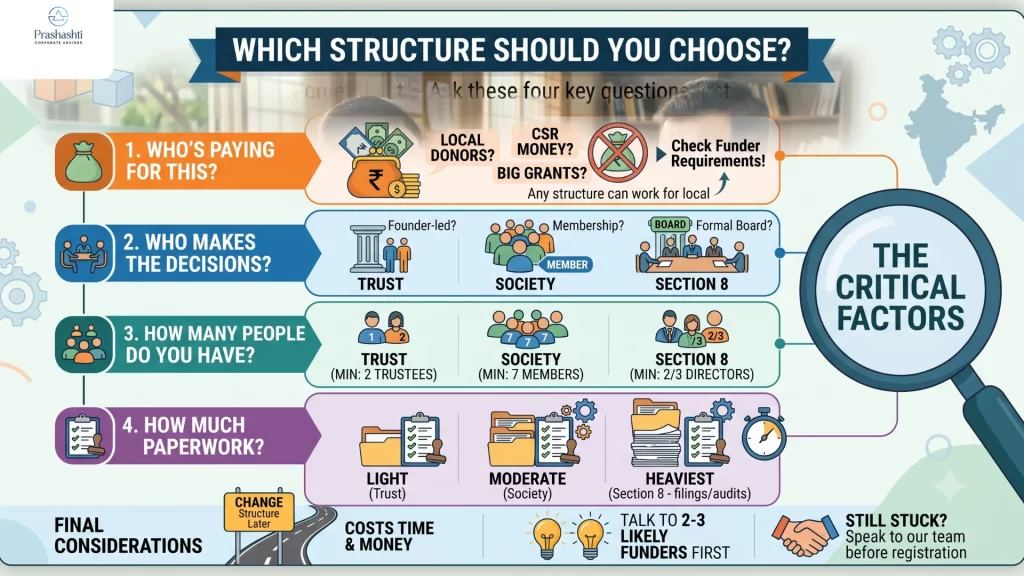
Forget which one is “best.” Ask yourself these four things instead.
- Who’s paying for this? If it’s local donors, almost any structure works. If you’re counting on CSR money or big grants, ask those funders what they accept before you register.
- Who makes the decisions? Two or three founders in charge? A trust. A group of members who vote? A society. A formal board? A Section 8 company.
- How many people do you have? A trust needs 2 trustees. A society usually needs 7 members. A Section 8 company needs 2 directors if it’s private, 3 if it’s public.
- How much paperwork can you handle? Section 8 companies have the most filings and audits. Trusts are usually lighter, though it depends on your state.
Still stuck? Talk to two or three likely funders first. You can change structure later, but it costs time and money.
Not sure which one fits your funders? Speak to our team before you register.
Difference Between NGOs and NPOs: The Key Takeaway
NGO and NPO are words people use. Trust, society and Section 8 company are structures the law recognises. 12A, 80G, CSR-1 and FCRA are permissions that decide what you can claim and receive.
Getting these details right from the beginning can make things much easier later. Prashasthi Corporate Advisors has provided end-to-end NGO registration and compliance services across India since 2014. The important thing is to choose the structure first, then work through the registrations you actually need.
Disclaimer: This blog is general information and not legal or tax advice. Rules differ by state and change often. Speak to a qualified CA, CS or an advocate before you register.