
You’ve registered your company. The CIN is in hand, PAN and TAN are sorted, and the bank account is open. On paper, you’re in business. But one filing quietly decides whether the company can legally commence business or exercise its borrowing powers, and most founders don’t think about it until an ROC notice lands in their inbox.
That filing is Form INC 20A. Missing it isn’t a small late fee you clear up later. It triggers a statutory penalty on the company, personal exposure for the officers responsible, and, in specific situations, the risk of the company being struck off the register.
Here’s exactly what happens if INC-20A is not filed, backed by the Companies Act itself and two officially recorded ROC penalty orders.
INC-20A Penalty at a Glance
Consequence | Current statutory position |
Filing deadline | Within 180 days of incorporation |
Company penalty | ₹50,000 |
Officer in default | ₹1,000/day, capped at ₹1,00,000 per officer |
Late filing fee | Additional fee applies based on delay (2x–12x) |
Strike-off risk | Possible only if Section 10A(3)’s conditions are both met |
Section 446B relief | Possible reduction for OPCs, small companies, startups, Producer Companies |
What Is INC 20A, in Simple Words?
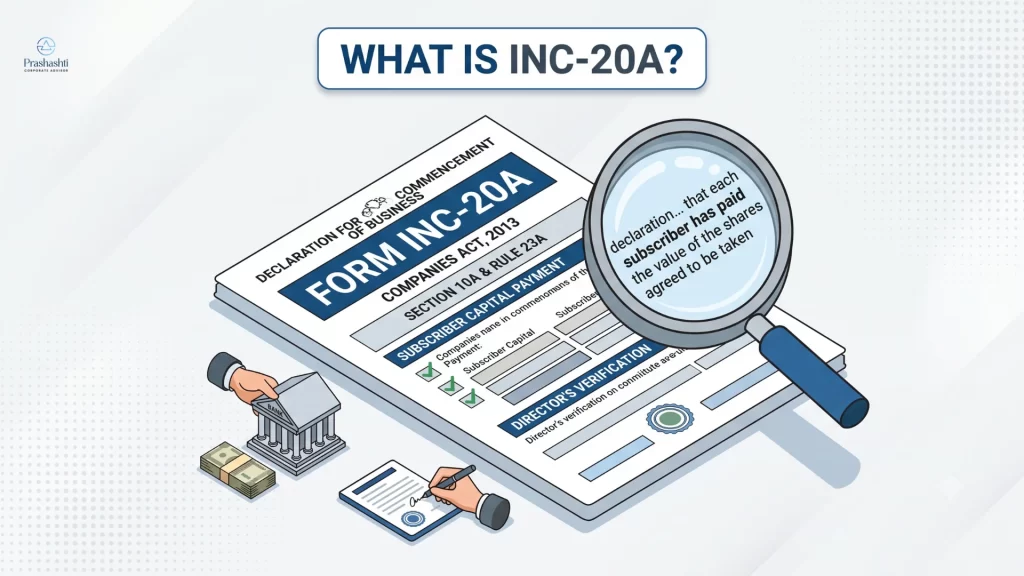
INC 20A is the “Declaration for Commencement of Business,” filed under Section 10A of the Companies Act, 2013, and Rule 23A of the Companies (Incorporation) Rules, 2014.
Here’s the part most people skip: INC-20A isn’t really about whether your office is running or your website is live. It’s a declaration that every subscriber to the Memorandum of Association has actually paid up the shares they agreed to take.
“Commencement of business” is the legal label, but the real function is capital verification, and only after this declaration is filed can the company legally commence business or exercise its borrowing powers, per the MCA’s own INC-20A Instruction Kit.
Expert takeaway: Think of INC-20A as both a commencement-of-business declaration and a statutory confirmation that the capital your subscribers committed to has genuinely landed in the company’s account. Get the second part wrong, and the first part doesn’t matter.
It applies to every company with share capital incorporated on or after 2nd November 2018. Companies incorporated earlier, and those without share capital, fall outside its scope.
What Is the Form INC 20A Due Date?
180 days from the date of incorporation. No extension is built into the section itself. If your Certificate of Incorporation is dated 1st March, your last day to file is roughly 27th August.
Common mistake we see: founders count 180 days from when the bank account got activated, not from the incorporation date on the certificate. The statutory clock runs from incorporation.
What Is the Penalty for Not Filing INC-20A?
Missed the 180-day deadline?
This is where the real cost begins, and it comes in layers.
- On the company: Under Section 10A(2), the company is liable for a penalty of ₹50,000.
- On the officer in default: Every officer in default is liable for ₹1,000 for each day the default continues, capped at ₹1,00,000 per officer.
That word choice matters. It’s the officer in default, not automatically every director on the board. Who counts as an officer in default depends on the facts: who signed the board resolution, who was actually responsible for the filing, and when they took charge. Don’t assume liability spreads evenly across every name on the board; it doesn’t work that way in practice.
- Regulatory risk: If the declaration still isn’t filed after 180 days, and the Registrar has reasonable cause to believe the company isn’t carrying on business, action can be initiated to remove the company’s name from the register.
A real, officially recorded order:
In an order dated 13 August 2024 (Order Ref: ROC/CBE/A.O./10A/40605/2024), the Registrar of Companies, Coimbatore, penalised a company ₹50,000 and imposed ₹1,00,000 each on two of its directors for a Section 10A default; the company had been unable to bring in the promised subscription capital within the 180-day window. The order draws directly on the statutory language: a director “files a declaration… that each subscriber to the memorandum has paid the value of the shares agreed to be taken.”
A more recent one, with a twist:
In an order dated 25 June 2026 (Order ID: PO/ADJ/06-2026/PU/02428), the RoC Pune dealt with a company that had entered into a loan agreement, treated as exercising borrowing powers, before filing INC-20A, and filed the declaration roughly a year and a half late. Because the company was a DPIIT-recognised startup and qualified as a small company, Section 446B applied, and the company’s penalty was reduced to ₹25,000 (directors still paid ₹50,000 each). Both these orders are publicly available through the MCA’s adjudication portal for anyone who wants to verify them directly.
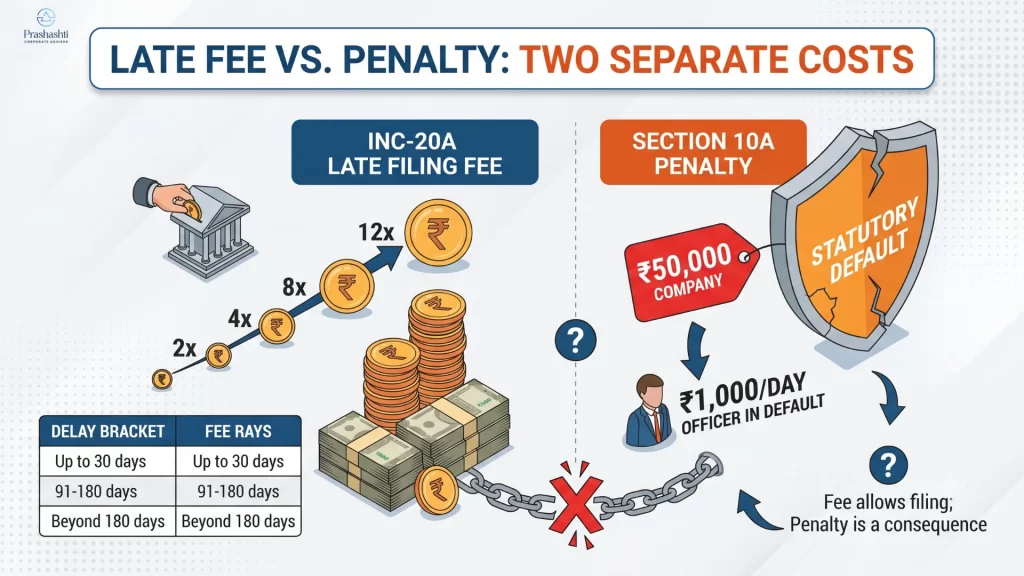
INC-20A Late Filing Fee vs Penalty: They Are Not the Same Thing
Cost | What it is | Who pays |
Normal filing fee | Standard statutory fee | Company |
Additional filing fee | Cost of filing after the deadline | Company |
Section 10A(2) penalty | Statutory penalty for the default itself | Company / officer in default |
Strike-off action | Regulatory consequence in specified circumstances | Company |
The additional filing fee scales with delay, per the MCA’s official instruction kit:
Delay period | Additional fee |
Up to 30 days | 2x normal fee |
31-60 days | 4x normal fee |
61-90 days | 6x normal fee |
91-180 days | 10x normal fee |
Beyond 180 days | 12x normal fee |
Paying this higher fee gets the form accepted on MCA21. It does not, on its own, erase the Section 10A(2) penalty. That’s a separate adjudication question, and both the Coimbatore and Pune orders above show ROCs treating it that way.
Can Section 446B Reduce the INC-20A Penalty?
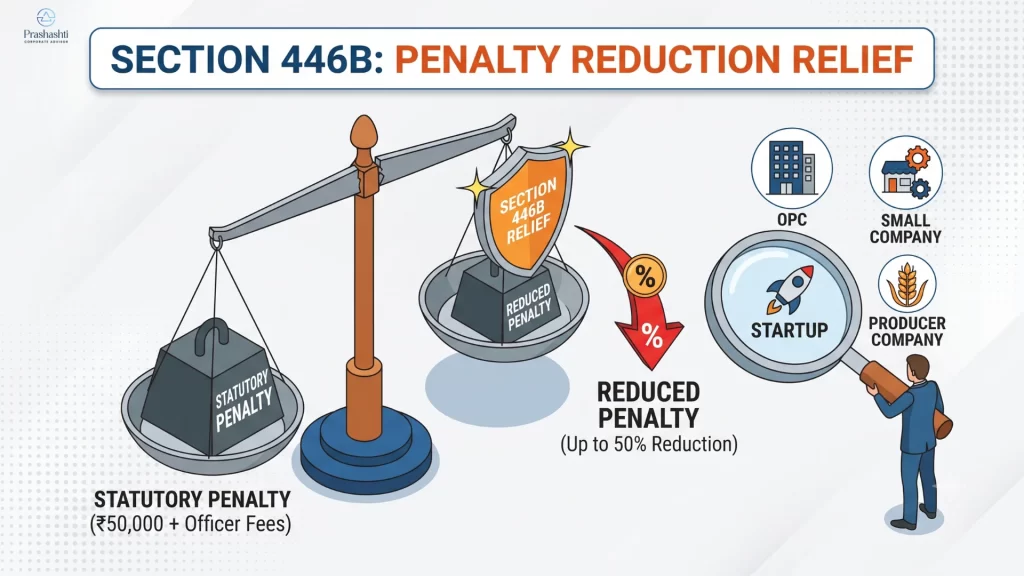
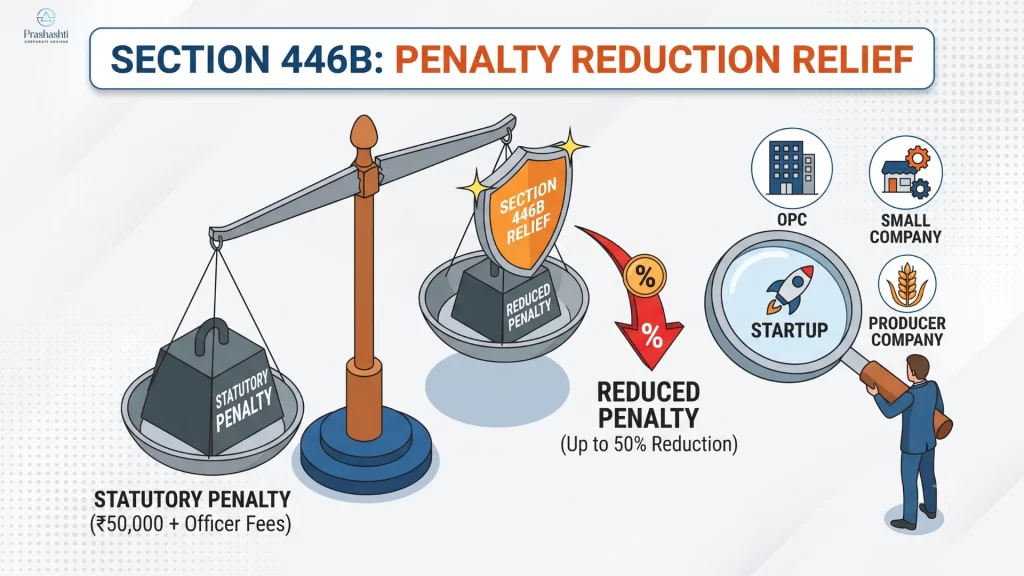
Yes, for One Person Companies, small companies, DPIIT-recognised startups, and Producer Companies, but eligibility isn’t automatic. Section 446B permits a penalty of not more than one-half of the penalty specified under the relevant provision, subject to statutory caps. It has to be established and accepted by the adjudicating officer, as it was in the Pune order above, not simply assumed because a company happens to fit the description.
Can You Still File INC-20A After 180 Days?
Yes. Crossing the deadline doesn’t close the door on filing. What it does mean:
- Follow the MCA’s filing procedure: pay the additional fee for your delay bracket.
- The form still needs verification by a practising CA, CS, or Cost Accountant.
- You’ll need the bank statement showing subscription money actually received.
- Filing late does not by itself erase any penalty exposure that may already be adjudicated under Section 10A(2).
What If Subscribers Haven’t Actually Paid Their Share Money?
This is the part that matters more than the deadline. The declaration is only valid if the capital has genuinely come in. If it hasn’t, filing anyway creates a false declaration, a far bigger problem than a late fee. Before filing, reconcile each subscriber’s committed capital against the bank statement, line by line, and don’t file until that trail is real.
Can a Company Do Business Before Filing INC-20A?
Not fully. Section 10A restricts a company from commencing business or exercising borrowing powers until the declaration is filed. Whether a given transaction crosses that line is a question of fact, the Pune order above treated signing a loan agreement before filing as exactly that kind of violation. Don’t treat every invoice or contract as automatically fine just because the company technically exists.
Can ROC Strike Off Your Company for This?
Only if both conditions under Section 10A(3), read with Section 248, are met:
- The declaration hasn’t been filed within 180 days, and
- The Registrar has reasonable cause to believe the company isn’t carrying on any business or operations.
A company that’s simply late but visibly operating faces the monetary penalties, not automatic strike-off. Strike-off risk is reserved for companies that look dormant or abandoned on the record.
What Founders Commonly Get Wrong About INC-20A?
Myth: “I paid the late fee, so I’m compliant now.”
Reality: The additional filing fee and the Section 10A penalty are separate. One gets your form accepted; the other is a statutory default that can still be adjudicated.
Myth: “Every director automatically pays ₹1 lakh.”
Reality: the penalty attaches to the officer in default, a question of fact, not a flat multiplier across the board.
Myth: “180 days pass, and the company is struck off automatically.”
Reality: strike-off needs both the missed deadline and the Registrar’s reasonable belief that the company isn’t operating.
Myth: “We’re a startup, so Section 446B wipes out the penalty.”
Reality: eligibility has to be claimed and accepted by the adjudicating officer; it isn’t self-executing.
What to Do If You've Already Missed the Deadline?
- Confirm the actual deadline is 180 days from the Certificate of Incorporation date, not from bank activation.
- Before doing anything else, verify the subscriber’s payment against bank statements.
- Determine your additional cost bracket based on the delaying time.
- If you are a small firm, OPC or DPIIT-recognised startup, do check your eligibility for Section 446B.
- Get the form attested by a practicing CA, CS or Cost Accountant.
- File and preserve the SRN, challan, and every supporting document.
- Separately assess penalty exposure. Filing doesn’t automatically close that question.
f you’ve already received a notice from the Registrar, it’s worth getting it reviewed by tax consultants in Bangalore before you respond. A firm that regularly handles ROC notices can tell you fairly quickly whether Section 446B applies to your case and what your actual exposure looks like.
Final Thoughts
INC-20A ties three things together: your subscribers’ capital, your company’s right to operate, and your officers’ personal accountability. Missing the 180-day window doesn’t just cost a filing fee. It opens up a separate statutory penalty and, in specific cases, regulatory action against the company itself. If you’re past the 180-day window or unsure where you stand, our corporate advisory team can help you work it out before it becomes a notice, along with Audit Services in Bangalore where applicable,
Prashasthi Corporate Advisors has been handling company registration and post-incorporation ROC compliance from Bangalore since 2014. As our founder puts it, “We ensure our clients navigate through this complex regulatory system with ease and maximize their profits with our insights and solutions.” If you’re past the 180-day window or unsure where you stand, our corporate advisory team can help you work it out before it becomes a notice.