
Reviewed by Vinay Pai, Co-Founder, Prashasthi Corporate Advisors | Prices and features checked on 12 November 2026. Plans change often, so confirm on the official pages before you buy.
Cloud kitchen licenses in Karnataka are the registrations and permissions you need before you take your first delivery order. Every cloud kitchen needs an FSSAI registration or license. Most also need a trade license (issued through the Greater Bengaluru Authority in Bengaluru) and Shops and Establishments registration, while GST, fire clearance and a few others depend on your setup.
Since 1 April 2026, FSSAI registration covers turnover up to ₹1.5 crore, and new licenses are valid permanently. So the old ₹12 lakh limit you’ll see in many articles is outdated. A small rented kitchen can take roughly ₹1.95 lakh to ₹4.7 lakh to set up, and about 45 days from your first step to launch day.
If you’re not sure which cloud kitchen licenses apply to you, or you’re following older guides that still point to BBMP, you could face fines or a delayed launch. Even a late trade license renewal can double your fee.
In this guide, we’ll walk through every license in simple language, what each one costs, how long things take, and the order that saves you the most trouble.
What Is a Cloud Kitchen? Types, Business Models and Examples
A cloud kitchen is a delivery-only food business. No dining area, no waiters. Just a kitchen, packaging and delivery partners like Swiggy or Zomato. Common cloud kitchen examples include:
- Single-brand kitchen: one menu, one brand, such as a biryani-only kitchen.
- Multi-brand kitchen: one Bengaluru kitchen selling biryani, burgers and Chinese under different app names.
- Restaurant’s delivery brand: an existing restaurant launches a separate delivery-only brand.
- Shared kitchen: you rent a station in a commissary kitchen used by several operators.
Whatever the model, the law sees a food business. Customers may never visit, but regulators still care how the food is made.
Is Karnataka a Good Place to Start a Cloud Kitchen Business?
Bengaluru is the obvious pick. Whitefield, HSR Layout, Koramangala, Electronic City and Marathahalli see heavy online ordering. Mysuru, Mangaluru and Hubballi are worth a look too, since rents may be lower.
Before choosing an area, open the delivery apps and search “cloud kitchen near me” for your target pincode. You’ll see who you’re up against, what they charge and which cuisines are crowded. Then check one boring but vital thing: does the property allow commercial food preparation?
Cloud Kitchen Licenses in Karnataka: Complete license and Registration Checklist
Requirement | Do you need it? | Who issues it |
FSSAI registration or license | Yes, always | FSSAI, through FoSCoS |
Trade license | Usually | Local civic body (GBA in Bengaluru) |
Shops and Establishments | Usually | Karnataka Labour Department |
GST registration | Depends | GST authorities |
Fire safety clearance | Depends on the building | Fire department |
Eating house license | Check locally | Local police licensing unit |
Professional tax | If you have staff | Karnataka state authorities |
“Depends” means your building, turnover and sales channels decide. Let’s go through each one.
1. FSSAI License for Cloud Kitchen
Does a cloud kitchen need an FSSAI license? Yes. Under the Food Safety and Standards Act, every food business must be registered or licensed with FSSAI, delivery-only or not. This is your cloud kitchen food license, and turnover only decides which type you get.
Here’s the 2026 change. FSSAI’s order of 13 March 2026 revised the limits from 1 April 2026:
Category | Annual turnover |
Registration | Up to ₹1.5 crore |
State License | Above ₹1.5 crore, up to ₹50 crore |
Central License | Above ₹50 crore |
If an older article mentions ₹12 lakh, it’s outdated. FSSAI’s official FAQ dated 27 March 2026 also confirms three useful things:
- Licenses and registrations issued on or after 1 April 2026 have perpetual validity. No renewals, unless the license is suspended, cancelled or surrendered.
- You can pay the fee for as many years as you like in one go.
- Existing holders can migrate to the new categories on FoSCoS without a fee.
Perpetual doesn’t mean “forget about it”. You still have to keep up hygiene and safety standards. Turnover isn’t the only test either, so pick the right kind of business when you apply on FoSCoS.
For the restaurant and food service category, the government fee is ₹100 a year for registration, ₹5,000 a year for a State license and ₹7,500 a year for a Central license, per FoSCoS’s eligibility and fee document. Fees are listed per year, but a perpetual license isn’t renewed, and you can pay for several years at once.
June 2026 update: FSSAI’s second amendment, notified on 23 June 2026, limits daily production records and FIFO/FEFO stock rotation to manufacturing businesses, as this PIB announcement explains. Non-manufacturing businesses are exempt. Check if your registered activity is classified as non-manufacturing as hygiene and food safety duties apply to every kitchen.
If you want a detailed breakdown of registration and licensing charges, refer to our guide on FSSAI license fees, which explains the applicable fee structure and licensing costs.
2. Trade license for Cloud Kitchen in Bengaluru (Now Under GBA)
Many online guides still tell you to apply to BBMP. That’s out of date. Bengaluru’s civic body is now the Greater Bengaluru Authority (GBA), with five City Corporations: Central, North, South, East and West. Trade licensing sits with the GBA framework, and you need the corporation that covers your exact address. Two kitchens a few kilometres apart can fall under different ones.
You can apply online through Seva Sindhu. Some portals may still show BBMP branding, so confirm the current application link with your City Corporation. Expect to submit your rent agreement, the owner’s consent, property details and ID proof. A health officer may inspect the premises.
Renewal also matters. For 2026-27, renewals opened on 1 February with no penalty that month. A 25% penalty applies in March and 100% from April, which effectively doubles your cost. You can renew for one to five years at a time. Small kitchens often pay around ₹1,000 to ₹3,000 a year, rising with trade type and premises size.
Outside Bengaluru, approach the municipal corporation or urban local body in Mysuru, Mangaluru, Hubballi-Dharwad or your town. In villages, check with the Gram Panchayat.
Trade licenses also require timely renewal to avoid additional penalties. To understand the renewal process, applicable deadlines and compliance requirements, read our detailed guide on trade license renewal in Bangalore
3. GST for Cloud Kitchen
Since 1 January 2022 GST on restaurant service supplied through apps such, as Swiggy and Zomato is paid by the platform under Section 9(5) of the CGST Act. This follows Notification 17/2021 and CBIC Circular 167/23/2021-GST and the platform issues the invoice. Restaurant service normally has a GST rate of 5%. Does not allow input tax credit.
However, the circular also states that supplies made through these platforms shall be included in your aggregate revenue for the purpose of determining GST registration criteria. So even an app-only kitchen should track its total turnover and check whether it must register. Direct orders through your website or WhatsApp, catering, packaged products and other taxable supplies need separate consideration. Check the GST portal and CBIC circulars, or ask a professional before deciding.
4. Shops and Establishments, Fire Safety and More
- Shops and Establishments: The Karnataka Shops and Commercial Establishments Act, 1961 applies to most businesses with a physical location, even small teams. Apply on the e-Karmika portal. Fees start around ₹405 for very small setups and rise with staff count. Banks often ask for this certificate too.
- Fire NOC: Fire NOC for a cloud kitchen depends on the building, size of the kitchen, and the occupancy. Ask the landlord what fire approvals already exist. Either way, plan for extinguishers, safe LPG, proper wiring and ventilation.
- Eating house license: Some police licensing units ask food outlets for this. Rules for delivery-only kitchens aren’t uniform, so ask your local authority before you open.
- Business structure and professional tax: A sole proprietorship suits a solo start. If you have partners or investors, consider an LLP or a private limited company. Once you hire staff, register for professional tax.
If you’re planning to establish a separate legal entity for your cloud kitchen, explore our company registration in Bangalore services to understand the incorporation process and requirements.
How to Apply for Cloud Kitchen License: Portals, Documents and Steps
You apply on a portal, but a different office reviews and issues the approval.
Registration | Apply on | Approval issued by | What to get right |
FSSAI | Food safety licensing authority | Correct food business category and documents | |
Trade license | City Corporation under GBA, or local body | Jurisdiction and premises papers | |
Shops and Establishments | Karnataka Labour Department | Employer and establishment details | |
GST | GST authorities | Applicability by supplies and turnover | |
Fire clearance | Local fire office | Fire department | Building-specific applicability |
Documents, by authority. Not every office asks for everything, and the portal’s live checklist decides.
Authority | Commonly asked for |
FSSAI | Photo ID, PAN, premises proof, landlord NOC where needed, business constitution papers. A State license also needs a kitchen layout, food product list and food safety plan |
Trade license | Rent agreement, owner’s consent, recent utility bill, PAN and ID of owners or directors, site photos |
Shops and Establishments | Owner and business details, premises proof, employee information |
GST | PAN, ID, address proof, bank details, constitution documents |
Steps in order:
- Fix the premises and business structure.
- File FSSAI on FoSCoS: create an account, choose your activity, upload documents, pay, and track queries.
- Apply for the trade license through the corporation covering your address, and keep the kitchen inspection-ready.
- Register on e-Karmika.
- Decide on GST with your CA.
- Confirm fire and other local requirements.
- Add your FSSAI number when you onboard with delivery apps.
Once your company is incorporated, it’s important to verify that your incorporation documents are authentic and correctly recorded. Read our guide on how to verify a company registration certificate in India for the verification process.
Expert Tip: Spell your address identically on every form. Mismatches often trigger queries.
Cloud Kitchen License Cost in Karnataka: Government Fees and Professional Charges
The cloud kitchen license cost has two parts. Government fees go to the authority and are the same no matter who files. Professional fees pay for documentation, correct filing and follow-ups. Ask any consultant to show them separately.
Item | Government fee (indicative) |
FSSAI registration | ₹100 a year |
FSSAI State license | ₹5,000 a year (restaurant category) |
Trade license | Around ₹1,000 to ₹3,000 a year for small kitchens |
Shops and Establishments | From about ₹405 |
GST registration | Free |
Licenses are only a slice of your budget. For a small rented kitchen, a planning estimate looks like this:
Expense | Estimated cost |
Rent deposit and first month | ₹40,000 to ₹1,00,000 |
Cooking equipment | ₹60,000 to ₹1,50,000 |
Refrigeration and storage | ₹20,000 to ₹50,000 |
Exhaust and ventilation | ₹15,000 to ₹40,000 |
Initial ingredients | ₹15,000 to ₹30,000 |
Packaging | ₹5,000 to ₹15,000 |
Marketing and photography | ₹10,000 to ₹25,000 |
Working capital | ₹30,000 to ₹60,000 |
That’s roughly ₹1.95 lakh to ₹4.7 lakh. These are our planning estimates, not quotes or government rates, so collect two or three quotes. Also budget monthly for salaries, power, platform commissions and food wastage.
How Long Does It Take to Start a Cloud Kitchen in Karnataka? A 45-Day Timeline
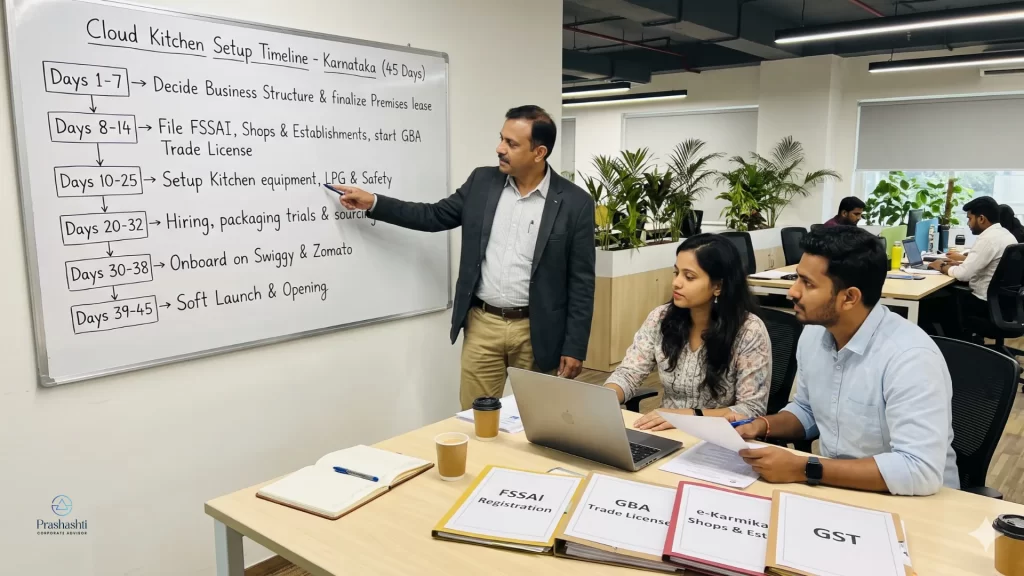
The trick is running tracks in parallel. Here’s an illustrative schedule, not a guaranteed approval timeline.
Days | What happens |
1 to 7 | Check premises, choose structure, collect documents |
8 to 14 | File FSSAI and Shops and Establishments, start trade license |
10 to 25 | Equipment, ventilation, LPG and safety set-up |
20 to 32 | Hiring, suppliers, packaging trials |
30 to 38 | Swiggy and Zomato onboarding |
39 to 45 | Soft launch, then public launch |
Authority processing and inspections are outside your control, so don’t take orders until your approvals are in.
Can You Run a Cloud Kitchen from Home in Karnataka? Home Kitchen vs Commercial Kitchen
A home-based cloud kitchen can work, but FSSAI registration doesn’t override zoning rules, your landlord’s terms or apartment association restrictions. Residential addresses can also make a trade license harder. Home saves rent while you test a concept, but space, storage and ventilation become a squeeze as orders grow. If you expect volume, a small commercial kitchen is usually the safer bet.
The PLATE Framework: Prashasthi Corporate Advisors license-Readiness Check
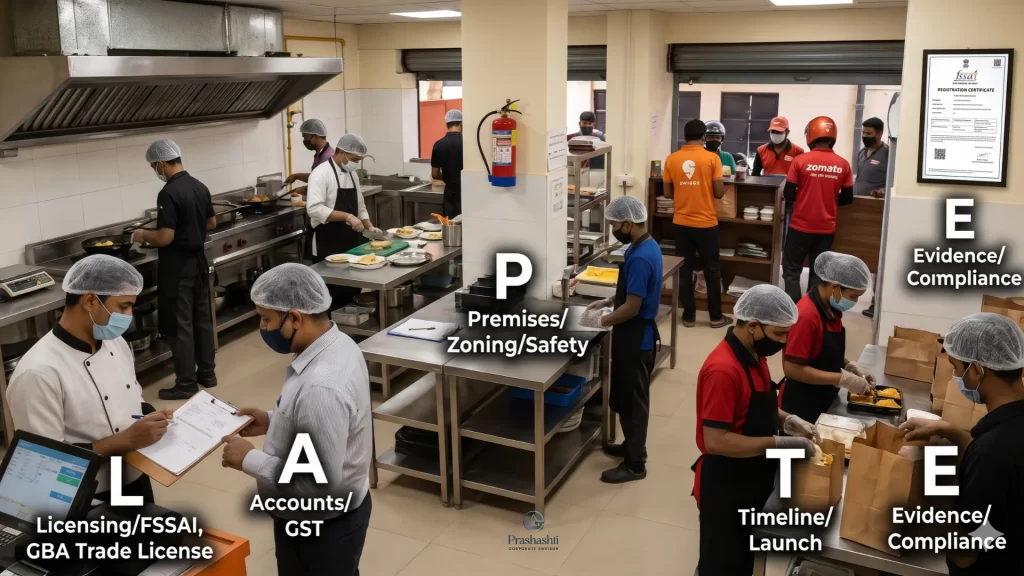
Over years of helping Bengaluru businesses with compliance, we’ve seen the same avoidable mistakes. So we use a simple check called PLATE before any food business signs a lease or files an application.
- P: Premises first. Confirm zoning, get the landlord’s written consent to commercial food use, and ask about fire and LPG approvals. Do this before paying a deposit.
- L: licenses in order. FSSAI first, since platforms and banks ask for it. Then trade license and Shops and Establishments, then GST if applicable.
- A: Accounts and tax. Pick your structure, open a business bank account and decide how GST applies to each sales channel.
- T: Timeline in parallel. Build the kitchen while applications are processed.
- E: Evidence and expiry. Keep copies of everything and set reminders. Your FSSAI is perpetual, but the trade license is not, and the GBA penalty doubles late fees.
Expert tips from our team: Many founders sign the lease first and discover later the landlord won’t give a trade license consent. Set a January reminder for trade license renewal. And don’t treat “perpetual” FSSAI as “no compliance”. For more on post-registration licenses, see our guide on business licenses after company registration in Bangalore.
Common Cloud Kitchen License and Registration Mistakes to Avoid
- Signing a lease before checking zoning and landlord consent.
- Applying under the wrong FSSAI category.
- Following guides that still point to BBMP or the ₹12 lakh limit.
- Assuming GST never applies to online food sales.
- Missing the February trade license renewal window.
- Buying expensive equipment before testing demand.
- Pricing the menu without platform charges.
Get Your Cloud Kitchen Licenses Sorted With Prashasthi
Starting a business is exciting — but the registration process? It can be overwhelming if you’re not prepared.
Did you know that over 30% of company registration applications in Bangalore get delayed due to incorrect or missing documentation?
According to data shared by professionals on CAclubIndia, founders often scramble last-minute to collect and verify their paperwork, costing them precious weeks in setup time.
In this blog, we break down the exact documents required for company registration in Bangalore, why each is needed, and how to prepare them correctly to ensure smooth and fast incorporation.
Whether you’re launching a Private Limited Company, LLP, or OPC, this guide will save you from delays, confusion, and potential rejection.