

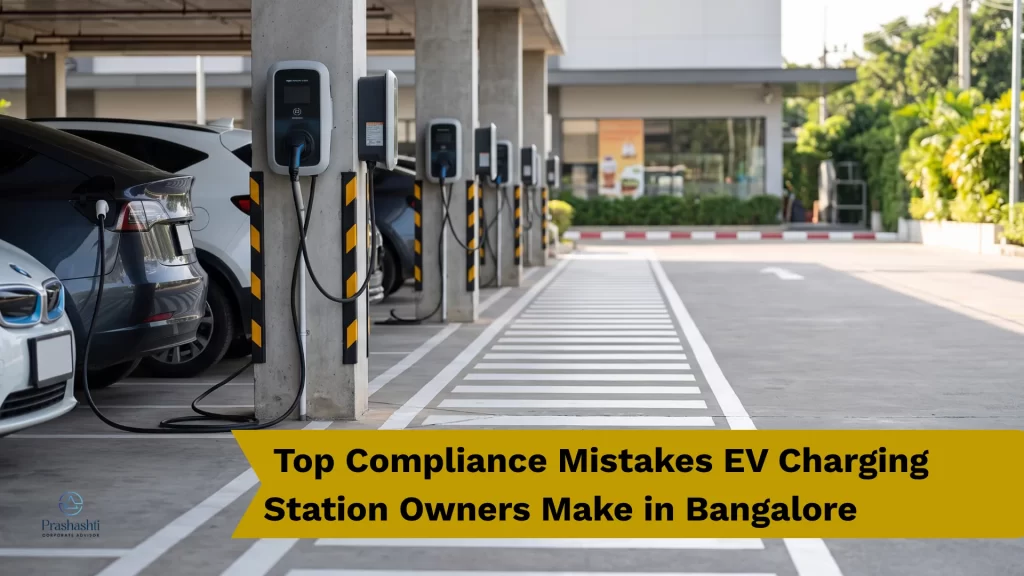
A lot of EV charging station plans in Bangalore start the same way. You find a “great” location. Good footfall, decent parking, rent that feels manageable. Everything looks perfect. So you go ahead, sign the lease, order the chargers, and start planning the launch.
And then reality hits you.
The building can’t handle the electrical load you need. The transformer capacity is insufficient. BESCOM approvals take longer than expected. Suddenly, what looked like a simple setup turns into extra civil work, higher costs, and months of delay.
This is exactly where EV charging compliance in Bangalore becomes important, but unfortunately, it’s also where most people start paying attention too late.
But instead, compliance should be part of your planning from day one. Not a checklist you rush through after investing all your money.
Between BESCOM requirements, transformer load planning, GST registration, Fire NOC, and basic company filings, there are several moving parts that can easily slow you down if missed early.
So, in this blog, we’ll take you through the most common compliance mistakes EV charging station owners make in Bangalore, and more importantly, how you can avoid them before they turn into expensive problems.
1. Not Checking Transformer Load Capacity Before Signing the Lease
A good location doesn’t automatically mean a good EV charging site.
Most operators first look at traffic, parking, rent, and visibility. The electrical side usually comes later, after the lease is already signed.
Always check the site’s existing sanctioned load, transformer capacity, and overall electrical setup. Then match it against what your chargers will actually need.
For example, a site planned for two 60 kW DC fast chargers is completely different from one running a few 7 kW AC chargers. And it’s not just about today’s setup, you also need to think about how many vehicles might charge at the same time, and whether you’ll expand later.
If the transformer or electrical system can’t handle the load, you’re looking at upgrades, load enhancement, or new infrastructure. That means more cost and delays before you even start operations.
That’s why not checking transformer load capacity before signing a lease is not just a technical miss. It can change the entire outcome of your business.
A proper site check should include:
- Existing sanctioned load.
- Transformer capacity.
- Proposed charger capacity.
- Expected simultaneous load.
- Scope for future expansion.
- Feasibility of new electricity connection.
The Ministry of Power’s 2024 EV charging guidelines also clearly talk about planning infrastructure in a way that supports the grid as EV demand grows. These apply across private, public, and highway charging setups.
Planning an EV charging station in Bangalore?
2. Missing BESCOM LT-6(c) Tariff Registration
Electricity is one of the biggest ongoing costs in an EV charging business, so getting the tariff right from day one really matters.
BESCOM’s own EV charging page confirms that KERC has notified a dedicated LT-6(c) tariff for EV charging stations. Many operators still treat the electricity connection like a normal commercial setup, or build their financial model on outdated assumptions.
That creates two real problems.
- First, your actual electricity cost may be very different from what you planned.
- Second, your connection and metering may not be correctly set up for EV charging use.
BESCOM guidelines also indicate that public charging stations require proper metering so consumption is recorded and billed under the correct EV tariff.
So, missing BESCOM LT-6(c) tariff registration is not just paperwork. Before commissioning, confirm:
- Correct tariff category.
- Connection type and approval.
- Metering arrangement.
- Applicable charges with BESCOM.

3. Launching the Station Without Assessing GST Requirements
Saying “no GST registration before launching” is often oversimplified.
The truth is that GST registration is determined by turnover, business structure and nature of supply. Some businesses will need GST from day one – others won’t, depending on how they run.
Before you start billing customers, you need to be clear on:
- Is registration under GST compulsory?
- How will charging sessions be accounted for?
- What will be the treatment of GST?
- What records do I need to maintain?
- Who is going to do the returns and reconciliation?
This is particularly important if you have many stations, fleet customers or app-based payments. For more details, see our guide on GST on EV Charging Station in India.

4. Starting the Business Without the Right Legal Structure
The chargers could be ready, but the business behind the chargers needs to be set up properly as well.
An EV charging business can be started as a proprietorship, partnership, LLP or a private limited company. For a broader overview, see EV Charging Station in India. Compliance, tax, and liability vary for each structure’s rules.
A common mistake people often make is choosing a structure quickly just to get started. It’s always better to decide the structure before signing major agreements.
For a growing EV charging business in Bangalore, you should think about:
- Ownership of the business.
- Investment structure.
- Liability exposure.
- Future investors.
- Number of planned stations.
- Funding requirements.
- Ongoing compliance load.
5. Not Filing Annual ROC Compliance After Incorporation
There are many founders who are busy running stations, managing vendors, and handling operations, and ROC filings get ignored in the background.
But companies still have necessary filings each year. This includes financial statements and annual returns filed with the Registrar of Companies, depending on the structure. Forms such as AOC-4, MGT-7/MGT-7A, etc., are usually necessary.
Not filing annual ROC compliance post-incorporation might lead to penalties, additional expenses, and legal troubles.
The simplest way to avoid this is to maintain a compliance calendar from day one. It should include:
- ROC filings
- Income tax requirements
- GST compliance (if applicable)
- Other statutory filings
6. Operating a Public Charging Station Without Checking Fire NOC Requirements
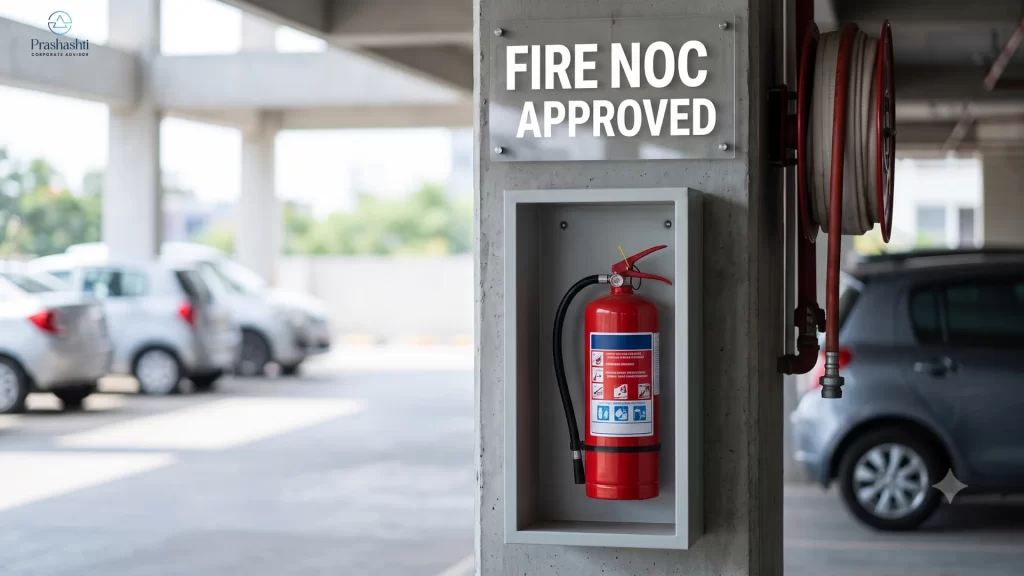
Not all EV charging stations will have a Fire NOC by default, but operating without a fire NOC in public spaces, assuming it doesn’t need one, is a dangerous mistake, especially in public or commercial locations.
Whether a Fire NOC applies depends on your site and building type. Interestingly, Karnataka’s official EV Vidyuth Sevegalu portal clarifies that BESCOM itself does not require an NOC to install chargers in an apartment’s individual parking lot, but a Fire Department NOC and CEA-compliant installation are still mandatory.
Public charging stations carry real risks: electrical equipment, parked cars, customers moving around, and emergency access routes. CEA safety regulations also call for fire-retardant materials and appropriate detection/alarm systems where applicable.
Check whether a fire NOC EV station requirement applies to your individual site before operating. For Bangalore-specific licensing requirements, see EV Charging Station License Bangalore. If it does, then finish it before going live.
Also make sure:
- Clear emergency access.
- Firefighting tools at hand.
- Charger installation is safe.
7. Signing a Lease Before Completing Regulatory Due Diligence
An EV charging site is a regulated operational setup. Before signing a lease, you need to confirm whether the property can actually support your plan or not.
At minimum, check:
- Electrical and transformer capacity.
- BESCOM connection feasibility.
- The application of the EV tariff.
- Leasing terms and approvals.
- Parking design .
- Fire protection measures.
- Access for customers.
- Space for future expansion.
- Electrical upgrade cost.
Plus, be sure to include EV charging and any required electrical maintenance in the lease.
A better sequence: Site shortlist → regulatory due diligence → electrical assessment → commercial evaluation → lease signing
8. Treating Electrical Safety as Just an Installation Detail
Buying a certified charger is just the beginning. The full installation includes earthing, protection systems, proper cabling, isolation, and overcurrent protection. All of this needs to be designed and tested properly.
Proper earthing and testing of equipment as per manufacturer instructions are also specified by CEA standards. Before commissioning, check the following:
- Installation is well tested.
- The safety systems are being tested.
- Test certifications can be provided.
- Test certificates are available.
- Records are documented.
Expert Insight from Prashasthi Corporate: For apartment and society charging setups, we usually recommend resolving the sanctioned-load question with BESCOM in writing before any wiring work starts. A verbal assurance from an electrician that there’s ‘enough power’ isn’t something you can fall back on later.
9. Ignoring Parking, Cable Management and Emergency Access
Even a perfectly installed charger can fail operationally if the layout is wrong. Think about real usage, cars arriving, parking, plugging in, and leaving. If cables are poorly placed, they can become a safety hazard.
Common issues include:
- Cables crossing walking paths.
- Chargers are prone to damage by vehicles.
- Emergency routes blocked.
- Complicated vehicle motion.
- Peak hour traffic jam.
10. Assuming Compliance Ends Once the Station Goes Live
EV charging stations need constant attention: maintenance, safety checks, tax issues, corporate filing, and regulation changes.
CEA regulations also require proper documentation of design, installation, testing, inspections, and maintenance records. These must be retained for several years.
That’s why EV charging station regulations in India are about your ongoing discipline. A simple system helps:
- Keep a digital compliance folder.
- Store all test reports and drawings.
- Maintain maintenance logs.
- Track inspections and updates.
And whenever you add new chargers, reassess the electrical load again.
A simple cycle works best:
Plan → Verify → Install → Test → Document → Operate → Maintain → Review
Which Authorities and Rules Apply to an EV Charging Station in Bangalore?
Three different authorities govern your station, and it helps to know who does what. The Ministry of Power’s Guidelines for Installation and Operation of EV Charging Infrastructure-2024 decide who can operate a station, set up EV charging is a de-licensed activity, and lay down timelines for your DISCOM to give you a connection.
The Central Electricity Authority decides how it must be wired, earthed, and tested. And BESCOM, under tariffs approved by KERC, decides your connection category (LT-6(c) for dedicated EV charging load) and what you pay per unit. Skipping any one of these three doesn’t just risk a fine; it can mean your station simply can’t legally operate the way you planned it.
Expert Insight from Prashasthi Corporate: The founders we see running into trouble almost always separate the electrical conversation from the legal one. They finalise the site on an electrician’s opinion of load, then come to us for compliance only after signing the lease, by which point the BESCOM connection category and business structure are much harder and costlier to fix.
EV Charging Compliance in Bangalore: Pre-Launch Checklist
Keep this as a CPO compliance checklist.
Before Signing the Lease
- Transformer capacity verified.
- Existing electrical load assessed.
- Proposed charger load calculated.
- BESCOM feasibility checked.
- Applicable tariff confirmed.
- Property use verified.
- Fire-safety requirements identified.
- Parking and access assessed.
- Future expansion considered.
Before Launch
- Business structure established.
- Applicable GST requirements addressed.
- BESCOM/electricity requirements completed.
- Electrical installation tested.
- Charger commissioning completed.
- Applicable Fire NOC/approval obtained.
- Billing system ready.
- Compliance documents organised.
After Launch
- GST compliance maintained where applicable.
- ROC calendar maintained where applicable.
- Electrical maintenance scheduled.
- Safety records maintained.
- Regulatory changes monitored.
- Documents updated after modifications.
The "Don't Sign Yet" Test We Use Before a Client Commits to a Site
Across the EV charging projects we’ve reviewed, the most common pre-lease issue has been: almost every EV charging compliance mess we get called in to fix started at the same moment, the lease got signed before anyone checked if the site could actually support the plan. So we built a simple habit around it, and we’re sharing it because it’s saved more than one client from a costly mistake.
Before you pay a deposit, ask these seven questions. If you can’t confidently answer two or more, hold off.
- Do we know the site’s sanctioned load, not just its “available power”?
- Has BESCOM confirmed feasibility for our charger capacity in writing?
- Do we know which tariff category we’ll be billed under?
- Do the lease terms allow the electrical modifications we’ll need?
- Do we know whether this site needs fire clearance?
- Is there room, physically and legally, to expand later?
- Have we priced in the electrical upgrade if #1 comes up short?
EV Charging Compliance in Bangalore: What to Check Before You Invest?
Before investing in a site, take time to verify all these things:
Area | What to verify |
Site | Property use, lease rights, access |
Electrical | Sanctioned load and transformer capacity. |
BESCOM | Connection and EV tariff category. |
Safety | Electrical protection and testing |
Fire | Site-specific Fire NOC requirements. |
Business | Legal structure and registration |
GST | Registration and invoicing needs. |
ROC | Ongoing company filings |
Parking | Safe movement of vehicles and people. |
Expansion | Future charger capacity. |
For a full setup walkthrough, see our related guide: EV Charging Station Guidelines in Bangalore: 2026 Rules.
Planning an EV charging station in Bangalore? Get the electrical, BESCOM, tax, legal, and fire safety checks done before you commit.
What Prashasthi Corporate Can Help You Get Right?
Setting up an EV charging station in Bangalore sounds easy until you actually get into the approvals and technical checks. And the tricky part is that each site is different, so what works in one location may not work in another.
That’s really what EV charging compliance in Bangalore comes down to. Getting all these pieces in place from the beginning and continuing to stay compliant as the setup expands or changes.
Prashasthi Corporate works with businesses on corporate advisory services in India, including EV charging station setups. If you’re planning a new station or even reviewing an existing one, it’s usually worth getting the compliance side checked early. This helps you to avoid delays, rework and unnecessary expenses later on.
Disclaimer: This article is for general informational purposes and reflects publicly available regulatory information as of August 2026.