

A business owner in Bangalore finds a good location, compares EV chargers, and is ready to invest. Then someone asks, “Have you applied for the EV charging station license in Bangalore?” Suddenly, everything comes to a stop. A quick online search only makes things more confusing. One website says you need a government license, another talks about CEIG approval, while someone else mentions Fire NOC and BESCOM. You know this way it’s easy to feel stuck before the project even begins.
The truth is, setting up an EV charging station isn’t about getting one single license. It’s about knowing what approvals genuinely apply to your project and doing them all right. If you’re still planning your project, it’s worth understanding the complete EV charging station guidelines in Bangalore before beginning the approval process.
In this guide, we will clear up common myths, tell you the latest regulatory regulations in Bangalore, take you through BESCOM approvals, CEIG requirements, safety standards, documents, fees and the compliance checklist you need before you open your charging station.
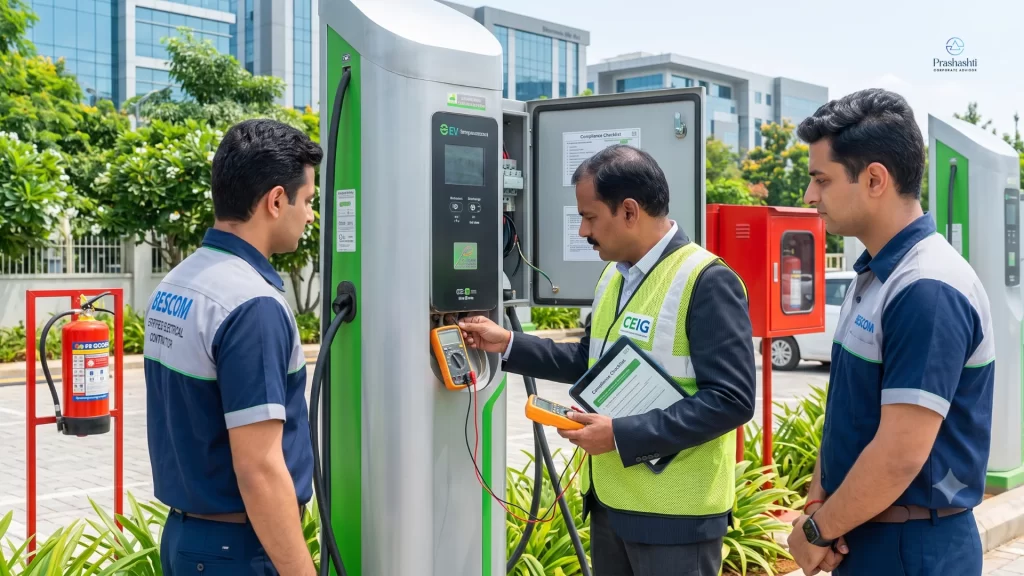
Myth vs Reality: Do You Really Need an EV Charging Station License in Bangalore?
If you’ve been looking into setting up an EV charging station, chances are you’ve come across the term “license” quite a few times.
Myth: Every EV Charging Station Needs a Government License
A lot of people assume that you need a special license just to run an EV charging station. That’s probably because we’re used to thinking of electricity as something tightly regulated, like power distribution companies. But EV charging doesn’t fall into that same category.
Reality: It’s More About Compliance Than a Single License
The Ministry of Power’s revised consolidated guidelines confirm that setting up a public charging station is a de-licensed activity. Any individual or entity can operate one without a distribution license, provided the station meets the technical, safety, and performance standards laid down by the Ministry of Power, the Bureau of Energy Efficiency (BEE), and the Central Electricity Authority (CEA). The Bureau of Energy Efficiency has also been designated the Central Nodal Agency for the EV public charging rollout.
Public vs Private Charging Stations
There’s also a difference between public and private setups.
Public charging stations are open to anyone. They often require a business electrical connection and have to keep up with certain tariff restrictions.
Private charging stations, apartments, offices, company grounds, are different, since they’re meant for internal use, and EV owners can charge at their residence or office using their existing connection without additional approvals under the Ministry of Power guidelines.
Common Regulatory Misconceptions
Here are a few things people often get wrong:
- Not every station needs CEIG approval for EV charging stations.
- A fire NOC EV charging station isn’t always mandatory.
- You can’t just install any charger you find online for commercial use.
- Home charging rules don’t apply to commercial setups.
Planning to set up an EV charging station?
EV Charging Station License in Bangalore: Regulatory Framework You Should Know
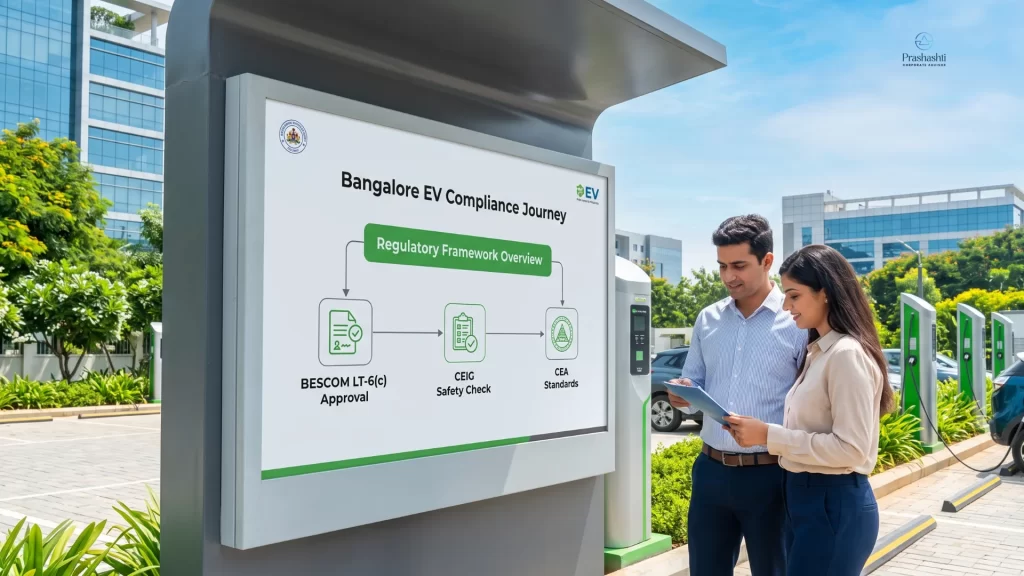
Setting up an EV charging station in Bangalore is not the job of a single authority. It’s more like a mix of different departments.
Ministry of Power Guidelines
At the national level, the Ministry of Power sets the overall direction. They’ve made it easier for private players to enter the EV charging space by removing the need for a distribution license.
Karnataka Clean Mobility Policy 2025-30
Karnataka has been proactive on EV adoption since its pioneering 2017 policy. That framework has now been replaced by the Clean Mobility Policy 2025-30, issued by the Karnataka Commerce and Industries Department and effective from February 11, 2025, for five years. It targets ₹50,000 crore in investment across the clean mobility value chain and includes direct incentives for charging infrastructure operators, not just manufacturers.
BESCOM’s Role
BESCOM is the one you’ll deal with for electricity. Whether you need a new connection or an upgrade in load, they handle it. If you’re planning a new installation, our guide on how to set up an EV charging station in India explains the overall process before you begin regulatory approvals.
If your current setup can’t support EV chargers, you’ll need a BESCOM EV charging approval before moving ahead. Bengaluru city LT connection requests (up to 150 kW) are targeted for completion within 7 days without right-of-way clearance, or 15 days if right-of-way is involved.
Karnataka Electricity Regulatory Commission (KERC)
KERC decides electricity tariffs. Your main running cost is energy; therefore it’s important to watch out for changes in rate.
BBMP & Local Clearances
Depending on your location, you may need approval for parking, use of the facility, or structural improvements.
Central Electricity Authority (CEA)
CEA is the national safety regulator. Its Measures Relating to Safety and Electric Supply Regulations set out the wiring, earthing, and maintenance requirements that apply to EV charging installations, and CEA has issued a specific EV charging safety schedule covering enclosure fire-retardance, protective earthing, and firefighting provisions.
Which Businesses Can Apply for an EV Charging Station License in Bangalore?
You don’t have to own a fuel station to get into this space anymore. In fact, a lot of different businesses can benefit from installing chargers:
- Hotels
- Shopping malls
- Apartment complexes
- Office campuses
- Hospitals
- Colleges and schools
- Fuel stations
- Independent commercial plots
The key is choosing a location where people actually need charging. And where you have enough space and electrical capacity to support it.
Complete Regulatory Checklist for an EV Charging Station License in Bangalore
Before you jump into installation, it helps to have a clear checklist.
Requirement | Authority |
Business registration | MCA / Local authority |
Property ownership or lease | Property owner |
Commercial electricity connection | BESCOM |
Sanctioned electrical load | BESCOM |
Transformer requirement (if applicable) | BESCOM |
CEIG inspection (where applicable) | Karnataka Electrical Inspectorate |
Fire safety compliance | Local Fire Authority (where applicable) |
GST registration | GST Department |
Accessibility and parking | Local authority |
Safety standards | CEA |
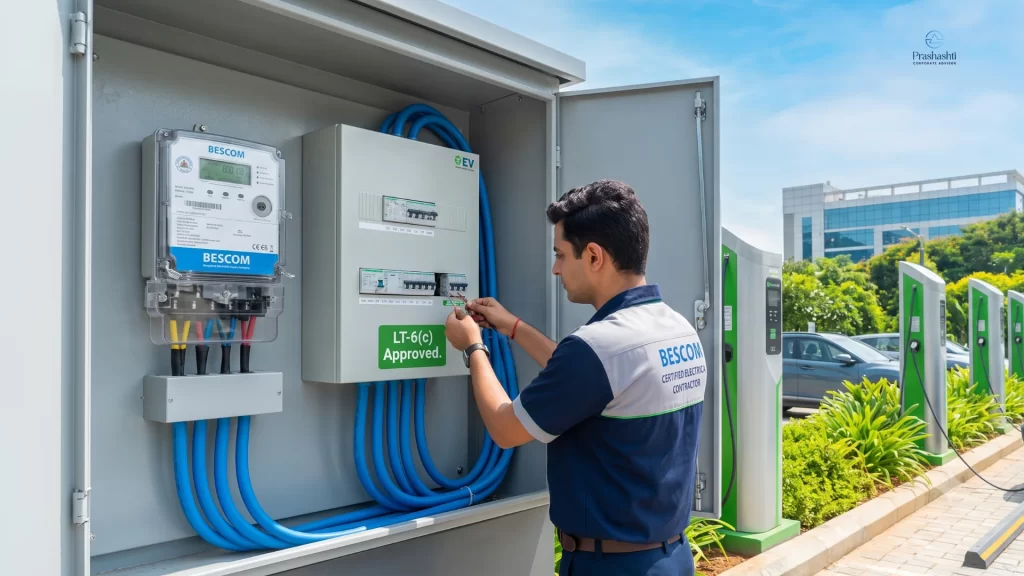
BESCOM EV Charging Approval: LT-6(c) Commercial Electricity Connection
For most setups, getting the electricity connection sorted is one of the first big steps.
Who Needs LT-6(c)?
If you’re running a public charging station and charging users, you’ll likely fall under the LT-6(c) tariff category.
Documents Required
You’ll typically need:
- PAN and ID proof.
- Business registration documents.
- Property ownership or lease papers.
- Load calculation details.
- Site layout.
- Single-line diagram.
- Charger specifications.
Online Application Process
New applications can be submitted online through BESCOM. Once you apply, they review your documents and see if your proposed load is possible.
Site Inspection
An engineer will visit your site to verify everything: layout, equipment placement, and electrical setup.
Meter Installation and Energization
Once approved, you pay the charges, get the meter installed, and your connection goes live.
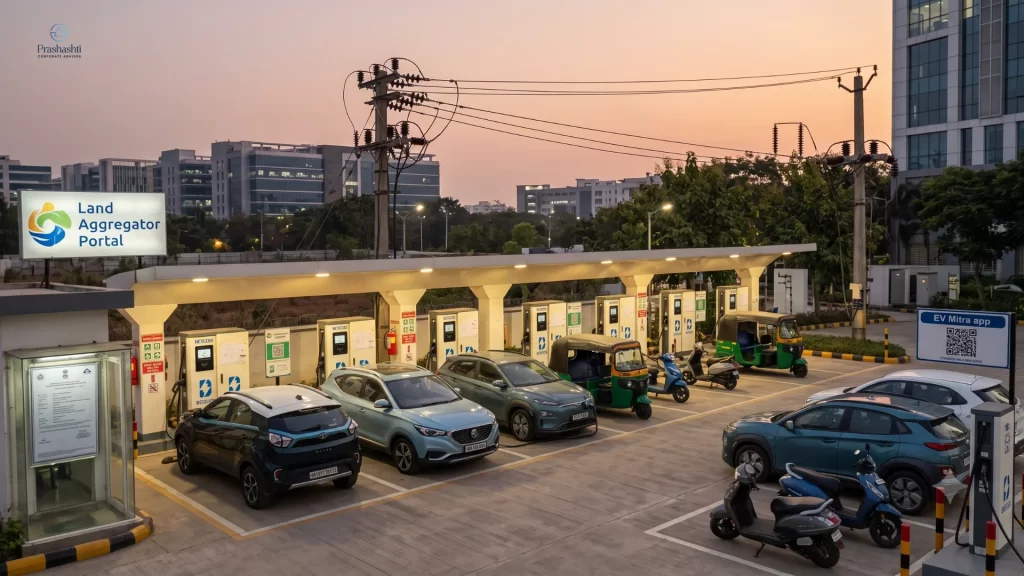
Also worth noting, Bangalore also has a Land Aggregator Portal that helps connect landowners with EV charging developers.
BESCOM Electricity Tariff for EV Charging Stations (Updated 2026)
Electricity is your largest recurring expense. The LT-6(c) price that covers public stations is revised periodically by KERC based on inputs such as fuel adjustment charges, GST changes and service-charge data from the EV Mitra app. Please confirm the live amount before modelling your business case as rates have changed more than once in the past two years and the May 2026 True-up Charge is added to the base rate.
Your bill usually includes:
- Energy charges
- Fixed charges
- Demand charges (if applicable)
- Taxes
Expert Insight: One pattern we consistently see in Bangalore is operators locking in a business model around a tariff figure quoted in an old blog post or a vendor’s pitch deck. Because LT-6(c) is a KERC-notified rate that has been revised multiple times in the last three years, and is now on a scheduled subsidy-reduction path, we always advise clients to build a margin buffer into their pricing rather than anchoring to whatever the current per-unit rate happens to be.
CEIG Approval EV Charging Station: When Is It Required?
CEIG is the abbreviation for Chief Electrical Inspector to Government. Not all projects need such permission. Usually it depends how big your system is and the kind of electrical infrastructure required.
Larger or high-capacity facilities are more likely to need an inspection. Typical documents are:
- Single-line diagram
- Equipment specs
- Earthing report
- Contractor license
- Test certificates
- Installation drawings
- Safety declaration
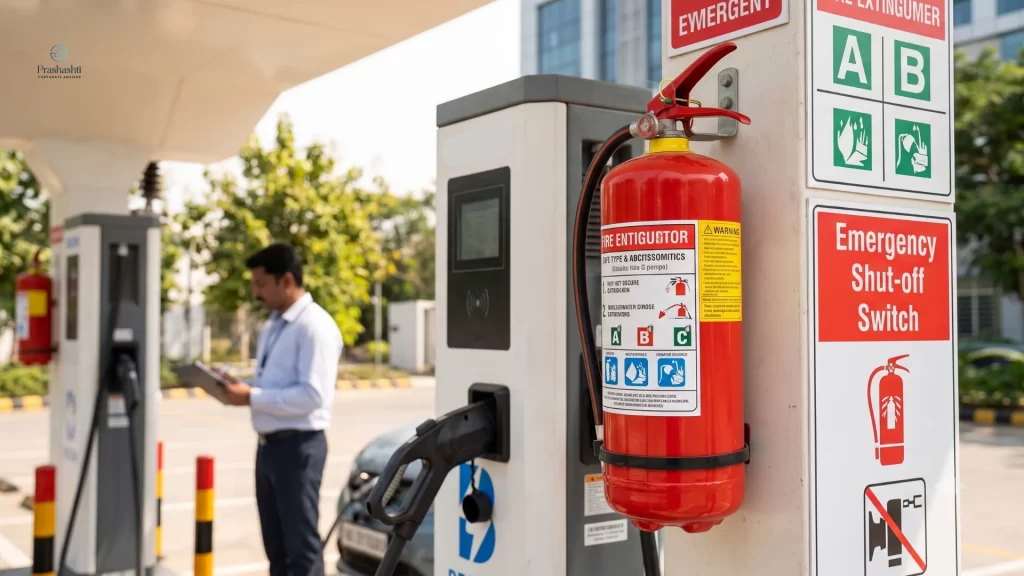
Fire NOC EV Charging Station: Do You Really Need One?
Not every charging station needs a Fire NOC. The type of building and local fire regulations are more the issue than the charger itself. That said, safety can never be taken lightly.
Minimum safety set-up should be:
Equipment | Purpose |
ABC Fire Extinguisher | General fire protection |
CO₂ Extinguisher | Electrical fires |
Emergency Shut-off Switch | Disconnect power quickly |
Smoke Detector | Early warning |
Warning Signage | User awareness |
Emergency Contact Display | Quick emergency response |
PPE Kit | Technician safety |
CEA Safety Guidelines Every EV Charging Station Must Follow
Some key things to get right:
- Proper earthing
- Correct cable sizing
- Circuit protection
- Surge protection
- Residual current protection
- Emergency shut-off systems
- Regular maintenance checks
Documents Required for an EV Charging Station License in Bangalore
Having your paperwork in order makes everything smoother. especially when you’re following the applicable EV charging station guidelines in Bangalore for commercial installations.
Document | Purpose |
PAN | Business identification |
Aadhaar | Identity verification |
GST Certificate | Tax registration |
Company Registration | Business proof |
Property Documents | Ownership verification |
Lease Agreement | Site authorisation |
Electrical Drawings | Technical review |
Load Application | Electricity connection |
Contractor Certificate | Installation compliance |
Equipment Certificates | Safety verification |
Why BIS Certification Matters for EV Charging Equipment?
s easy to go with cheaper chargers to save some upfront cost. But the equipment standard that truly governs EV charging hardware in India is IS 17017, produced by Bureau of Indian Standards in line with worldwide IEC 61851 and IEC 62196 standards. It has several sections that address general requirements, connector specifications, EMC compliance and communication standards. BIS-certified chargers offer you:
They will help in:
- Compliance with a legally recognised national standard.
- Better long-term reliability and easier maintenance.
- Interoperability with the wider charging network.
- Avoidance of compliance issues during inspection.
EV Charging Connector Types Explained
There are different charging connectors for different EVs, so be careful while choosing.
Connector | Vehicle Category | Common Use |
CCS2 | Passenger cars | DC fast charging |
Type 2 AC | Cars | AC charging |
GB/T | Commercial vehicles | Selected imported vehicles |
Bharat AC-001 | Two and three-wheelers | AC charging |
Bharat DC-001 | Older EV models | Legacy installations |
What Is OCPP and Why Is It Important?
OCPP (Open Charge Point Protocol) basically lets your charger talk to different software systems. Without it, you might get locked into one platform.
OCPP stands for flexibility, changing systems, remote usage monitoring and easier payment management. It also allows:
- Remote monitoring
- Online payments
- Software updates
- Usage tracking
- Fault alerts
Can Non-Compliant Chargers Affect Subsidies or Network Eligibility?
Yes. Using non-compliant equipment can lead to:
- Missing out on incentives.
- Trouble joining charging networks.
- Warranty issues.
- Software compatibility problems.
- Delays during inspections.
Land Selection & Karnataka Land Aggregator Portal
Location is very important. The Karnataka Land Aggregator Portal can help you to find suitable sites. When choosing a land, you should search for:
- Easy access from main roads
- Enough parking space
- Existing electrical setup
- Room for expansion
- Good visibility
- Nearby commercial activity
GST Registration, Tax Benefits & Incentives
If you are running a commercial charging station, you will have to register for a GST.
Depending on current government regulations there may be incentives available but these can change so always check the latest details.
Data: KERC’s own 2026 filings acknowledge that the LT-6(c) EV charging tariff is currently one of the most heavily cross-subsidised categories in the state, running at close to -49% below the average cost of supply. Under the Electricity Act’s cross-subsidy reduction mandate, and following a Karnataka High Court direction, KERC has notified a formal roadmap: starting FY 2028-29, the EV tariff’s subsidy gap will be narrowed by about 5 percentage points annually until it comes within the ±20% band that applies to most other categories.
Post-Installation: Compliance Requirements You Shouldn't Miss
Ongoing Obligation | Typical Frequency | Why It Matters |
Electrical safety re-inspection | Periodic, per CEA/CEIG norms | Keeps your installation compliant as equipment ages. |
Fire extinguisher servicing | Annual | Required for extinguishers to remain effective and for fire-safety compliance to hold. |
Contractor/electrical license renewal | As per license validity | An expired contractor license can invalidate future inspection sign-offs. |
Tariff and service-charge review | Whenever KERC issues a new order | Keeps your billing to customers within the regulator-approved ceiling. |
Usage/data reporting | As specified by CEA/DISCOM guidelines | Public charging stations are expected to report usage data to the DISCOM/CEA. |
Insurance review | Annual | Charging equipment, cabling, and public liability exposure change as usage scales. |
Expert Insight: Most compliance breakdowns we’re called in to fix aren’t at the approval stage, they happen 12-18 months after a station goes live, when a fire safety renewal or a contractor license lapses quietly and nobody notices until an inspection or an insurance claim. Building a compliance calendar into your operations from day one is far cheaper than fixing a lapse after the fact.
What is The Estimated Cost of Regulatory Compliance?
Apart from buying chargers, you’ll need to budget for:
- Application fees
- Electrical infrastructure
- Transformer (if required)
- Safety equipment
- Inspection charges
- Consultancy fees
- Documentation costs
Questions to Ask Before Choosing an EV Charger Vendor
Before you finalize a vendor, ask:
- Is the charger BIS certified?
- Does it support OCPP?
- Is installation included?
- What’s the warranty?
- Do you have local support?
- Can you help with CEIG documentation?
- Are spare parts available?
- Will there be software updates?
- Do you offer AMC?
Common Compliance Mistakes That Delay Approvals
A lot of delays happen because of simple mistakes:
- Choosing the wrong tariff category
- Incorrect load calculation
- Missing drawings
- Poor earthing
- Using non-certified chargers
- Ignoring fire safety
- Incomplete paperwork
Public vs Private EV Charging Stations: Regulatory Comparison
Requirement | Public Station | Private Station |
Electricity tariff | Commercial | Depends on usage |
BESCOM approval | Usually required | Depends on connection |
CEIG inspection | Project-specific | Project-specific |
Fire compliance | As applicable | As applicable |
GST | Business dependent | Usually not applicable for personal use |
Consolidated EV Charging Station Compliance Checklist India
Before you go live, run through this:
- Business registered
- BESCOM connection approved
- Sanctioned load confirmed
- CEIG requirement verified
- Fire safety completed
- Electrical drawings prepared
- BIS-certified charger installed (IS 17017)
- OCPP compatibility confirmed
- GST registration completed
- CEA safety compliance verified
- Clean Mobility Policy 2025-30 subsidy eligibility checked
- Post-installation compliance calendar set up
Ready to launch your EV charging station?
Need Help with EV Charging Station Approvals in Bangalore?
If you’re searching for how to start an EV charging station in Bangalore, one thing you’ll quickly realise is that there isn’t just one “license” you need to get. It’s more about handling a few different approvals and making sure everything is done the right way from the start.
You’ll need to deal with BESCOM for the power connection, follow CEIG guidelines for electrical safety, and make sure fire safety norms are in place. And on top of that, keeping your documents organized and up to date makes a huge impact in the flow of things.
It can seem a little difficult at first, but once you know what to do it’s not too bad. If you don’t want to go through all this by yourself, Prashasthi Corporate can help you sail through the procedure and keep it on track. They can help you in BESCOM approvals, CEIG/KSEI documentation, fire safety compliance and complete support for setting up your EV charging, making your approval procedure straightforward and stress-free.
Disclaimer: This article reflects publicly available regulatory information as of 2026 and is intended to help you understand the general compliance landscape for EV charging stations in Bangalore. It is not a substitute for professional legal, financial, or engineering advice, and it does not guarantee approval, subsidy eligibility, or compliance outcomes for any specific project.




Pingback: EV Charging Compliance Bangalore: 10 Mistakes to Avoid