

Last winter, a man driving an electric car from Pune to Nashik had to stop at three different places just to find one working charger. One station was offline. Another had a long queue. The third finally worked, but by then he had already wasted almost two hours sitting inside his car searching for charging apps again and again.
That is still the reality in many parts of India.
Electric vehicles are increasing fast, but the charging infrastructure is still struggling to catch up. And the numbers paint an awful picture. India’s network of public charging stations rose from roughly 6,586 in early 2023 to more than 29,000 by mid-2025, a fourfold increase in only two years. But the country is probably going to need 3.9 million charging outlets by 2030 to keep pace with projected EV growth.
That gap is exactly why more businesses are now trying to register EV charging stations in India and enter this growing market. But once people start researching, another problem appears. The information online feels confusing, outdated, or too technical.
This blog will talk about how to start an EV charging station, including the steps needed to get it approved, how much they cost, franchise possibilities, how much money you’ll need to start.
Why Do More People Want to Register EV Charging Stations in India Today?
Five years ago, finding an EV charging station outside a few metro cities was difficult. Even now, many areas still don’t have enough public chargers.
But EV sales keep increasing.
Delivery companies are using electric scooters because fuel costs are expensive. Apartment owners are asking for charging facilities. Cab operators are slowly shifting toward electric vehicles. Even people buying personal cars now ask one question before purchasing:
“Where will I charge it?”
That is exactly why the EV charging station business is growing.
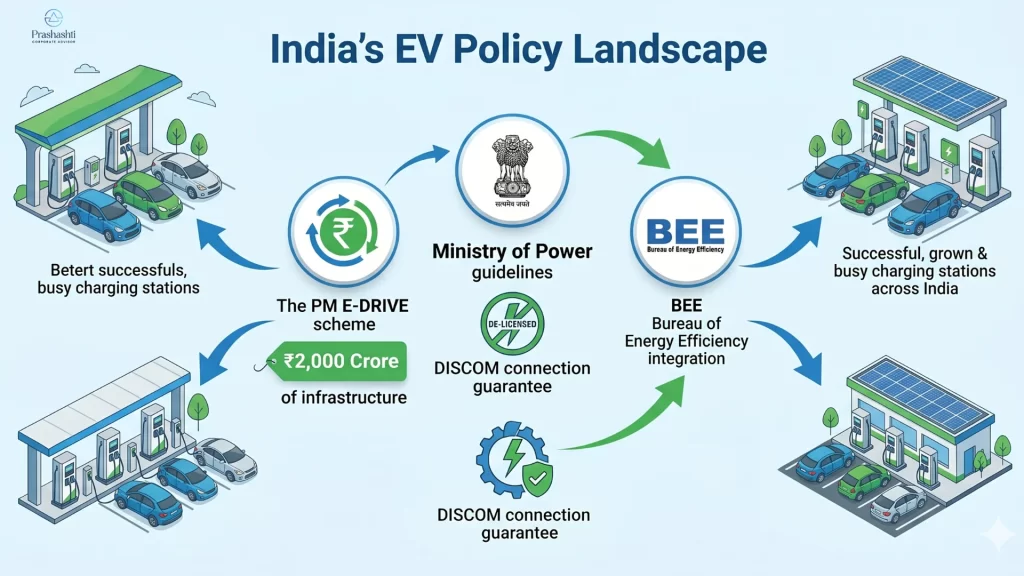
The government is also pushing EV infrastructure through different policies and subsidy programs. The government’s PM E-DRIVE initiative, launched in October 2024, has allotted ₹10,900 crore for electric mobility, out of which ₹2,000 crore is for EV public charging infrastructure, with an objective to set up around 72,000 charging stations across the country. These are being deployed on 50 national highway routes and high traffic places, including metro stations, airports, railway stations, and fuel outlets.
But honestly, the real reason behind the growth is simple: people need charging points nearby. Without charging infrastructure, EV adoption slows down, which is why many entrepreneurs are now exploring company registration in Bangalore before entering the EV infrastructure business.
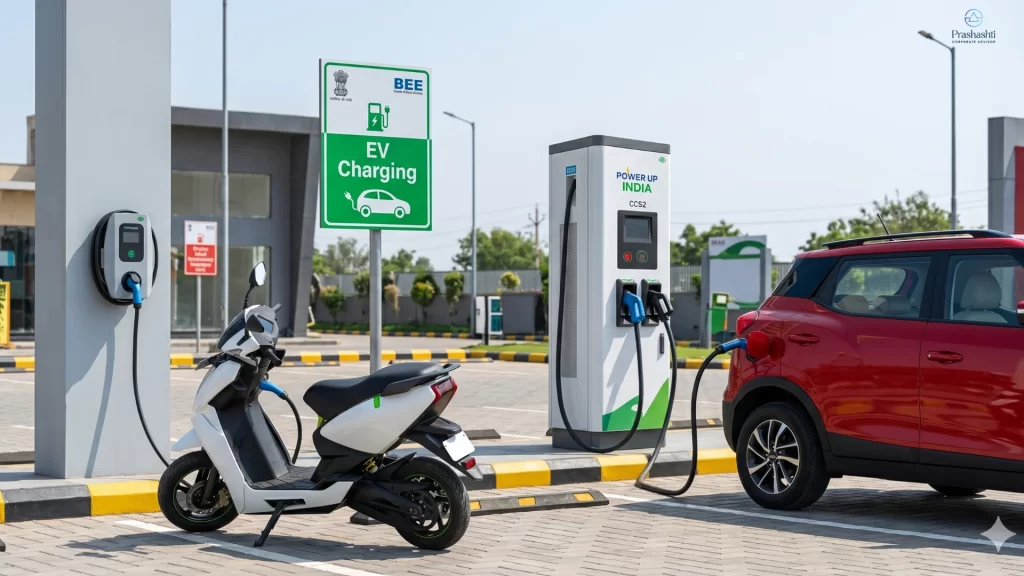
Who Can Register an EV Charging Station in India and Enter This Business?
This surprises many people, but you do not need to own a massive company to enter this business.
A charging station can be started by:
- Small business owners.
- Startups.
- Hotel owners.
- Fuel station operators.
- Mall owners.
- Parking space owners.
- Apartment developers.
- Even individual entrepreneurs.
Is a License Required?
For public charging of electric vehicles, the government has already said that this is not a licensed business.
But that does not mean you can simply install a charger and start operating the next day.
- Electricity approvals are still needed.
- Safety standards still apply.
- Commercial permissions may also be required depending on where the station is being installed.
What Policies Should You Understand Before Starting an EV Charging Station in India?
Planning to start an EV charging station business in India?
If you want to register an EV charging station in India, the policy side matters as much as the charger itself. Many people skip this part and end up spending more than they planned.
PM E-DRIVE Scheme
- Supports public charging stations.
- If you qualify, it can save you a lot of money on your project.
- Covers places like highways, malls, fuel outlets, and government sites.
You can find the operational guidelines for the deployment of EV Public Charging Stations (EV PCS) under the PM E-DRIVE Scheme here.
Ministry of Power Guidelines
- EV charging is de-licensed
- DISCOMs must support approved connections
- Chargers must follow BIS and NABL testing rules
- UPI and digital payments are required
Here are the guidelines for installing and operating EVCIs.
BEE’s Role
BEE manages the national charging database and the EV Yatra platform. That means your station should be listed properly so users can find it.
Step-by-Step Process to Register an EV Charging Station in India
Here are the important EV charging station requirements in India that you need:
Step 1: Decide What Type of Charging Station You Want
If you’re setting up inside apartments, cafés, or office spaces, an AC charger usually makes more sense. Cars stay parked longer there anyway, so slower charging is not a big problem.
But highway routes and busy commercial areas are different. People want quick charging and less waiting time. That’s where DC fast chargers work better.
Some businesses are also choosing battery swapping setups now, especially for delivery riders and e-rickshaws. Instead of charging, riders simply swap the battery and leave within minutes.
The important thing is matching the charger to the area. A costly fast charger in a low-demand area may sit empty most of the day.
Step 2: Choose the Location Carefully
This business depends heavily on location. A charging station hidden inside a low-traffic area usually struggles, even if the setup looks good. Meanwhile, a small charging point near apartments or office clusters may stay busy daily. Many businesses also take support from professional corporate advisory services in India while evaluating project feasibility and infrastructure planning. Before finalizing a location, people usually check:
- EV movement nearby.
- Parking availability.
- Electricity access.
- Nearby residential or commercial buildings.
- Visibility from the road.
Step 3: Apply for Electricity Connection
EV chargers, especially fast chargers, need a proper electrical support. You’ll have to apply through the local DISCOM for a commercial connection and sanctioned power load.
In some setups, transformer upgrades may also be needed. That increases both cost and waiting time. This is exactly why you should plan electricity first and buy chargers later.
Expert Insight: If your local DISCOM (Electricity Board) is taking more time than the stipulated period to process your application, without any acceptable technical cause, you can now register a complaint with the Consumer Grievance Redressal Forum (CGRF) under the Electricity (Rights of Consumers) Rules, 2024.
Step 4: Complete the Required Approvals
To register an EV charging station in India, you need some permissions. If the chargers are to be put indoors:
- Shopping malls
- Office buildings
- Commercial parking lots
- Apartment buildings
You’ll likely require the property management’s approval first.
If the installation is larger, fire safety assessments may also be required. Some local authorities may require additional electrical or commercial permissions.
Step 5: Install the Chargers Properly
A cheaper charger may save money initially, but constant downtime, failed payments, or charging errors usually frustrate customers very quickly. That is why most businesses now prefer certified chargers with:
- Bharat DC standards
- CCS2 support
- OCPP compatibility
- App-based monitoring systems.
Clean wiring, proper safety systems, and stable software make the station feel reliable for everyday users.
Step 6: Make Your Station Visible Online
Once the station is ready, people should actually be able to find it.
Most EV drivers check charging applications or Google Maps before they stop. That’s why station owners often post their charges on EV platforms and network apps.
Features such as QR payments and mobile booking and live charging status further enhance customer experience and drive repeat usage.
Documents Required To Register for an EV Charging Station in India
Usually, the required documents include:
- Aadhaar card.
- PAN card.
- GST registration.
- Property ownership or rental agreement.
- Electricity documents.
- Business registration certificate.
What Are The EV Charging Stations’ Costs in India?
One of the biggest reasons people hesitate to enter this sector is uncertainty around investment.
The truth is, EV charging station costs can vary massively.
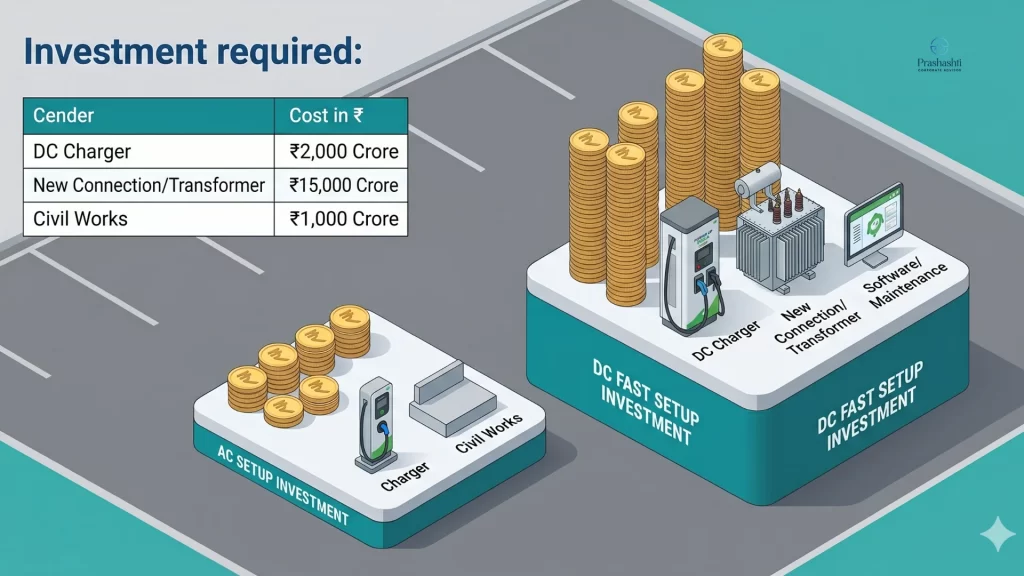
A small AC charger setup for apartments or cafés may start around ₹1.5 lakh to ₹5 lakh.
But commercial fast-charging stations are completely different. A proper DC fast-charging setup can easily go beyond ₹20 lakh or even ₹50 lakh, depending on infrastructure requirements.
And honestly, the charger itself is not always the biggest expense.
People often forget costs like:
- Transformer upgrades
- Civil work
- Parking setup
- Software systems
- Maintenance
- Internet connectivity
- Electricity deposit charges
Cost breakdown table:
Component | Estimated Cost (AC Setup) | Estimated Cost (DC Fast) |
Charger Hardware | ₹1.5 Lakh – ₹4 Lakh | ₹8 Lakh – ₹15 Lakh |
New Connection / Load | ₹50,000 – ₹1 Lakh | ₹2 Lakh – ₹5 Lakh |
Civil & Electrical Work | ₹30,000 – ₹70,000 | ₹1.5 Lakh – ₹3 Lakh |
Annual Software/Maintenance | ₹10,000 – ₹25,000 | ₹50,000 – ₹1.2 Lakh |
TOTAL INITIAL CAPEX | ~₹2.5 Lakh – ₹6 Lakh | ~₹12 Lakh – ₹25 Lakh+ |
Many operators also consult experienced tax consultants in Bangalore while planning long-term taxation and operational compliance.
EV Charging Station Franchise Opportunities
A lot of beginners now prefer an EV charging station franchise instead of starting alone. It is safe because all of the work is usually handled by the parent company.
Brands like Tata Power EZ Charge, Statiq, ChargeZone, and Jio-bp pulse already have growing charging networks in India.
An EV franchise may provide:
- Charger installation support.
- Software systems.
- Branding.
- App integration.
- Maintenance support.
But franchise models are not automatically better. Some companies offer strong support. Others mainly focus on expansion numbers while operational support remains weak.
That is why you should study:
- Revenue sharing
- Maintenance responsibility
- Service response time
- Hidden charges
- Contract terms
Is It Beneficial to Register An EV Charging Station in India in 2026?
Yes, it can be. But not every charging station becomes profitable quickly. This is not the kind of business where money starts flowing from day one.
In many places, EV adoption is still growing slowly. Some charging stations remain underused during the first year. But stations located near:
- Highways
- EV fleet hubs
- Apartments
- Office spaces
usually perform better over time. Many operators also earn through additional services like cafés, parking, or retail partnerships.
Which EV Charging Standards Are Mandatory in India in 2026?
Here are the main connectors used in India:
Connector Type | Common Usage | Power Range | 2026 Status |
Bharat AC-001 | 2W & 3W charging | Up to 10 kW | Common for e-rickshaw hubs |
Bharat DC-001 | Fleet & low-voltage EVs | Up to 15 kW | Used in fleet depots |
Type 2 AC | Residential & semi-public charging | Up to 22 kW | Widely accepted |
CCS2 | Fast charging for modern EV cars | 50–500 kW | Mandatory for highways |
CHAdeMO | Older imported EVs | Varies | Slowly being phased out |
What Are the Common Challenges Faced By People While Registering an EV Charging Station in India?
Some of the common challenges are :
- High upfront investment.
- Charger downtime.
- Slow electricity approvals.
- Maintenance issues.
- Low EV traffic in smaller towns.
Competition is also increasing in bigger cities now. That is why blindly copying someone else’s business model rarely works.
Final Thoughts on How To Register an EV Charging Station in India
The EV market in India is clearly moving forward. More electric vehicles are coming onto the roads every year, but charging stations are still limited in many areas. That gap is exactly why many people now want to register EV charging stations in India and explore the business early.
But this is not the kind of business where things work on guesswork. A good location, proper power planning, and the right charger setup matter much more than trends or social media hype. Even a small setup can work well if it is planned properly.
Then there are people who require help with registrations, approvals or business start-up. Companies such as Prashasthi Corporate Services are already helping businesses manage these processes in a simpler and more practical way.




Pingback: EV Charging Station Guidelines in Bangalore: 2026 Rules
Pingback: EV Charging Station License Bangalore: 2026 Approval Guide
Pingback: GST on EV Charging Station India: Rates, ITC & Rules
Pingback: EV Charging Compliance Bangalore: 10 Mistakes to Avoid