

Many love a business name, but don’t verify their right to use it. Some of them start the company after purchasing the domain name and developing a logo and packages. And then the surprise comes: there’s already a brand that sounds like theirs, and they are being asked to modify the name they’ve been creating their whole business around.
People do this all the time but it’s incredibly easy to avoid. Before you spend money on branding or file an application, try a trademark checker in India. Just take a moment. Checking whether the name or picture you desire has already been registered will help you decide if it is worth going ahead with your application and if there are any complications that could arise from a similar trademark.
This simple check will save you problems, delays, legal complications and the expense of starting afresh with a new brand name.
We’ll show you how to use the official IP India Public Search site to see if a trademark is available, how to read the search results, how to pick the right trademark classes, and what to do before and after you file your trademark application.
According to the latest figures on filing activity from around the world from the World Intellectual Property Organization, India’s trademark applications grew 7.4% in 2024, second only to Brazil. India has now become the fourth largest source of origin for trademarks with about 532,900 applications being lodged in a year.
What Is a Trademark Checker in India?
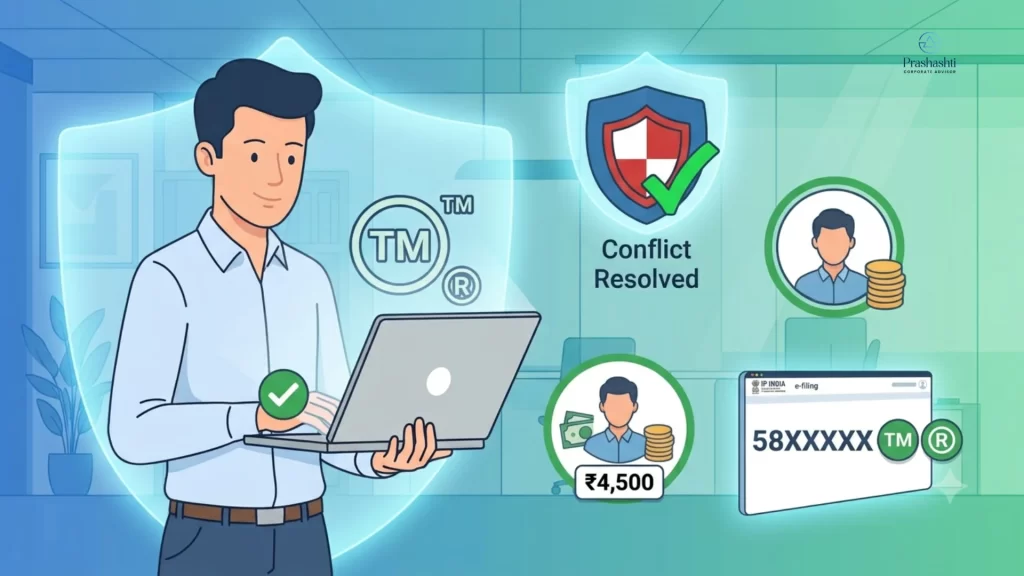
A trademark checker is an online-based tool which allows you to search for existing trademarks in India. The data is obtained from the official records of the CGPDTM (Controller General of Patents, Designs, and Trade Marks) and is available in the public search engine IP India, the official portal of the Government of India’s Department for Promotion of Industry and Internal Trade, Ministry of Commerce and Industry.
The idea is simple: make sure your brand name, logo or phrase is not already registered or applied for.
Let’s say you’re planning to start a clothing brand called “Urban Nest.” Before filing anything, you can search that name and see if someone else has already registered it (or something very similar) in the same category.
Now, just to be clear, a trademark search doesn’t guarantee approval. But it gives you a pretty good idea of where you stand and helps you avoid obvious conflicts.
Why Is a Trademark Search Important?
A lot of first-time founders think checking a company name or domain availability is enough. But it’s not.
You can register a company name and still run into trouble if someone else owns the trademark for a similar brand. These are two different things legally. Doing a proper trademark search helps you:
- Avoid unnecessary objections during the application process.
- Stay clear of legal disputes later.
- Save money by not filing weak applications.
- Build a brand that’s actually protectable.
A real-world example worth knowing: in March 2026, the Delhi High Court closed out a 20-year trademark dispute between Lacoste and Crocodile International, ruling that Crocodile International’s mirror-image crocodile logo infringed Lacoste’s mark and copyright, and ordered an accounting of profits dating back to 1998 (ICLG, Trade Mark Laws and Regulations 2026 – India Chapter). Twenty years of litigation is the extreme end of what an avoidable name collision can cost. It’s also a useful reminder that even a logo that just “looks similar”, not identical, can be found infringing.
Types of Searches Available in a Trademark Checker in India
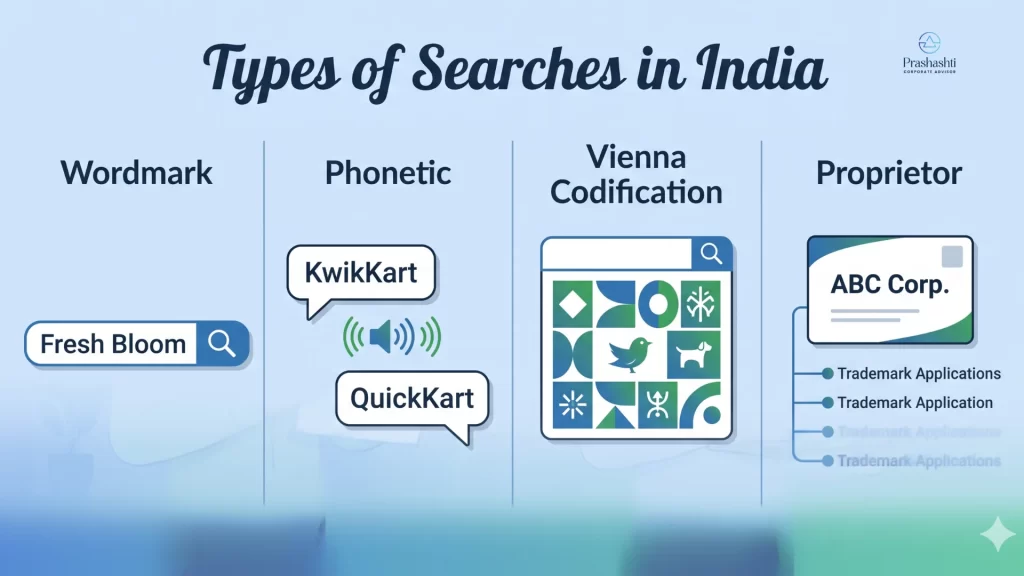
When you go to the official search portal, you’ll see a few different options. Each one serves a slightly different purpose depending on what you’re trying to register.
Wordmark Search
It checks the exact words in your brand name. So if your brand is “Fresh Bloom,” this search will show you trademarks with the same or similar wording.
Phonetic Search
Sometimes names look different but sound almost the same, and that can still create problems for you.
For example, “KwikKart” and “QuickKart” are spelled differently, but they sound the same. From a trademark perspective, that can create confusion.
Wordmark vs Device Mark
When you apply for a trademark, you’ll need to decide what exactly you want to protect.
A wordmark protects just the name, no matter how it’s styled. A device mark protects the logo or design. Most businesses eventually go for both, but if you’re starting out, many people begin with a wordmark.
Vienna Codification (Logo Search)
If you’re registering a logo, you can’t just search by words. That’s where Vienna codification comes in. It classifies logos based on visual elements, like animals, shapes, symbols, etc. So even if two logos that don’t look identical, similar elements will still be flagged.
Proprietor Name Search
This one is useful if you want to check what trademarks a particular person or company owns.
Understanding Trademark Classes Before Using a Trademark Checker in India
Before you begin your search, you need to know which category your company belongs to. India is now using the Nice Classification technique which classifies trademarks into 45 classes, now in its 13th Edition, which is effective from January 1, 2026.
- Classes 1-34 are for goods.
- Classes 35-45 are for services.
Here are a few examples:
Business | Trademark Class |
Clothing | 25 |
Cosmetics | 3 |
Restaurant Services | 43 |
Advertising | 35 |
Software Development | 42 |
Choosing the right class is important because your trademark protection only applies to the class you register in.
Expert Insight: The Nice 13 amendment changed certain products and services headings, and in particular, software-adjacent businesses are now re-examining whether their offerings still fall neatly into one class, or are now in between two. If you have not done a trademark search since January 2026, you should perform it again with the updated class descriptions.
Ready to file your trademark application?
How to Check Trademark Availability Using a Trademark Checker in India?
The process is pretty straightforward once you know what to do.
- Go to the official IP India Trademark Public Search portal at tmrsearch.ipindia.gov.in. This is the live search tool maintained by the CGPDTM.
- Enter the captcha, then choose the type of search you want to run: Wordmark, Phonetic, Vienna Code, or Proprietor Name.
- Choose the right trademark class for your business. If you’re unsure, verify it on IP India’s classification tool first rather than guessing.
- Type in your brand name and run the search.
- Review the list of results. You’ll see the application number, owner name, class, and current status for each similar or identical mark.
- Look past exact matches. Pay close attention to similar spellings, similar sounds, and whether competing marks fall in the same class as yours.
- Cross-check the well-known marks list (covered below) separately, it won’t always surface in a standard wordmark search.
How to Read Trademark Search Results?
Just because you see similar trademarks doesn’t automatically mean you’re in trouble. Each result comes with a status, and that matters a lot, too.
- Registered: This one is active and protected. You need to be careful here.
- Objected: The registry has raised concerns, but it’s not been rejected yet.
- Objection: Someone has objected to the application.
- Abandoned / Withdrawn: These are no longer active but are still worth a look.
If your trademark search tool shows “No Results Found,” that’s a good sign, but there’s no guarantee. Similar names or logos might still come up during examination.
What to Do If Your Trademark Is Taken?
If you find a similar kind of trademark, don’t panic.
- First, check its status. If it’s abandoned, it might not be an issue.
- Next, look at the class and the type of business. If it’s in a completely different industry, there may not be a conflict.
- But if the name is very similar and in the same class, it’s usually better to rethink your brand name early rather than to deal with rejection later.
Expert Insight: Most of the trademark queries we get from founders come after they’ve already invested in branding; by then, the options are limited to damage control rather than prevention. The compliance instinct that protects a business on the tax consultants side and registration side applies just as directly here: a fifteen-minute search and a correctly chosen class, done before you spend a rupee on packaging or a domain, is the cheapest insurance a growing business can buy
How to File a Trademark After a Search?
Once you’re reasonably confident about your trademark, you can move ahead with filing your TM application.
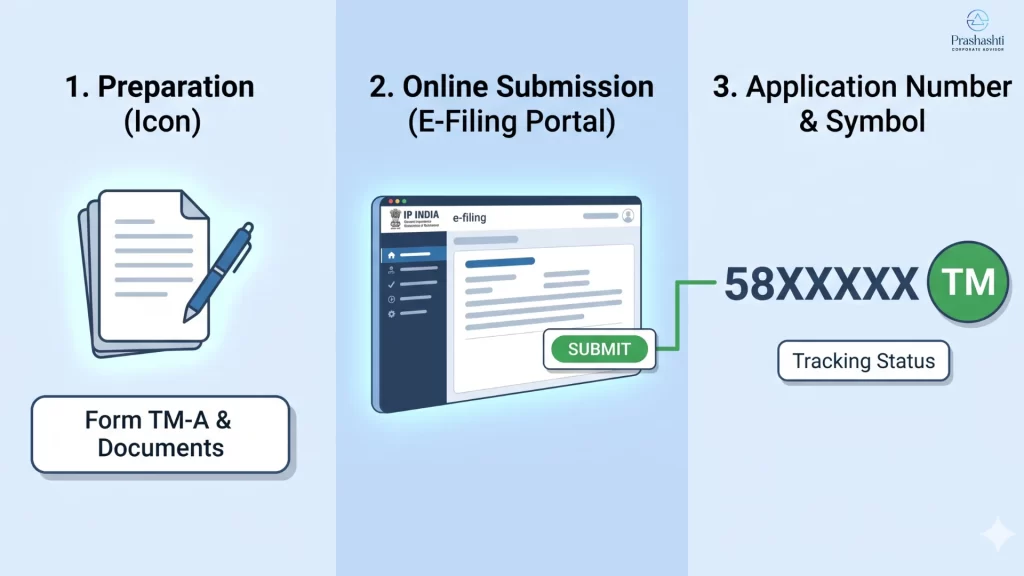
This includes choosing the right class, preparing your documentation, and online submission of the application (via Form TM-A through the IP India e-filing portal).
The point is to understand that even tiny faults in the application might create delays.
Once you file, you will get an application number that may be used for tracking the status of your trademark. Your priority date is locked in from this moment, and you can start using the ™ symbol immediately, even though the ® symbol is legally reserved for marks that have completed full registration.
Trademark Objection After Filing: What Happens Next?
You can still get an objection, even if you’ve done everything perfectly.
This usually occurs when the examiner finds similarities to existing trademarks, or considers your mark lacks distinctiveness.
An objection isn’t the end of the road. You can respond with a proper explanation; this is called a trademark objection response.
Just make sure you respond within the deadline. Missing it can lead to your application being abandoned.
TM Registration Timeline & Cost in India
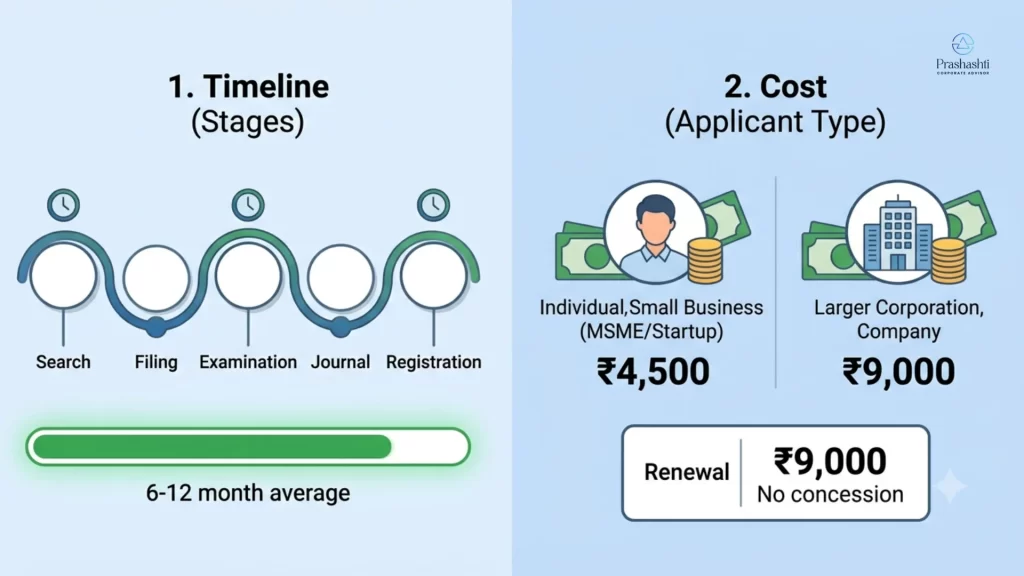
A lot of people ask about the TM registration timeline & cost. Here’s a current, government-fee-accurate picture:
Stage | Estimated Time |
Trademark Search | Same Day |
Filing Application | 1 Day |
Examination | 1-3 Months |
Journal Publication | 4-6 Months or more |
Registration (If Unopposed) | 6-12 Months or longer |
Official government filing fees, prescribed under the First Schedule of the Trade Marks Rules, 2017:
Applicant Type | E-Filing Fee (per class) |
Individuals, DPIIT-recognised startups, Udyam-registered MSMEs. | ₹4,500 |
Companies, LLPs, and other entities. | ₹9,000 |
Physical (offline) filing costs roughly ₹500 more per class than e-filing in each category. These are official IP India statutory fees, not professional service fees, and they are charged per class, per application; filing in three classes means paying the fee three times. This concession requires you to hold a valid DPIIT startup certificate or Udyam MSME registration certificate at the time of filing, not applied for after the fact (IP India, Forms & Official Fees).
Once registered, a trademark is valid for 10 years and renewable indefinitely in 10-year blocks. Renewal carries a fee of ₹9,000 per class, regardless of the applicant type; the startup/MSME concession does not apply to renewals.
Common Mistakes to Avoid During a Trademark Search
Some errors that can be avoided include:
- Looking for exact matches.
- Ignoring the names that sound alike.
- Choosing the wrong class.
- Relying only on Google or domain checks.
- Skipping logo searches.
- Assuming company registration gives trademark rights.
Expert Tips to Improve Your Trademark Registration Chances
- Try to choose a unique and creative name instead of something generic or descriptive; it’s easier to register.
- Search in multiple classes if needed. Always do both wordmark and phonetic searches. And if you have a logo, don’t forget to check that too.
- Confirm your DPIIT or Udyam certificate is active and in hand before you file; if you’re relying on the concessional fee, it cannot be claimed retroactively.
- If you’re unsure about anything, it’s always better to get corporate advisory services
There might be some issues with your search results that could be detected by a trademark expert to help you decide on the right action. The people team at Prashasthi Corporate can help you understand what you need to do to search for and file your trademark, so you can be more sure when you file it.
Trademark Checker in India: Final Thoughts with Prashasthi Corporate
Seeking help from a trademark checker in India is a small step, but it can save you from bigger trouble later. When you check the right class, compare similar names, and review logo matches too, you lower the risk of objections and wasted filing effort. It also makes your TM application feel much more solid. If anything still looks confusing, there is another way you can choose. For businesses that want support or help with the search and filing process, Prashasthi Corporate is one place you can turn to for trade license renewal and trademark compliance. They can help you to know how the whole process is done and make it easy for you to register your trademark.
Disclaimer: This article is for general informational purposes and does not constitute legal advice. Trademark fee schedules, classification editions, and procedural rules are subject to government notification and amendment. For advice specific to your filing situation, consult a registered trademark agent.


Pingback: Difference Between Trademark, Patent and Copyright in India