

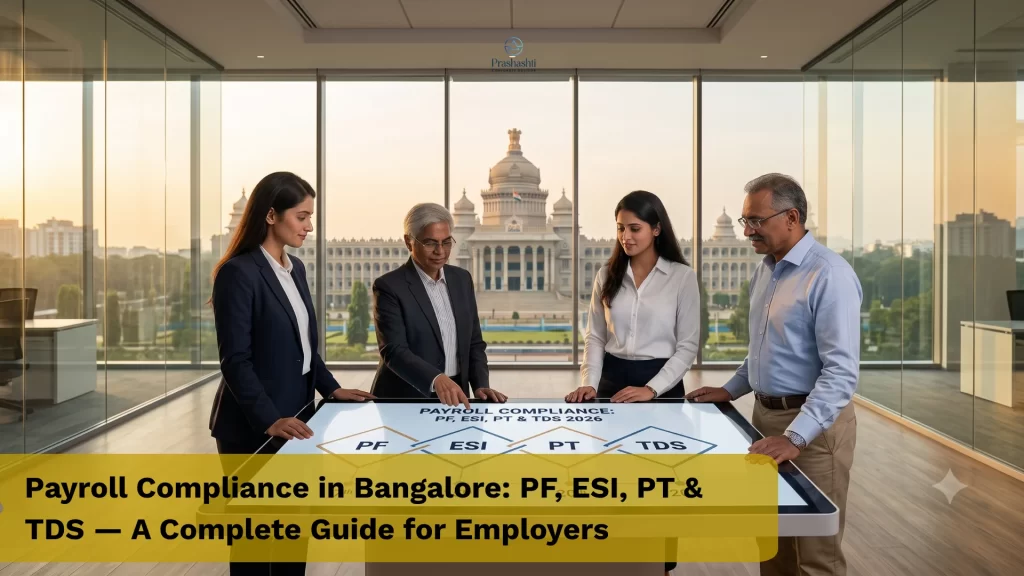
Payroll is more than just paying salaries on time. It’s a legal requirement. Payroll compliance in Bangalore is to calculate, deduct and deposit money with four separate government entities every month. EPFO, ESIC, Karnataka Commercial Taxes Department and the Income Tax Department. Miss one deadline and you have to pay interest, penalties, and in some cases, a notice you really didn’t want.
This guide will simplify PF, ESI, PT, and TDS compliance for Bangalore employers in 2026: the rates, the deadlines, and where the rules changed recently. Think of it as your statutory payroll deductions India reference and employer payroll compliance India 2026 checklist all rolled into one.
Who Needs Payroll Compliance in Bangalore?
Not every compliance applies to every employer. This depends on employee count, salary levels, and the specific law.
- A 5-person startup may fall outside PF and ESI depending on the applicable coverage rules, so employers should first assess PF registration eligibility. Both have minimum headcount thresholds but still owes TDS the moment any salary crosses the exemption limit, and now owes LWF too, since the Karnataka threshold dropped to 10 employees.
- A 25-person IT company or SME is almost always PF- and ESI-applicable, and needs to track PT for every employee earning above ₹25,000.
- A larger employer or GCC deals with all five compliances simultaneously, often across multiple Karnataka locations with separate PT and LWF registrations.
The rule of thumb: check applicability by employee count first, then by individual salary levels, a business can be compliance-liable for some employees and exempt for others in the same payroll run.
PF Compliance in Bangalore: Rates, UAN, ECR and Deadlines
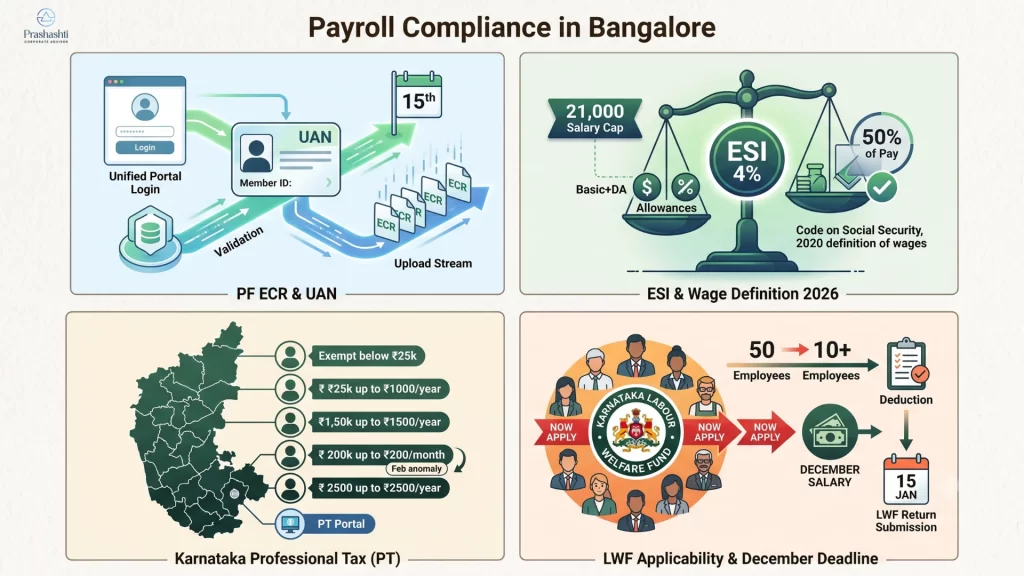
PF contribution remains at 12% from the employee and 12% from the employer. Employees who want to contribute beyond the mandatory amount can also consider VPF contribution. Calculated on Basic + DA.Of the employer’s contribution, 3.67% goes into EPF, 8.33% into EPS (limited to ₹15,000 in salary; see the EPS pension calculation for the pension component) (limited to ₹15,000 in salary) and 0.5% into EDLI.
What’s new in 2026? EPFO revamped/re-engineered its ECR 3.0 system, an upgraded version of the Electronic Challan-cum-Return system on the EPFO Unified Employer Portal, with tighter validation and automated penalty calculation. The filing deadline is still the 15th of the following month, and this date is absolute. It doesn’t shift even if the 15th falls on a Sunday or bank holiday.
But there is a common trap: Filing on the 15th itself instead of a day or two earlier. Net banking payments can fail, and once the 15th passes, interest kicks in immediately under Section 7Q, plus damages under Section 14B that scale from 5% to 25% depending on how late you are. Target the 13th or 14th instead of filing it closer to the 15th of every month. If your team handles PF and ESI registration in Bangalore in-house, it’s worth having it reviewed alongside your ESIC setup at least once a year.
ESI Compliance in Bangalore: Eligibility, Rates and Contributions
ESI contribution is 4% total: 3.25% from the employer, 0.75% from the employee, on gross wages up to ₹21,000 a month (₹25,000 for employees with disabilities). Deposits go through the ESIC employer portal by the 15th of the following month, as per Regulation 31 of the ESI (General) Regulations, 1950.
Here’s what many Bangalore payroll teams missed: following ESIC’s notifications dated 10 and 11 December 2025 and the broader new labour law 2026 framework operationalising the Code on Social Security, 2020, ESI wages are now defined as Basic + DA + retaining allowance. If the total of these three components is less than 50 percent of an employee’s entire salary, the difference is added back to the ESI wages. In practice, this implies that salary structures that depend too much on HRA or other allowances to keep ESI salaries low, do not work the way they did. This is something worth considering before an inspector does it for you.
One more thing HR often gets wrong: once an employee’s salary crosses ₹21,000 mid-cycle, they stay covered until the contribution period ends (April-September or October-March). You don’t stop deducting just because they got a raise. Employees covered under ESI can also access a range of ESIC benefits under the scheme.
Need help staying compliant?
Professional Tax Compliance in Karnataka: Rates, Registration and Deadlines
This is where Bangalore employers need to pay close attention, because PT is a state subject and Karnataka revised it recently.
Since April 2025, under the Karnataka Tax on Professions, Trades, Callings and Employments (Amendment) Act, 2025, employees earning below ₹25,000 a month are exempt from Professional Tax, up from the earlier ₹15,000 threshold. Anyone at or above that threshold pays a flat ₹200 a month, except in February, when the deduction jumps to ₹300, so the annual total works out to exactly ₹2,500 (the constitutional cap on professional tax).
PT registration and returns are handled through the Karnataka Commercial Taxes Department’s PT portal, and monthly returns are due by the 20th of the following month. Don’t confuse this with e-Karmika; that’s a separate portal used for Shops and Commercial Establishments Act registration, not PT filing. Mixing the two up is a surprisingly common mistake among first-time Bangalore employers.
It is also worth knowing that PT has no exemption under the Income Tax Act. Employees sometimes assume PT deductions reduce their taxable income the same way certain investments do. They don’t work that way; PT is a separate state tax.
Salary TDS Compliance in Bangalore: 2026 Rules and Form 138
That is the biggest fundamental change for 2026. The old Income Tax Act, 1961 was replaced by the Income Tax Act, 2025 from the date of 1st April, 2026. TDS on salary is now under Section 392, instead of the regular Section 192.
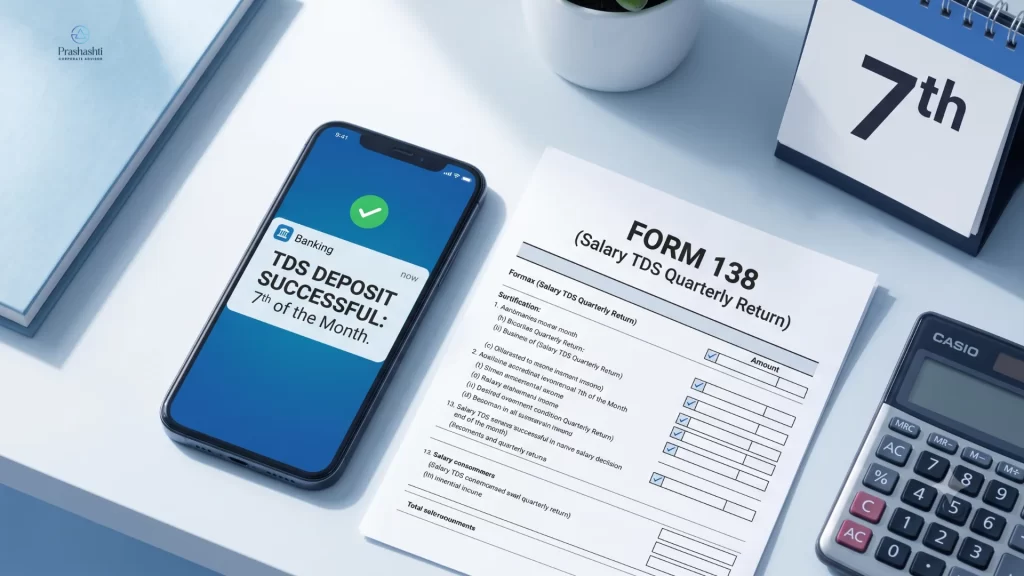
The quarterly TDS return for salary now is Form 138 instead of Form 24Q from Q1 of Tax Year 2026-27 forward. Any employer should use Form 138 to deduct salary TDS on Tax Year 2026-27 and not Form 24Q. Using the incorrect form may lead to problems during reconciliation as well as while generating employee tax certificates.
Form 16 vs Form 130 (don’t mix these up): Form 16 is still relevant for salary for FY 2025-26 under Income Tax Act , 1961. The revised Income Tax Act, 2025 shall apply to salary paid for the Tax Year 2026-27 (1st April 2026 to 31st March 2027) and the salary TDS Certificate for this purpose is Form 130. Thus, the two forms apply to separate tax periods in this transition. In simple words:
- Salary FY 2025-26 → Form 16
- Salary for Tax Year 2026–27 → Form 130
There is no change in the deposit deadline. TDS should be deposited with the government by 7th of the next month and for deductions in March, by 30 April. Quarterly return filing dates also stay familiar: 31 July, 31 October, 31 January, and 31 May.
If your offer letters, payslip templates, or HR handbook still reference “Section 192” or “Form 16,” update them. It won’t change how tax is calculated, but it will confuse employees and create mismatches when they try to auto-fill their ITR.
Labour Welfare Fund Compliance in Karnataka: Rates and Eligibility
LWF in Karnataka got two updates that Bangalore employers should not ignore. First, the contribution rate rose to ₹50 from the employee and ₹100 from the employer, per year. Second, and most important, the applicability threshold dropped from 50 employees to just 10 employees, effective 7 January 2026.
That means a lot of small Bangalore offices that were exempt until recently are now covered. The contribution gets deducted from the December salary, and employers file returns with the Karnataka Labour Department by 15 January the following year.
Together, all these four pieces: PF, ESI, PT, and TDS compliance in Bangalore, form the core of what any HR or finance team needs to track every month. Miss the pattern across all four, and you’ll spend more time fighting with notices than running payroll.
Expert Insight: Why Cross-Regime Reconciliation Matters More Than Any Single Deadline
Most payroll compliance advice treats PF, ESI, PT, and TDS as four boxes to tick. In practice, the real risk sits in the gaps between them, not inside any single calculation.
PF wages, ESI wages, PT-taxable salary, and TDS-taxable income are four different numbers, built on four different wage definitions, even though they all come from the same payslip. A salary structure optimised to minimise PF often distorts the ESI wage base, especially after the 2025 wage notification that pulls allowances above 50% of pay into ESI-eligible wages. Get one definition wrong, and it doesn’t just affect that one filing. It throws off the reconciliation across all four.
Practitioner Insight: The fix isn’t a bigger spreadsheet. It’s a fixed sequence, closed before the payroll register is finalised each month:
- Lock gross wages and NCP (non-calculable period) days first.
- Calculate PF wages, then ESI wages, using their separate definitions.
- Apply the PT slab against the same finalised gross.
- Calculate TDS last, against taxable salary net of the other statutory deductions.
Employers who run this sequence every month (rather than calculating each compliance separately) catch mismatches before a filing goes out, not after EPFO or ESIC flags one. That’s the difference between compliance as four different activities, and compliance as one connected control process.
Monthly Payroll Compliance Calendar for Bangalore Employers
Compliance | Action | Frequency | Due Date |
PF (ECR + payment) | File and pay via EPFO portal | Monthly | 15th of the following month |
ESI | Deposit via ESIC portal | Monthly | 15th of the following month |
ESI half-yearly return | Self-certify contribution | Half-yearly | 11 Nov / 12 May |
PT | Deduct and remit via PT portal | Monthly | 20th of the following month |
TDS | Deposit via TIN/Income Tax portal | Monthly | 7th of the following month (30 April for March). |
TDS return (Form 138) | File quarterly | Quarterly | 31 Jul / 31 Oct / 31 Jan / 31 May. |
Form 130 (was Form 16) | Issue to employees for Tax Year 2026–27 | Annual | 15 June 2027 |
LWF | Deduct in Dec salary, remit | Annual | 15 January |
Penalties for Payroll Non-Compliance in Bangalore
Compliance | Consequence of delay |
PF | 12% p.a. interest (Sec 7Q) + 5–25% damages (Sec 14B), based on delay length. |
ESI | 12% p.a. interest + damages under Regulation 31-C (5–25%, graded by delay). |
PT | 1.5% per month interest on unpaid tax, plus a 10% penalty if not paid voluntarily before a notice is served. |
TDS | ₹200/day late filing fee, interest at 1.5% per month on unpaid tax. |
LWF | Penalty notices from the Karnataka Labour Welfare Board, plus interest on arrears. |
Common Payroll Compliance Mistakes Bangalore Employers Make
- Treating the 15th as a soft deadline.
It isn’t. Interest starts from the 16th, irrespective of any delay in the bank.
- PF Wages logic is applied to ESI.
Both have different wage concepts, particularly post the wage notification of 2025.
- Small teams are exempted from the LWF assumption.
The current exemption limit is 10, not 50.
- PT filing was done via e-Karmika mistakenly.
That portal is for Shops & Establishments registration, not Professional Tax.
- Sticking with Form 24Q or Form 16 templates.
These are legally outdated for FY 2026-27 salaries.
- Forgetting NCP days in ECR.
Unpaid leave and absconding periods must be marked correctly, or PF wages get overstated.
Keep Your Payroll Cycle on Track With Prashasthi Corporate
Payroll compliance in Bangalore isn’t one task; it’s four separate systems running in parallel, each with its own portal, rate, and deadline. PF and ESI follow the 15th; PT follows the 20th; TDS follows the 7th. Add LWF once a year, and reconciliation becomes a full-time discipline, not a once-a-month checklist. If you’re building out broader employer payroll compliance in India in 2026 across multiple states, get in touch with our Prashasthi team for a compliance review.
We’ll walk through your current setup and flag gaps before EPFO or the Income Tax Department does. And if you’re wondering whether or not your income structure stands up to the new ESI wage definition or the Income Tax Act 2025, book a consultation before your next filing cycle.
Disclaimer: This article is for general information. Statutory rates and thresholds change by government notification. Verify current figures on the EPFO, ESIC, Karnataka Commercial Taxes, and Income Tax Department websites before filing.



Pingback: How to Know Your ESIC Insurance Number Online in India