

Bangalore EV Charging Station Guidelines: Rules, Approvals & Setup Basics
A few months back, a friend of mine who owns a small commercial building in Electronic City thought installing EV chargers would be easy money. Every day, he saw more electric cars in his parking area, so the plan sounded obvious. Put up two chargers, attract tenants, earn extra income. The idea was simple.
But soon problems started showing up. BESCOM started asking for additional load approval, the wiring work became more expensive than expected, and one installer told him something completely different from another.
That is the problem many people are facing right now. Bangalore’s EV market is growing fast, but most people still do not know the EV charging station guidelines in Bangalore before investing. And honestly, missing a small compliance step here can cost both time and money later.
So in this blog, we are going to break everything down properly, from BESCOM approvals and safety rules to setup costs, charger types, permissions, and the common mistakes businesses should avoid before starting an EV charging station in Bangalore.
Understanding EV Charging Station Guidelines In Bangalore
A lot of business owners assume they need a petrol-pump-style license to start charging operations.
The Ministry of Power announced a Central Government policy on 17 September 2024, considering EV charging as a de-licensed activity. Still, there are rules. Businesses planning charging infrastructure should also understand the broader EV charging station requirements in India before moving into Bangalore-specific approvals and compliance. Current EV charging station guidelines in Bangalore mainly focus on:
- Electricity infrastructure
- Safety compliance
- Charger standards
- Accessibility
- Power management
The national rules also demand the public charging stations to have a minimum density of at least one charging station every 1 km × 1 km grid in urban areas by 2030 and fast charging stations to be installed every 50 km on state roads such as Bengaluru-Mysuru and Bengaluru-Pune.
BESCOM Rules And Electricity Requirements
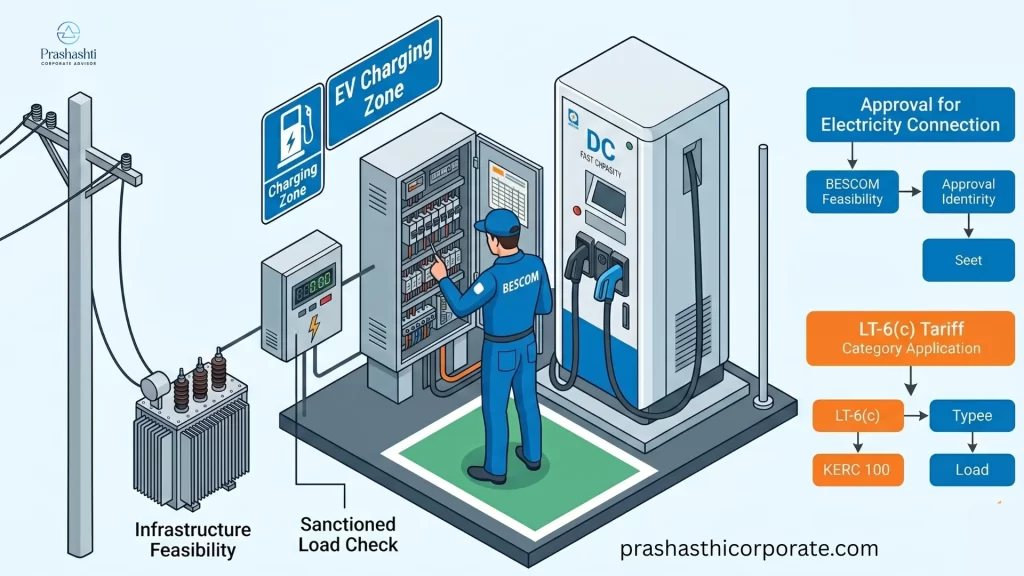
The current BESCOM EV policy has separate electricity tariff structures for EV charging operations. The KERC-notified special tariff for EV charging is within the LT-6(c) category that was specifically created to help electric vehicles.
Charging Tier | What You Pay BESCOM (Wholesale Cost 2026) | Standard Bangalore Retail Rate (What you should charge users to make a profit) | Your Net Margin |
AC Normal Charging | ₹5.06 per kWh | ₹11.00 to ₹13.00 per kWh | ~₹6.00 to ₹8.00 |
DC Fast Charging | ₹5.06 per kWh | ₹18.00 to ₹24.00 per kWh | ~₹13.00 to ₹19.00 |
Note: From 1st May 2026, BESCOM subscribers additionally pay an additional 56 paise/unit as FY25 True Up Charges allowed by KERC. Confirm your final applicable pricing immediately with BESCOM before finalizing your business model.
Before installation, operators usually need approval for:
- Electricity connection.
- Sanctioned load.
- Dedicated meter setup.
- Infrastructure feasibility.
For example, someone may rent a property thinking the location is perfect, only to later discover the transformer nearby cannot support fast charging infrastructure. Sometimes additional electrical work becomes necessary.
This is why checking electrical feasibility early is important. Most of these technical procedures fall under EV charging station regulations that Karnataka businesses are expected to follow.
Safety And Compliance Standards
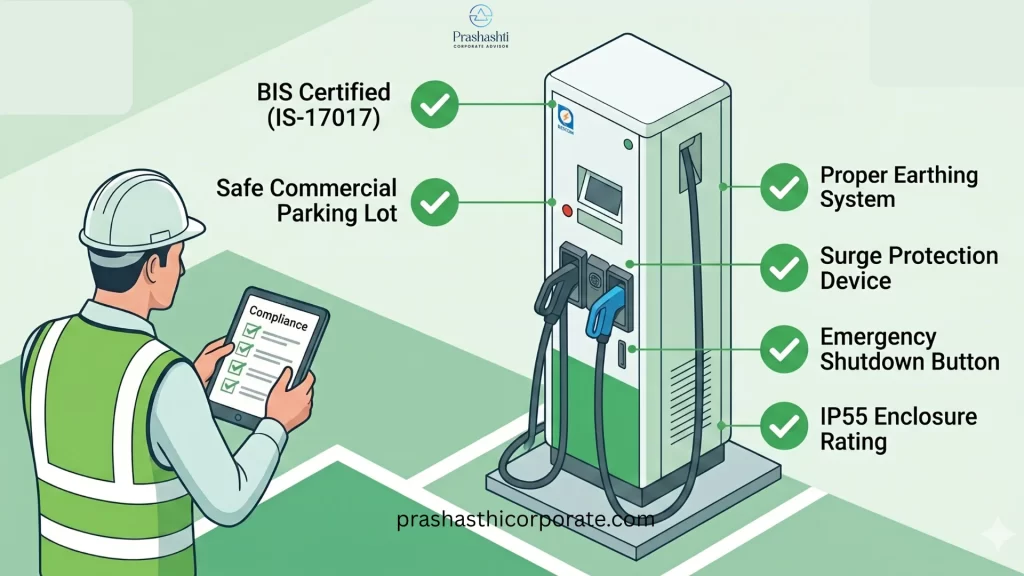
This is the one primary compliance requirement that operators miss. From now on, all chargers sold in India will be required to have BIS certification in the IS-17017 series, and that is now mandatory. The IS-17017 Standard addresses:
- General safety requirements and earthing.
- AC Connector Variants (Type-2 / Bharat AC-001).
- DC rapid charging procedures (CCS2/Bharat DC-001).
- Communication protocols (IS 15118).
- Electromagnetic compatibility (EMC).
A standard setup should also include:
- Proper earthing.
- Circuit protection.
- Surge protection.
- Approved wiring (IS standards)
- Emergency shutdown systems
- IP55 or higher enclosure rating for outdoor chargers
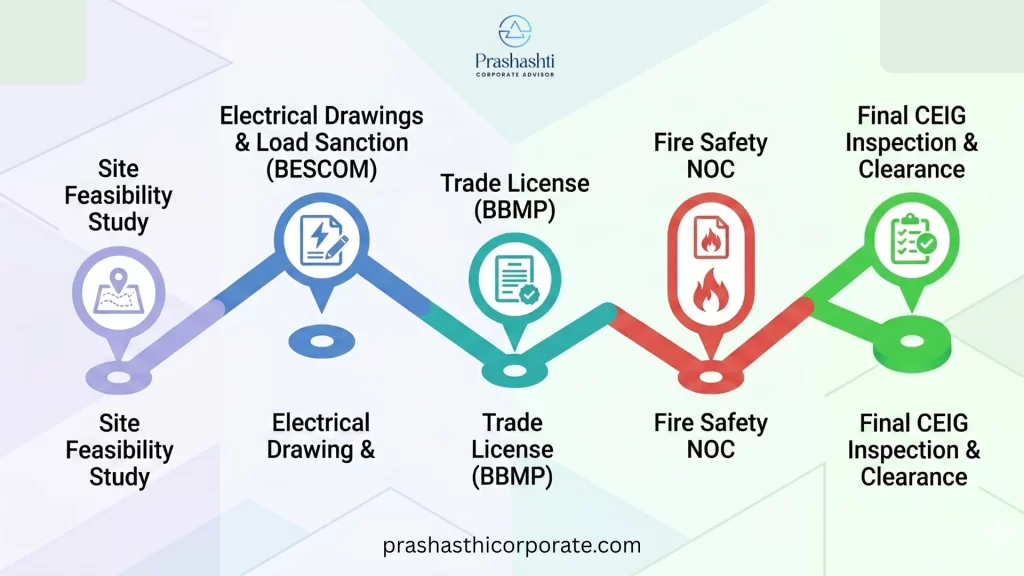
Depending upon the charger capacity and overall size of the infrastructure, the commercial properties installing infrastructure as per EV charging station guidelines in Bangalore may also require CEIG (Chief Electrical Inspector to Government) inspection and fire safety clearance.
Government Subsidies You Can Actually Claim in 2026
1. PM E-DRIVE Scheme (Central Government)
The PM E-DRIVE (Electric Drive Revolution in Innovative Vehicle Enhancement) initiative was launched in September 2024 with a total budget outlay of ₹10,900 crore. The budget includes ₹2,000 crore for public EV charging facilities also.
The plan covers the installation of about 72,300 public charging stations across India, including around 22,100 fast chargers for four-wheelers. This strategy is expected to help accelerate infrastructure growth for businesses wanting to enter the EV charging industry in the coming few years.
2. Karnataka Clean Mobility Policy 2025-30
Karnataka’s Clean Mobility Policy, which is applicable from February 11, 2025, is currently among the more operator-friendly EV rules in India and has various direct benefits for charging station operators.
Incentive | Detail |
Capital subsidy – Fast charging stations | 25% subsidy up to ₹10 lakh, for first 500 stations |
Battery swapping stations | 25% subsidy (₹3-10 lakh depending on vehicle category) |
New charging stations planned | 2,500 via PPP + 100 via ESCOM funds |
Budget allocation | ₹350 million (₹35 crore) in 2024-25 |
Grid support | ₹3,400 crore in Battery Energy Storage Systems (BESS) investment |
Planning to start an EV charging station in Bangalore?
Approvals And Licenses Required Under EV Charging Station Guidelines In Bangalore
Electricity Connection Approval From BESCOM
This is usually the first step before installation begins. BESCOM checks whether the location can handle the required power load, especially for fast chargers. The process normally includes:
- Application submission.
- Electricity load assessment.
- Meter installation.
- Site inspection.
- Final approval.
Trade License Requirements
For commercial charging stations, BBMP or local municipal approvals may be needed. This mostly depends on:
- Business type
- Property usage
- Commercial activity
Apartment charging setups are generally simpler compared to public charging stations.
Fire Safety And Building Permissions
Large setups inside commercial buildings may require:
- Fire safety clearance.
- Parking approval.
- Structural compliance checks.
Other Important Documents You Require
Document | Why It Is Needed |
Identity proof | Applicant verification |
Property documents | Ownership confirmation |
Electrical drawings | Power planning |
NOC | Owner permission |
Layout plan | Charger placement approval |
Since EV charging projects involve multiple approvals, documentation requirements, and operational planning, many businesses also work with professional corporate advisory services in India to streamline the setup process.
Types Of EV Charging Stations Allowed In Bangalore
1. AC Charging (Standard/Destination Charging )
Standards: Bharat AC001 (for commercial 2-wheeler/3-wheeler fleets) and Type-2 Mennekes (for modern cars).
Best Used For: Tech parks on Outer Ring Road, corporate headquarters, and large residential clusters in Whitefield, where vehicles are parked for 3 to 8 hours.
Business advantage: Very low first machine costs, very little impact on power grid load.
2. DC Fast Charging (High-Speed Hubs)
Standards: CCS2 (Combined Charging System 2)
Best used for: Locations where the vehicle turnaround time is between 20 and 60 minutes such highway corridors (Bengaluru-Mysuru or Bengaluru-Pune tollways), fuel stops and commercial hubs.
Business Advantage: Higher cost per unit, but it requires strict thermal and electrical safety equipment.
Feature | AC Charger | DC Fast Charger |
Charging Speed | Slower | Faster |
Setup Cost | Lower | Higher |
Electricity Requirement | Lower | Higher |
Ideal Location | Apartments, offices | Public stations, highways |
What Is The EV Charging Station Setup Cost In Bangalore?
Under the EV charging station guidelines in Bangalore, the charges for a small apartment or office set-up usually range between ₹50,000 and ₹3 lakh.
Commercial charging hubs are different. The cost of fast charger, transformer upgrading, electrical infrastructure, civil construction, software, etc might range from ₹10 lakh to ₹50 lakh or more depending upon the scale.
Continuous costs that many operators don’t realize:
- BESCOM power bills monthly
- Annual maintenance & servicing
- Subscriptions for software/network management
- Uptime and Internet Monitoring
- Payment gateway charges (usually 1.5-2% of transaction amount)
Industry Data: Industry data shows that well-located DC fast-charging stations can achieve breakeven within 24-36 months and deliver a post-breakeven annual ROI of 15-32% (Avaada Energy, 2026). It depends on the rate of consumption. The aim is to attain to these levels with 30-50% of daily use.
Solar + EV Charging: Why Many Bangalore Operators Are Slowly Moving Towards It?
Running an EV charging station in Bangalore can become expensive when electricity bills start increasing month after month. That is one reason many operators are now looking at solar-integrated charging setups instead of depending completely on BESCOM power.
Karnataka is already investing nearly ₹3,400 crore into Battery Energy Storage Systems (BESS) to support EV demand using solar-generated energy. Some practical advantages include:
- 40-60% lower BESCOM power bills during daytime charging.
- net metering benefits by selling excess solar power back to the grid.
- lower dependence on grid electricity during peak hours.
Best Locations To Set Up An EV Charging Station In Bangalore
In Bangalore, a charging station where EV users already spend time has a much better chance of succeeding. High-performing zones include:
- Tech parks and IT corridors: Outer Ring Road, Whitefield, Electronic City.
- Large apartment communities: Sarjapur Road, Hebbal, Devanahalli.
- Highway entry/exit points: Bengaluru-Mysuru, Bengaluru-Pune, Airport Road.
- Commercial destinations: Malls, multiplexes, large retail parks.
Fleet hubs: Logistics parks, cab aggregator depots.
Why Is Bangalore Emerging As A Major EV Charging Hub?
Bangalore was always expected to become a strong EV market. The city already had the right conditions for it. People travel long distances daily. Fuel prices continue to increase. Tech adoption is high. And many younger buyers are more open to switching to electric vehicles than before.
But what really pushed EV growth was the rise of electric scooters and commercial fleets.
- Delivery companies started using EV two-wheelers because running costs were lower.
- Ride-hailing companies also began experimenting with electric cabs.
Slowly, charging demand started spreading across the city. Now the demand is visible in places like:
- Whitefield
- Electronic City
- Outer Ring Road
- Airport road
- Large apartment communities
Even residential builders have started discussing EV-ready parking during project planning because buyers ask about it.
Karnataka’s EV push also played a major role. The government has been expanding charging infrastructure and supporting EV charger installation in Bangalore through state policies and public-private projects.
That’s why a lot of companies are searching for:
- Public charging stations
- Apartment charging setups
- Office charging systems
- Fleet charging hubs
- Highway fast chargers
The market is still developing, which means there is space for new players. But the setup has to be planned properly.
Final Thoughts on EV Charging Station Guidelines In Bangalore
Bangalore is seeing a major movement towards electric vehicles right now. There needs to be more charging points in apartments, companies are rolling out EV fleets and customers already expect there to be charging in a lot of commercial spaces.
But starting without understanding the EV charging station guidelines in Bangalore might lead to complications later, especially when it comes to getting power clearances, safety regulations and planning for infrastructure. At first glance, a charging station seems straightforward, but behind the scenes there is a lot going on.
As the EV industry continues to develop across the city, companies like Prashasthi Corporate are also helping businesses through the regulatory and setup side more effectively.




Pingback: GST on EV Charging Station India: Rates, ITC & Rules
Pingback: EV Charging Compliance Bangalore: 10 Mistakes to Avoid