
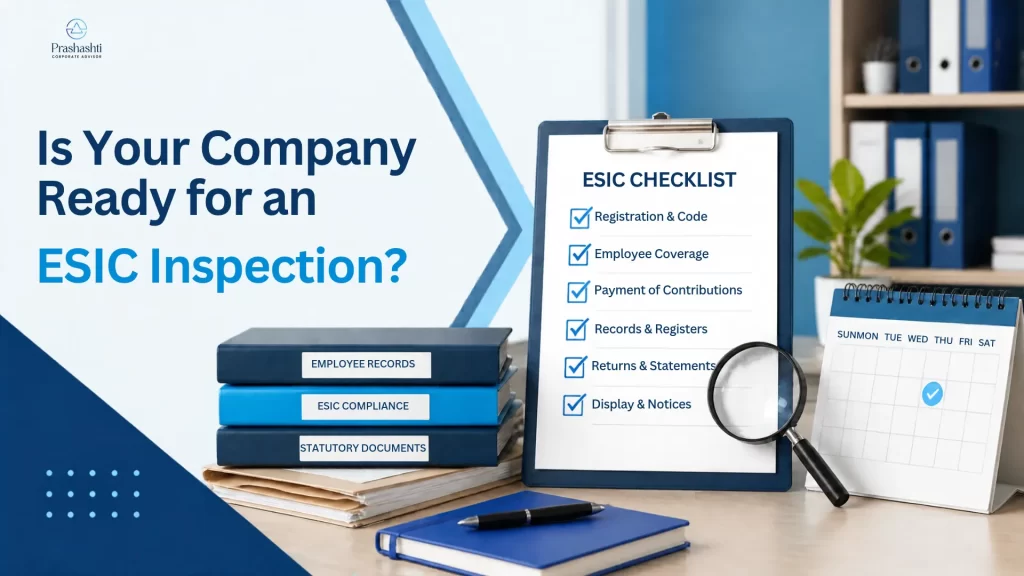
An ESIC inspection in Karnataka is an official check by an Inspector-cum-Facilitator to confirm that your establishment is registered, that eligible employees are enrolled, and that contributions are paid on the right wages. To be ready, keep your attendance, payroll and ESIC portal records matching, and test your salary structure against the wage definition in Section 2(88) of the Code on Social Security, 2020.
Since the Code came into force on 21 November 2025, inspections can be randomly selected under Section 122. So even if you’ve never been inspected, you can’t count on staying off the list. Establishments with 10 or more persons are generally covered, and the wage ceiling is ₹21,000 a month.
Most ESIC trouble doesn’t come from fraud. It comes from small mismatches nobody checked, like 42 people in the attendance register but only 38 on the ESIC list.
In this guide, we’ll walk you through what an ESIC inspection in Karnataka involves, which records to keep, what happens on inspection day, and how to reply to a notice without panic.
What Is an ESIC Inspection and Who Does It?
An ESIC inspection (also called an ESI inspection) checks whether your establishment is registered, has enrolled eligible employees, and has paid the right contributions on time.
Since the Code came into force on 21 November 2025, inspectors are called Inspector-cum-Facilitators under Section 122 of the Code. For ESI work, the Labour Ministry’s notification S.O. 2356(E) of 8 May 2026, published in the Gazette of India, appoints officers such as Social Security Officers and Assistant Directors.
Here’s what most people don’t know. Section 122 lets the government notify a web-based inspection scheme and confer randomised selection of inspections on these officers. Whether a particular inspection comes through that route depends on the notifications in force, so “we’ve never been inspected” tells you little about next year. Section 123 also expects you to keep records and registers, and you should be ready to produce them when asked.
An inspection isn’t an accusation. It’s verification. But it only goes smoothly when your records agree with each other.

Who Needs ESIC Registration in Karnataka?
Your ESIC registration threshold comes down to three checks:
- Headcount: generally 10 or more persons. Some notified hazardous occupations can trigger coverage with fewer. Count everyone for this test, including people earning above the ceiling (Section 2(26) of the Code).
- Wage ceiling: ₹21,000 a month, or ₹25,000 for a person with a disability. The Labour Ministry’s FAQs on the labour codes of 16 March 2026 say the existing ceiling continues. No replacement had been notified when we last checked.
- Registration route: online through the Shram Suvidha portal or the ESIC employer portal.
Not sure where you stand? Our PF & ESIC registration page explains the process.
How the 50% Wage Rule Affects ESIC Contributions?
This is where employers get caught. ESIC’s December 2025 circular says coverage and contributions now follow the “wages” definition in Section 2(88). Wages means basic pay, dearness allowance, and retaining allowance. Certain components, including house rent allowance, conveyance allowance, overtime allowance and commission, are excluded, subject to the 50% add-back rule: if the excluded items exceed 50% of total remuneration, the excess is added back. Bonus is excluded only where it meets the specific condition in Section 2(88), meaning statutory bonus that isn’t part of the remuneration payable under the terms of employment.
Try it on one employee (illustrative numbers):
Item | Amount (₹) |
Total monthly remuneration | 30,000 |
Basic + DA | 12,000 |
Left-out items (HRA, conveyance, etc.) | 18,000 |
Left-out limit (50% of total) | 15,000 |
Added back as wages | 3,000 |
Wages for ESIC | 15,000 |
That’s under the ₹21,000 ceiling, so this person is covered even though total pay is ₹30,000. Under Rule 19 of the Social Security (Central) Rules, 2026 (G.S.R. 344(E)), each share is rounded up to the next rupee separately: employer 3.25% = ₹487.50, rounded to ₹488, and employee 0.75% = ₹112.50, rounded to ₹113.
Payroll note: Don’t mix up two tests: whether a person is within the ceiling, and how much is payable. Components such as overtime can be treated differently in each, so check both steps.
Here’s a rule of thumb. Wages can’t fall below half of total remuneration, so where the 50% rule applies, total pay of around ₹42,000 is a useful first screening point against the standard ₹21,000 ceiling. For employees eligible for the ₹25,000 disability ceiling, the matching illustrative point is ₹50,000. Actual eligibility depends on the salary components, so check each person.
How Have the New Labour Codes Changed ESIC Compliance in 2026?

Last updated: 17 November 2026
- 21 Nov 2025: The Code came into force, and the ESI Act was repealed. Old dues don’t disappear, because the repeal is subject to Section 6 of the General Clauses Act (Section 164(3) of the Code).
- Dec 2025: ESIC issued circulars on the new wage definition and registration. Its SPREE-2025 amnesty window closed on 31 December 2025, so coverable employees found unregistered can now face past dues.
- 8 May 2026: The Social Security (Central) Rules, 2026 were notified, with contributions at 3.25% (employer) and 0.75% (employee). Under Section 164(2)(b), earlier ESI rules, regulations and schemes continue during a one-year transition, to the extent they’re consistent with the Code.
- Around 20–21 Nov 2026: That transition reaches its one-year point. Draft replacement ESI regulations were published in July 2026 and weren’t final when we last checked. Verify the latest notifications on the ESIC website before relying on either old or new provisions.
Which Documents Should You Keep Ready for an ESIC Inspection?
Section 123 of the Code expects employers to keep records and registers, electronically or otherwise. These are the ESIC records to maintain:
Record | What the officer checks | Common slip |
Registration certificate, employer code | Details match your address and business | Office shifted, ESIC not updated |
Employee register, IP numbers | Every eligible person is enrolled | Joiners missed, leavers still active |
Attendance, muster rolls | Real headcount for the period | Contract staff left out |
Wage register, payslips | Code wages vs wages used for ESIC | Gross salary or old logic used |
Challans, returns | Paid on time, matches payroll | Paid but never reconciled |
Contractor records | Worker lists, deployment, ESIC proof | Relying on a verbal “all done” |
Accident records | Injuries reported | Not reported or not filed |
Books, vouchers | Wage payments trace back | Cash wages with no trail |
Contributions are due by the 15th of the following month. Our guide to paying ESIC online covers challans step by step.
Expert Insight By Arun Bhandary: Do the headcount test first. Count everyone physically working for you, contract staff and above-ceiling earners included, before you look at any other record. Most gaps show up right there.
Ensure every eligible employee has a valid ESIC insurance number recorded in your employee register. If you need help understanding how employees can find or verify their number, read our guide on How to Know Your ESIC Insurance Number Online in India.
The Prashasthi Three-Mirror Check: Are Your Employee, Payroll and ESIC Records Matching?
Think of your compliance as three mirrors. An officer is really checking whether all three show the same picture.
- Mirror 1, Floor: who actually works here (attendance, contractor deployment).
- Mirror 2, Payroll: what you paid them (wage register, Code wages).
- Mirror 3, Portal: what ESIC knows (IP list, challans, returns).
Compare headcount, wages, and dates across all three:
Mismatch | Risk | Fix first |
Eligible person on floor, missing on portal | High | Enrol now and document dates |
Payroll wages differ from wages used for ESIC | High | Recalculate under Section 2(88) |
Leaver still active on portal | Medium | Update the exit date |
Challan total differs from payroll total | Medium | Reconcile and note the reason |
Contractor list incomplete | Medium | Collect list and ESIC proof |
Paperwork missing, data right | Low | Rebuild from source, never backdate |
The 10-minute test: pick one recent month and count heads in each mirror. If the three numbers differ, you’ve found your starting point. Use this as an internal screening tool, not a statutory compliance score. How serious a mismatch is depends on its nature, the money involved and the legal requirement. One missing eligible employee can matter more than three minor paperwork gaps.
Here’s what a completed sheet looks like (fictional employees, for illustration only):
Employee ID | Attendance | Payroll | ESIC portal | Discrepancy |
E001 | Present | Paid | Registered | None |
E002 | Present | Paid | Missing | High |
E003 | Present | Wages differ from ESIC wages | Registered | Review |
E004 | Left in August | Paid till exit | Still active | Medium |
Expert Insight By Arun Bhandary: Reconcile monthly, not yearly. Keep a one-page sheet that matches payroll headcount with your ESIC list on the day you file.
What Happens When an ESIC Inspector Visits Your Establishment?
The officer usually reviews attendance, wages, challans, and contractor records, may speak to employees, and compares everything with ESIC’s data. Make it smooth:
- Nominate one coordinator from HR or accounts.
- Ask for the officer’s identity and authorisation.
- Keep documents ready in an indexed folder, paper or digital.
- Answer only what’s asked, accurately. Don’t guess.
- Note every document requested, and keep copies of what you hand over.
Never alter old records or create new ones to fill gaps. Obstructing an inspector or failing to produce records on demand is itself an offence under Section 133.
Received an ESIC Inspection Notice? Here's What You Should Do Next
Steps to take after receiving a notice:
- Hour 0–4: Read it closely. Note the period, date, officer, and documents requested. Name your coordinator.
- Day 1: Run the Three-Mirror Check for that exact period. List gaps honestly.
- Day 2: Build an indexed bundle with a one-page cover note. For your ESIC inspection notice reply, answer the specific query, attach proof, and skip unrelated pages.
- Always: Keep proof of submission.
If the notice raises a demand, get advice before you accept or dispute it. Our team handles this under Handling Notices.
Practical example: A cover note that lists “Annexure 1: attendance, April–September; Annexure 2: wage register; Annexure 3: challans” makes the officer’s job easier and usually means fewer follow-up queries.
What Happens When ESIC Identifies Underpaid Contributions?
If an inspection identifies a possible contribution shortfall, the matter may lead to an assessment inquiry under Section 125 of the Code. An authorised officer notified for this purpose conducts it, not the Inspector-cum-Facilitator. You must be given a reasonable opportunity to present your case before any order is passed. Section 125(1) also sets a five-year period for starting proceedings.
Financial consequences of an ESIC contribution shortfall
- Outstanding contributions: the unpaid amount itself.
- Interest: simple interest at 12% a year from the due date until payment (Section 127). It’s notified in S.O. 2357(E) of 8 May 2026, and S.O. 2698(E) of 29 May 2026 specifies the same rate, deemed in force from 21 November 2025.
- Damages: where levied, up to the amount of arrears, and only after you’ve been heard (Section 128).
Can an employer appeal against an ESIC assessment order?
Yes. Section 126 gives you 60 days from the date of the order to appeal. You must deposit 25% of the contribution ordered, or the contribution on your own calculation if that’s higher.
Common ESIC Compliance Violations, Late Payment Charges and Penalties
Here are the common violations and penalties under the Code. Confirm the exact wording of Section 133 on India Code.
Violation | Where it sits | Statutory punishment |
Failing to deposit an employee’s share already deducted | Section 133(a) | Imprisonment of at least one year and a ₹1 lakh fine |
Other contribution payment defaults | Section 133(a) | Imprisonment of 2–6 months and a ₹50,000 fine |
Obstructing an inspector, or not producing records on demand | Section 133(f), (k) | Imprisonment up to six months, or a fine up to ₹50,000, or both |
Late payment | Sections 127, 128 | Interest at 12% a year, plus damages after a hearing |
Pre-Nov 2025 defaults | Section 164(3) | Still recoverable |
These are subject to the statutory qualifications and exceptions in the Code.
There’s one useful safeguard. Before launching a prosecution, the authority must give you a written direction and a period to comply (Section 137). If you comply in time, no proceeding starts. But repeat a violation of the same nature within three years and that second chance is gone.
ESIC Audit in Bangalore: Do a Mock Check First
An ESIC audit in Bangalore here means a mock inspection you run on yourself, not one ordered by ESIC. A good one takes your last 12 months through the Three-Mirror Check, re-tests wages under Section 2(88), and reviews contractor files. Fixing a gap on your own is far cheaper than explaining it later.
ESIC Regional Office in Karnataka: Bangalore Office Address and Contact Details
ESIC Regional Office, Karnataka: Panchdeep Bhavan, No. 10, Binny Fields, Tank Bund Road, Binnypet, Bengaluru – 560023. Phone: 080-26742485. ESIC’s toll-free number is 1800-11-2526 (ESIC contact page). Office updates are on the Karnataka Regional Office portal. Confirm these details there before visiting.
Book Your ESIC Compliance Health Check With Prashasthi Corporate
Not sure whether your floor, payroll and portal records match? Our team can run a mock inspection, test your wages under the new definition, and give you a clear fix list. Book a compliance health check or call +91 96064 96418.
Disclaimer: This guide is for general information, not legal or professional advice. Labour-code rules, notifications and ESIC circulars are still changing, and your facts may differ. Check official sources before you act and speak to a qualified professional about your own situation. Prashasthi Corporate Advisors isn’t responsible for decisions made on this article alone.