


Operating a business in India will usually require you to manage multiple compliance procedures, which include tax audit compliance. Among most founders, freelancers and professionals, understanding how to determine whether they have met their tax audit requirements can create confusion.
For many founders, freelancers and professionals, the thought that they may miss their audit obligation creates concern and anxiety since missing an audit obligation could result in penalties or notices.
Being aware of when your total sales, gross receipts or cash flow exceed the audit threshold may protect you from having to rush to meet your audit obligations at the last minute and/or experiencing financial losses.
What Is a Tax Audit and Why Is It Mandatory for Certain Businesses?
Before diving into limits and numbers, it helps to know what a tax audit really means. A tax audit is simply a review of your books of account by a Chartered Accountant to check whether the income, expenses, and claims shown in your ITR are accurate. The purpose of these tax audit requirements is not to accuse you of wrongdoing, but to ensure compliance under Section 44AB (Section 63 under the new Income Tax Act, 2025, effective from Tax Year 2026–27).
When you meet tax audit requirements, your financial records become more transparent, helping you avoid unnecessary tax disputes later.

When Does Business Turnover Trigger a Mandatory Tax Audit in India?
A common question companies have about their turnover is whether they are required to meet tax audit requirements under the Income Tax Act. The tax audit requirement threshold for most companies is ₹1 Crore of total receipts or turnover of all sales made during a financial year (April-March).
However, there is a significant exception for e-commerce businesses that use digital payments. If both your cash receipts and cash payments do not exceed 5% of your total transactions, the tax audit limit for you will be ₹10 Crores.
Therefore, a company that has ₹9 crore of turnover and very little cash in its transactions will not have to meet the tax audit requirement, while a company that has a large amount of cash in its transactions and just over ₹1 crore of turnover will.
Tax Audit Thresholds at a Glance (Comparison Table)
| Category | Audit Threshold | Higher Limit Condition | Higher Limit |
|---|---|---|---|
| Business (General) | ₹1 Crore | Cash receipts & payments ≤ 5% | ₹10 Crores |
| Professionals | ₹50 Lakhs | Digital receipts ≥ 95% | ₹75 Lakhs |
| Presumptive Scheme (44AD) | Audit if profit < 6% / 8% | Cash ≤ 5% | Turnover up to ₹3 Crores |
| Penalty for Non-Compliance | — | Section 271B | Auto-fee: ₹75,000 (≤30 day delay) or ₹1,50,000 (>30 days) — portal-triggered, no waiver from AY 2026–27 |
Businesses often confuse tax audits with other mandatory audits, especially as turnover grows. Understanding how a tax audit differs from a statutory audit can help avoid compliance overlap.
How do rules differ for professionals like doctors and architects?
Professionals such as doctors, lawyers, architects, consultants, and freelancers have different tax audit requirements. Their threshold is based on gross receipts rather than turnover.
Earlier, professionals needed an audit if they crossed ₹50 Lakhs. This has now increased to ₹75 Lakhs, but only if 95% or more of receipts come from digital modes. If cash receipts exceed 5%, the older limit applies. For many independent professionals, this upgraded limit makes tax audit requirements much easier to manage.
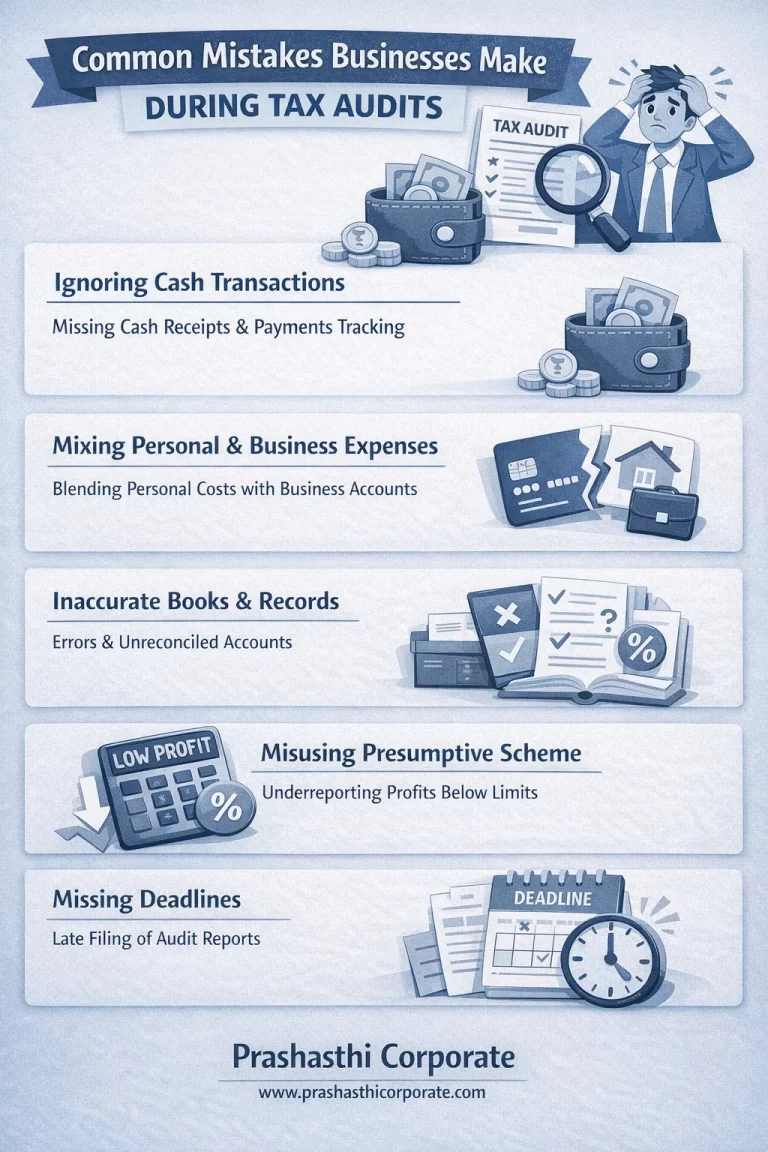
Why might choosing the 'Presumptive Scheme' complicate things?
Presumptive Taxation Scheme – Section 44AD – is a good option for many small businesses because it allows them to avoid making detailed records and journals of transactions and maintain tax records by just providing a general overview of their business activities. However, if you choose this option, you must still meet the specific requirements for conducting tax audits for some businesses.
If you choose this option and report lower profits than are allowed by law (either 8% of total income from non-digital sales or 6% of total income from digital sales) and your business has taxable income exceeding the basic exemption level, you will be required to complete a tax audit. You cannot simply choose the lower profit option without the proper documentation to support your decision. This makes accurate income computation essential. Businesses that do not fully understand how business income tax is calculated in India often underestimate their compliance exposure.
In addition, the limit for presuming on tangible assets (also known as “tangible property”) has now increased to ₹3 Crores, as long as cash receipts do not exceed 5%. This means that tax audit requirements are now very flexible; however, you will need to have clear records supporting this flexibility. Proactive tax planning and management therefore plays a crucial role when opting for presumptive schemes
Why is September 30th An Important Date For Your Calendar?
Understanding the timelines is as important as understanding thresholds. Due date for submission of Tax Audit Report (Form 3CA/3CB and Form 3CD) is September 30th of the Assessment Year. Being unable to meet this deadline has a direct consequence on your ITR filing since tax audit requirements need to be fulfilled earlier to the submission of the return.
The last date to file your Tax Audit Report for AY 2026–27 (FY 2025–26) is September 30, 2026 and the ITR filing deadline for audited cases is October 31, 2026. For taxpayers with abroad transactions requiring a transfer pricing audit, the extended deadline is October 31, 2026 for the audit report itself.
Important: Change in Budget 2026: If you miss the September 30 limit, you will be assessed an automatic fee (not a penalty) by the Income Tax Portal. Officers won’t have the option to charge you for this fee. Any delay up to 30 days shall attract a fee of ₹75,000; and any delay after 30 days shall attract a fee of ₹150,000. The “reasonable cause” argument will not hold from AY 2026-27 onwards.
Another important reason to act fast is that from April 2026, the ICAI will allow only 60 audits per CA partner. That means busy organizations could fill up fast; those that wait until the last quarter could really feel pressure to act quickly. Don’t leave booking your CA till the last minute – get it booked well before August.
What are the financial consequences of ignoring an audit?
Failure to comply with tax audit obligations can create high costs for taxpayers. Section 271B states that noncompliance will result in a penalty of 0.5% of a taxpayer’s turnover with a maximum penalty amount of ₹1,50,000. For those businesses that have a very small profit margin this is a significant amount.
The tax audit requirement serves to verify and enforce that a taxpayer’s accounting records and related entities are in conformance with all applicable laws and regulations. If a taxpayer does not meet these requirements, then they could face additional audits and notices from the income tax department and greater scrutiny from other tax authorities.

What Is the 5% Cash Rule and How Does It Affect Tax Audit Applicability?
The 5% Rule holds great significance with regard to the change in Tax Audit Requirements. The new turnover limits, which allow for relaxed cash receipts and cash payment thresholds, require both transactions to be less than 5% of total cash.
If either exceeds this threshold, you are immediately reverted to the Old Limits of ₹1 Crore, relating to Businesses, or ₹50 Lakhs, relating to Professionals.
How to Stay Audit-Ready Without Stress (Quick Checklist)
- Maintain monthly reconciliation
- Keep cash and digital transactions distinct;
- Proactively monitor the 5% cash threshold;
- Refrain from combining personal and business expenses;
- Review presumptive declarations prior to filing;
- Prepare audit documentation well in advance of September.
How Can Businesses Prepare in Advance to Avoid Tax Audit Issues?
Good preparation removes most of the stress around tax audit requirements. Organize your invoices monthly, separate cash records from digital transactions, and reconcile your books on time. This not only makes the audit smoother but also helps you clearly prove whether you meet or avoid tax audit requirements under the 5% Rule.
Being proactive gives you a clear view of your financial health and keeps your compliance journey steady.
As businesses grow, tax audits increasingly intersect with broader financial decisions such as capital structuring, MAT applicability, and leverage planning. Understanding corporate tax breakup for different company types along with MAT applicability for startups in India helps businesses approach audits as part of a long-term financial strategy rather than a standalone compliance task.
Why Is Professional Guidance Important for Managing Tax Audit Compliance?
Growing turnover is a positive sign, but it also means paying attention to tax audit requirements. Did your business exceed ₹1 Crore, or enjoyed the 10 Crore digital mark, or surpassed the professional boundary, or prefer presumptive taxation: it is always better to know the precise provisions so you do not incur expensive errors.
Prashasthi Corporate would gladly bear the burden so you can concentrate on what is most important to you- growing your business with the confidence you merit.




Pingback: Corporate Tax in India: Rates & Breakup by Company Type
Pingback: Digital KYC for Indian Corporates: Compliance, Onboarding & Future Trends
Pingback: OPC Company Registration vs Sole Proprietorship (2026 Guide)
Pingback: Partnership Firm Registration Cost in Bangalore (2026 Fees Guide)
Pingback: OPC vs LLP Tax 2026: Which Saves More Tax in India?
Pingback: MSME Form 1 Filing Requirements in 2026 Explained
Pingback: Audit Types in India: Know Which Audit Your Business Needs