

Most companies don’t suddenly discover MSME Form 1 filing requirements because they were proactively tracking compliance. Usually, the panic starts a week before the deadline.
The accounts team pulls an ageing report. Someone notices a few old vendor invoices. Then comes the real confusion.
“Is this supplier even registered as an MSME?”
“Does this payment cross 45 days?”
“Do we actually need to file?”
This happens with so many people.
In 2026 audits, tax reviews, due diligence checks, and internal compliance inspections, the delayed MSME payments are now being identified. Section 43B(h) has also increased the burden, as payment delays have already begun to impact tax planning and statutory reporting obligations during the tax audit process for companies.
In this blog, we will understand the applicability of MSME Form 1, who needs to file, due dates, documents required, typical mistakes, and a realistic CFO checklist in simple terms.
What Is MSME Form 1, And Why Was It Implemented?
The MSME Form 1 is a half yearly return to be filed with the Ministry of Corporate Affairs (MCA). It is utilized by firms to settle outstanding dues of Micro and Small Enterprises.
The government introduced this because delayed payments were becoming a serious problem for smaller businesses.
A large company delaying payment by two months may treat it as routine cash flow management. For a small supplier, that same delay can affect salaries, inventory purchases, rent, and day-to-day operations.
That imbalance is exactly why this reporting system exists.
The filing requirement comes under Section 405 of the Companies Act, 2013, and forms part of broader corporate compliance obligations covered in this comprehensive ROC filing checklist for private limited companies.
But honestly, most companies do not think about the law first. They think about it when:
- auditors start asking questions,
- tax consultants bring up Section 43B(h),
- or the compliance team realizes vendor data is incomplete.
Who Must File MSME Form 1?
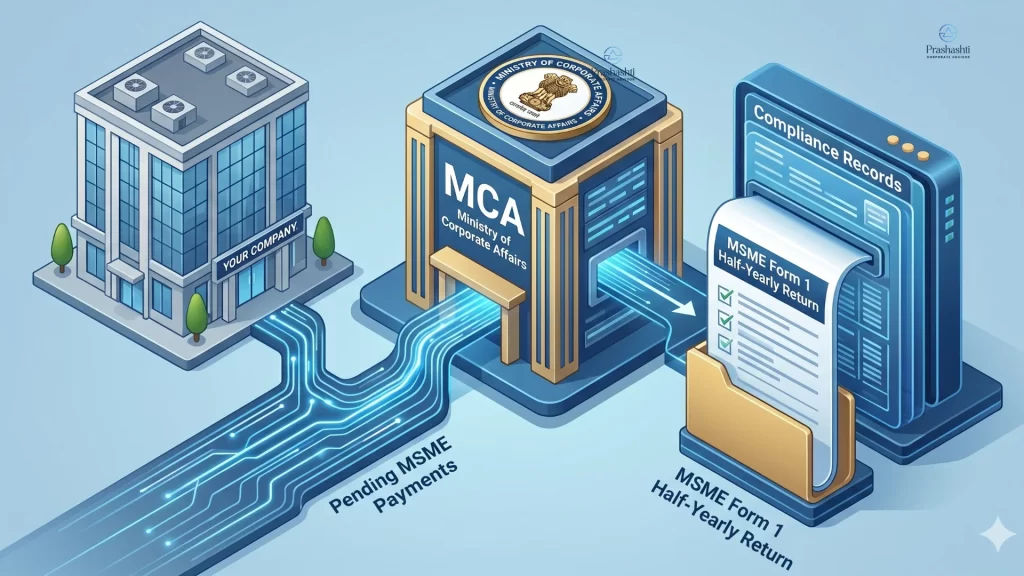
Just because a vendor is small does not automatically mean MSME Form 1 applies. A company needs to file MSME Form 1 if:
- The supplier is an officially registered Micro or Small Enterprise as per Udyam Registration.
- That payment is more than 45 days overdue for that supplier.
- The business is a company incorporated under the Companies Act.
The filing requirement can apply to:
- Private limited companies.
- Public limited companies.
- OPCs
- Section 8 companies.
- Startups with overdue MSME payments.
One thing many finance teams miss is that medium-sized enterprises are not covered under this reporting requirement.
LLPs and partnership firms are generally outside the scope of MSME Form 1.
Expert Insight:
Authority Fact: As per the RBI’s latest 2026 updates, the current Bank Rate dictates that the MSMED Interest Penalty (which is 3x the Bank Rate) remains a challenging 16.5% per annum.
For a CFO, a late payment is a high-interest, non-tax-deductible loan. At Prashasthi Corporate Services, we have noted that the MCA’s V3 platform now automatically points out anomalies between your MSME Form 1 filings and your Section 43B(h) tax claims.
Understanding the MSME Form 1 Filing Requirements
MSME Form 1 filing requirements are a half-yearly thing. Missing these dates can lead to penalties under Section 405(4) of the Companies Act, which was recently tightened to include fines up to ₹3 lakh for continued non-compliance.
The filing gets triggered when:
- The supplier is a registered Micro or Small Enterprise, and
- Payment crosses the 45-day limit.
That’s the core rule.
Requirement | Description |
Applicable Entity | Companies purchasing from MSMEs |
Trigger Condition | Payment pending beyond 45 days |
Filing Frequency | Half-yearly |
Governing Authority | MCA |
Relevant Law | MSMED Act + Companies Act |
The real challenge is not understanding the rule. The challenge is maintaining clean records throughout the year.
A lot of finance teams still depend heavily on Excel sheets for vendor tracking. The problem starts when nobody updates those sheets regularly.
Then the filing deadline arrives and suddenly old invoices are being checked manually one by one. That is where the problems happen.
How Does the 45-Day Rule Affect MSME Form 1 Filing Requirements?
The 45-day timeline sounds simple until companies actually start calculating it.
Under MSME rules:
- Payment should generally be made within the agreed credit period.
- Even if both the parties agree to a longer timeline, the payment period normally cannot exceed 45 days.
- The countdown starts from the date of acceptance of goods or services.
Now this is where it gets tricky.
- Companies delay formal acceptance internally.
- Purchase teams may not update records properly.
- Approval emails may sit unanswered for days.
The law also talks about deemed acceptance. So if objections are not raised within a specific period, acceptance may automatically be assumed.
MSME Form 1 Due Date in India: Important Filing Timeline
The MSME Form 1 due date comes twice every year. For April to September, the due date is 31 October. For October to March, the due date is 30 April.
Reporting Period | Due Date |
April to September | 31 October |
October to March | 30 April |
Many businesses still review MSME dues only near these deadlines. That approach usually creates unnecessary pressure.
Many companies are moving to monthly tracking of MSMEs in 2026. Mostly because compliance scrutiny has increased sharply after Section 43B(h).

What Important Details Are Needed for MSME Form 1 Filing Requirements?
Before preparing the form, companies usually need:
- Supplier details,
- Udyam Registration information,
- Outstanding invoice amounts,
- Ageing reports,
- and reasons for delayed payment.
Sounds simple. But in practice, vendor records are often scattered across departments.
Procurement has one version. Accounts have another. Compliance teams chase both sides for confirmation.
That is why businesses are now trying to integrate MSME verification directly into vendor onboarding systems.
How Do Companies Handle MSME Form 1 Filing Requirements on the MCA Portal?
The filing itself is not the difficult part.
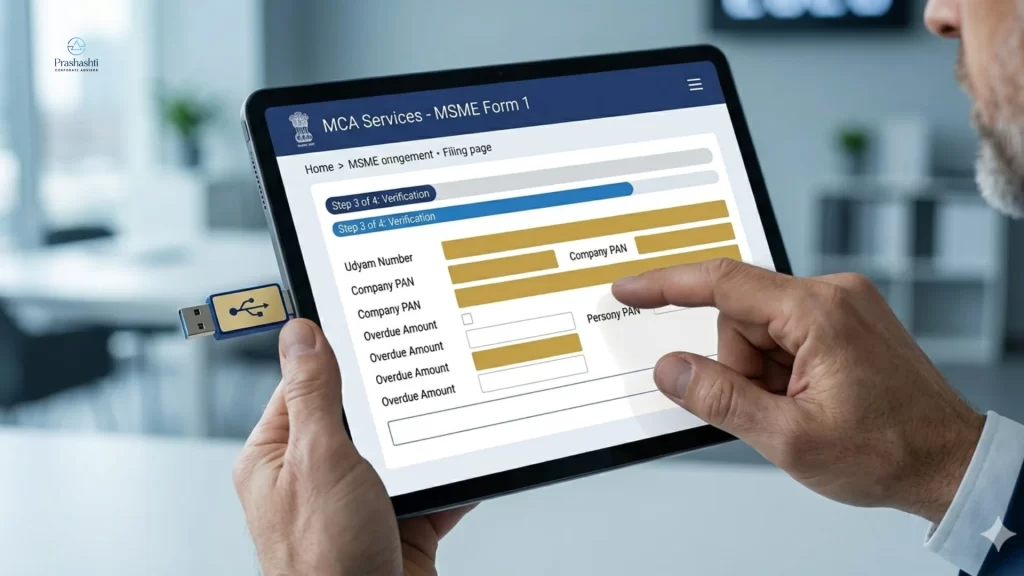
Companies log into the MCA portal, fill in supplier details, add overdue payment information, attach supporting records where needed, and submit the form using DSC authentication.
That part can usually be completed fairly quickly.
What consumes time is preparing accurate data.
Especially when:
- Invoice ageing is unclear,
- Vendor classification was never verified.
- Or departments maintained separate records all year.
By the time the deadline arrives, finance teams often spend more time fixing data than actually filing the form.
Common MSME Filing Mistakes CFOs Still See
Some of the most common mistakes include:
- Assuming vendor MSME registration is not important.
- Checking overdue invoices only near the filing deadline.
- Confusing Medium Enterprises with Micro and Small Enterprises.
- Maintaining incomplete ageing reports.
- Missing proper vendor declarations during onboarding.
One of the common problems that finance teams deal with is insufficient documentation. The supplier may have its MSME status, but nobody collected the Udyam details earlier.
Then, just before filing, accounts teams start chasing old emails, invoices and vendor confirmations. That last minute hurry tends to lead to reporting errors and undue stress.
Is Your Old Vendor List Still Valid for MSME Form 1 Filing in 2026?
A mistake many companies are still making in 2026 is relying on old MSME certificates collected last year. Vendor classifications do not stay fixed forever.
Updated MSME Classification Matters
Because of inflation-linked adjustments and business growth, some vendors that earlier qualified as “Small” may now fall under the “Medium” category.
- Micro: Up to ₹2.5 Cr Investment / ₹10 Cr Turnover
- Small: Up to ₹25 Cr Investment / ₹100 Cr Turnover
Why This Changes Your Filing Requirement
If a supplier has moved into the “Medium” category, MSME Form 1 may no longer apply to that vendor.
Pro tip: A fresh Udyam Verification this quarter can help companies avoid unnecessary reporting and reduce compliance confusion later.
What MSME Form 1 Filing Requirements Should CFO Teams Check Before Filing?
A good MSME compliance filing typically begins far before the filing deadline. Those companies that wait until the last week generally have untidy records and missing vendor details.
Here are some practical actions that can make the process easier:
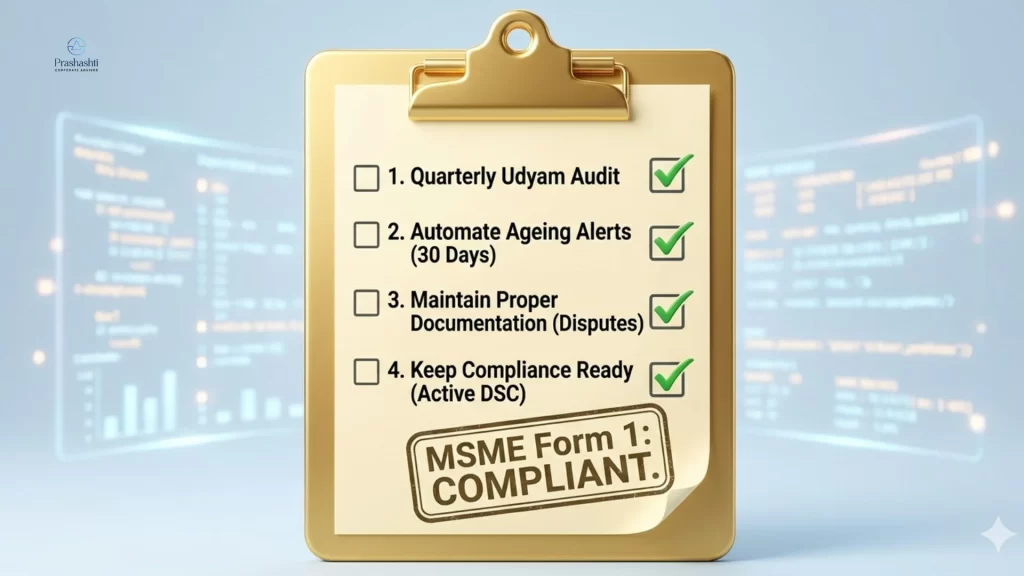
Quarterly Udyam Audit
Don’t rely on vendor data from the past. The categorization of MSMEs may vary over a period of time. Therefore, finance teams should keep on checking the Udyam Registration Portal for supplier details from time to time.
Automate Ageing Alerts
Many corporations are now installing ERP systems like SAP, Tally or Oracle to flag MSME invoices after 30 days. That extra buffer allows teams to act before the 45-day limit becomes a compliance problem.
Maintain Proper Documentation
In the event of a quality issue, procurement teams should document the dispute within the 15-day window to pause the “Deemed Acceptance” clock.
Keep Compliance Ready
Ensure the Director’s DSC remains active before filing deadlines and maintain a separate MSME ledger to make MCA reporting easier.
Wrapping Up MSME Form 1 Filing Requirements with Prashasthi Corporate Services
Most companies do not struggle with MSME Form 1 because the form is not difficult. The real issue is usually poor tracking. Vendor details are missing, ageing reports are checked too late, and suddenly, the finance team is trying to fix everything near the deadline.
That is why MSME compliance now needs regular attention instead of last-minute filing work.
Updating MSME data throughout the year makes it easier for firms to make the entire process much less stressful. As the requirements keep on changing, teams working with experienced compliance professionals like Prashasthi Corporate Services find it easier to stay organised, prevent last-minute confusion, and handle the MSME reporting in a more streamlined manner.