


Imagine you live in Dubai and want to start a business in India. You have the money, the idea is ready, and someone in India is willing to help. But can you register an LLP while living abroad? Yes, NRIs can register an LLP in India in most cases, provided they meet the applicable legal and investment requirements. At least one Designated Partner must meet the residency requirement of 120 days in a financial year under Section 7 of the LLP Act, 2008. Your business activity must also qualify under the applicable FEMA and FDI rules, and the required RBI filings must be completed after the investment.
This guide covers LLP registration for NRIs, from eligibility and documents to registration costs, timelines, and annual compliance. Updated for 2026, it also covers Press Note 2 and the new Income-tax Act, 2025. If you’re planning to set up a business in India as an NRI, check the FEMA rules before transferring any money.
Prashasthi Corporate three-check test: Never treat NRI incorporation as one decision. Ask three separate questions. Can the partners join (LLP Act)? Can the money come in (FEMA)? Can the resident partner stay compliant (120 days)? If any answer is “not sure,” pause before filing.

Can an NRI Register an LLP in India?
Yes, with conditions. The LLP Act, 2008 decides who can become a partner. FEMA and the FDI policy then decide whether a non-resident can invest in your particular business. Many people mix up the two. Being allowed to join an LLP does not mean you can invest in any sector.
LLP for foreign nationals follows the same Act, but conditions differ by investor. NRIs, OCIs, and other non-residents can face different approval rules. Investors or beneficial owners linked to land-border countries, and Pakistan-related cases, are assessed separately. Check the current FDI policy for your own case.
Can an NRI be a Designated Partner?
Yes. A Designated Partner carries the legal responsibility for the LLP’s filings. An NRI can hold the role, as long as at least one Designated Partner is resident in India.
LLP Registration Eligibility for NRIs in India: Requirements and Rules
The main incorporation requirements are simple:
- At least two partners, with no upper limit.
- At least two Designated Partners who are individuals.
- A registered office in India, for which you may consider a Virtual Office in Bangalore, subject to applicable registration requirements.
- No minimum capital under the LLP Act. (Your bank, your business plan, and your licences may still need a certain amount.)
The Resident Designated Partner Rule
Section 7 of the LLP Act, 2008 says at least one Designated Partner must be a resident in India. Since the 2021 amendment (effective 1 April 2022), that means at least 120 days of stay during the financial year. The old test was 182 days, and many websites still print it. This is a days-of-stay test, not a citizenship test. It is also different from the Resident Director rule for private companies, which uses 182 days.
Expert Insight from Arun Bhandary, Founder, Prashasthi Corporate Advisors: Do not name a resident Designated Partner just because they have an Indian address. Ask for proof of how many days they will actually be in India this financial year. If they travel a lot, you have a problem waiting to happen, because the LLP has to keep a resident Designated Partner all through its life, not only on the day of incorporation.
FDI and FEMA Rules for LLP Registration for NRIs in India
Foreign investment in an LLP needs particular attention, because the rules depend on your sector, your investor status, and the way the money moves.
Automatic Route for FDI in LLP
Foreign investment in an Indian LLP is allowed under the FEMA Non-Debt Instruments Rules, but the automatic route is not open for every business. These FDI rules for LLP say the LLP’s activity must sit in a sector where 100% FDI is allowed under the automatic route, with no FDI-linked performance conditions. Sectors that need government approval or carry caps cannot use the LLP structure. Some activities, such as lottery, gambling, chit funds and Nidhi companies, are prohibited for foreign investment. Please check the current sector list with the DPIIT and the RBI before you commit, and review the applicable Business License Registration requirements for your proposed activity.
A software consulting LLP often qualifies, but check the exact activity. If your activity has an FDI cap or needs approval, compare structures and routes before you choose. A private limited company works only where the rules allow that investment.
Expert Insight from Arun Bhandary, Founder, Prashasthi Corporate Advisors: Before I discuss the registration form with any NRI, I ask for the NIC code and a one-paragraph description of the business. The sector check decides everything that follows. Do not send money into India until this is settled.
NRI Investment On A Non-Repatriation Basis
NRIs and OCIs can also invest on a non-repatriation basis, which may be treated like domestic investment under the FEMA Non-Debt Instruments Rules. You then cannot freely send the money or profits abroad. The exact treatment depends on the investor and the transaction, so confirm it with your CA before you transfer funds.
Land-Border Countries (Press Note 2, 2026)
In March 2026, DPIIT issued Press Note 2 (2026 Series), revising the FDI policy on investments connected with countries sharing a land border with India. The rules address beneficial ownership, applicable ownership thresholds, control, and ultimate effective control. The applicable FEMA notification and implementation requirements should also be checked before investing. Do not assume that a shareholding percentage alone determines whether approval is required.
RBI Reporting After You Invest
RBI reporting depends on the investment or transfer and the FEMA guidelines that apply. Form LLP-I covers specified capital contributions and profit-share acquisitions by a non-resident. Form LLP-II covers specified transfers between residents and non-residents. An LLP that has received investment may also be required to file an annual FLA return. Confirm applicability and deadlines with your authorised dealer bank.
All of this is filed on the RBI’s FIRMS portal through the LLP’s bank. Some sites mention FC-GPR/FIFP. Neither is the form for an LLP. FC-GPR is for companies issuing shares, and an LLP uses LLP-I. Keep the inward remittance proof and KYC papers from the first transfer.

Documents Required for LLP Registration by NRIs
The LLP registration documents for NRI partners differ from those of resident partners. Confirm the final list with the MCA on the day you file, and review the Documents Required for LLP Registration in Bengaluru for additional guidance.
Who | Documents usually needed |
NRI or foreign partner | Passport; overseas address proof such as a bank statement or utility bill (recent); photograph, email and mobile number; consent to act as Designated Partner (Form 9) |
Resident partner | PAN; Aadhaar, passport or voter ID; recent address proof; photograph, email and mobile number |
Registered office | Utility bill; rent agreement or ownership proof; NOC from the owner |
A bank, a DSC provider and the overseas authority may each ask for something extra. These are not part of the MCA list, so keep them apart in your own checklist.
Authenticating Overseas Documents
The route depends on the country and the document. If your country is a member of the Hague Apostille Convention, documents are usually notarised and then apostilled (see the HCCH for the member list). If it is not, they are usually attested by the Indian Embassy or Consulate (see the Ministry of External Affairs). Add an English translation where needed. Do not assume that apostille works for every country and every document.
Expert tip from Arun Bhandary: Compare the spelling of your name on the passport, the address proof, and the DSC application before you notarise anything. A mismatch is a cheap error to fix before notarisation and an expensive one after.
Step-by-Step NRI LLP Registration Process
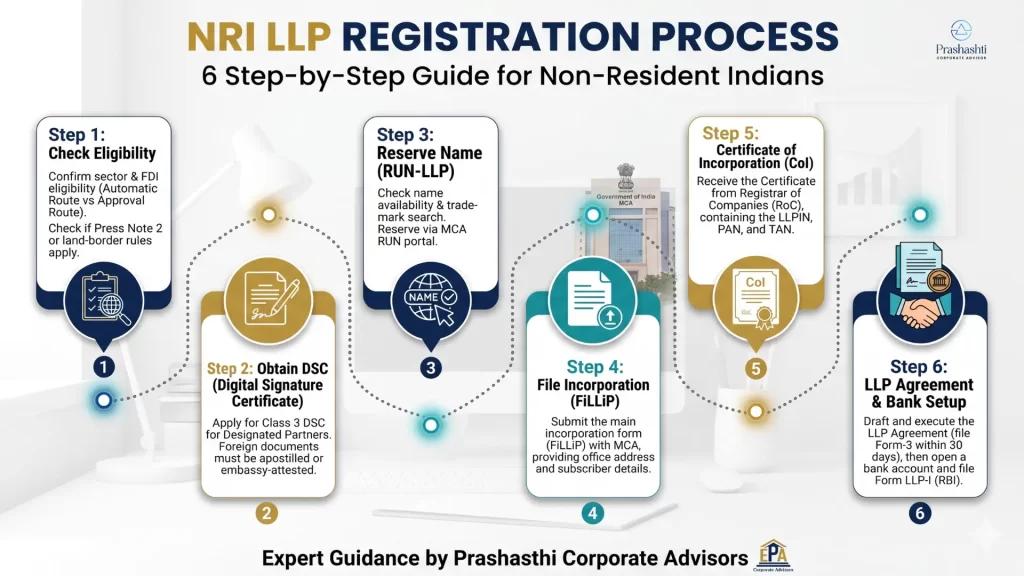
The NRI LLP registration process has six steps. Think of them in order. Skipping step 1 is the costliest mistake.
- Check the business activity and investor status: Confirm the sector, the investment route, and whether any land-border or other approval rule applies.
- Get the DSCs: Every Designated Partner needs a Class 3 DSC. Foreign applicants usually have to send authenticated identity documents.
- Reserve the name: Use the RUN-LLP service or the name field in the incorporation form. Check that the name does not match an existing company, LLP or trademark.
- File FiLLiP: This is the MCA’s incorporation form. It carries partner details, the registered office, the business activity and the subscriber details. Check every field before you submit, since corrections afterwards cost time.
- Receive the Certificate of Incorporation: The Registrar issues it with your LLPIN. Check which tax identifiers, such as PAN and TAN, come with it. Do not treat banking and tax set-up as complete at this stage.
- Sign and file the LLP agreement: The agreement fixes the capital, the profit-sharing ratio and each partner’s role. File it on Form 3 within 30 days of incorporation. Stamp duty depends on the state. Then open the bank account and, if foreign money is coming in, plan the Form LLP-I filing.

LLP Registration Cost for NRI Partners and Timeline
The LLP registration cost for NRI founders has four parts: government fees, DSC charges, state stamp duty, and overseas document costs. Here are indicative figures. Verify each on the MCA portal before you budget.
Item | Indicative cost |
Name reservation (RUN-LLP) | ₹200 |
FiLLiP filing fee | ₹500 to ₹5,000, depending on the contribution slab |
DSC per Designated Partner | ₹1,000 to ₹2,500 (provider charge, not a government fee) |
Stamp duty on the LLP agreement | Varies by state |
Notarisation, apostille or attestation abroad | Varies by country |
Professional fees | Varies by provider |
Providers often quote ₹6,000 to ₹35,000 in total. Ask whether that includes DSCs, stamp duty and authentication. With clean documents, expect roughly 10 to 15 working days. Document authentication, name approval and MCA processing decide the real number.
LLP vs Private Limited Company for NRIs in India: Which Is Better?
Both work for NRI business in India. The right one depends on your sector and funding plan, as well as the advantages and disadvantages of an LLP in India.
Point | LLP | Private Limited Company |
Foreign investment | Only in sectors on the automatic route with no conditions | Route depends on the sector; most sectors allow it, with conditions in some |
Resident requirement | One resident Designated Partner (120 days) | One resident director (182 days, per the Companies Act) |
Raising money | Capital contribution only; no shares or ESOPs | Can issue shares; investors often prefer this |
Yearly MCA forms | Form 8 and Form 11 | AOC-4 and MGT-7 |
Tax | Flat 30% plus surcharge and cess; partners’ profit share is exempt | Taxed as a company. Check current rates and conditions with your tax adviser. |
Consider an LLP if your activity is eligible, you want a flexible partnership arrangement and you do not plan to sell equity. Consider a private limited company if you plan to raise investor money, issue employee stock options, or sit in a sector with conditions.
If you are still weighing the two, see our pages on LLP registration and private limited registration.
Post-Registration Compliance and Taxation for an LLP Owned by NRIs
Registration is the easy part. These are the usual yearly items. Dates can change through MCA or CBDT notifications, so confirm them each year.
- Form 11 (annual return): due 30 May.
- Form 8 (statement of account and solvency): due 30 October.
- DIR-3 KYC for every Designated Partner: due 30 September.
- Income tax return (ITR-5): 31 July for non-audit cases and 31 October for audit cases, unless extended. However, for audited cases in Tax Year 2026-27, the Tax Audit Report is due 21 October 2026, and the final audited ITR is due 21 November 2026.
- Form 3 and Form 4: file within 30 days of a change in the LLP agreement or in partners.
- FEMA filings: Form LLP-I, Form LLP-II, and the FLA return, only where they apply to your investment.
Missing Form 8 or Form 11 triggers a slab-multiplier fee escalating up to 30 times the normal filing cost, plus an uncapped daily fee beyond 360 days. Audit applies above the limits in the LLP Rules (₹40 lakh turnover or ₹25 lakh contribution at the time of writing), so check the current rule. Our statutory compliance team tracks these dates for clients.
For FY 2025-26, an LLP pays 30% tax, plus 12% surcharge above ₹1 crore and 4% cess. A partner’s profit share is exempt, while remuneration and interest are taxable. For payments or credits up to 31 March 2026, Section 194T of the 1961 Act applies. From 1 April 2026, the same TDS sits under Section 393(3) of the Income-tax Act, 2025 (Table, Sl. No. 7). The rate is 10% on the full amount once payments or credits to a partner pass ₹20,000 in a financial year. If the partner is a non-resident, ask your tax professional whether this rule or the non-resident TDS rule under Section 393(2) applies.
Expert Insight from Arun Bhandary, Founder, Prashasthi Corporate Advisors: Put the Form 11 and Form 8 dates in the calendar of both the resident and the overseas partner, not only the accountant’s. Digital signatures from an overseas partner take time to arrange, and a Form 8 deadline is not the moment to discover that a DSC has expired.
5 Common Mistakes to Avoid During LLP Registration for NRIs
- Sending money before the sector check: If the sector does not qualify, you may have to unwind the investment.
- Treating the resident partner as a formality: The resident Designated Partner is a legal requirement for the whole life of the LLP.
- Skipping the LLP agreement details: Capital, profit share, exit, and what happens if a partner dies or leaves must be written down. The default rules in the Act may not suit you.
- Missing the RBI filing: The bank transfer is not the end of the job when foreign investment comes in.
- Choosing an LLP when you plan to raise equity: An LLP cannot issue shares, so switching later means a conversion and fresh compliance.
Need Expert Help with LLP Registration for NRIs in India?
Not sure whether your sector qualifies, or how to authenticate your documents from abroad? Our corporate advisory team checks your FDI and FEMA position, reviews your overseas documents, and handles the full incorporation and the filings after it.