

Every September, we get the same call at our desk: “Wait, do I actually need an audit? Which one?” And every September, someone finds out the hard way, with a notice, a fee, or a rejected loan application.
Here’s the truth: there isn’t just one type of audit. For most Indian businesses, three of the most important to understand are statutory, tax, and internal audits. They’re governed by different laws, triggered by different thresholds, and done by different people for different reasons. Confuse them, and you either pay for an audit you didn’t need, or worse, skip one you legally required.
This blog breaks down the three main audit types for Indian businesses: statutory, tax, and internal. By the end, you’ll also know exactly which one applies to you.
What Are the Different Types of Audits in India?
There are several types of audits in India. They are done for different legal, tax, compliance, risk and financial purposes. The main types of audits in India are statutory, tax, internal, cost, secretarial, GST reconciliation, forensic, and bank-related audits.
Audit Type | Governing Law | Mandatory? | Who Conducts It |
Statutory Audit | Companies Act, 2013 | Yes, for all companies | Chartered Accountant |
Tax Audit | Income Tax Act (Section 63, formerly 44AB) | Yes, above turnover/receipts threshold | Chartered Accountant |
Internal Audit | Companies Act, Section 138 + Rule 13 | Yes, for listed companies and large unlisted/private companies. | CA, Cost Accountant, or Board-appointed professional |
GSTR-9C / GST Reconciliation Statement | CGST Act, Section 44 + Rule 80 | Required for taxpayers crossing the prescribed turnover threshold. | Self-certified by the taxpayer; GST authorities may conduct a separate audit. |
Cost Audit | Companies Act, Section 148 | Yes, for specified regulated/non-regulated sectors above turnover thresholds. | Cost Accountant in practice. |
Secretarial Audit | Companies Act, Section 204 | Yes, for companies above prescribed capital/turnover/borrowing limits. | Company Secretary in practice. |
Forensic Audit | No single dedicated statute, triggered by suspected fraud, litigation, or regulator direction. | Situational | Forensic auditor/CA with forensic expertise. |
Stock/Concurrent Audit | Bank-specific/RBI guidelines | Mandatory for borrowers above bank-set limits | CA appointed by the lending bank. |
We’ll cover statutory, tax, and internal audit in depth below, since these are the ones most businesses actually need to plan for.
Which Audit Types in India Are Mandatory?
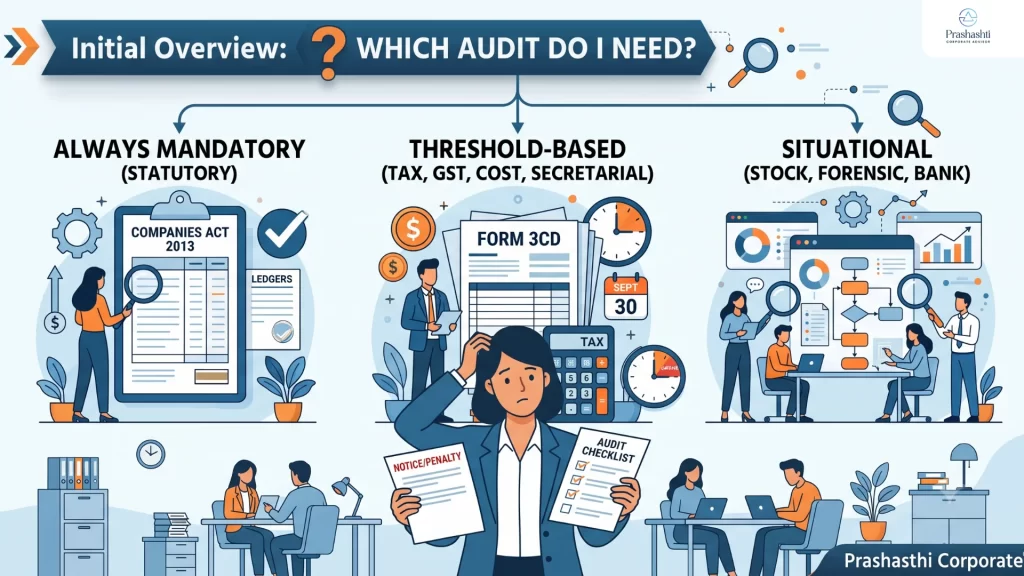
Before the deep dive, here’s the mandatory-vs-situational split that most readers are actually looking for:
- Always mandatory once you’re a company: Statutory audit
- Mandatory once you cross a number: Tax audit, GST reconciliation (GSTR-9C), cost audit, secretarial audit, internal audit.
- Mandatory only if a bank or regulator asks for it: Stock audit, concurrent audit, forensic audit.
Unsure about your audit requirements?
What Is a Statutory Audit?
A statutory audit under the Companies Act, 2013 is the one no company can skip. Under Section 143, every company registered in India, be it a private limited, public limited, or one-person company, it doesn’t matter; it must get its books audited every year by an independent Chartered Accountant.
There’s no turnover exemption here. A company that made zero revenue last year still needs one. A dormant company still needs one.
According to the Ministry of Corporate Affairs’ Corporate Data Management portal, India has well over 22 lakh companies registered with the MCA, of which more than 14 lakh are currently active. Every one of those active companies, from a single-founder private limited company to a listed multinational, owes a statutory audit each year, regardless of size.
In our experience advising early-stage founders, this is the single most common surprise: people assume “no business activity” means “no audit,” and it doesn’t.
Key facts about statutory audit:
- Law: Companies Act, 2013 (Section 139–147).
- Who it applies to: Every registered company, without exception.
- Auditor appointment deadline:The first auditor of a non-government company is appointed by the Board within 30 days from the date of registration; if the Board fails to do so, the members appoint an auditor in the required manner. The appointment of the following auditors is generally made at the Annual General Meeting.
- What it looks at: Whether the financial statements present a “true and fair view” of the company’s financial status in accordance with accounting rules.
- Who benefits: Shareholders, regulators, lenders and anyone who needs the company’s numbers to be correct.
Sole proprietorships and most partnership firms don’t fall under this rule; statutory audit is a company-specific obligation. But once you incorporate, the clock starts.
What Is a Tax Audit?
A tax audit doesn’t care whether you’re a company, a proprietorship, or an LLP. It cares about one thing: how much money moved through your books.
Tax audit applicability in India in 2026 works on thresholds set under Section 44AB of the Income Tax Act. For more details, see our guide on tax audit requirements.
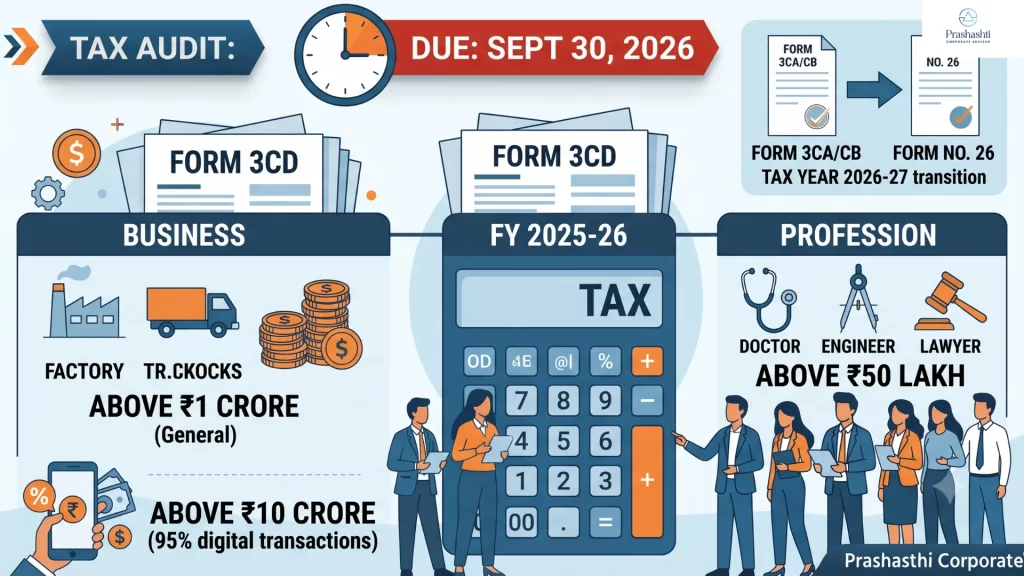
For FY 2025-26 (AY 2026-27), tax audit thresholds under the Income Tax Department’s framework are:
Category | Threshold |
Business | Above ₹1 crore |
Business where cash receipts AND cash payments are within 5% | Above ₹10 crore |
Profession | Above ₹50 lakh |
The enhanced limit only kicks in if cash receipts and cash payments each stay within 5% of total transactions. If you cross that cash limit even slightly, you drop back to the lower threshold. There’s also a separate trigger for taxpayers under presumptive taxation schemes (like Section 44AD) who declare profits lower than the prescribed rate; audit applies to them too, regardless of turnover.
How it works:
Where TDS applies, businesses must also ensure that the deducted amount is deposited correctly; see our guide on how to pay TDS online for the payment process.
- Conducted by: A practising Chartered Accountant.
- Report format: Form 3CA or 3CB, along with Form 3CD. Form 3CA applies where your accounts are already audited under another law (typically companies); 3CB where they aren’t.
- Due date: 30 September 2026 for most taxpayers; 31 October for those covered under transfer pricing provisions.
- Penalty for missing it: A fee under Section 271B, 0.5% of turnover or gross receipts, capped at ₹1.5 lakh. Budget 2026 relabelled this from a “penalty” to a “fee,” but the amount still lands on you.
A Quick Word on the 2026 Transition
This is worth flagging clearly, because it trips up even experienced finance teams: from 1 April 2026, the Income-tax Act, 2025 has replaced the 1961 Act. Tax audit is now covered under Section 63 of the new Act (the old Section 44AB), and from Tax Year 2026-27 onward, Forms 3CA, 3CB, and 3CD get consolidated into a single new form, Form No. 26.
For your FY 2025-26 filing (due September 2026), you’re still working with the old forms and the old section numbering. The new Form 26 framework kicks in for Tax Year 2026-27 and beyond. Don’t assume the paperwork stays the same next year; it doesn’t.
Missing the tax audit deadline carries a cost of 0.5% of turnover or ₹1,50,000, whichever is lower. We’d rather you plan for September than find this out in an assessment notice.
One thing worth remembering: a company that crosses the tax-audit threshold ends up doing both a statutory audit and a tax audit in the same year, and the tax audit typically builds on the already-audited financial statements. A proprietorship crossing the threshold only needs the tax audit, statutory audit doesn’t apply to it at all.
What Is an Internal Audit?
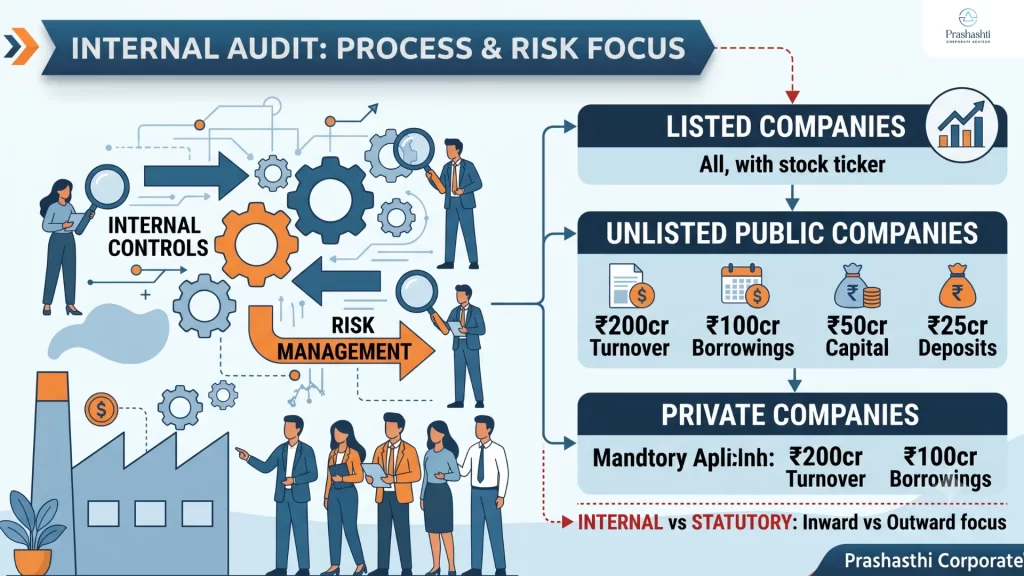
This is where internal audit vs statutory audit in India confusion usually starts. People assume internal audit is a lighter, informal version of statutory audit. It isn’t. It looks inward, at your processes, controls, and risk management, for your own management and board, not for outside stakeholders.
Under Section 138 of the Companies Act, read with Rule 13 of the Companies (Accounts) Rules, 2014, internal audit becomes mandatory for prescribed classes of companies, assessed against the immediately preceding financial year:
- Listed companies: mandatory, regardless of size
- Unlisted public companies: mandatory if any one of these was met in the preceding financial year, turnover ₹200 crore or more, paid-up capital ₹50 crore or more, borrowings from banks or financial institutions above ₹100 crore, or outstanding deposits above ₹25 crore
- Private companies: mandatory if turnover was ₹200 crore or more, or borrowings from banks or financial institutions exceeded ₹100 crore, in the preceding financial year
Who can conduct it: A Chartered Accountant, Cost Accountant, or another professional as the company’s Board decides, within what the applicable rules permit.
Below these thresholds, internal audit isn’t compulsory. But we’ve seen plenty of growing businesses adopt it voluntarily anyway. Banks and investors increasingly ask for one during due diligence, threshold or not. Companies with significant loans, investments, guarantees or securities should also review their obligations under Section 186 of the Companies Act 2013.
Master Comparison Of Different Audit Types in India
Aspect | Statutory Audit | Tax Audit | Internal Audit |
Governing law | Companies Act, 2013 | Income-tax Act, 1961, Section 44AB for FY 2025-26; Income Tax Act, 2025, Section 63 from Tax Year 2026-27 | Companies Act, 2013, Section 138 + Rule 13 |
Mandatory for | All companies | Businesses/professionals crossing turnover limits. | Listed companies + large unlisted/private companies. |
Threshold | None | ₹1 cr / ₹10 cr (business), ₹50 lakh (profession) | ₹200 cr turnover or ₹100 cr borrowings (varies by company type). |
Conducted by | Chartered Accountant (statutory auditor) | Chartered Accountant | CA, Cost Accountant, or qualified professional. |
Report format | Auditor’s Report under Section 143 | Form 3CA/3CB + Form 3CD | Internal audit report to Board/Audit Committee. |
Due date | Before AGM | 30 September 2026 for FY 2025-26; 31 October 2026 for applicable transfer-pricing cases | No fixed statutory date; usually periodic/quarterly. |
Purpose | True and fair view of accounts for shareholders. | Verify tax compliance for the tax department. | Strengthen internal controls and risk management. |
Which One Do You Actually Need? A Quick Decision Tree
- Are you a registered company (private, public, or OPC)? → You need a statutory audit. No exceptions.
- Does your business or profession fall within the applicable tax-audit conditions? → A tax audit may be required. Check turnover/gross receipts, cash transaction conditions, and any applicable presumptive taxation provisions.
- Are you listed, or did you cross ₹200 crore turnover / ₹100 crore borrowings as a private company? → Internal audit is mandatory as well.
- None of the above apply, and you’re a proprietorship or small firm below thresholds? → No audit is legally required, though bookkeeping discipline still matters.
Can a Business Need All Three Audit Types in India?
Business situation | Statutory | Tax | Internal |
Private company, ₹5 crore turnover | yes | Usually yes, subject to tax-audit conditions | Depends on borrowings/capital |
Proprietorship, ₹5 crore turnover | No | Yes, subject to applicable conditions. | Voluntary |
Large private company meeting internal-audit threshold | Yes | Potentially | Yes |
Listed company | Yes | Potentially | Yes |
Expert Insight: The New ICAI Audit Cap Changes When You Should Book Your CA
The Institute of Chartered Accountants of India has notified the Chartered Accountants (Limit on Number of Tax Audits) Guidelines, 2025, capping each Chartered Accountant, whether practising individually or as a firm partner, at 60 tax audit assignments per financial year, effective 1 April 2026. The cap aggregates across every firm a CA is a partner in, and it can’t be pooled or shared between partners.
This isn’t just a professional-conduct detail. It has a practical consequence for you as a business owner: as the ceiling tightens capacity at busy CA practices, waiting until late August to approach an auditor is going to get harder, not easier, in the years ahead.
Our practical advice: lock in your tax auditor by July, not September. It costs you nothing to engage early, and it protects you from scrambling for a CA with spare capacity two weeks before the deadline.
Choosing the Right Audit Type for Your Business With Prashasthi Corporate
Check your entity type. Check your turnover. Check your borrowings. The law tells you exactly what applies. Skipping an audit you owe doesn’t save money; it just moves the cost from a CA’s fee to a penalty notice.
If you’re still unsure which audit types in India apply to your business, Prashasthi Corporate Advisors can map your entity, turnover, and structure against the exact thresholds and help you stay compliant through our corporate advisory services in India. Get in touch to have your audit obligations reviewed.
Disclaimer: This article is for general informational purposes and reflects the compliance position as understood at the time of writing. Tax and company-law provisions depend on your specific facts, entity type, turnover, and transaction pattern.