

Running a business is already a lot to handle. Then something small comes up; maybe your HR manager mentions that a recent payroll check doesn’t quite line up with the new labour law 2026 rules. At first, it didn’t seem like a big deal. But then the questions start. Do you need to adjust salaries? Are your employee records actually up to date? Have your contracts and policies kept up with the latest changes? These are the kinds of things most employers don’t think about until something forces them to.
The truth is, staying compliant isn’t as overwhelming as it sounds. Once you know what’s changed, it’s mostly about making a few smart updates and keeping things in check. In this blog, we’ll go over five key labour law changes you should look at this quarter, what they actually mean for your business, and how you can deal with them without overcomplicating things.
Why Employers Should Review the New Labour Law 2026 This Quarter?
Labour laws don’t stay still for long, and honestly, neither do businesses anymore. With hybrid work, changing payroll structures, and more digital processes, the new labour law 2026 isn’t just another update to skim through. It directly affects how you run your business day to day.
Where things officially stand (as of July 2026): The Ministry of Labour and Employment notified the four Labour Codes, namely, the Code on Wages 2019, Industrial Relations Code 2020, Code on Social Security 2020 and Occupational Safety, Health and Working Conditions (OSH) Code 2020, as effective law on 21 November 2025. The Central Rules under all four Codes were formally notified on 8 May 2026 providing the framework its operational backbone minimum wage computation methodologies, the pay-floor formula, digital compliance criteria and inspection mechanisms. You can verify both notices on the official portal of the Ministry of Labour and Employment and PIB press releases.
What Has Changed Compared to The Previous Regulations?
The Labour Codes 2026 update, which is gradually replacing multiple older laws with four major Labour Codes, is the biggest change. These include wages, industrial relations, social security and workplace safety.
On paper it sounds like simplification, and in many respects it is. But it also means companies will need to reconsider how they manage things like payroll, documentation and employee benefits.
Some of the major modifications are:
- Easier compliance processes.
- More move to digital records.
- A standard wage definition.
- More clear expectations around employee benefits.
- Better documentation for occupational safety.

What's Driving the Labour Codes 2026 Update?
The whole idea behind the Labour Codes is very simple: to make things simple.
Previously, employers had to navigate through many laws, of which many of them overlapped or contradicted each other. Now, everything is grouped into four broader codes, making it easier to understand what’s required.
Another big push is toward digital compliance. Employers are expected to maintain records electronically, submit returns online where needed, and keep documentation organised.
Even though labour code implementation isn’t happening at the same pace everywhere, it’s still smart to start reviewing your policies now. The Ministry of Labour and Employment maintains a dedicated FAQ page that is updated as new clarifications are issued, and it is worth bookmarking.
Not sure if you're labour law compliant?
State-Wise Labour Code Implementation Tracker (Updated 2026)
Status | States (as of mid-2026) |
Final rules notified | Madhya Pradesh, Uttar Pradesh, Gujarat, Karnataka, Haryana, Uttarakhand, Jharkhand, Odisha, Bihar, Chhattisgarh, Assam. |
Draft rules published, final pending | Maharashtra, Tamil Nadu, Kerala, Punjab, Rajasthan, Telangana, Andhra Pradesh, West Bengal. |
Still drafting / early stage | Remaining states and UTs. |
What this means practically:
- If your registered establishment is in a “final rules notified” state, the new wage, safety, and social security compliance obligations are enforceable now, inspections can and do check against them.
- If you’re in a “draft rules” state, old-law compliance still applies for state-specific procedures, but the 50% wage rule (a Central Rule) is already binding regardless of your state’s status.
- Multi-state employers should maintain a live compliance matrix rather than assuming one national deadline.
We recommend checking your state labour department’s portal directly, or having Prashasthi Corporate confirm your specific state’s status as part of a quarterly review, notifications are updated frequently and third-party trackers can lag.
Change #1: Revised Wage and Salary Compliance Requirements
Salary structures aren’t just about what employees take home each month. They affect PF, gratuity, bonuses, and other statutory payments, and even EPS pension calculation, making it important to review compensation components carefully under the new wage definition.
Key Regulatory Updates
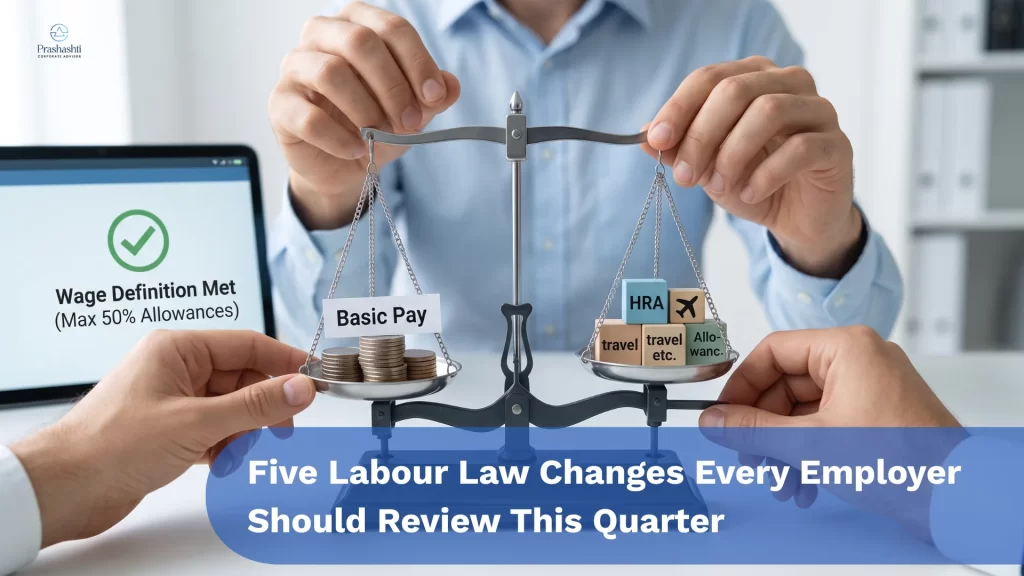
One of the most talked-about changes is the 50% wage rule. Under Section 2(y) of the Code on Wages, “wages” means all remuneration except a specific set of exclusions (HRA, overtime, commissions, gratuity, and similar components), and those exclusions cannot collectively exceed 50% of total remuneration. If too much is pushed into allowances, it directly changes how PF, gratuity, and bonus are calculated, and typically increases statutory cost.
Employers should take a closer look at:
- Salary breakups.
- Payroll systems.
- Offer letters.
- Compensation policies.
Industries Most Affected
Businesses that rely heavily on allowances or variable pay will need to review things more carefully. This includes:
- IT and tech companies
- Manufacturing
- Retail
- Hospitality
- Construction
Employer Action Checklist
Here are a few practical steps to get started:
- Review salary structures.
- Check payroll calculations.
- Update contracts if needed.
- Verify statutory contributions.
- Align HR and payroll teams.
Expert Insight: The 50% rule seems simple enough, on paper, but the companies that are hit are the ones that only fix it going forward, and don’t reconcile the last few payroll cycles. We suggest our clients do a back check for the last 2-3 months of payroll before making any changes to ensure correction is clean and does not raise any question during PF or ESIC inspection.
Change #2: Working Hours and Leave Rules Employers Should Review
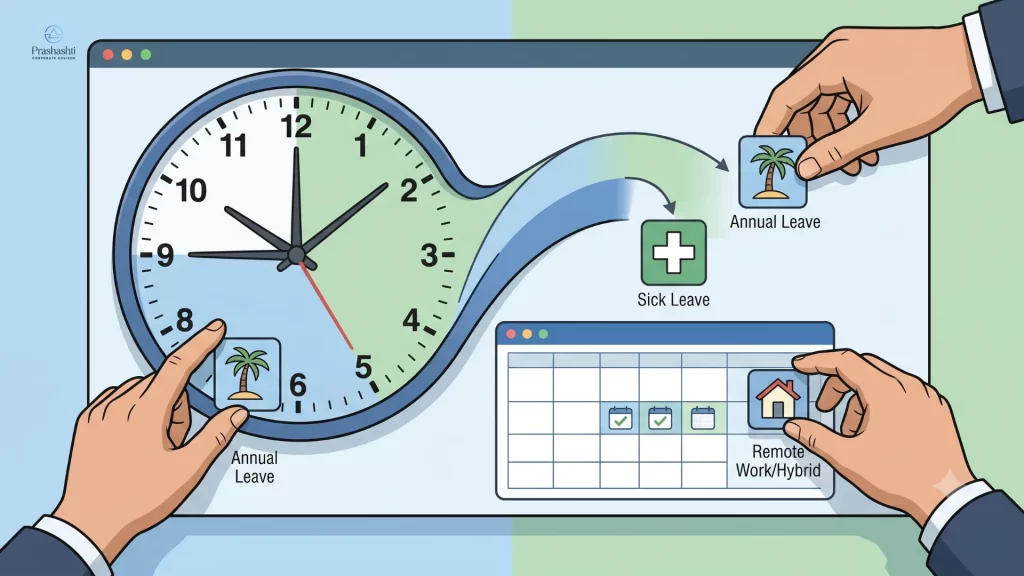
With flexible work becoming more common, managing working hours isn’t as straightforward as it used to be.
Working Hours Under the Labour Codes
The Labour Codes do allow for more flexibility but also require employers to set appropriate working hours and manage overtime adequately.
Your attendance system should reflect if the team is remote, or works various hours. Otherwise you will have differences.
Leave Policy Updates
It’s worth reviewing:
- Annual leave
- Casual leave
- Sick leave
- Holiday lists
- Approval processes
Practical HR Implications
Managers should also be trained so they apply rules consistently. This helps avoid confusion and keeps things fair across teams.
Change #3: Enhanced Social Security and Employee Benefits
Employee benefits are getting more attention under the Labour Codes, and rightly so.
Changes Employers Should Monitor
Employers should regularly review:
- Provident Fund (via the EPFO official portal)
- ESIC (via the ESIC official portal)
- Gratuity.
- Maternity benefits.
- Other statutory schemes.
Reviewing Employee Benefits Regulations
The new framework leans more towards employee benefits regulations, especially for emerging employment arrangements.
One important topic is the fixed-term employee gratuity. In some cases, fixed-term employees may be eligible for gratuity without completing five years of service. If your business uses fixed-term contracts, this is something you shouldn’t ignore. Employers should also periodically review EPS pension calculation to ensure provident fund contributions and retirement benefits are aligned with the latest statutory requirements.
Documentation Employers Should Maintain
Previous Requirement | New Labour Law 2026 Requirement | Employer Action |
Paper-based employee records | Greater emphasis on organised digital records. | Digitise employee files and review them regularly. |
Basic benefit documentation. | Updated statutory benefit records. | Verify PF, ESIC and gratuity documentation. |
Periodic policy reviews | Continuous compliance monitoring. | Conduct quarterly HR audits. |
Expert Insight: We’re increasingly seeing employers extend fixed-term contracts under the old assumption that gratuity only kicks in after five years. That assumption no longer holds. If you have fixed-term staff who’ve crossed even a short tenure, it’s worth getting your gratuity liability recalculated now rather than at renewal time.

Change #4: Digital Compliance and Record-Keeping Requirements
Maintaining digital records is no longer an option. The employer must maintain organized digital records of:
- Staff details
- Attendance
- Salary
- Leaves
- Appointment letters
- Exit records
Digital Inspections and Compliance with OSH Code
Compliance with the OSH Code implies maintenance of safety records, training records, and readiness for an inspection anytime.
Payroll Documentation Requirements
The payroll records must be kept accurate and up to date. Regularly keep reviewing:
- Pay register Deductions
- Tax details
- Overtime wages
- Declarations by employees
Best Practices
- Ensure records security
- Quarterly compliance review
- Documents support
- Standardization of procedure

Change #5: Stronger Penalties for Non-Compliance
Failure to comply may result in fines, legal notifications or greater scrutiny. Even if enforcement differs from state to state, it’s not worth the risk. An employer who pays less than what is required to an employee under the law is penalized with a fine up to ₹50,000 for the first violation under Section 54 of the Code on Wages, 2019. Repeat offence within five years can lead to imprisonment of up to three months, fine of up to ₹1,00,000 or both.
Trends in Inspections Employers Should Watch For
The inspections are more thorough and documentation-based. Authorities check out:
- Payroll ledgers.
- Personnel records.
- Attendance data
- Contracts.
- Statutory reports.
- Compliance with the contract labour threshold.
Risk Mitigation Strategies
The best approach is to make compliance part of your routine.
Regular policy reviews, payroll checks and internal audits can catch problems early. Also, keep an eye on state-level updates, they can differ.
Your Q3 2026 Compliance Calendar
Most compliance checklists tell you what you should be checking. So here’s what’s actually due when, so you can plan HR and payroll bandwidth around real dates:
Date | What’s Due |
Ongoing | Karnataka OSH Code and Social Security Code rules, monitor for final notification; several provisions only become binding once these are issued. |
Every 6 months | ESIC returns filing via the ESIC portal. |
Quarterly | Internal HR/payroll audit against the 50% wage rule, gratuity liability, and digital record completeness. |
30 June (annually) | Provisional aggregator welfare-fund contributions, where applicable, under the Social Security Rules. |
31 October (annually) | Final audited aggregator welfare-fund statement, where applicable. |

Employer Labour Law Compliance Checklist for This Quarter
If you’re not sure where to start, here’s a simple labour law compliance checklist:
- Review HR policies.
- Check salary structures.
- Audit payroll, deductions, and ESIC benefits to ensure employee records and statutory contributions remain accurate.
- Verification of records of PF, ESIC and gratuity .
- Update staff handbook.
- Reviewing contracts and agreements.
- Digital records to be complete.
- Training of HR and Payroll department teams.
- Conduct a quarterly audit.
- Review all legal obligations for employers under the Labour Codes and state rules.
New Labour Law 2026: Staying Compliant with Support from Prashasthi Corporate
The new labour law 2026 is a good reminder that compliance isn’t something you look at only when rules change. It’s something that needs regular attention. Looking at your payroll, HR policy, employee benefits and documentation from time to time can help avert problems before they arise and keep things going smoothly.
Sometimes the small updates are the ones that matter the most. If you can get to the gaps early on, you’ll spare yourself the trouble of dealing with bigger concerns later on. And if you are not totally confident that everything is up to the mark with the latest criteria, seeking professional corporate advisory services from experienced compliance experts like Prashasthi Corporate can make labour law compliance much easier.
Being knowledgeable and proactive today can save you time, stress and avoidable costs down the road at the end of the day.
Disclaimer: This article is intended for general informational purposes only and reflects the status of the Labour Codes, Central Rules, and Karnataka state rules as understood as of July 2026. It does not constitute legal, tax, or professional advice, and should not be relied upon as a substitute for consultation with a qualified labour law professional or compliance advisor regarding your specific circumstances.