

“Did we make the ESIC payment this month?”
That question usually comes up when someone is already busy with ten other things.
Maybe payroll has just been processed. A client is waiting for a callback. Employees are asking questions. Then someone from the accounts team realizes the payment of ESIC is still pending.
Now the rush begins. You log in to the portal, look for the challan, double-check the contribution amount, and hope everything gets done before the due date. Most employers have been there at some point. ESIC payments are not difficult, but compliance tasks often get pushed behind day-to-day business work.
The good news is that once you know where to go and what to do, the process is really easy. In this blog, we will take you through the online ESI payment process. We will see the latest contribution rates, important dates and how to avoid common mistakes.
Data: On 31st March 2024, the employees covered under the ESI Act were 3.14 crore covering 3.72 crore insured persons and their family entities, amounting to 14.44 crore beneficiaries across India. What’s more, January 2025, saw an addition of 18.19 lakh new employees, a year-on-year growth of 2.34% in net registrations in comparison to January 2024.
What this means for employers: The rising formalization of India’s workforce has led to an increase of over 18 lakh employees in ESIC registrations in just one month. As regulatory systems become digital, employers should prepare for more rigorous compliance monitoring and a greater focus on the accurate reporting of employee data.
What Is ESIC Payment?
The Employees’ State Insurance (ESI) system is a social security scheme under the Employees’ State Insurance Act, 1948, and is run by the Employees’ State Insurance Corporation (ESIC), a statutory body under the Ministry of Labour and Employment, Government of India.
Under the program both employer and employee pay monthly payments based on a proportion of the employee’s gross wages. These contributions, combined, are used to provide a wide variety of ESIC benefits for employees and their dependents:
- Medical benefit: 100% coverage of outpatient and inpatient care at ESIC dispensaries and specialized hospitals from Day 1 of employment.
- Sickness benefit: 70% of average daily pay up to 91 days per year (with respect to 78 days of contribution in the qualifying period).
- Maternity benefit: 26 weeks full wages during confinement.
- Disablement benefit: 90% of wages in the case of temporary total disabilities; a monthly pension in the case of permanent disability.
- Dependent’s benefit: Monthly payment to family members if the insured dies from a work-related injury.
- Funeral costs: A fixed sum paid on the death of an insured individual.
The employer deducts the employee’s contribution at source and submits both the contributions with ESIC every month. Employers who are unsure whether their establishment falls under the scheme should first understand the requirements for ESI registration online before beginning compliance obligations.
Employers can get assistance with PF & ESIC Registration in Bangalore for registration and compliance.
Payment of ESIC: Latest ESIC Contribution Rates for 2026
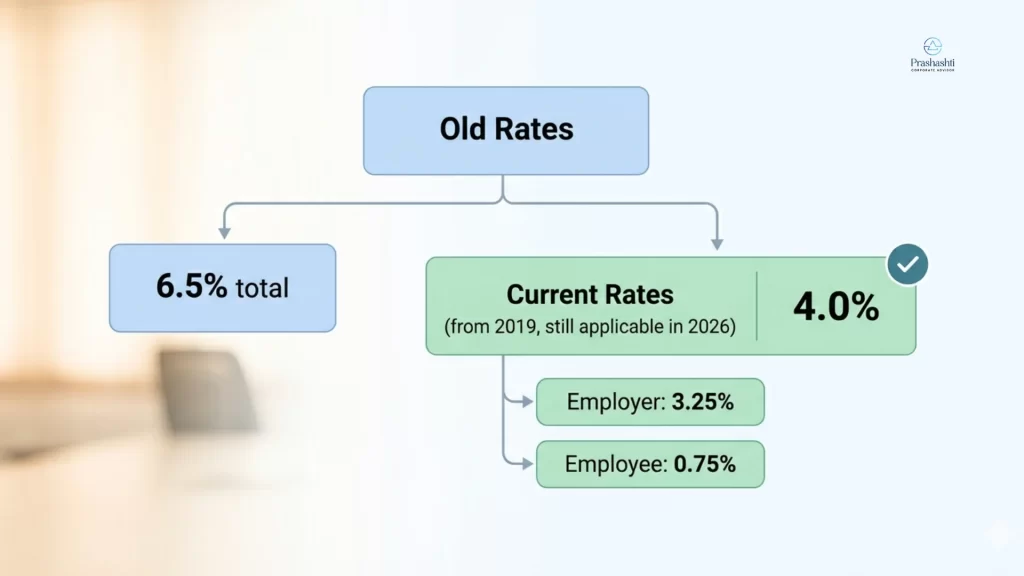
Before making contributions, employers should be familiar with the applicable rates. The Government of India has lowered the overall ESI contribution rate from 6.5% to 4% of gross salaries from 1 July 2019. The employer’s part was cut from 4.75% to 3.25% and the employee’s contribution from 1.75% to 0.75%. The ESIC contribution rates for 2026 continue to remain the same.
- Employer contribution: 3.25% of wages
- Employee contribution: 0.75% of wages
Let us consider a basic example. Let’s say an employee is paid Rs 20,000 per month.
The employer would pay 650 rupees and the employee 150 rupees. This means the total contribution of ESIC for the employee would be ₹ 800 for the month. Along with ESIC contributions, employers should also account for the PF contribution of employer while estimating their overall monthly statutory payroll costs.
Understanding the Due Date of Payment of ESIC for Employers
One of the most common reasons employers get hit with penalties is missing the payment deadlines.
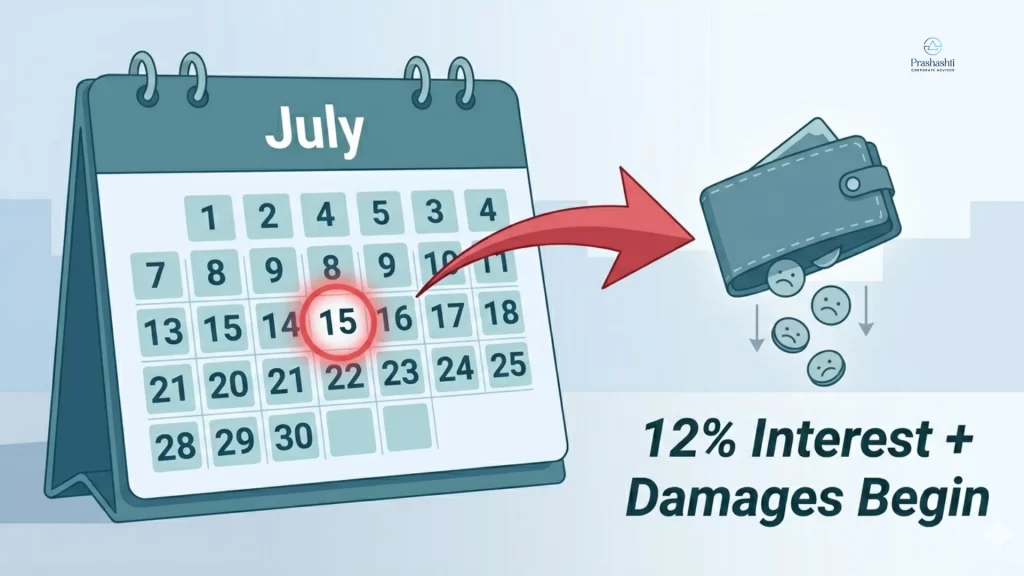
Normally, the due date of payment of ESIC is the 15th day of the month following the wage month.
For example, if you are paying contributions for June salaries, then the payment should be made by 15 July.
Many companies pay just at the last moment. That might work sometimes, but a banking difficulty, an internet problem or a portal delay can get you into trouble soon.
ESIC Registration for New Employers: What to Know Before Payment of ESIC
Businesses hiring employees for the first time should also evaluate their PF registration eligibility, as both EPF and ESIC registrations often become applicable together depending on workforce size and statutory coverage requirements.Businesses must complete ESIC registration for new employers before they are allowed to make contributions.
Registration is compulsory for companies covered under the ESI plan as per the applicable laws and coverage criteria of employees. Employers should also review broader labour law compliance requirements to ensure that ESIC registration aligns with other statutory obligations applicable to their workforce.
On registration, the employer is provided with a unique ESIC code number. The code is needed for employee enrollment, contribution filing, generation of challans, and online payments.
Employers have to register before they can use ESIC payment services.
Expert Insight from Prashasthi Corporate: The compliance surprises we see for our clients are mostly not from the rules that are already out there, but from the changes that were announced but not tracked. One such change is the proposed modification of the ESIC wage ceiling. 20-100 employee businesses should undertake a shadow calculation now: How many employees now earning between Rs. 21,000-30,000 are exempted? What is the cost of the extra monthly contribution? This simple task will save you a lot of trouble later on.
What Are the Prerequisites Before Making Payment of ESIC Online?
Spend a few minutes to prepare before you start the payment contribution.
- Login access to the ESIC Employer Portal at esic.gov.in.
- Your 17-digit employer code number.
- Monthly paycheck data for all covered employees, verified and finalized.
- Bank account with active online banking and sufficient funds.
- Clear knowledge of which employees are above the compensation threshold of ₹21,000 for the month.
How to Complete the Payment of ESIC Online: Step-by-Step Process?
Well, it’s quite easy to make the payment once everything is ready.
Step 1: Visit ESIC Portal
To begin with, go to the official ESIC website and locate the ESIC employer login portal.
Step 2: Sign into Your Employer Account
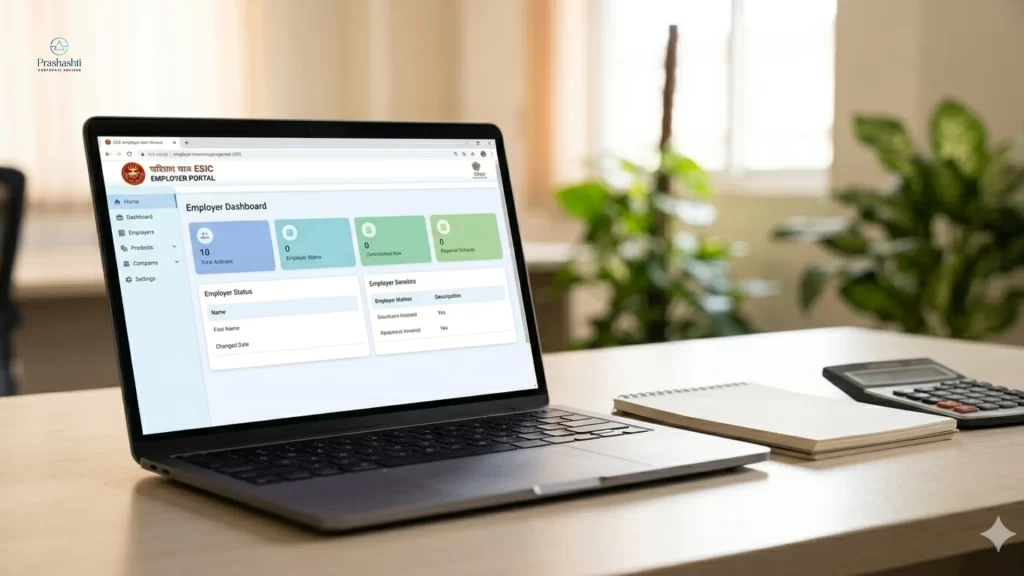
Log in with your username and password. The portal also asks for full CAPTCHA or OTP verification. If you have logged in successfully, you will be redirected to the employer dashboard. In case you have lost your credentials, please use the ” Forgot Password” option in the site itself.
Step 3: Verify Employee and Wage Details
Before you generate any challan, please move to the Contribution Filing section. Check the covered employee list for the month. Ensure that the gross salary of every employee is correctly entered and that the system is able to identify employees who fall within the ₹21,000 ceiling correctly. If you hired or fired an employee during the month you will need to update the system before you can proceed.
Step 4: Generate the Monthly Contribution Challan
After checking the employee details, create the monthly contribution challan for the salary for that month. The system will calculate the employer and employee contributions automatically based on the gross salaries you submitted. Before you confirm, be sure the system is calculating contributions on gross wages and not on basic salary.
Before you go for payment, download or write down the challan reference number.
Step 5: E-payment of ESIC challan
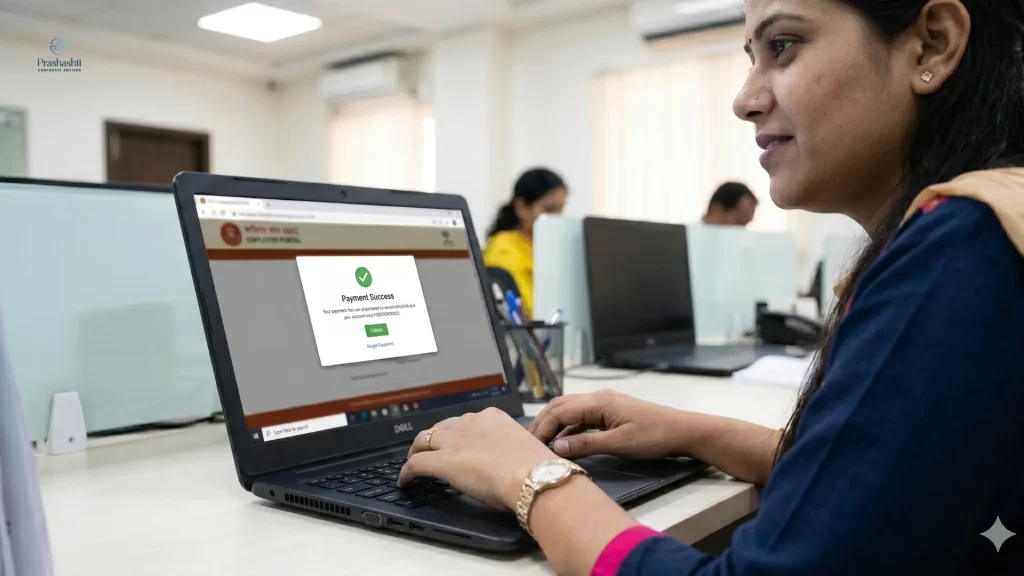
After generation of challan, choose the option of online payment. Make E-payment of ESIC challan through net banking. You will then be led to the payment gateway where you may choose your bank and complete the transaction.
Step 6: Make the Payment
Accept the payment through the way of banking you chose. Do not reload the page or close the browser untill the transaction is complete and a message of confirmation shows up on the screen.
Step 7: Download your receipt
After payment completion, download the Challan Receipt and Payment Acknowledgment successfully. It’s a good idea that you keep the digital copy and a backup copy for future reference.
How to Verify the Payment of ESIC Status Online?
After the transaction is complete, do not assume it is complete. Always verify.
Go back to the employer dashboard and check the Payment History section. The challan which you have just paid should indicate a verified status. If it takes time to reflect, check again after a few hours. Processing delays of a few hours are normal, especially on heavy payment days between the 13th and 15th of the month.
If the payment is not reflected in the next 24 hours, please contact ESIC on 1800-11-2526 (toll free) or raise a ticket on the ESIC website.
ESIC Compliance Calendar: Key Dates for FY 2026-27
Month | Action Required |
Every month by the 15th | Deposit monthly contributions for the previous wage month. |
11 November 2026 | File half-yearly ESI return for April–September 2026. |
11 May 2027 | File half-yearly ESI return for October–March 2027. |
Ongoing | Update portal for new joiners, exits, and salary revisions. |
Watch for | Ministry of Labour circular on revised ₹21,000 wage ceiling. |
Common Errors During ESIC Payment and Their Solutions
Sometimes, when everything is right, things can go wrong.
Issue | Possible Cause | Solution |
Payment has failed after deduction. | Banking or network issue. | Wait for reconciliation and verify transaction status. |
Challan not generated. | Incorrect employee data. | Check the records and regenerate the challan. |
Login problem. | Incorrect credentials. | Reset password through the portal. |
Payment not reflected. | Processing delay. | Check the payment history after some time. |
Invalid employer code. | Incorrect code entry. | Verify registration details. |
Late Payment Penalty and Other Consequences
Missing an ESIC payment can be costly. In case of delayed payment of contributions, simple interest at the rate of 12% per annum shall be payable for each day of delay as per Regulation 31A of ESI (General) Regulations, 1950.
Further, the damages for delay under Section 85B of the ESI Act (read with Regulation 31C) are from 5% and 25% per annum of the outstanding contributions depending upon the time of delay.
Delay Period | Damages on Arrears |
Up to 2 months | 5% |
2 to 4 months | 10% |
4 to 6 months | 15% |
Above 6 months | 25% |
What the data says: According to the ESIC Standard Note dated January 2025, the amount of arrear payments from defaulting employers stood at ₹5,899.27 crore as of a recent cut-off date. This is a big part of the ₹18,351 crore collected in FY 2023-24. This figure illustrates that ESIC’s enforcement and recovery actions are tough, well funded and systematic.
Expert Insight: From our experience advising small and mid-sized enterprises, ESIC penalties rarely occur from intentional non-compliance, they rather happen from payroll cycles that run too close to the 15th deadline. If salary is processed on 12th or 13th and the challan is generated on 14th, then there is no possibility of bank failure or portal failure. We always encourage our clients to make 10th of every month the internal date for ESIC payment and not 15th. That five-day cushion has prevented more than one client from being hit with a penalty that may have been avoided.
Simple Tips to Complete the Payment of ESIC on Time
A few simple steps can make your monthly ESIC compliance a lot easier.
- Check employee wage records before reporting contributions. Contribution mistakes are often caused by little payroll errors.
- Second, don’t wait until the last day to make payments. Technical troubles usually happen when you’re in a rush.
- Third, always download and save the ESIC payment receipts. Proper records can save a lot of time if documents are needed down the track.
- Lastly, do payroll and ESIC record reconciliation regularly. Keeping good records on a regular basis helps to see problems before they get worse.
Insight: Businesses expanding beyond 50 employees should integrate payroll software directly with compliance workflows to avoid contribution mismatches. As the number of employees increases, manual processes tend to error employee records, contribution calculations and statutory filings.
What Employers Should Remember About Payment of ESIC?
The payment of ESIC is a frequent compliance responsibility, but it must not be neglected. It all works better when donation records are accurate, payments are made on time, and receipts are correctly kept. It also guarantees that employees will continue to get the benefits under the ESI system without any interruption.
Prashasthi Corporate guides companies at all stages of growth on ESIC compliance, payroll regulations and other corporate compliance challenges. Getting organized today can save you time, money and unneeded stress down the road.