


Indian labour laws are changing and compliance with labour laws has become a big concern for all employers. By implementing four new Labour Codes and increasing the intensity of the enforcement in all states, the businesses in 2026 will need to be more vigilant than ever.
Regardless of whether you are operating a startup, SME or a big organisation, compliance is no longer a choice; it has a direct impact on your business operations, reputation and financial security.
Violation of labour laws today may attract fines in the lakh range, closure of business, and even prosecution. This is the reason why a clear knowledge of labour law compliance is necessary before the new structure is finally in place in India.

Why Should Your Business Prioritise Labour Law Compliance Now?
Many employers once viewed labour law compliance as paperwork that could be managed later. That approach no longer works. Workplace safety failures caused more than 400 worker deaths in 2024 alone, prompting stricter government action. Authorities have increased inspections, introduced digital compliance tracking, and empowered Inspector-cum-Facilitators with automated systems.
By 2026, inspections will rely on central databases rather than physical files. Over 31 crore workers are already registered on the e-Shram portal, making it nearly impossible to stay invisible. Businesses are being penalised for issues as small as incorrect wage classification or delayed wage slips. Labour law compliance today protects you from these risks before they escalate.
Understanding Labour Law Compliance and What Has Changed
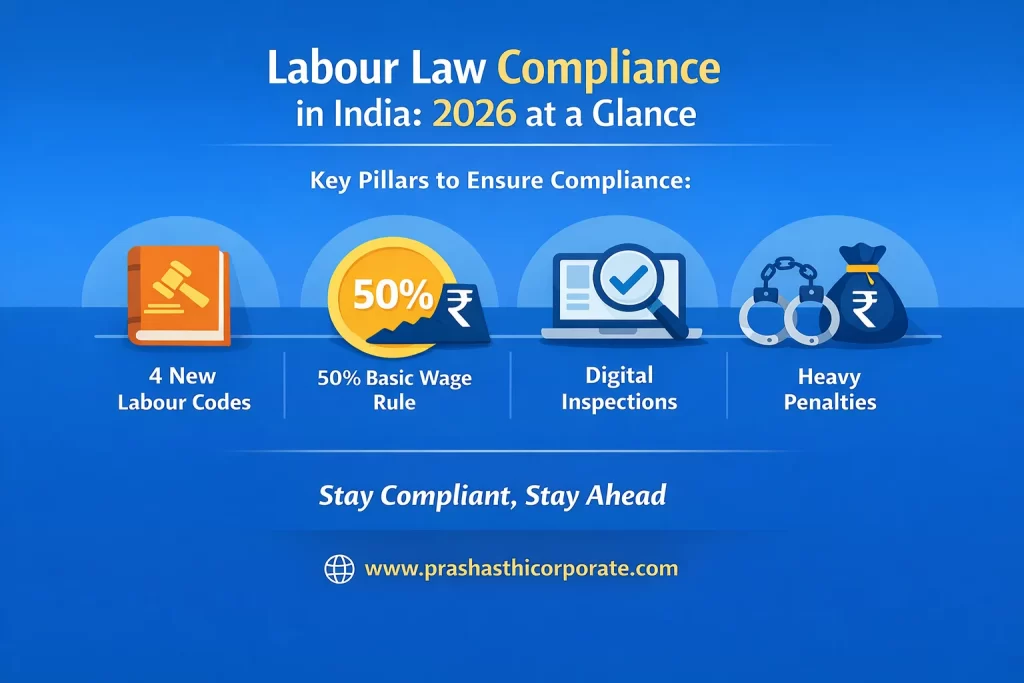
Labour law compliance has evolved far beyond salary payments and attendance registers. The four Labour Codes Wages, Industrial Relations, Occupational Safety and Health, and Social Security have replaced over 44 older laws with a unified structure.
One major change is the wage structure rule. Basic salary must now form at least 50 percent of total CTC. This directly impacts PF, ESI, gratuity, and bonus calculations. States such as Delhi implemented this early, raising minimum wages to ₹18,456 for unskilled workers and ₹24,356 for graduates from April 1, 2025.
These changes mean payroll planning, cost forecasting, and statutory filings must be aligned carefully with labour law compliance norms. For a deeper understanding of statutory coverage, businesses should also understand the scope of ESIC benefits and how wage restructuring affects eligibility under social security laws.
Wages & Salary Structure
| Aspect | Earlier Regime | Under Labour Codes |
|---|---|---|
| Definition of wages | No uniform definition | Single, standard definition of wages |
| Basic salary structure | Employer-driven, flexible | Basic must be ≥ 50% of total CTC |
| Impact on PF, ESI & gratuity | Often minimized through allowances | Higher statutory contributions |
| Minimum wage calculation | Varied across laws | Uniform principle across states |
| Bonus eligibility | Linked to specific acts | Integrated under Code on Wages |
Organisations restructuring payrolls should clearly understand the PF contribution of employers, including the financial implications on CTC planning and long-term liabilities.
Labour Law Compliance Checklist for Monthly and Quarterly Tasks
Maintaining discipline and consistency is the foundation for effective compliance with Labour Laws. When a deadline is missed, it results in immediate penalties and inspections.
Regarding monthly responsibilities:
- The 15th of each month is the due date for PF contributions
- The 15th of each month is also when ESI payments are due
- Wage slips must be issued to all employees in a timely fashion
- Attendance and wage registers must be updated every day
Regarding quarterly obligations:
- The Labour Welfare Fund is payable quarterly where applicable
- Internal Compliance checks to identify errors in your documents will be conducted every quarter
- Verify the wages that you pay employees against the notifications from the state government on the Minimum Wage Act.
Regarding annual obligations:
- Returns that are required by the Factories Act, Minimum Wages Act, and Payment of Bonus Act must be filed on or before the due date
- Factory Licenses and Factory Registrations must be renewed
- Safety Training must be conducted and documented properly.
Maintaining this cycle eliminates a stressful, unpredictable process when it comes to compliance with Labour Laws.
How Expensive Is Non-Compliance in Today’s Environment?
Businesses that neglect labour law compliance risk incurring massive financial consequences. Under the Code on Wages, employers who do not pay minimum wage face a fine of ₹50,000 for each first offence. Repeat offenders could face a fine of ₹1 lakh, or in some cases, be imprisoned for as long as three months.
The OSH Code provides for significantly higher penalties compared to the previous legislation with fines of up to ₹5 lakh for serious violations, and imprisonment of up to two years for repeat offenders whose actions result in injury or death to workers.
Additionally to the fines/fines, your company may also have difficulty obtaining government contracts, be unable to continue its operations during inspections, and suffer losses due to harm to its public image as a result of failing to protect the safety and health of its employees.
Why Multi-State Labour Law Compliance Is So Difficult?
The compliance with labour laws becomes much more complicated in the case of companies functioning across states. Even though Labour Codes are the central laws, state rules are required for their implementation. There were those states that embraced the codes at a fast pace, whereas there are those that brought in changes or postponements.
The wage structures, registration requirements and inspection processes vary according to your state. Depending on the location of the company, the states of Karnataka, Maharashtra, and Tamil Nadu will be required to follow the various minimum wage values, report format, and frequency of inspections. Implementing a unified wage system is most likely to lead to breaches. Multi-state employers often struggle with inconsistent statutory thresholds. This is especially common with provident fund applicability, where companies are unsure when registration becomes mandatory. Understanding PF registration eligibility across states is critical to avoid unintentional non-compliance during inspections.
What Strong Labour Law Compliance Looks Like in Practice
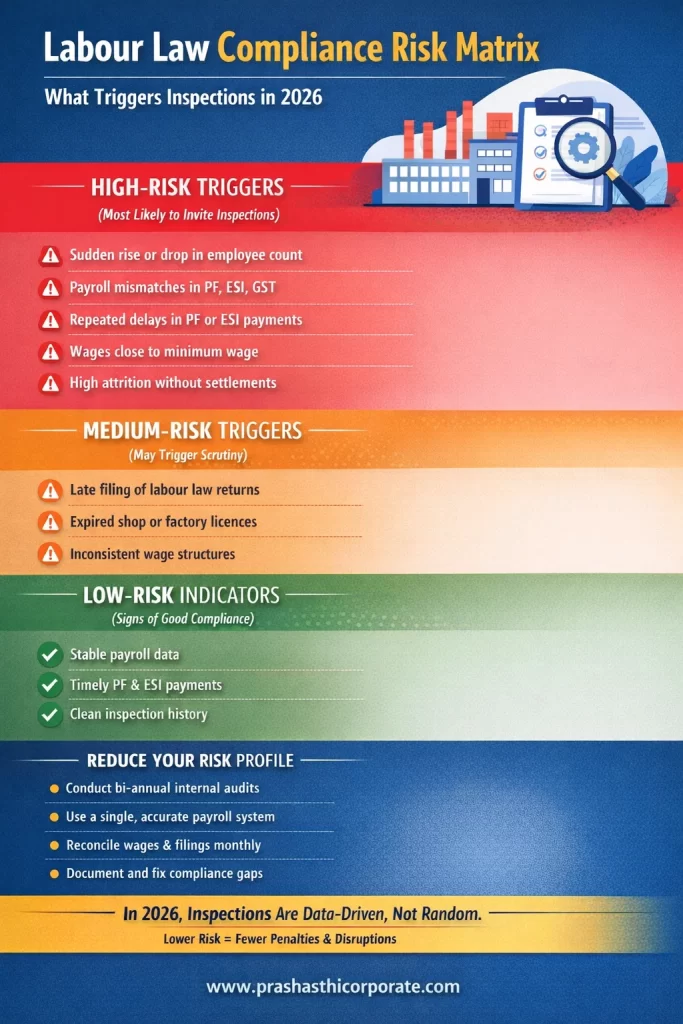
Companies that handle the labour law effectively do not wait until they are notified. They perform quarterly reviews of payroll, monitor electronic statutory deadlines, and educate internal departments on compliance fundamentals.
These organisations do not consider compliance as an annual assignment but as part of the day-to-day activities. They have clean records, are swift to regulatory changes, and are always ready to undergo an inspection. Labour law compliance also has a direct bearing on a company’s financial structure. Payroll costs, statutory contributions, and tax planning must work in alignment. Employers who clearly understand the corporate tax breakup for different company types are better positioned to forecast compliance-related expenses accurately.
Conclusion
Compliance with the laws of labour is no longer simply a requirement of law; it is a sign of leadership that is responsible. Companies committed to labour compliance will continue to promote and improve the protection of their employees, thereby reducing their potential for legal liability, while also increasing their credibility with regulators, employees and investors.
When the labour ecosystem in India continues to become more formalised by the year 2026, organisations that incorporate labour lawfulness into their daily operation will not only be free from penalties, but they will also have a sustainable competitive advantage.
Related
Discover more from Prashasthi Corporate Advisors
Subscribe to get the latest posts sent to your email.




Pingback: Digital KYC for Indian Corporates: Compliance, Onboarding & Future Trends
Pingback: Private Limited Company Compliance Checklist – Bengaluru (2026)