


Reviewed by Arun Bhandary, Co-founder at Prashasthi Corporate Advisors. Rules checked against RBI, MCA and Income Tax Department sources on 19th November 2026.
Branch Office vs Subsidiary vs Liaison Office is the choice every foreign company faces before entering India: operate as an extension of the parent (a branch or liaison office), or set up a separate Indian company (a subsidiary). Each route comes with different rules on permitted activities, tax, liability and compliance.
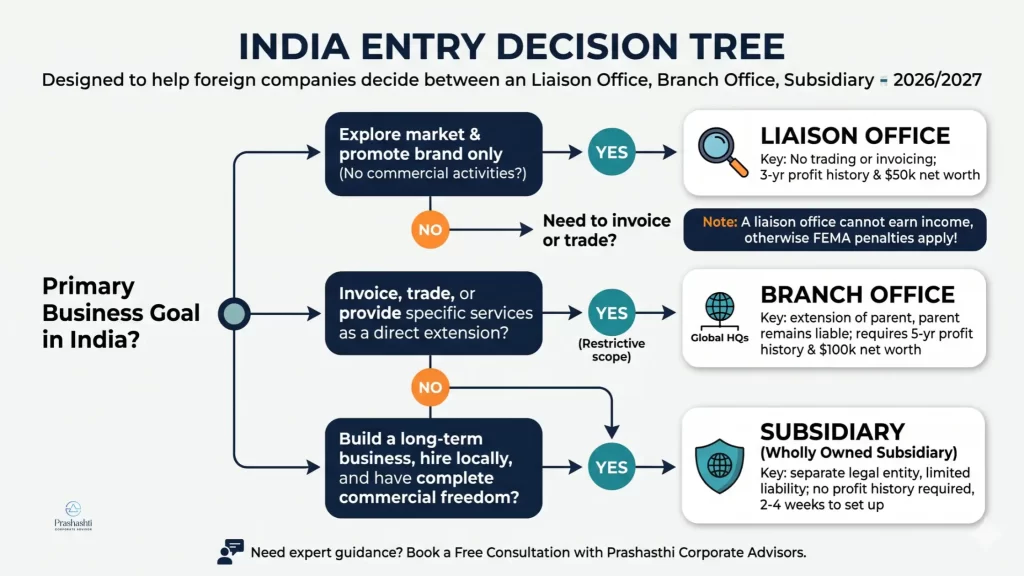
Tax treatment differs too. A foreign company’s Indian branch is usually governed by the relevant laws of tax on foreign companies. An eligible Indian subsidiary can choose for the concessional tax rate of 22% under Section 200 of the Income-tax Act, 2025, subject to certain circumstances. Effective tax burden also depends on surcharge, cess, available deductions and the specific tax position of the company. On the RBI side, a branch office needs a five-year profit record and at least USD 100,000 net worth, and a liaison office needs three years and USD 50,000.
Many companies start with a liaison office to test the market. That’s sensible, but it can’t earn income in India, so the moment you want to invoice a customer, you’ll need a different structure. Picking the right structure on day one saves months and avoids FEMA trouble.
In this blog post, we’ll go into detail about Branch Office vs Subsidiary vs Liaison Office in India and how to choose between them, with a decision test and a compliance calendar most guides skip.
Key Takeaways
- Liaison Office: for market research and communication only. It can’t trade, invoice or earn income.
- Branch Office: can earn from certain approved operations but has no distinct legal personality; thus, the parent remains liable.
- Subsidiary: It is a separate Indian firm having the widest area of activity and is usually a limited liability company. It is subject to sector FDI laws.
- Tax: A branch is subject to the tax laws applicable to international companies. A qualifying subsidiary can opt for the 22% regime under Section 200, subject to limits, plus surcharge and cess.
- Current rules: the 2016 RBI framework still applies. The 2025 draft changes were not notified in the sources we checked.
- Deadlines: FC-1 within 30 days of setup, and the Annual Activity Certificate by 30 September.

Types of Business Structures for Foreign Companies in India
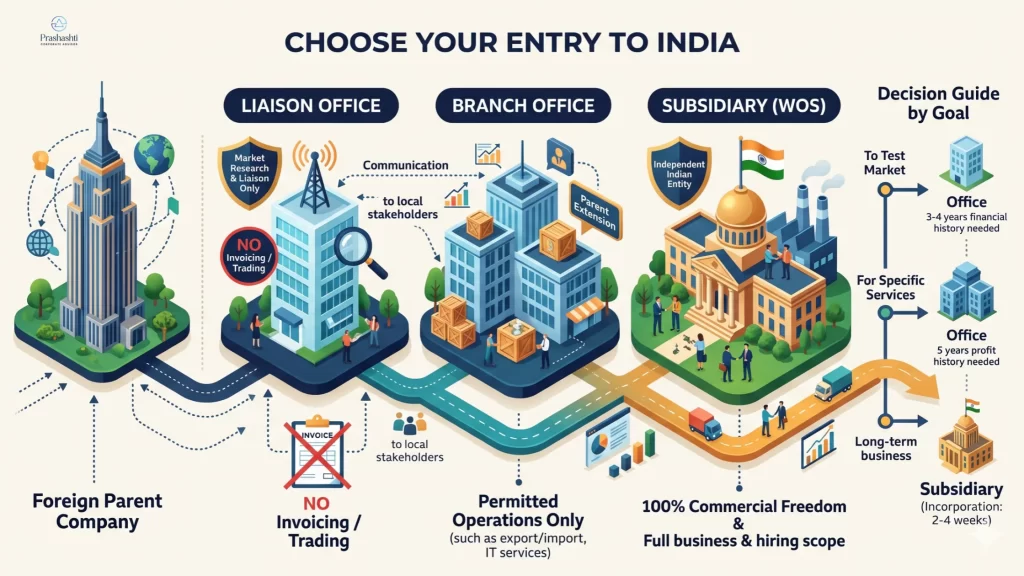
Liaison Office (LO): Think of it as your head office’s eyes and ears in India. It can represent the parent, promote exports and imports, and connect you with Indian companies. It cannot trade, invoice or earn income, and its costs are met by money sent from abroad. Approval usually comes for an initial three years, which an Authorised Dealer (AD) Category-I bank can extend. Applications are generally processed through an AD Category-I bank under the RBI framework, and certain cases need prior RBI or other regulatory approval. The full activity list is in the RBI Master Direction.
Branch Office (BO): An extension of the foreign company. It can earn from permitted activities such as export and import, consultancy, research, software and technical support, and it can hire staff and open a bank account within that scope. But it has no separate legal identity, so the parent stays responsible for its obligations. Manufacturing and retail trading are generally off the table.
Subsidiary: An Indian company incorporated under the Companies Act, 2013. If the parent owns 100% it is a wholly owned subsidiary in India. It is a separate legal entity and can sell, hire and execute contracts and its duties are usually independent of the parent, save in rare legal circumstances. A Private Limited Company requires two directors and two shareholders. Resident Director Requirement under Section 149(3) of Companies Act, 2013: One of the Directors is required to stay for a minimum of 182 days in India in the Financial Year. Where a firm is newly incorporated this applies proportionately. Ownership must be as per FDI policy, which allows 100% ownership in some sectors under the automatic route, while others have caps or need government approval.
Project Office (PO): Built for one contract. If you have a contract from an Indian company, the project has its regulatory permits and is funded by inward remittance, an international financing agency or a term loan from a public financial institution or bank in India, then general license is possible. The project finishes with it. These parameters have been stipulated in the RBI Master Direction.
Branch Office vs Subsidiary vs Liaison Office in India: Complete Comparison
All three structures aid foreign enterprises to establish a presence in India, but differ in their legal status, activities allowed and compliance requirements.
Here’s a side-by-side comparison to help you see the difference.
Comparison factor | Branch Office | Subsidiary | Liaison Office |
Legal status | Extension of foreign parent | Separate Indian legal entity | Extension of foreign parent |
Ownership | Foreign parent | Foreign shareholders | Foreign parent |
Revenue generation | Yes, for permitted activities | Yes | No |
Commercial activities | Restricted | Broad business activities, subject to law | Not permitted |
RBI involvement | Applicable FEMA approval framework | Not normally required for incorporation itself | Applicable FEMA approval framework |
Tax treatment | Foreign company tax provisions | Domestic company tax provisions | No commercial income permitted |
Liability | Generally rests with parent | Generally limited to subsidiary’s assets | Generally rests with parent |
Compliance | FEMA and Companies Act | Companies Act, FEMA and FDI reporting, where applicable | FEMA and Companies Act |
Closure | Regulatory and statutory closure process | Winding-up or strike-off process, as eligible | Regulatory and statutory closure process |
The Income-tax Act, 2025 is in force from 1 April 2026, and its section 200 replaces the old section 115BAA. The optional 22% rate comes with conditions, including limits on certain deductions and loss set-offs, and headline rates are before surcharge and cess. Rates are on the Income Tax Department site, and our tax team can model both options for you.
Which Business Structure Should You Choose for Your India Entry?
Your goal | Best fit |
Testing the market, meeting distributors, studying competitors | Liaison Office |
Delivering permitted services or export/import work without a new company | Branch Office |
Building a long-term business, hiring a local team, selling in India | Subsidiary |
Executing one specific contract | Project Office |
Don’t choose only because something looks cheaper to set up. Cheap to open can be expensive to outgrow.
5 Questions to Ask Before Choosing a Business Structure in India
Here’s the framework we’d walk any foreign founder through before touching a form.
- Will you invoice Indian customers? If yes, rule out the LO straight away.
- Where should the risk sit? If you want Indian liabilities walled off from the parent, a subsidiary is the structure that generally does that. BO and LO keep the parent exposed.
- How big will the Indian team get? A BO can hire, but a large local team, vendors and local contracts are usually simpler inside a company.
- Does your sector have FDI limits? Check the policy first. Caps and approvals apply whichever structure you choose.
- What’s your exit plan? Closing a BO or LO runs through your AD bank. Closing a company means strike-off or winding up. Both take time.
How to read your answers: “No” to question 1 and a 12-to-36-month exploration plan point to an LO. A narrow, permitted service line, and a parent comfortable carrying the risk, points to a BO. Anything broader points to a subsidiary.
Expert insight: Don’t ask “which structure is cheapest?” Ask “who in India will sign contracts, quote prices and receive payments?” Write down the honest answer. If any of those happens in India, a liaison office is out, and a branch works only if the activity sits on the RBI’s permitted list. Most structuring mistakes start with a vague activity plan, not the wrong legal form.
Expert Tips from Prashasthi Corporate Advisors
- Write your activity list first: Match every planned activity against the RBI’s permitted list. Whatever doesn’t fit decides your structure for you.
- RBI and MCA are two tracks, not one. Offices are generally processed through an AD Category-I bank under the RBI framework (certain cases need prior RBI approval), and they also need registration with the Registrar of Companies. Run both in parallel.
- Authenticate documents before signing: Whether you need notarisation, apostille or consularisation depends on the country where you sign.
- Set up your compliance calendar on day one: Late filings can cost more than the structure ever saved. Our statutory compliance team handles this for many clients.
Can You Convert a Liaison Office into a Branch Office or Subsidiary?
Under current rules, a Liaison Office can’t start trading, and there’s no direct route to turn it into a subsidiary. Your options are to set up a separate subsidiary while the LO keeps running, apply to change the LO’s permitted activities where the rules allow (it still can’t earn income), close the LO, or wait for any conversion route that amended FEMA regulations may introduce. Either way, you’ll rebuild contracts, bank accounts and teams, which is the hidden bill of choosing an LO “because it’s cheaper”.
The 2025 draft proposes letting an office convert into a branch, but that’s still a proposal. If you’re fairly sure you’ll sell in India within a year or two, starting with a subsidiary often avoids a double setup.
RBI, MCA and FEMA Compliance Requirements for Foreign Companies in India
What | When | Applies to |
Form FC-1 (register with the Registrar of Companies) | Within 30 days of establishing the place of business | LO, BO, PO |
Form FC-2 (report changes) | Within 30 days of a change in registered particulars | LO, BO, PO |
Form FC-3 (annual accounts and list of places of business) | Within 6 months of the close of the foreign company’s financial year | LO, BO, PO |
Form FC-4 (annual return) | Within 60 days of the last day of the financial year | LO, BO, PO |
Annual Activity Certificate | By 30 September each year, to your AD Category-I bank and, for BOs and LOs, the Director General of Income Tax (International Taxation) | LO, BO |
Form FC-GPR on the FIRMS portal | Within 30 days of allotting shares to the foreign investor | Subsidiary |
Annual returns, audit, tax (AOC-4, MGT-7 or MGT-7A) | Every year | Subsidiary |
FC-3 runs from the foreign company’s own financial year: if it ends on 31 December 2025, FC-3 is due by 30 June 2026. This follows the Companies (Registration of Foreign Companies) Rules, 2014 and the MCA’s August 2026 FAQs. Check current forms on the MCA site, and see our audit services if you need certificates prepared.
Branch Office vs Subsidiary vs Liaison Office: Setup Costs and Timelines
Structure | What drives the cost | Planning timeline |
Liaison Office | AD bank application (RBI approval where required), authenticated documents, professional fees, office and staff (funded by parent) | Around 4–8 weeks or longer |
Branch Office | Same as LO, plus audited accounts and tax compliance | Around 4–8 weeks or longer |
Subsidiary | Incorporation, professional fees, statutory audit, FC-GPR reporting; share capital is business funding, not a fee | Around 2–4 weeks to incorporate |
Project Office | Depends on the contract and approvals | Varies |
These are planning ranges, not promises. Document authentication and bank checks cause most delays. We haven’t quoted rupee fees because they shift with your documents and scope, so ask for a written quote.
Common Mistakes Foreign Companies Make During Business Setup in India
- Doing business through a Liaison Office: Invoicing, taking customer payments or negotiating prices can create FEMA problems.
- Treating a BO like a subsidiary: Its activities must stay inside the approved scope.
- Forgetting MCA after RBI: FC-1 has its own 30-day clock.
- Checking sector FDI limits late: Do it before you apply, not after.
- Planning around draft rules: More on that below.
RBI Approval and FEMA Regulations for Branch and Liaison Offices in India
oday’s rules come from the FEMA 22(R)/2016-RB regulations and the Master Direction. A Branch Office needs a five-year profit record and net worth of at least USD 100,000. A Liaison Office needs three years and USD 50,000.
On 3 October 2025, the RBI released draft regulations that would drop those financial tests, merge office types into “Branch” and “Office”, and ease closures. Comments closed on 24 October 2025. A draft isn’t law until it’s notified, and the sources we checked for this November 2026 update showed no final notification, so the 2016 framework still applies.
Before you apply, open both RBI links, ask your AD bank which version it’s processing, and confirm your sector in the FDI policy.
Final Thoughts
Choosing between a Branch Office vs Subsidiary vs Liaison Office comes down to what you’ll actually do in India. LO for exploring, BO for specific permitted work, subsidiary for building something lasting.
Not sure which fits? Book a free structure consultation with our corporate advisory team. We’ll map your activities, ownership, and expansion plans to the right structure. You can also contact us directly.
Disclaimer: This article is general information, not legal, tax or investment advice.