

If you’ve ever had to pay TDS online for the first time, you’ve probably had the same reaction as most people: “Why is this so confusing?”
You deduct the tax, keep the amount aside, and think the job is done. Then comes the actual payment. Suddenly, you’re looking at terms like ITNS 281, TAN, assessment year, major head, minor head, and wondering if you’re filling everything correctly. A single mistake could result in more work later on, and nobody wants to have to deal with notices, corrections or penalties for a simple fault.
What makes 2026 distinct from all other years is that the law itself changed during this process. The Income Tax Act, 1961, which governed TDS for nearly six decades, was abolished on 1 April 2026 and replaced by the Income Tax Act, 2025. If you deducted TDS before 1st April 2026, you are still filing under the previous Act. Today if you are deducting TDS then you are on the renumbered and reorganized system.
In this blog, we’ll make it all simple. You will get to know what TDS is, who needs to deposit TDS, how the ITNS 281 challan works, what details you need to keep ready, and exact methods to pay TDS online using the Income Tax portal in 2026.
What is TDS, and Who Needs to Pay It?
Understanding Tax Deducted at Source (TDS)
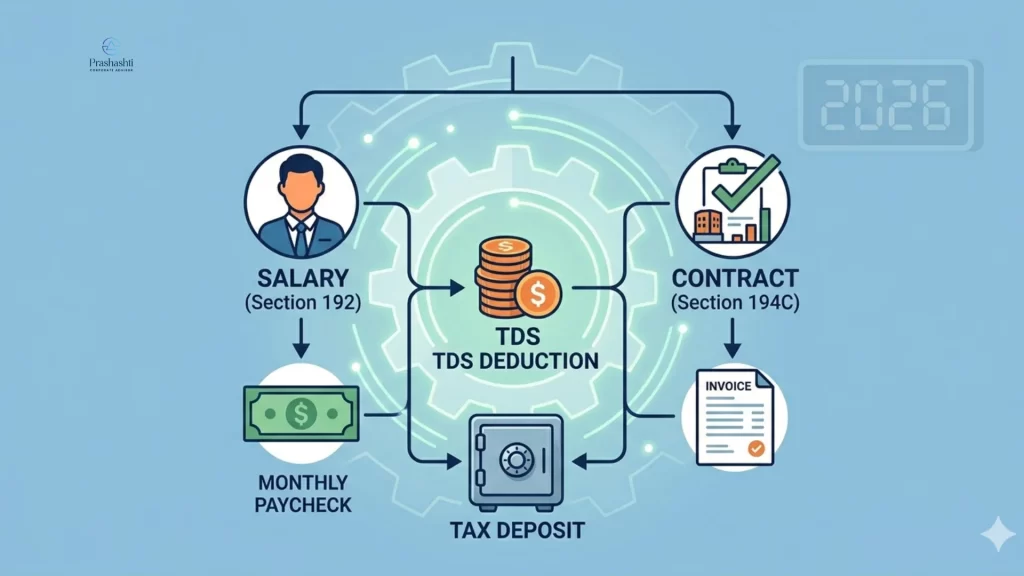
TDS or Tax Deducted at Source is a way by which the government can collect tax at the time of income payment rather than at the end of the financial year. TDS can apply to:
- Salary
- Contractor payments
- Professional fees
- Rent
- Commission
- Interest income
For example, let’s say a company pays a consultant ₹1,00,000 and the TDS rate applicable is 10%. The company will deduct TDS of ₹10,000 and pay ₹90,000 to the consultant. The deduction of Rs 10,000 has to be deposited with the Income Tax Department.
Who is Responsible for Depositing TDS?
The tax is deposited by the person or company who deducts the tax. These are the:
- Employers’ TDS deduction on wages.
- Businesses paying contractors/professionals.
- Companies that pay rent over the limit.
- Interest withholding tax by banks.
- Persons covered under the terms of TDS.
For companies, TDS compliance forms part of the broader direct tax framework, alongside the corporate tax obligations applicable to different business structures.
What Happens if TDS is Deposited Late?
If TDS deducted but not deposited in time:
- Interest will be charged on late payment.
- Late fees are being applied.
- Some penalties are imposed.
- TDS return filing is difficult.
Regular compliance reviews and audit services in Bangalore can help identify such issues before they result in penalties.
What is ITNS 281 Challan When You Pay TDS Online?
If you have ever deposited TDS before, you have probably heard about the ITNS 281 challan. This is the challan used for depositing:
- TDS (Tax Deducted at Source)
- TCS (Tax Collected at Source)
Whether the deduction is from salary, contractor payments, rent, or professional fees, the payment is made through the ITNS 281 framework. The challan is used for:
- Regular TDS payments.
- TDS payable after assessment.
- TCS deposits.
If you want to understand the structure of the challan or review the fields before making a payment, you can refer to the official ITNS 281 Challan PDF
Difference Between Challan 280, ITNS 281 and ITNS 282
These challans are confusing for many especially when they are paying taxes for the first time. Here’s the comparison:
Challan Type | Purpose |
Challan 280/280N. | Payment of Income Tax. |
ITNS 281 | Payment of TDS and TCS. |
ITNS 282 | Payment of Other Direct Taxes. |
Is The ITNS 281 Still Applicable in 2026?
Yes. The previous OLTAS system has been stopped and now payments are done through the e-Pay Tax feature available on the income tax e-filing page. But the base challan for TDS payments continues to be ITNS 281.
So the interface has been changed and made easy but the challan is the same.
What Are the Prerequisites for TDS Payment Online?
Before you start the payment process, keep a few details handy. Trust me, having these ready saves a lot of time.
1. TAN Number
The first and most important requirement is your TAN number. This is different from PAN and is mandatory for depositing TDS. Businesses completing their company registration in Bangalore should ensure they obtain a TAN before deducting and depositing TDS.
2. Assessment Year
It’s also important to select the right year for the assessment. The procedure of TDS return filing might become complicated if the wrong year is selected.
3. Deductee Category
You will be asked to choose:
- 0020: Company Deductees
- 0021: Non-Company Deductees
4. Type of Payment
The commonly used Minor Head codes are:
- 200: Regular TDS/TCS payment
- 400: Demand payment
For most regular TDS deposits, Minor Head 200 is used.
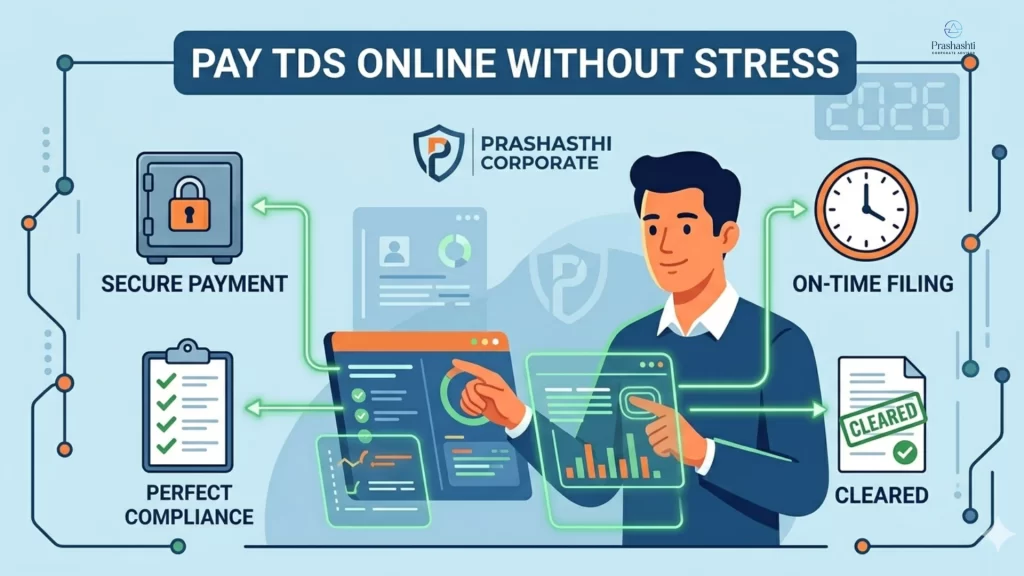
How to Pay TDS Online – A Step-by-Step Process
So, let’s get right into the actual process. If it’s your first time making the payment, don’t worry. It’s a really simple process.
Step 1: Visit the Income Tax e-Pay Tax Portal
Visit https://www.incometax.gov.in/iec/foportal/ , login using your TAN (post login) or use the e-Pay Tax fast link and authenticate using TAN, cellphone number and OTP (pre login).
Step 2: Selection of Relevant Income Tax Act
At the page for selection of the Act, select “Income Tax Act, 1961” in case your payment is for deduction up to and including 31st March 2026, while select “Income Tax Act, 2025” in case your payment is for Tax Year 2026-27 onwards.
Step 3: Create a New Payment and Choose Year
Click on “New Payment” and enter the relevant Assessment Year or Tax Year and click on Proceed at the Pay TDS/TCS tile.
Step 4: Choose Deductee Type & Residential Status
In the “Select Deductee Type” page, select the appropriate Major Head (Company/Non-Company) and the deductee’s residential status. Note: You will require a unique challan for each deductee-type and residential status combination.
Step 5: Complete the Nature of Payment Details
On the “Add Nature of Payment Details” screen, give the section-wise (or payment code-wise) break-up, that is, Tax, surcharge and education cess for each category. If there is a section 234E fee or a penalty, enter it separately in “Details of Other Payments”. Check this screen twice, because a mistake here leads to a lot of extra work later on.
Step 6: Check the tax breakup details and proceed further
Check all the data listed in the summary of Add Tax Breakup Details, TAN number, year, major and minor head, code/section and amount.
Step 7: Select the Mode of Payment
Select from Net Banking, Debit Card, UPI, Pay at Bank Counter, RTGS / NEFT or any other allowed Payment Gateway mechanism.
Step 8: Make Payment
After making the payment you will receive an email or SMS about the same.
Step 9: Download the Challan Receipt
The Challan receipt is to be downloaded right away because it consists of CIN number, BSR code, and payment date. However, you can download it even later from the Payment History section after logging into the website; but, it won’t be easy if you do not save it yourself. The CIN number and BSR code will be used for filing returns and verifying the challan later.
Expert Insight: The common problem our team is receiving this quarter isn’t a payment failure, it’s firms applying the older section number to a transaction that should have migrated to the new Act, since their accounting software hadn’t been updated for the renumbering. The change is procedural, not technical: If you’re processing a TDS payment in 2026, first check the earlier-of-credit-or-payment date, then use that to determine the Act, the challan, and the section/code, not the other way around.
What Are the Due Dates You Must Know to Pay TDS Online?
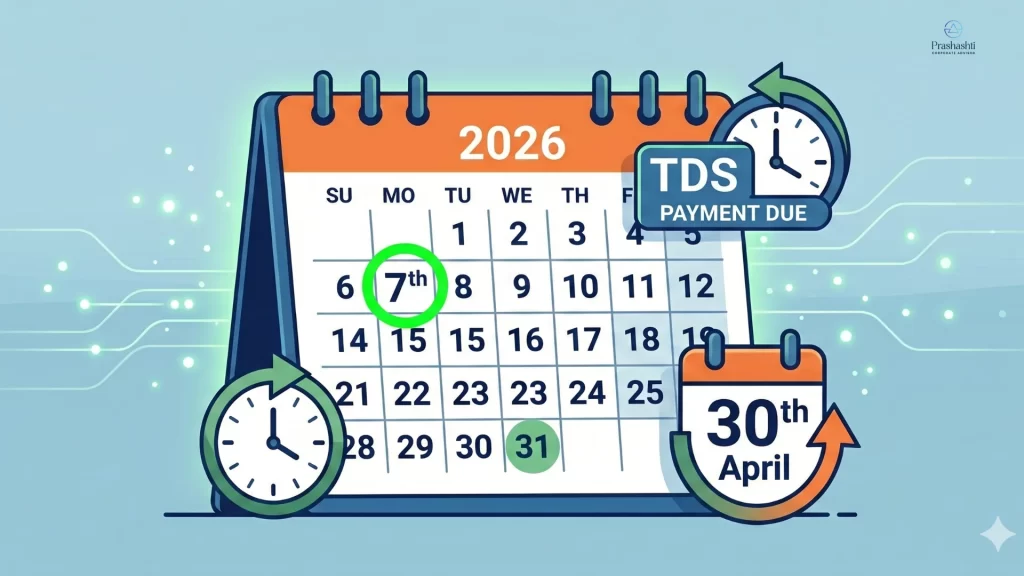
One of the most common reasons for penalties is simply forgetting the due date. Generally, the due dates are:
TDS Deduction Month | Due Date for Payment |
April to February | 7th of the following month |
March | 30th April |
Property purchase, rent by individual/HUF, contractor/professional payment by individual/HUF, or VDA transfer (Sections 194-IA, 194-IB, 194M, 194S). | 30 days from the end of the month of deduction, via challan-cum-statement. |
What Are the Interest and Penalties If You Pay TDS Online Late?
Default | Provision | Rate/Amount | Calculated From |
Late deduction | Section 201(1A) | 1% per month or part | Date tax was deductible → date actually deducted. |
Late deposit | Section 201(1A) | 1.5% per month or part. | Date of deduction → date of deposit. |
Late return filing | Section 234E | ₹200/day, capped at TDS amount. | Due date → date of filing. |
Serious/repeated default | Section 271H. | ₹10,000–₹1,00,000 (AO’s discretion). | – |
TDS not deducted/deposited | Section 40(a)(ia) | 30% of the expense is disallowed. |
Worked example: Suppose TDS of ₹50,000 gets deducted on 10th of a month but gets deposited after two months. Any part of a month is considered as a full month for the purpose of Section 201(1A). Thus, the interest works out to ₹50,000 × 1.5% × 2 = ₹1,500. In addition, if the associated return is also filed late, there is a supplementary cost of ₹200/day under Section 234E.
Expert insight:
In our experience, the businesses still quoting 194C or 194J on transactions made after 1 April 2026 are not making a typo; they are running on accounting software nobody changed. That gap will be tougher to cover once assessing officers start automatically cross-checking section references against the credit/payment date.
How to Verify TDS Challan Status After You Pay TDS Online?
After making the payment, check if the challan has been successfully booked on the TRACES portal (TDS Reconciliation Analysis and Correction Enabling System), the official portal of the Income Tax Department for the same. You will require the CIN or BIN, TAN and the duration of payment. The challan may be Matched, Unmatched or Overbooked.
Unmatched indicates that the TAN or challan data mentioned on your TDS return do not match with the records. You will have to file a correction statement to fix that mismatch. Don’t worry if the challan does not reflect immediately, as the bank processing takes some time.
Common Errors While Paying TDS Online
Even experienced taxpayers make mistakes while depositing TDS. Some of the mistakes are:
- Entering the wrong TAN number.
- Selecting an incorrect assessment year.
- Choosing the wrong nature of payment.
- Selecting the wrong deductee category.
- If you quote an old section number (e.g. 194C or 194J) for a payment made on or after 1 April 2026, then under the new system this will result in a system-level validation error when you file your return and you will need to file a correction statement to fix the reference.
- Payment failure after the amount is debited.
Correction in TDS Challan
If you realise that a mistake has been made, don’t panic. In many situations, corrections in the TDS challan are possible.
Certain fields can be corrected through the authorised bank or by following the correction process prescribed by the Income Tax Department.
However, not every field can be changed easily, which is why accuracy at the time of payment is always better, which is why many businesses rely on experienced tax consultants in Bangalore to review challan details and compliance requirements before filing.
TDS Rates for Different Payments
Different payments are subject to different TDS rates for different payments.
Nature of Payment | Old Section | New Reference (2025 Act) |
Salary | 192 | Section 392 |
Contractor Payments | 194C | Section 393, relevant table entry |
Professional Fees | 194J | Section 393, relevant table entry. |
Rent | 194I | Section 393, relevant table entry. |
Budget 2025-26 has brought about certain changes in thresholds: TDS-free interest limit for senior citizens has been doubled from ₹50,000 to ₹1 lakh per annum and the threshold for TDS-free yearly rent has been raised from ₹2.4 lakh to ₹6 lakh (₹50,000/month), both authorized by the Income Tax Department.
The rate being applied now is available on the official e-filing portal or can be checked with a licensed tax professional. Always check before deducting as the rates are subject to adjustment through the yearly Finance Act.
TDS on Salary vs Contract Payments
A question that comes up quite often is the difference between TDS on salary vs contract payments. For salary:
- TDS is deducted on the basis of the expected annual income of the employee.
- Tax slab considerations.
For payments related to a contract:
- TDS is deducted at the rates prescribed under Section 194C.
- Usually the deduction is connected to the paid amount as well as applicable limits.
Benefits of Paying TDS Online
There was a time when depositing TDS involved paperwork and bank visits. Thankfully, that’s no longer the case. When you pay TDS online, you will get:
- Fast payment processing.
- Instant challan generation.
- Easy record keeping.
- Secure payment options.
- Convenient challan tracking.
- Reduced paperwork.
Pay TDS Online Without Stress With Prashasthi Corporate
The process of paying TDS online is simple, but little mistakes in challan data, payment codes or due dates might create more work later. Spending a few minutes going over everything before you make a payment could save you a lot of worry.
Whether you require any assistance with online TDS payments, issues relating to challans or TDS return filing, Prashasthi Corporate helps companies and taxpayers to comply with these demands precisely and on time so that they may focus on their business.




Pingback: Audit Types in India: Know Which Audit Your Business Needs