


Outsourced accounting for startups means hiring an outside firm to run your books, file GST and TDS, process payroll and send monthly reports, so you don’t need an in-house finance team. A typical Bangalore package covers bookkeeping, bank reconciliation, GSTR-1 (due on the 11th), GSTR-3B (due on the 20th), TDS deposits (by the 7th), payroll, and an MIS report. Fees depend on transaction volume, team size, and scope. Startup private limited companies commonly pay around ₹10,000 to ₹35,000 a month. These are market ranges, not quotes.
If you’re matching bank entries at 11 pm and wondering whether GST went out on time, this guide is for you. It shows what you get each month, what costs extra, and how onboarding works, using 2026 rules, so no bill surprises you later.
What Is Outsourced Accounting for Startups?
You hand your accounting work to an outside firm. They record transactions, reconcile your bank, file GST and TDS, run payroll, and send reports. You send documents and answer questions.
It’s different from a freelancer who helps at tax time. A good startup accounting service runs every month, on a fixed schedule, with a clearly defined scope. That schedule is what you’re really paying for.
Why do Bangalore Startups Outsource Their Accounting?
Bangalore is crowded with startups. Karnataka had over 22,600 DPIIT-recognised startups on 31 March 2026, second only to Maharashtra, according to the government’s Startup India data. Most of them can’t afford a full finance team on day one.
Here are four situations Bangalore founders run into. They’re common examples, not client stories.
- A SaaS startup collecting through Razorpay: The gateway pays you after cutting its fees, and on a different day from your invoice. Without monthly reconciliation, your books and bank never match.
- A tech company paying overseas freelancers: Foreign payments bring TDS and remittance questions. Ask your firm who handles them.
- A startup taking foreign investment: This needs FEMA reporting under RBI rules. Most firms bill it separately.
- A growing engineering team: Cross 20 employees and PF kicks in. Cross 10 and ESI may apply.
What Do Outsourced Accounting Services Include Each Month?
Here’s the full list. If a firm can’t show you this, keep looking.
Deliverable | What lands in your inbox |
Bookkeeping | Updated ledgers with every sale, bill and expense |
Bank and gateway reconciliation | Bank, card and Razorpay/Stripe entries matched to books |
Payables and receivables | Who you owe, who owes you, what’s overdue |
GST | GSTR-1 and GSTR-3B filed, input credit matched |
TDS | Deduction working, challan, quarterly return |
Payroll | Payslips, salary entries, PF/ESI where applicable |
Financial statements | P&L, balance sheet, cash flow |
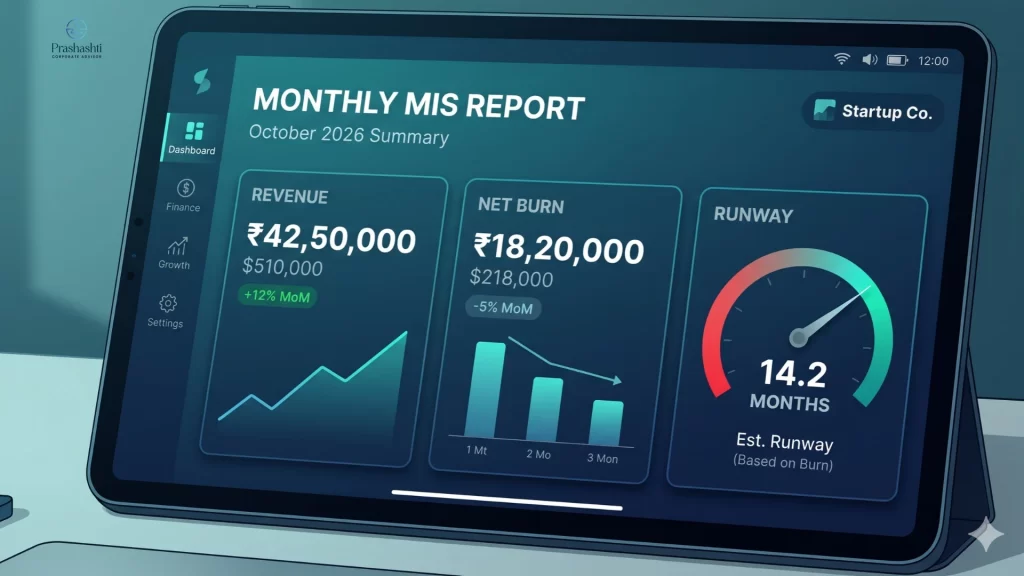
MIS report | Revenue, costs, burn, runway, plus short commentary |
Let’s look closer at the parts founders find confusing.
Reconciliation: This is your real quality check. The accountant matches your bank statement to your books line by line. Missing payments, duplicate charges, and hidden gateway fees show up here.
GST: Regular monthly filers file GSTR-1 by the 11th and GSTR-3B by the 20th. Your accountant also matches your purchase invoices with GSTR-2B, so you claim only the credit you’re entitled to.
Smaller businesses may qualify for the QRMP scheme. Eligible regular taxpayers with aggregate annual turnover up to ₹5 crore can file returns quarterly, subject to conditions. But they still pay tax every month. Quarterly GSTR-3B dates also depend on your state. For Karnataka, it’s the 22nd of the month after the quarter. Check the GST portal’s QRMP guidance for your case.
Arun Bhandary, Co-Founder of Prashasthi Corporate Advisors, puts the monthly habit simply:
“Reconcile GSTR-2B before you file GSTR-3B, every month, whichever tool you use. A mismatch you catch on the 15th costs you a phone call to the supplier. One you catch after filing can cost you input credit.”
TDS: From 1 April 2026, the Income-tax Act, 2025 governs TDS. Which Act applies depends on the earlier payment or credit. Events on or before 31 March 2026 stay under the 1961 Act. Later ones are under the new Act where TDS provisions are mainly under sections 392 (salary) and 393 (other payments). Rates and thresholds stayed largely the same, but section and form numbers changed. Ask your firm if their systems already use them. The Income Tax Department publishes the latest guidance.
TDS deducted in a month is generally deposited by the 7th of the next month. March is the exception: that deposit is due by 30 April. Returns are filed quarterly.
Payroll: PF applies once you have 20 or more employees. ESI generally applies from 10 employees, for staff within the wage limit. PF contributions are generally due by the 15th of the following month. ESI is a separate scheme with its own registration. Its contributions are also generally due within 15 days of the end of the month, under ESIC Regulation 31. Coverage depends on your establishment and each employee’s eligibility. See EPFO and ESIC for the latest rules. If you’re nearing either threshold, a PF and ESIC registration check before you hire is cheaper than a late-registration penalty.
MIS reports: The best reports include a short note on what changed and why. If your MIS is only numbers, you’re paying for a printout.
How Does the Monthly Accounting and Bookkeeping Process Work?
Every firm runs a little differently, so treat this as a sample. Agree your own dates in writing.
- 1st–5th: You share bills, invoices, and bank statements. The team records and starts reconciling.
- 6th–10th: Books close. You get a draft P&L. The TDS deposit goes out by the 7th.
- 11th–15th: GSTR-1 is filed by the 11th. PF and ESI contributions go out by the 15th, as two separate payments.
- 16th–20th: GSTR-3B is filed by the 20th. You get your MIS pack and a short call.
- 21st–30th: The team chases pending papers and flags upcoming payments.
“Books closed by the 10th” is a promise you can hold a firm to. “As soon as possible” isn’t.
The 4 Stages of Startup Accounting: From Basic Bookkeeping to Financial Strategy
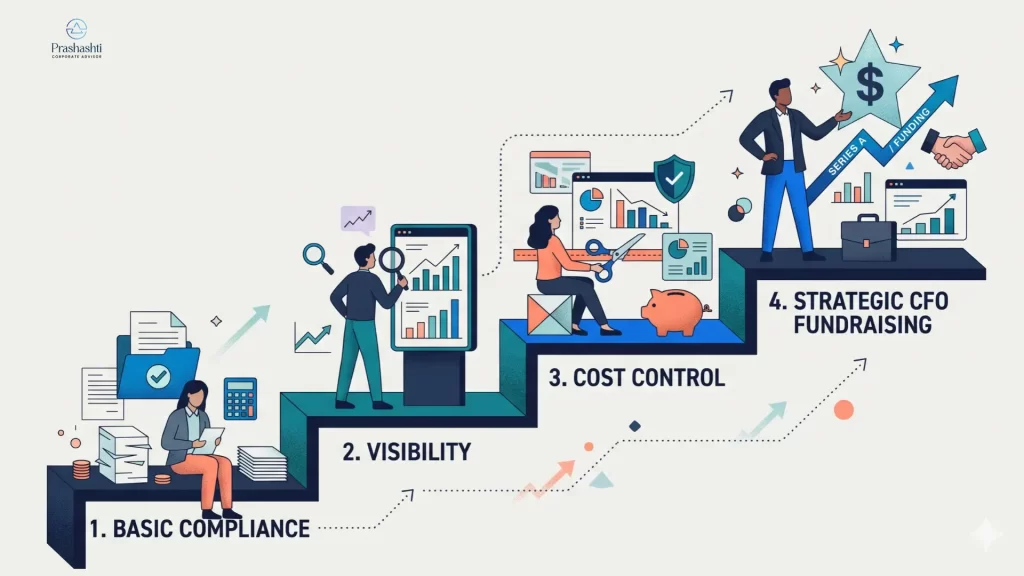
Most accounting articles only list services. Here’s a simple way to see where you stand. This is our own framework, not an industry standard.
- Stage 1: Compliance. Books are kept, returns filed, salaries paid. This is where most pre-seed startups begin.
- Stage 2: Visibility. Monthly MIS, tight reconciliations, clear cash reports. You always know where money went.
- Stage 3: Control. Budgets, variance checks, department-wise costs. You catch overspending before it hurts.
- Stage 4: Strategy. Fundraising prep, forecasting, scenario planning. This is CFO-level work.
A founder with perfect books but no idea of runway sits at Stage 1. That’s a risky place to be after a funding round.
What Should a Monthly MIS Report Include for Startups?
An MIS shows founders what the books mean. Here’s an illustration for a loss-making startup. The numbers are made up.
Metric | Illustrative month |
Revenue | ₹12,00,000 |
Operating expenses | ₹18,00,000 |
Net monthly burn | ₹6,00,000 |
Cash in bank | ₹45,00,000 |
Runway | About 7.5 months |
Runway is cash divided by average monthly net burn. Net burn is cash going out minus cash coming in. It’s not the same as total spending, so make sure your accountant uses the right one.
One more check: ask if your books run on an accrual basis. Cash-basis books can make the runway look healthier than it is when you have prepaid costs or deferred revenue.
Monthly Accounting Checklist: 7 Things Every Startup Founder Should Check
Use this every month. You don’t need to be an accountant.
- Did books close by the agreed date?
- Does the bank balance in the report match your actual bank balance?
- Were GSTR-1 and GSTR-3B filed? Do you have the acknowledgements?
- Was TDS deposited by the 7th?
- Does payroll match the salary you approved?
- Did the MIS explain any big change in costs?
- Do you know your runway in months?
Two or more “no” answers in a month? Talk to your firm that week.
What's Included in a Monthly Accounting Package and What Costs Extra?
Ask before you sign. Hidden costs live here.
Usually included: bookkeeping up to an agreed volume, monthly GST, quarterly TDS, payroll for a set headcount, and standard monthly reports.
Usually extra: cleaning up old books, statutory audit, ROC and company secretarial filings, FEMA filings, financial modelling, fundraising support, tax notices, and extra GST registrations or entities.
Get a one-page scope sheet. If it isn’t on the sheet, assume it costs more.
How Much Does Outsourced Accounting Cost in Bangalore?
There’s no single price. Firms advertise very different numbers because they sell different scopes. Basic packages for tiny companies start from a few thousand rupees a month. Startup private limited companies with payroll and MIS commonly pay somewhere between ₹10,000 and ₹35,000. Growing companies with several registrations or heavier reporting pay more. Treat these as market ranges, not quotes.
What moves the price:
- Monthly transaction volume.
- Number of employees.
- Scope (books only, or books plus GST, TDS, payroll and MIS).
- Bank accounts and payment gateways.
- Foreign clients, vendors or investors.
Don’t pick the cheapest quote. A package that skips reconciliation costs more later, when someone has to fix the books before a funding round. Outsourcing is usually cheaper than a full-time accountant plus software plus CA review. But work out your own numbers first, since savings claims like “60%” often have no calculation behind them.
How to Get Started With an Outsourced Accounting Firm: The First 30 Days
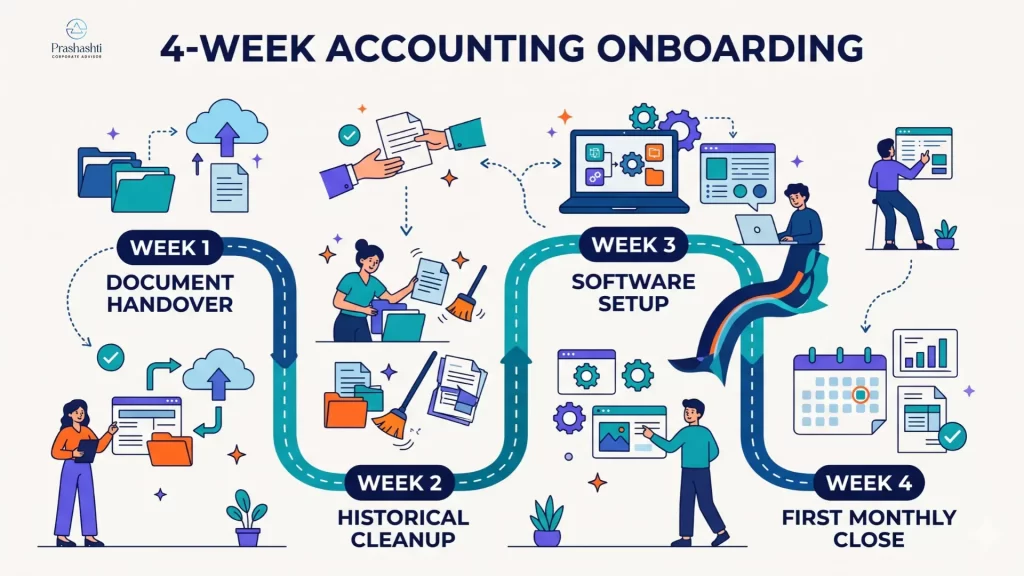
Week 1: Handover. You share incorporation papers, PAN, TAN, GST login, bank statements, and last year’s financials. You also pick software. Zoho Books, Tally, and QuickBooks all work. Prashasthi’s Tally vs Zoho Books comparison can help you choose.
Week 2: Cleanup. The team checks old entries, fixes errors, and lists pending filings.
Vinay Pai, CA and Co-Founder of Prashasthi Corporate Advisors, sees the same mistake often: “Most businesses don’t outgrow their software; they outgrow their process. A messy chart of accounts in a new cloud tool is still a messy chart of accounts. Clean the process first, then pick the tool.”
Week 3: Setup. Chart of accounts, payroll setup, TDS mapping, reconciliation rules.
Week 4: First close. You get your first reconciled books and MIS. Expect questions. That’s normal.
Outsourced Accountant vs. Virtual CFO for Startups: What's the Difference?
They do different jobs. An accountant records and reports what happened. A virtual CFO looks ahead: runway, hiring, pricing, fundraising. Most pre-seed startups need the accountant first. Add CFO-level advisory once you raise or scale.
Investors ask for more than clean books. They want reconciled bank accounts, payroll records, tax reconciliations, revenue schedules, and cap table details. Keep your DPIIT papers handy too. Under rules notified on 4 February 2026, a standard startup can stay recognised for up to 10 years with turnover of ₹200 crore or less in every year. Recognised DeepTech startups get up to 20 years and ₹300 crore. Other conditions apply. See Startup India.
5 Common Startup Accounting Mistakes That Can Hurt Your Fundraising Plans
- Unreconciled bank accounts: Investors check this first.
- Mixing personal and business spending: It confuses expenses and tax.
- Booking revenue too early: Subscription revenue belongs to the period you deliver the service.
- Missing vendor documents: No invoice, no input credit, and a weak audit trail.
- Wrong payroll and tax liabilities: Small errors pile up quickly.
Also, never share raw banking passwords. Ask for role-based access and a signed NDA.
How to Choose the Right Accounting Outsourcing Company in Bangalore?
Ask these on your first call:
- Who reviews my work before I see it, and which CA owns the final output?
- What do you automate, and who checks it?
- What’s my close date, in writing?
- Who’s my single contact, and what happens if they leave?
- Can I speak to two founder clients?
- Can my CA reach the books without calling me first?
Arun Bhandary says the last one is the simplest test: “Can your CA reach the books without calling you first?”
Red flags: no written scope, no sample report, no close date, and a price that sounds too good.
A Realistic Scenario: What Changes in 90 Days
This is an illustrative scenario, not a real client case. The numbers are made up.
Picture a Bangalore SaaS startup with 18 employees, collecting subscriptions through Razorpay. The founder updates the books once a quarter, so the numbers are always three months old.
Month 1: Team reconciles 3 months of bank entries to gateway payouts It discovers a gateway fee not booked and two duplicate vendor payments. Also reconciles purchases to GSTR-2B and takes payroll off of a spreadsheet.
Month 2: Closes books 10th. TDS due date is 7th, GSTR-1 is 11th, and GSTR-3B is 20th.
Month 3: First Full MIS arrives. Burning 6 lacs a month, 45 lacs in the bank, runway ~7.5 months. The creator now has solid numbers to plan recruiting and fundraising.
Prashasthi Corporate Advisors has worked with Bangalore businesses since 2014 across tax and advisory, payroll, statutory compliance and audit.
Looking for Reliable Accounting Services for Startups in Bangalore?
If you’re a Bangalore founder tired of chasing receipts and deadlines, we can take that off your plate. Book a free consultation or request a custom proposal with Prashasthi Corporate Advisors, and we’ll map your monthly deliverables, close date and a clear price with no surprises. Contact us here.
Disclaimer: This article is general information, not legal, tax or accounting advice. Due dates, rates and rules change, and your situation may differ.