

You have a startup in Karnataka. The product is ready, the business is moving, and now you start looking at government funding. Then comes the confusing part. You find one page talking about ₹50 lakh grants, another mentioning ₹1 crore, and a third still using rules from the older policy. Which one actually applies to you?
That’s where the Karnataka Startup Policy 2025-2030 matters. The Karnataka Startup Policy is the state government’s framework for funding, incubating, and mentoring startups through 2030, run by the Department of Electronics, IT & BT via Startup Karnataka and the Karnataka Innovation and Technology Society (KITS). It targets 25,000 new startups over five years, with at least 10,000 expected outside Bengaluru, and it funds them mainly through the ELEVATE family of grants.
The problem isn’t a lack of schemes. There are plenty. The real challenge is understanding which support fits your startup and whether you meet the current eligibility rules.
In this article, we’ll look at what has changed, how ELEVATE works, who can apply, what funding is available, and what you should have ready before you apply.
What Changed Under the Karnataka Startup Policy 2025-2030?
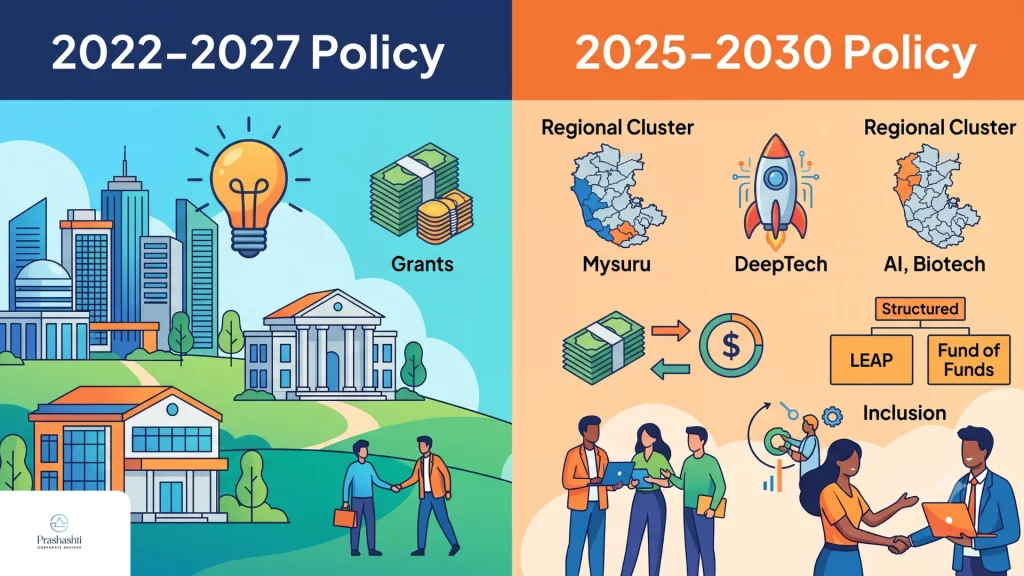
Before getting into the schemes, let’s clear up one common source of confusion. A lot of information online still refers to the 2022-2027 policy, while the 2025–2030 framework has introduced some important changes.
Earlier approach (2022–2027) | 2025–2030 direction |
Bengaluru-heavy ecosystem | Stronger Beyond Bengaluru focus, with named regional clusters |
One broad startup support umbrella | More targeted, track-specific programmes |
General innovation support | Dedicated DeepTech funding stream (ELEVATE NxT) |
Grant-led Karnataka startup funding | Grants plus wider ecosystem mechanisms (LEAP, Fund of Funds, cluster infrastructure) |
Centralised ecosystem | Regional clusters and local infrastructure investment |
General founder pool | Explicit inclusion tracks for specific founder groups |
Karnataka Startup Policy in 2026: Budget and Key Targets
The Karnataka cabinet cleared the policy on November 6, 2025. Most contemporaneous coverage, Entrepreneur India, Analytics India Magazine, Outlook Business, and Swarajya among them, reported the approved outlay as ₹518.27 crore to bolster the startup ecosystem in sectors such as AI and blockchain through funding, incubation, and mentorship.
When the policy was formally unveiled two months later at the January 2026 ELEVATE felicitation event, YourStory reported the figure as ₹570.675 crore for the policy. The difference appears across reporting from the policy’s approval and formal rollout, so the KDEM policy page should be treated as the reference point for the final operational figure.
What both figures agree on: the policy aims to establish up to 25,000 startups over the next five years, including 10,000 in regions outside Bengaluru, with a named focus on AI, blockchain, quantum computing, semiconductor design, and other DeepTech domains. Cities singled out for regional growth include Mysuru, Mangaluru, Hubballi-Dharwad, and Kalaburagi, alongside Belagavi, Tumakuru, and Shivamogga in other official summaries. Alongside Karnataka startup grants, the policy also covers a one-time Karnataka startup incentive of up to ₹50 lakh for private incubation centres, PF and ESI reimbursements of ₹3,000 per employee per month for the first two years, capped at ₹12 lakh per company, and R&D/cloud subsidies.
Karnataka Startup Policy: Funding for Startups Outside Bengaluru
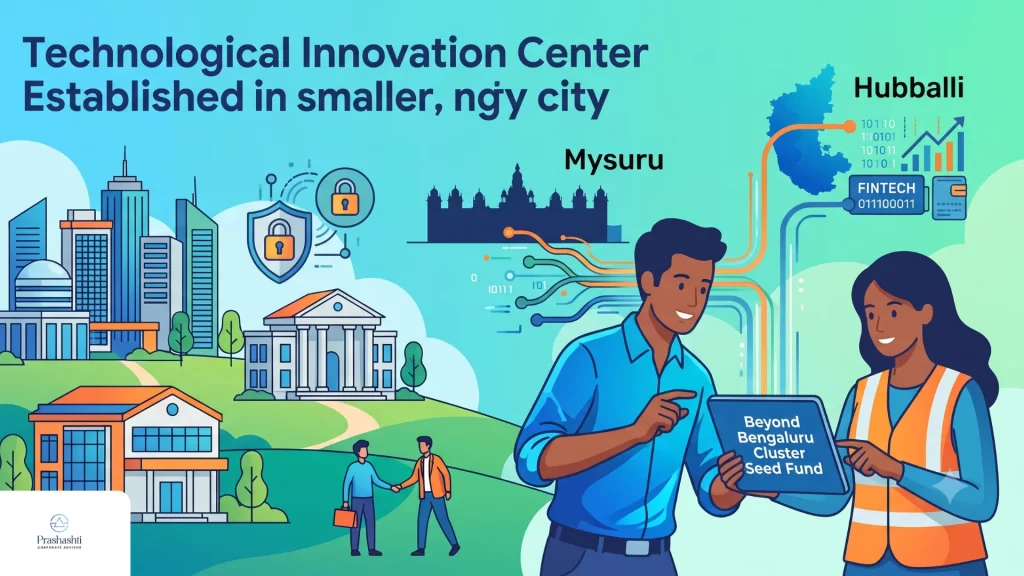
Bengaluru already concentrates the capital, the incubators, and the talent in Karnataka. That’s an advantage, but it also pushes up rents and makes it harder for a founder in Hubballi to get taken seriously without relocating. The policy’s answer is a Beyond Bengaluru Cluster Seed Fund, reported at ₹75 crore, plus a broader Fund of Funds totalling ₹500 crore to support startups developing innovative solutions with longer gestation periods, aimed specifically at emerging clusters outside Bengaluru.
Treat sector-to-city pairings you’ll see floating around online (Mysuru = cybersecurity, Hubballi = fintech) with some caution. They’re not formally written into the policy text; they’re patterns commentators have noticed, not rules.
DeepTech Funding Under Karnataka Startup Policy (ELEVATE NxT)
A DeepTech startup doesn’t behave like a consumer app. Longer R&D cycles, heavier upfront capital, a much longer runway to revenue. A funding model built for fast-iterating SaaS founders doesn’t map cleanly onto a startup building sensors or biotech IP. Karnataka’s solution runs through LEAP (Local Economy Accelerator Program) and ELEVATE NxT.
LEAP is the five-year, ₹1,000-crore initiative designed to strengthen emerging clusters outside Bengaluru by providing access to infrastructure, funding and sector-specific support, approved by the Karnataka Cabinet earlier in 2025. Within that umbrella, the state budget separately earmarked an INR 300 Cr fund and INR 100 Cr corpus to support the deeptech startups in the state.
At ELEVATE NxT, the actual DeepTech grant-in-aid call under LEAP, launched in January 2026, coverage of the event described it as a Rs 150-crore deeptech grant programme under its Local Economy Accelerator Program, offering up to Rs 1 crore per startup in milestone-based funding.
Whether the ₹150 crore figure is the ₹100 crore corpus plus a later top-up, or a differently scoped number, isn’t clarified in public reporting. Check the official ELEVATE NxT call notification.
Priority sectors named across official summaries: AI, blockchain, quantum computing, biotechnology, semiconductors, and sustainability-linked technologies.
Current ELEVATE Karnataka Calls (September 2026 Update)
As of this week, the live ELEVATE portal shows two active calls, not the four-track structure from earlier in the year:
ELEVATE NxT (DeepTech, Pan-India)
- Up to ₹1 crore in grant-in-aid, milestone-based.
- Turnover must stay under ₹300 crore in any financial year since incorporation.
- Must be within 20 years of incorporation.
- Startups registered outside Karnataka can apply, but if selected, must shift their Registered Office to Karnataka within 4 months.
- No ELEVATE Grant-in-Aid received in the last 3 years.
- Minimum founding/core team of two.
ELEVATE Minorities 2026
- Up to ₹50 lakh, one-time grant-in-aid.
- Must be incorporated in Karnataka, turnover under ₹200 crore, within 10 years of incorporation.
- At least one Director/Partner from a community recognised by the Karnataka Minorities Development Corporation. Muslims, Buddhists, Jains, Sikhs, or Parsis, holding a minimum 51% equity stake, with a valid digital Minority Certificate carrying an RD Number.
Applications for this round opened September 21, 2026, through the official portal. If you’re reading this close to publication, don’t take these eligibility numbers as fixed for future rounds. ELEVATE has changed its track structure at least three times in 2026 alone. Confirm the live call details on the ELEVATE portal each time before applying.
ELEVATE Karnataka Scheme: Grant Tracks and Eligibility
Historically, ELEVATE was best known for a single flagship grant-in-aid, offering up to ₹50 lakh plus subsidised mentoring and incubation. Today, it has become one of the better-known startup grants in Karnataka, with different tracks opening for different types of founders. That track record is public: since its 2017 launch, the ELEVATE programme has disbursed Rs. 287.85 crore in grants to 1,230 startups across the state, and the 2025 cohort alone recognised 146 startups selected under the ELEVATE 2025 programme, receiving a total grant support of ₹38.85 crore, with around 43 percent of the selected ventures women-led, and a similar proportion based outside Bengaluru.
What’s changed is the structure, repeatedly, within the same year. In May 2026, a 25th call ran four parallel tracks (General, Shakti for women-led ventures, Unnati for SC/ST founders, Aspire for startups outside Bengaluru Urban) simultaneously for the first time.
By September, the live portal shows a different pairing (NxT and Minorities). The constant across all of it: a startup can apply to more than one applicable track, but the pitch is evaluated once, and the grant is capped; it doesn’t stack.
ELEVATE Scheme in Karnataka: Eligibility Criteria
The ELEVATE tracks share a rough baseline, but every call sets its own exact numbers; don’t treat this as one universal checklist:
- Registered entity (Karnataka or, for some tracks, anywhere in India).
- A defined incorporation-age ceiling (10 years for most tracks, 20 years for ELEVATE NxT specifically).
- A turnover cap (₹200 crore on most tracks, ₹300 crore on ELEVATE NxT).
- Minimum two-person founding/core team.
- Genuine innovation, not a resale or franchise model.
- No ELEVATE grant received in the prior 3 years.
Track-specific conditions stack on top: ownership thresholds for Shakti, Unnati, and Minorities; geography for Aspire; Technology Readiness Level and DeepTech qualification for NxT. Policy eligibility and scheme eligibility aren’t the same thing. Qualifying under the broader Karnataka Startup Policy doesn’t mean you automatically clear the bar for a specific call; always check the current call notification directly.
What Founders Should Prepare Before Applying For Elevate Karnataka?
Beyond the pitch deck, ELEVATE applications are document-heavy, and incomplete submissions get rejected right away. Across current and recent calls, the recurring requirements are:
- Certificate of incorporation for your entity type.
- MOA / Partnership Deed / LLP Deed, as applicable.
- CA-certified revenue certificate for the appropriate financial year stating that you are within the turnover cap.
- CA-attested shareholding pattern (important for Shakti, Unnati and Minorities tracks where ownership % is a qualifying criteria)
- Patent certificates, if available, can help with IP claims.
- A notarised startup affidavit on stamp paper, naming KITS as the counterparty.
- An anonymised qualification pitch deck (no company name, logo, or founder details) plus a separate business-model deck for the in-person round.
Expert Insight (Arun Bhandary, Founder, Prashasthi Corporate Advisors):
The single biggest reason we see grant applications stop isn’t the pitch. It’s the paperwork. A shareholding pattern that isn’t CA-attested, or an incorporation certificate that doesn’t match the entity type declared on the portal, gets an application rejected before a jury even sees it. Get your registration and compliance documents audit-ready before you touch the application form, not after.
If your documentation isn’t in order yet, sorting out company registration or an LLP registration properly the first time avoids exactly this problem later. The same applies to MSME/Udyam registration, which several founders keep alongside their startup recognition for other state and central benefits.
How to Apply for ELEVATE Karnataka - Step by Step ?
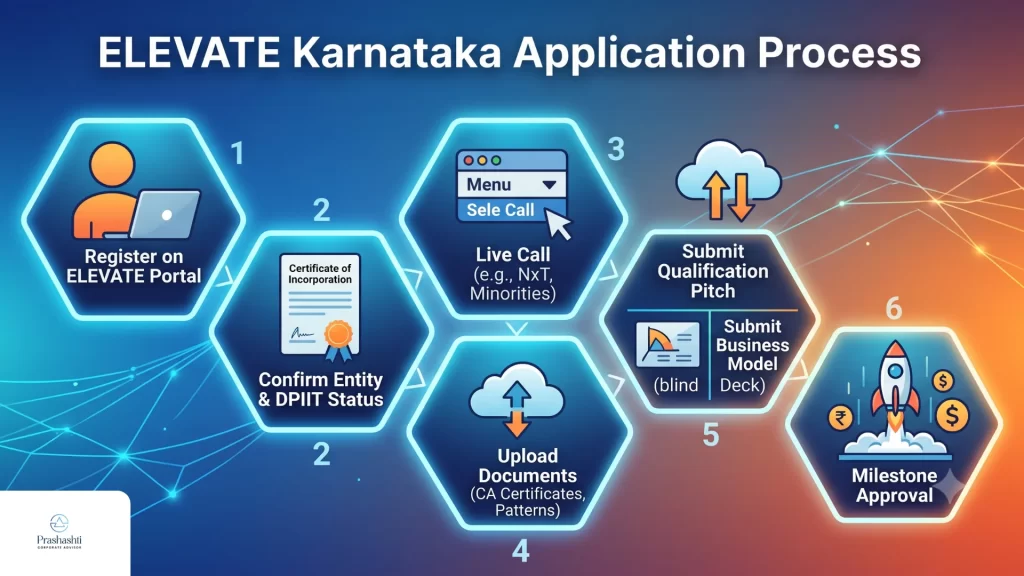
- Register on the ELEVATE portal using your company and founder information.
- Please confirm your entity: Incorporation Certificate, CIN/Registration information, and DPIIT status, if applicable.
- Choose your call: ELEVATE NxT, Minorities, or whichever is currently live.
- Document upload: CA-certified income certificate, shareholding pattern, and other needed files.
- Submit your pitch decks: a qualification deck first (limit 2 slides, no firm name, logo, or founder details) used for blind jury screening, and a full business-model deck for the in-person round.
- Get your ELEVATE Application ID to track status through document screening, technical evaluation, and jury pitch in person.
Funding is distributed in two equal parts. The first part is provided after signing a tripartite agreement between KITS, your allocated K-Tech innovation partner, and your firm. The second part will be granted after assessment and approval of your first milestone. For broader compliance and business structuring requirements, founders can also explore corporate advisory services in India.
Karnataka Startup Funding Schemes for Women, SC/ST and Minority Founders
It’s tempting to describe Shakti, Unnati, Aspire, and Minorities as “extra benefits.” That undersells what’s happening. Running multiple targeted tracks alongside a general call, in the same funding cycle, signals that the government treats access, not just funding, as something that needs intentional design. A first-generation founder in Kalaburagi doesn’t start from the same place as one in Koramangala.
Which ELEVATE Karnataka Scheme Should You Apply To?
Startup profile | Track to check | Typical support | Key eligibility question |
Early-stage, any sector | ELEVATE General (when open) | Up to ₹50 lakh | Is the current call active? |
DeepTech / hard science | ELEVATE NxT | Up to ₹1 crore | Does the tech meet TRL and DeepTech criteria? |
Minority-community-led | ELEVATE Minorities | Up to ₹50 lakh | Is 51%+ equity held by a qualifying founder with an RD-numbered certificate? |
Women-led (when open) | ELEVATE Shakti | Up to ₹50 lakh | Is 51%+ women ownership sustained through the project? |
SC/ST-led (when open) | ELEVATE Unnati | Up to ₹50 lakh | Does the ownership structure meet the current call’s threshold? |
Outside Bengaluru Urban (when open) | ELEVATE Aspire | Up to ₹50 lakh | Is the registered office outside Bengaluru Urban specifically? |
Scaling past proof-of-concept | Regional incubators, K-Tech partners | Mentoring, market access | Have you been mapped to a K-Tech innovation partner? |
Karnataka Startup Policy 2025–2030: Get the Basics Right First
The Karnataka Startup Policy 2025-2030 can open up useful funding and support, but getting the grant isn’t where the work starts. First, you need to know which ELEVATE track fits your startup, whether you meet its current rules, and whether your documents are in order. That last part is easy to overlook until it becomes the reason an application gets held up. This is where basic corporate compliance matters. Prashasthi Corporate Advisors works with businesses in areas such as company registration and compliance, which can help founders get that groundwork sorted before they focus on the funding application.
Disclaimer: This article is for general informational purposes and reflects publicly available information as of late September 2026.