

Imagine wrapping up your financial year, thinking everything’s sorted, and then your CA says,
“You need both a tax audit and a statutory audit.”
Wait, both? Aren’t they the same thing? That’s where most business owners get caught off guard.
One audit keeps the taxman happy, the other keeps your company legally clean. But together, they decide how compliant (and credible) your business really looks. If you’re still building clarity around basic financial processes, you may also find our guide on the difference between bookkeeping and accounting helpful.”
Let’s break down the tax audit vs statutory audit confusion in simple terms
What Is a Statutory Audit?
Let’s see what a statutory audit means. The law says that a statutory audit must look at the company’s books and financial statements. For example, the Companies Act of 2013 in India says that the businesses must have their annual financial statements checked.
The main goal is to give an unbiased opinion that the company’s financial statements show a “true and fair view” of a particular business. The auditor checks the books, looks at transactions, checks internal controls, and looks at the balance sheet, profit and loss account, and cash flows.
Important points:
- It’s mandatory for companies, regardless of how large or small their business is (unless exempted).
- A chartered accountant has to do the audit, and this person should not work in the company.
- The focus is wide, covering all of the company’s books and statements, including internal controls, following accounting rules, and making sure the financial reports are correct.
What Is a Tax Audit Under Section 44AB? Meaning, Limits & Forms Explained
Now let’s talk about the meaning of a tax audit. Now let’s talk about what a tax audit means. A tax audit in India is the audit required under Section 44AB of the Income‑tax Act 1961. It steps in when certain turnover or receipt thresholds are crossed.
The goal of a tax audit is to ensure that your business/profession has maintained books correctly, claimed deductions properly, and reported income accurately for tax purposes.
For instance, a company that makes more than ₹1 crore a year or a professional who gets more than ₹50 lakhs a year. If less than 5% of transactions are in cash, the limit is higher (₹10 crore).
In other words, you must get a tax audit when you hit certain limits. The auditor fills out forms (commonly Form 3CA/3CB with Form 3CD) and submits them to the tax department, verifying your income tax calculations and disclosures. For deeper financial efficiency, explore our detailed guide on Tax Planning & Management for businesses.
Did You Know?
From April 2026, every CA partner can sign a maximum of 60 tax audits per year. Booking your audit early will matter more than ever.

Tax Audit vs Statutory Audit: Detailed Comparison Table
Let’s pull together a clear comparison so you can see how these two diverge. This is your go-to table for a tax audit vs a statutory audit:
How to Prepare for a Tax Audit and Statutory Audit: Step-by-Step Guide
- When preparing for a tax audit vs a statutory audit, organization is everything. Keep your books of accounts up to date: ledgers, invoices, bank statements, and cash registers.
- For tax audit, especially: track cash receipts/payments carefully (to check if you qualify for a higher threshold).
- Appoint your CA well ahead of the deadline. Ensure they are comfortable with both statutory and tax audit matters if required.
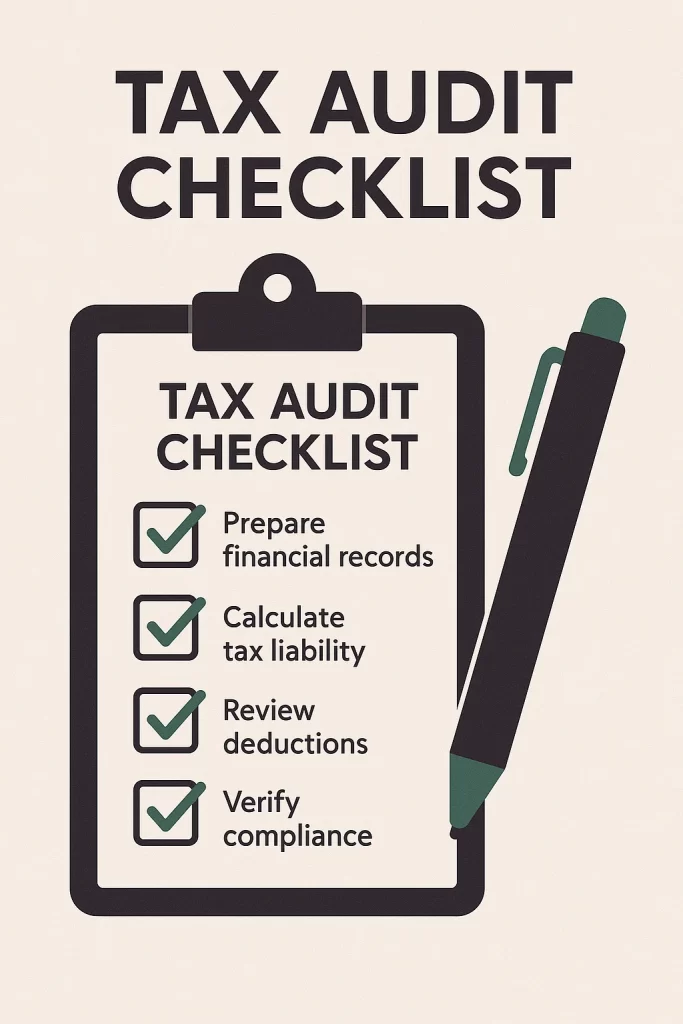
- Prepare a checklist: closing stock valuation, fixed asset register, depreciation, GST returns, TDS certificates, and previous year’s financials.
- Review deadlines early: for tax audit, the deadline was recently extended in some cases.
- Are you a new or small business? If so, check to see if you are exempt from presumptive taxation or the low turnover level. This could save money or time.
Risk & Consequences
| Parameter | Tax Audit | Statutory Audit |
|---|---|---|
| Risk If Ignored | Penalty under Sec 271B | Violations under Companies Act |
| Financial Penalty | 0.5% of turnover (max ₹1.5 lakh) | Fines, prosecution, director disqualification |
| Operational Impact | Scrutiny from IT Dept. | Problems in fundraising, banking, compliance ratings |
| Reputation Impact | Medium | High |
Who Needs Which Audit? (Quick Decision Guide by Business Type)
Private Limited Company
Statutory Audit – Mandatory
Tax Audit – Applicable only if turnover crosses limits under Section 44AB
LLP
Statutory Audit – Not mandatory unless turnover or partner contribution limits are crossed
Tax Audit – Applicable if Section 44AB thresholds are exceeded
Sole Proprietorship
Statutory Audit – Not required
Tax Audit – Required only after crossing turnover or professional receipt limits
Partnership Firm
Statutory Audit – Generally not required
Tax Audit – Mandatory if limits under the Income-tax Act are exceeded
Section 8 / NGO
Statutory Audit – Mandatory
Tax Audit – Depends on income level and nature of activities
Recent Updates You Should Know
- From April 2026 on, the Institute of Chartered Accountants of India (ICAI) says that each partner in an accounting company will only be able to do 60 tax audits a year. It’s meant to make things better.
- The Central Board of Direct Taxes (CBDT) extended the deadline for tax audit report submission for FY 2024-25 to 31 October 2025 (from earlier 30 September 2025).
- Also, changes to Form 3CD that take effect on April 1, 2025, require more information to be given, such as certain income from streaming or telecasting (Section 44BBC).
These changes show that the auditing system is always changing. Getting ahead of new rules will help your business. If you’re operating as an LLP or planning to switch structures, review the advantages and disadvantages of LLPs in India to ensure compliance during audits.

Tax Audit vs Statutory Audit — Getting It Right Matters More Than You Think
Understanding tax audit vs statutory audit isn’t just about avoiding fines; it’s about protecting your business’s reputation. When your books are clean and compliant, investors trust you, banks respond faster, and growth feels smoother.
Think of audits as your business’s health check, not a headache. The right guidance makes all the difference. Firms like Prashasthi Corporate don’t just handle filings; they help businesses see the bigger picture behind every audit. Because when compliance becomes clarity, your business moves forward without second-guessing every number.
FAQs
Can a company skip the tax audit if it already does a statutory audit?
No. Having a statutory audit does not automatically replace the tax audit requirement. If you cross the tax audit thresholds, you must still get the tax audit. The two serve different laws.
Can the same chartered accountant do both audits for my company?
Yes, if they are qualified and you appoint them for both tasks. But they must complete each audit according to its legal basis and format.
What will happen if I miss the deadline of the tax audit?
You could face a penalty under Section 271B of the Income Tax Act: usually 0.5% of turnover/gross receipts, subject to a minimum of ₹1.5 lakh. Also, you may lose or delay certain deductions or face scrutiny.




Pingback: Tax Audit Requirements in India: Limits, 5% Rule & Key Mistakes
Pingback: PF Contribution of Employer: Rules, Split & Updates 2026
Pingback: Tax Audit Requirements in India (FY 2025–26) | Section 44AB Guide