

Picking a business name itself feels hard. Then your CA asks, “OPC or LLP?” And suddenly, the name doesn’t matter anymore. The structure does. Same idea. Same work. But two very different tax outcomes. One could help you save lakhs. The other could make profit sharing easier.
If you’re still evaluating business structures at a broader level, understanding how to choose the right company structure for your business can help clarify the long-term implications before diving into tax comparison.
Most founders in 2026 get stuck at this point. The tax gap is true, and it affects how much you actually keep. In this blog, we’ll break down the OPC vs LLP tax 2026 in simple words so you can decide with clarity.
What Are OPC and LLP?
Before we discuss taxes, you need to know what these two structures actually mean.
OPC (One Person Company)
- Started by one person
- Separate the legal identity from the owner
- Personal assets are protected
- Taxed like a private limited company
It works for founders who are working alone and want restricted liability and a business structure. At the implementation stage, founders often evaluate procedural timelines and compliance formalities involved in one person company registration in Bangalore before deciding.
LLP (Limited Liability Partnership)
- Requires at least two partners
- Partners have limited liability
- Flexible internal management
- Taxed as a partnership firm
LLPs are common among consultants and small teams. Both structures can be registered through company registration services in India. At the registration stage, documentation accuracy plays a major role in avoiding delays. The documentation checklist for LLP registration in Bengaluru outlines the typical compliance expectations during incorporation:
Why Taxation Matters for Your Business?
Tax decides how much profit you actually keep. And that shapes how your business grows.
It affects:
- Pricing decisions
- Hiring plans
- Reinvestment
- Expansion speed
In the OPC vs LLP tax 2026, the real difference is simple: how profits are taxed and whether extra tax applies when you take money out. That gap can change your final take-home amount. Before comparing rates, it’s important to understand how business income tax calculation in India works at a foundational level, especially when evaluating post-tax profitability.
How OPC Is Taxed in India (2026 Rules) ?
An OPC is treated as a domestic company under the Income Tax Act, 1961. So it follows corporate tax rules, not partnership rules.
In 2026, it has two options:
- 22% concessional tax under Section 115BAA (plus surcharge and cess).
You give up certain deductions but get a stable, lower base rate. Many founders prefer this for predictability. Understanding current tax audit requirements helps founders anticipate additional compliance costs - Regular corporate regime, which allows deductions but usually comes with a higher rate.
If the OPC is DPIIT-recognized, it may claim tax holiday benefits under Section 80-IAC, subject to CBDT conditions.
After corporate tax, dividends are taxed in your personal slab. No DDT anymore.
OPCs can also:
- Claim business expenses
- Depreciate assets
- Carry forward losses
It’s structured, compliant, and built for scale.
How LLP Is Taxed in India (2026 Rules)
Many people ask, Is LLP tax-free in India? No, it is not.
An LLP is taxed as a separate entity under the Income Tax Act. In 2026, it pays:
- A flat 30% tax on total income
- Plus surcharge and cess, if applicable
This 30% rate stays the same, no matter how high or low the profit is.
The benefit? Once the LLP pays tax, profits can be distributed to partners. There is no additional tax at the entity level on that distribution. That means there is only one layer of tax at the business level.
This simple structure is why many service firms prefer LLPs. One thing that LLPs don’t have is the option to pay a lower 22% corporate tax, which is open to companies like OPCs. For founders planning incorporation in Karnataka and evaluating execution aspects, LLP company registration in Bangalore involves a comparatively flexible compliance framework.
You can always check the Income Tax Department’s 2026 Tax Slabs for legal proof.
OPC vs LLP Tax 2026 — Key Differences Explained
According to the Ministry of Finance, the tax treatment is based on whether your entity is a “Company” or a “Firm.” Here is a clear side-by-side comparison of LLP vs OPC tax treatment in 2026:
Basis | OPC | LLP |
Tax Rate | ~22% (if opted under 115BAA) | 30% flat |
Best For | Reinvestment & scaling | Stable withdrawals |
Profit Distribution | Dividend taxed personally | No second tax at entity level |
Startup Benefits | Can qualify for Startup India tax exemption if DPIIT is recognized | Generally not eligible for Startup India tax holidays |
Compliance & Filing | Slightly stricter | Comparatively simpler |
The Real World Math: ₹10 Lakh Profit Scenario
Let’s look at how much stays in your pocket after all taxes under the OPC vs LLP tax in 2026, assuming you want to take the money home.
In an LLP:
- Business Tax: Your LLP pays a flat 31.2% on ₹10,00,000 = ₹3,12,000.
- Take Home: You withdraw the remaining ₹6,88,000.
- Personal Tax: ₹0. (Partner’s share of profit is exempt under Section 10(2A) of the Income Tax Act.)
- Final Take-Home: ₹6,88,000.
In an OPC:
- Business Tax: The OPC pays ~25.17%, which is ₹2,51,700.
- Post-Tax Profit: ₹7,48,300 remains in the company.
- Withdrawal (Dividend): If you take this out as a dividend, it will be added to your personal income. If you’re in the 15% slab (as of 2026), you will owe ₹1,12,245.
- Final Take-Home: ₹6,36,055.
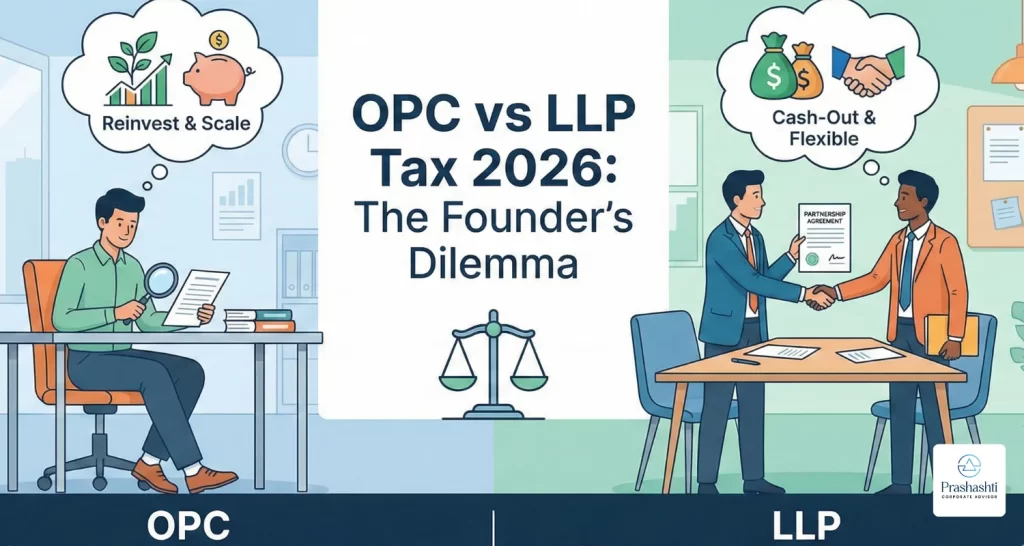
Expert Insight: In 2026, the OPC is a “Reinvestment Machine,” while the LLP is a “Cash-Out King.” You will save more if you keep the money in the business to buy assets or grow. The lower 25% corporate rate is better for this. If you need the cash for personal expenses, the LLP’s single-layer tax is superior.
OPC vs LLP Tax 2026 — What Matters Most?
Choosing between OPC vs LLP tax 2026 is not merely a compliance step. It is a structural decision that affects capital retention, funding readiness, and long-term scalability. Before registering, founders should look at not only the current tax outflow but also the direction of future growth.
Advisory firms like Prashasthi Corporate help businesses choose the right structure and follow Indian corporate law. They do this by helping businesses align their structure with their long-term goals instead of just short-term tax savings.
Related
Discover more from Prashasthi Corporate Advisors
Subscribe to get the latest posts sent to your email.