
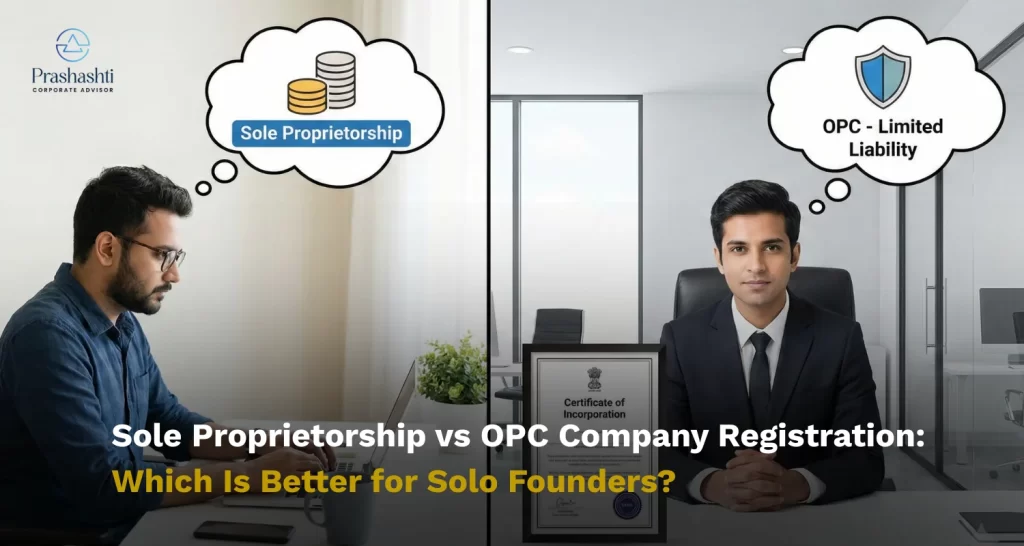
Many solo founders in India start with a burst of energy, only to hit a wall: How should the business be legally registered? A freelancer begins earning ₹1 Lakh a month, corporate clients start asking for “Company-level” invoices, and suddenly, a basic PAN card isn’t enough. In 2026, the gap between a Sole Proprietorship and a One Person Company (OPC) has widened due to new digital compliance under the MCA V3 portal and the revised Income Tax slabs. If you’re still exploring the broader landscape of structures available, you can first review the different types of company registration in India before deciding between the two.
This guide breaks down OPC Company Registration vs Sole Proprietorship in simple terms so you can choose the structure that actually fits your business stage.
Understanding Sole Proprietorship
In India, a Sole Proprietorship is the simplest way to trade. There is no legal distinction between the owner and the entity.
- Registration: No formal “incorporation.” You simply register for GST or obtain a Udyam Certificate via the MSME Portal. If your turnover increases, it’s important to understand the tax audit requirements under Section 44AB to avoid penalties.
- The Risk: Unlimited Liability. If your business faces a legal suit or debt of ₹20 Lakhs, your personal savings, car, and gold can be legally attached to pay it off.
- Best For: Low-risk service providers (Designers, Tutors, Micro-consultants) earning under ₹10-15 Lakhs annually.
Understanding One Person Company (OPC)
As defined under Section 2(62) of the Companies Act, 2013, a One Person Company (OPC) is a company with only one member. If you’re specifically calculating local costs, you can also review the detailed breakdown of OPC registration cost in Bangalore.
- Legal Identity: Legally, it is its own “person.” There are bank accounts and valuables that belong to it.
- The Shield: Your personal liability is limited to the Unpaid Share Capital. If the company goes into debt, your personal house is safe.
- Continuity: You must appoint a Nominee. If something happens to you, the business continues seamlessly.
If you’re preparing to register, make sure you check the complete list of documents required for company registration in Bangalore to avoid delays during incorporation. The procedural and compliance differences are detailed under Private Limited Company Registration in Bangalore, especially for businesses planning expansion or external funding.

Key Differences Between OPC Company Registration vs Sole Proprietorship
|
Aspect |
OPC |
Sole Proprietorship |
|
Initial Cost |
~₹15,000 – ₹25,000 |
~₹2,000 – ₹5,000 |
|
Audit Requirement |
Mandatory every year by a CA |
Only if turnover > ₹1 Cr (under Sec 44AB) |
|
Compliance Portal |
MCA V3 Portal (High scrutiny) |
GST & Income Tax Portal |
|
Taxation |
Corporate Tax (Fixed 22% – 25%*) |
Income Tax & GST Portals |
|
Public Credibility |
High (Viewable on MCA Master Data) |
Moderate (Linked to individual) |
Before deciding, founders usually evaluate the actual breakup of government and professional expenses. You can review the detailed breakdown of company registration fees in India to understand stamp duty, ROC fees, and compliance costs involved.
The Hidden Cost of Compliance in OPC Company Registration vs Sole Proprietorship
While a Proprietorship costs almost nothing to maintain, an OPC requires a Chartered Accountant (CA).
- Proprietorship Annual Cost: ~₹2,000 – ₹5,000 (GST filings & ITR).
- OPC Annual Cost: ~₹15,000 – ₹25,000 (Statutory Audit, ROC filing fees, and professional charges). As the company grows, compliance becomes more structured. You may also want to understand ongoing legal compliances of a Private Limited Company if you plan to scale beyond OPC in the future.
Expert Insight: In 2026, a lot of founders jump into OPCs to get the title “Director,” only to be hit with audit fees. We suggest switching to an OPC only if your monthly income regularly goes over ₹1.5 Lakhs. — Prashasthi Corporate.

Growth, Credibility, and Business Expansion
When a company grows, the reputation becomes more important. Clients and banks usually feel safer doing business with a registered company than with a sole owner. An OPC is a formal system that helps people trust each other when they sign contracts and work together.
Key growth advantages include:
- Stronger professional image for corporate clients.
- As the business grows, it’s easy to switch to a Private Limited Company.
- Better long-term continuity compared to proprietorship.
Some founders also look at the growth of the main, LLP, and company structures. However, the OPC is still the best option for solo founders who want the benefits of a corporation without the need for partners.
When Should a Founder Choose Each Structure?
The right structure depends on the stage of the business and risk level.
- Choose Sole Proprietorship when you want to test a concept, work as a freelancer, or start small with an income that isn’t guaranteed and few rules to follow.
- Choose OPC when revenue becomes stable, clients grow larger, contracts increase, or legal protection becomes important. If you’re planning to incorporate and want expert assistance, reviewing the list of top company registration consultants in Bangalore may help you choose the right advisory partner.
Expert Insight: Integration of GST, PAN, and MCA records has made things more clear than ever before. Clients now check the MCA Master Data site for “Company Status” before signing important contracts. An OPC is no longer a nice-to-have if you want to do business with big Indian MNCs or sell services; you need one to build trust.
The 2026 Reality: AI Scrutiny and Hidden OPC Risks
There are a lot of founders who don’t know how compliance has changed in 2026 when they are comparing OPC Company Registration vs Sole Proprietorship. The MCA now uses e-scrutiny tools based on AI that find problems automatically when filings. Punishments can be given for small mistakes very fast.
Key things to know:
- Nominee trap: If your nominee’s Aadhaar–PAN KYC is not updated, filings may get blocked, triggering ₹100 per day penalties.
- Geo-tagging rule: OPCs must submit geo-tagged office photos; placeholder addresses no longer work.
- Exit advantage: Changing a proprietorship later is hard, but changing an OPC to a Private Limited Company can be done online in about 10 days.
Making the Right Choice in OPC Company Registration vs Sole Proprietorship
Choosing between an OPC vs Sole Proprietorship boils down to risk vs. cost. A Sole Proprietorship can save you thousands of dollars in compliance costs if you’re testing an idea that isn’t very risky. The One Person Company (OPC) is the best way to protect your assets and build your brand in India, but only if you’re signing high-value contracts or building a brand that can grow.
If you’re still not sure, companies like Prashasthi Corporate can help founders make these choices clear and easy to understand. They can also help make sure that the business goals are in line with the right legal structure without adding extra complexity.
Are you ready to sign up? Call Prashasthi Corporate today for a smooth, professionally guided incorporation process!
Register Your Business in India With Us!
Related
Discover more from Prashasthi Corporate Advisors
Subscribe to get the latest posts sent to your email.