

If you run a growing startup in India, you’ve probably heard the term Minimum Alternate Tax (MAT) thrown around. Even with tax holidays and government support, MAT for startups in India continues to influence how much tax founders ultimately pay.
The concept might seem confusing at first. You’re told that you don’t need to pay tax for the first few years under schemes like Section 80-IAC, but then a tax like MAT shows up in your balance sheet anyway.
This blog will break down what MAT really means, how it affects startups, and what has recently changed in Budget 2025. No technical jargon. Just real, practical information to help you understand how it impacts your business decisions.
A Quick Look at Startup Tax Benefits
India wants to become a global startup hub. That’s why the government introduced several tax benefits under the tax regime for startups, especially under Section 80-IAC of the Income Tax Act.
Startups recognised by DPIIT (Department for Promotion of Industry and Internal Trade) can claim a 100% tax holiday for three consecutive years, within their first ten years of incorporation. In Budget 2025, this benefit was extended until March 31, 2030, which is a positive move.
But here’s the catch — even if you qualify for a tax holiday, you may still need to pay MAT for startups in India if your firm earns a profit on paper (“book profit”).
What Is MAT for Startups in India and Why Does It Matter?
Minimum Alternate Tax is a way for the government to make sure companies don’t avoid paying taxes entirely by using deductions, exemptions, or incentives. Even if your ordinary tax due is zero, MAT requires you to pay a minimum amount, presently 15% of your book profit.
Here is a simple example.
Assume your startup had a book profit of ₹1 crore in FY 2024-25. Due to tax exemptions under Section 80-IAC, your income tax liability is zero. However, under MAT rules, you’ll still have to pay 15% of ₹1 crore, which is ₹15 lakh as MAT.
Moreover, this generally surprises many founders who assume they won’t owe anything during their exemption period.
MAT Credit: A Relief for Startups
Here’s where MAT credit comes in. The MAT tax you pay is not gone forever. When your tax holiday expires, you can carry this sum forward and apply it to future tax bills.
Before Budget 2025, startups could carry forward this credit for 10 years. Now, this period has been extended to 15 years, giving more breathing space to early-stage businesses.
So, if you’re paying ₹15 lakh as MAT now, you may get to reduce your tax bill by that amount in any of the next 15 years when you’re paying regular income tax again. This helps to balance things out over time, especially for a growing startup firm that anticipates consistent revenues in the future.
Clause 206 in Budget 2025: What’s Changing for MAT and Startups?
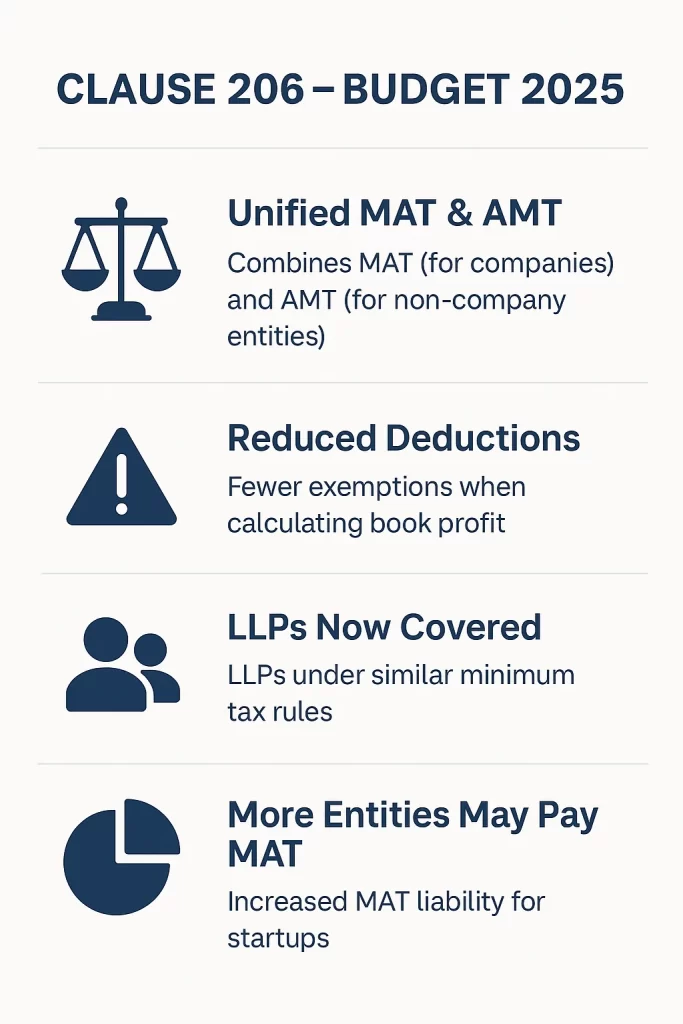
Clause 206 of Budget 2025 proposes to unify the requirements for the Minimum Alternate Tax (MAT) with the Alternative Minimum Tax (AMT for non-company entities). This could tighten the framework for exemptions and deductions that startups currently rely on.
However, Clause 206 may result in fewer deductions being allowed while calculating book profit, which in turn can increase the MAT amount payable.
Furthermore, this clause also widens the net to include other types of entities like LLPs under similar minimum tax rules. If your growing startup is registered as an LLP and enjoys deductions or exemptions, you might still get caught under these minimum tax provisions.
Though the clause is still being reviewed and interpreted by tax professionals, it’s safe to say startups will need to pay more attention to how their tax books are structured.
Understanding such nuances early can prevent future compliance stress — something we’ve covered in depth in our explainer on Corporate Advisors vs Finance Advisors, which compares strategic advisory vs operational financial management for startups.
Why Minimum Alternate Tax Still Matters for Startups?
For early-stage startups, cash flow is everything. You may have money on paper, but not in your bank account. If you’re being asked to pay MAT based on book profit, it can affect your runway as well as growth plans.
Moreover, this MAT credit system helps in the long run, but it doesn’t remove the short-term impact. You’re paying real cash today, and that can hurt if you’re not prepared.
Also, the fact that the MAT applies during the Section 80-IAC tax holiday period often leads to confusion. Many startups expect to pay nothing and end up with a sizable tax bill. This is why understanding MAT is crucial if you’re planning your budget, raising funds, or reinvesting profits. Understanding MAT for startups in India helps founders plan budgets, manage runway, and negotiate better with investors. You can explore this further in our article on Role of Corporate Advisors in Business Success.
Smart Tax Planning Tips to Manage MAT for Startups in India
If your growing startup is heading toward profitability, there are a few things you can do to minimise MAT impact:
- Consider alternate tax regimes like Section 115BAA or 115BAB. These provide reduced flat tax rates (22% for domestic enterprises, 15% for manufacturing startups) and can completely free you from MAT. However, you will have to give up other deductions and exemptions, so make your decision carefully.
- Maintain clear accounting records. Keeping your book profits and taxable income cleanly separated helps you track your MAT credit better.
- Include MAT planning in your cash flow projections. If you know you’ll be paying MAT, prepare for it. Include it in your fundraising goals or spending plans.
Stay updated with CBDT notifications and Income Tax rule changes, especially around new clauses like 206, which may redefine what counts as book profit.
Why Founders Should Plan for MAT Early?
For many growing startups, the real challenge isn’t just launching a business, it’s navigating what comes after. One such roadblock is the MAT. Even during tax holiday periods, MAT can cut into cash reserves and catch founders off guard.
But this isn’t a dead end. With recent policy changes like the extended credit period and flexible tax regimes for early-stage companies, they now have better ways to manage their tax exposure, if they know where to look.
Prashasthi Corporate collaborates closely with startups to help them understand these issues early on. Whether it’s selecting the right structure, planning for MAT, or staying compliant as you grow, our goal is simple: assist you in making informed decisions from the start, so taxes never slow you down.
Related
Discover more from Prashasthi Corporate Advisors
Subscribe to get the latest posts sent to your email.