


Business Income Tax Calculation in India: Step-by-Step Guide (2026)
Today, a large number of youngsters in India are turning towards the business sector. Most qualified individuals aim to start their own business in India because of passion and profit. Running a business often includes many challenges. Calculation of income tax is an important step in the management of any business. The online calculator is useful in calculating the income tax. It is equally important for businessmen on how to calculate income tax for the business.
Business Tax Calculation in India – Things You Must Know
If you have a business of your own, it is necessary to know certain things about the business income tax. Here is the list of the important things related to business income tax:
1. Tax provisions
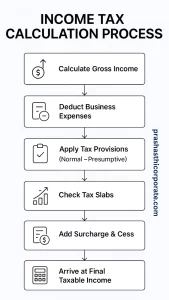
The first step is to find the taxable income of the business. To calculate the taxable business income, you must consider normal provision and presumptive taxation. Under normal provision, the taxable income is calculated by deducting the cost of goods sold and expenses from the sales.
Under the Presumptive Taxation Scheme (Section 44AD), you can declare a flat profit of 6% (digital sales) or 8% (cash sales) of your turnover. For the 2026 filing season, this scheme is available to businesses with a turnover of up to ₹2 Crores.
Important: This limit is increased to ₹3 Crores if your cash receipts are 5% or less of your total turnover.”
2. Tax rate for businesses
Under the New Tax Regime (which is now the default), there is no separate age-based slab benefit. The slabs are uniform for everyone.
Slab rates will vary under these categories. You can check the income tax from the official site.
3. Surcharge and Cess
The third step is to know the surcharge on the annual business income. For individuals and sole proprietors, a surcharge of 10% is payable if the annual income is between INR 50 lakh and INR 1 crore. A surcharge of 15% (capped at 25% for those under the New Tax Regime) on the annual income of above INR 1 crore is applicable. Additionally, the Health and Education cess of 4% applies to the income above INR 1 crore.
For businesses unsure about surcharge applicability, consulting a business tax consultant in Bangalore can provide clarity. LLP or a firm earning up to INR 1 crore will have to pay the tax of 30%. The tax rate of 25% is applicable for the companies that earn a turnover of less than INR 250 crores.
These are some important things to know about how to calculate income tax for businesses. You can also hire a professional tax consultant to determine the income tax rate for your business.
At a Glance: Business Tax Summary for 2026
| Entity Type | Basic Tax Rate | Surcharge Threshold | Surcharge Rate | Cess |
| Individuals / Sole Props (New Regime) | Slab Rates (0% to 30%)* | ₹50 Lakh – ₹1 Crore | 10% | 4% |
| ₹1 Crore – ₹2 Crore | 15% | 4% | ||
| Above ₹2 Crore | 25% | 4% | ||
| Partnership Firms / LLPs | Flat 30% | Above ₹1 Crore | 12% | 4% |
| Domestic Companies (Turnover ≤ ₹400 Cr in FY 23-24) | Flat 25% | ₹1 Crore – ₹10 Crore | 7% | 4% |
| Above ₹10 Crore | 12% | 4% | ||
| Domestic Companies (Any other) | Flat 30% | ₹1 Crore – ₹10 Crore | 7% | 4% |
| Above ₹10 Crore | 12% | 4% | ||
| Companies (u/s 115BAA) | Flat 22% | Any income level | 10% | 4% |
Tax-free income for business
Businesses can also benefit from structured compliance and planning through expert corporate advisory services in India. As per the latest budget, the first income of the business up to INR ₹4,00,000. is tax-free for the business.
The flat rate of 30% tax is applicable for partnership firms and domestic companies. However, it is 25% in some companies. Slab rates vary across these categories. You can check the latest business tax slabs from the official income tax website.
List of businesses that are tax-free in India
Before calculating the income tax for the business in India, you must know the tax-free businesses. The list of tax-free businesses in India is:
- Charitable organisations registered under Section 80G should not pay income tax in India
- Agriculture income is fully exempt for Hindu Undivided Families and Individuals
- Political parties registered under Section 29A are exempt from paying income tax
- Religious institutions do not have to pay income tax after fulfilling some conditions
- Mutual Funds and portfolio management services are exempt from paying income tax under some conditions.
In addition, small businesses below the threshold are exempt under certain rules of small business tax exemption in India. An online business tax calculator is useful for quickly determining your tax liability, but understanding how the tax is calculated is equally important for every business owner.
Income Tax Return Filing for Businesses in India (ITR Forms)
Individuals earning income from the business must file the following forms to file income tax returns:
1. ITR-3- Individual and HUF
- Who – ITR-3 applies to Hindu Undivided Family HUF and individuals.
- Income– Income from any profession, business, house property, salary, and capital gains
- Tax calculation– Income is calculated after deduction of the allowable business expenses
- Due date– 31st July for Non-audited accounts or 31st October for audited accounts
2. ITR- 4 (Sugam)
- Who can file– ITR-4 (Sugam) is for individuals, HUFs, and firms (other than LLP) who are residents and have a total income of up to ₹50 Lakhs and have income from business or profession computed under sections 44AD, 44ADA, or 44AE.
- Kind of income– Income from any business and profession only
- Tax calculation– Income is considered based on total receipts
- Due date– 31st July every year
Income Tax for Small Businesses in India – 2026 Guide
India has many small-scale industries and businesses, as per the stats of 2025. Small businesses have to pay income tax based on the amount of taxable income. You can calculate the taxable income by deducting the business expenses from the total revenue in a year.
The income of businesses in India is taxed as per the type of taxpayer.
- Individuals and HUFs: Under the New Tax Regime (default for 2026), the basic exemption limit is ₹4 Lakh. However, thanks to the Section 87A rebate, if your total taxable income is up to ₹12 Lakh, your effective tax is zero.
- Partnership firms and companies– 30% of the taxable income
Small companies with a turnover of up to ₹400 Crore (in FY 2023–24) enjoy a concessional rate of 25%. Alternatively, companies can opt for the Section 115BAA regime to pay a flat 22% tax, provided they forego specific deductions. For a detailed breakdown of corporate tax rates for different company types, you can check this guide.
Tax refund for small businesses
Small businesses in India can get a tax refund if they pay taxes over the total tax liability. They can also get a tax refund if their suppliers deduct TDS and pay it to the government. Under Section 194-I, the threshold for deducting TDS on rent has been increased from ₹2.4 Lakhs to ₹6 Lakhs per year.
TDS paid by the suppliers will be shown against the PAN of the small business. If the tax liability is less than the tax amount, the extra amount is considered a refund.
Penalties for non-payment of taxes
The businesses in India that do not file annual returns have to pay up to INR 5000, if the return is filed after the due date (usually July 31 for individuals/non-audit or Oct 31 for audit cases). In case of taxable income of less than INR 5,00,000, the business must pay a penalty of INR 1000. In 2026, under the new regime, you don’t pay tax up to ₹12 lakh, but you still have to pay this filing fee if you file late.
Businesses must pay a penalty of 1% every month if they do not pay the advance taxes.
Conclusion
These are the important rules related to income tax for businesses in India. You must know the various concepts to understand how to calculate income tax on your business. The best way to save your business from a penalty is to hire a Contact Prashasthi Corporate Professional Tax Consultants. The professional will help you at every stage of calculating the taxable income. They will guide you to get the maximum savings with helpful tips. To avoid penalties and maximize savings, you must understand how to calculate income tax for businesses in India and stay updated with corporate tax rates 2026.
FAQs
In India, limited liability partnerships (LLPs) pay a flat tax of 30% of their taxable income plus a 4% health and education cess and a surcharge.
Yes, but under Section 44AD, small businesses with annual sales up to ₹2 crore can choose to use India's Presumptive Taxation Scheme, in which revenue is determined as a fixed percentage of sales.
- For individuals and HUFs with business income, ITR-3
- ITR-4 (Sugam): For professionals and small enterprises subject to presumed taxation
- ITR-5 and ITR-6: For companies, LLPs, and partnership firms
Related
Discover more from Prashasthi Corporate Advisors
Subscribe to get the latest posts sent to your email.




Pingback: Smart Tax Planning Management for Businesses in India
Pingback: Corporate Tax in India: Rates & Breakup by Company Type
Pingback: Annual ROC Filing Checklist for Private Limited Companies
Pingback: PF Registration Eligibility: Rules, Criteria & Employer Guidelines
Pingback: Tax Audit Requirements in India: Limits, 5% Rule & Key Mistakes
Pingback: How to Register a Partnership Firm in Bengaluru: Step-by-Step Guide