

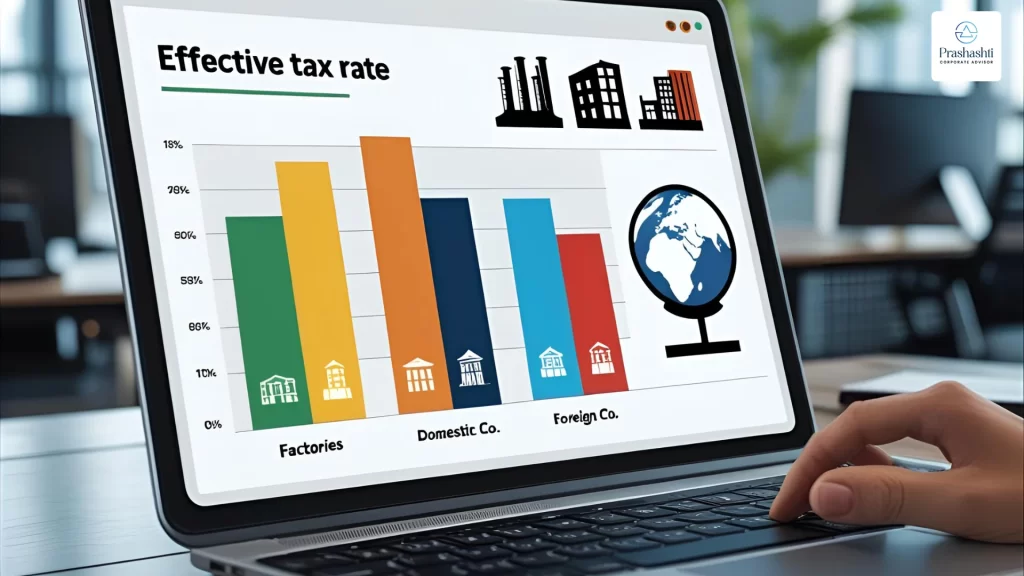
Running a business in India? Then taxes are more than simply paperwork; they are a part of your plan. Corporate tax is a major aspect of that puzzle.
But here’s the thing: not all businesses pay equally. Tax rates, surcharges, and exemptions vary depending on how your company is structured, from tiny domestic businesses to multinational corporations.
In this blog, we’ll break down how corporate tax works for different types of companies and how to choose the structure that saves you the most.
What Is Corporate Tax?
Corporate tax is a tax imposed on corporations’ profits. In India, it is administered by the Income Tax Act of 1961 and applies to both domestic and foreign firms doing business in India. The rate you pay is determined by your company’s turnover, structure, and if you choose a unique tax regime.
Domestic Companies: Standard Tax Rates
For domestic companies, the tax rate is mainly decided based on your annual turnover:
- If your previous year’s total turnover or gross receipts were less than ₹400 crore, the tax rate is 25%.
- If your turnover is above ₹400 crore, the tax rate goes up to 30%.
However, this is only the basic rate. You will also have to pay:
- Surcharge: If your income exceeds ₹1 crore but is less than ₹10 crore, a 7% surcharge is applied. If your income surpasses ₹10 crore, the surcharge goes up to 12%.
- Health and Education Cess: A flat 4% is charged on the total of your tax and surcharge.
So, while your base tax may be 25% or 30%, your effective tax rate can end up being somewhere between 26% to 36%, depending on your income. For the Assessment Year 2026-27, the 25% rate applies if your turnover in FY 2024-25 was less than ₹400 crore. If you are a brand-new company, you generally start at the 25% bracket (or 22% under Section 115BAA). For a detailed breakdown, check out our guide on how to calculate income tax for businesses in India?
Special Corporate Tax Regimes for Domestic Companies
The government developed two special tax regimes, Sections 115BAA and 115BAB, to reduce corporate tax burdens and encourage investment.
Section 115BAA: 22% Base Rate
This section offers a lower corporate tax rate of 22%, but it comes with conditions:
- The majority of deductions and exemptions cannot be claimed.
- You are exempt from Minimum Alternate Tax (MAT).
- A 10% surcharge applies, along with the 4% cess.
When you add it all up, the effective tax rate becomes around 25.17%.
This option is ideal for companies that don’t rely heavily on tax exemptions and want a simpler, lower-tax route.
Section 115BAB: 15% Base Rate
This regime is specifically for new manufacturing companies incorporated after October 1, 2019, and starting operations before March 31, 2024.
-
The Deadline: To qualify for the 15% rate, companies must have started operations before March 31, 2024.
-
For 2026 Businesses: If you are starting a new company today (in 2026), you are generally ineligible for the 15% rate. Your best low-tax option is Section 115BAA at 22% (Effective 25.17%).
Like Section 115BAA, deductions are not allowed, but you’re also exempt from MAT.
This is one of the world’s lowest corporate tax rates, and it aims to establish India as a worldwide manufacturing hub.
Minimum Alternate Tax (MAT)
Now, let’s talk about Minimum Alternate Tax.
MAT was introduced to ensure that companies that report huge profits in their books don’t end up paying zero tax because of multiple deductions.
Here’s how it works:
- Normal Tax Liability: Calculated on taxable income after all deductions.
- MAT Liability: Calculated at 15% of your “Book Profit” (plus applicable surcharge and cess).
However, if you choose to be taxed under Section 115BAA or 115BAB, you are not liable to pay MAT at all.
The 2026 Effective Rates:
-
Income < ₹1 Cr: ~15.6% (Base 15% + 4% Cess)
-
Income ₹1 Cr – ₹10 Cr: ~16.7% (includes 7% Surcharge)
-
Income > ₹10 Cr: ~17.47% (includes 12% Surcharge)
MAT credit can be carried forward and adjusted against future tax liabilities for up to 15 years, which is useful for companies switching regimes or during low-income years. Companies subject to MAT or higher turnover thresholds must also evaluate whether they fall under mandatory tax audit requirements, as audit applicability directly impacts compliance costs and reporting obligations.
The 2026 “Lapse” Warning: If you switch to Section 115BAA (22%) or 115BAB (15%), you are exempt from paying MAT. However, all existing MAT credit expires immediately. You cannot use it to offset the 25.17% effective tax rate. If you have large MAT credit balances, stay in the Old Regime until the credit is used before switching.
Choosing the right company structure at the time of registration can significantly impact your tax liabilities here’s how to register your company in Bangalore.
Corporate Tax for Foreign Companies: Different Game, Higher Rates
Foreign corporations earning income in India are likewise liable to corporate tax, although at significantly higher rates than domestic companies.
Here’s the breakdown:
- General income: Now taxed at a base rate of 35% (previously 40%).
- Royalties or Fees for Technical Services: Taxed at 50%.
Additional charges:
- Income between ₹1 crore and ₹10 crore: 2% surcharge.
- Income exceeding ₹10 crore: 5% surcharge.
- Cess: A uniform 4% Health and Education Cess applies to the sum of tax and surcharge.
This means the effective tax rate for foreign companies now typically ranges between 36.4% and 38.22%.
The rules for MAT also apply to foreign companies if they have a Permanent Establishment (PE) in India.
Don’t Forget the Cess
Across all types of companies, be it domestic or foreign, a Health and Education Cess of 4% is uniformly applicable. It is charged on the total of your tax and surcharge and adds a significant amount to your final tax bill.
Are There Any Tax Exemptions?
Yes, but they are restricted.
- The Finance Act 2025 extended the incorporation deadline for the startup tax holiday. Startups incorporated up to March 31, 2030, are now eligible for the 3-year tax vacation (Section 80-IAC).
- Companies that do not use Sections 115BAA or 115BAB can still claim standard deductions such as depreciation, R&D benefits, and SEZ-related exemptions, but they may be less advantageous than lower-tax regimes.
Why Corporate Tax Matters for Your Business Decisions?
Choosing the right corporate tax regime is more than just a compliance decision; it affects your profits, cash flow, and long-term growth.
- New manufacturing companies may benefit greatly from Section 115BAB.
- Companies with low deductions might find Section 115BAA more efficient.
- Older firms with high deductions or MAT credits may prefer sticking to the regular structure.
It’s not just about picking the lowest rate; it’s about understanding your financial structure and what makes the most sense for your business. Choosing the right corporate tax regime should be part of a broader financial strategy, where proactive tax planning and management helps businesses optimise cash flow, reduce long-term tax exposure, and remain fully compliant.
Corporate Tax vs Cash Flow: Why the Lowest Tax Rate Isn’t Always the Best Choice?
Many businesses assume that choosing the lowest corporate tax rate automatically leads to higher profits. In actuality, corporate tax decisions have a direct impact on cash flow timing rather than just overall tax expenditure.
A lower tax regime like Section 115BAA or 115BAB may reduce your headline tax rate, but it also removes access to deductions such as accelerated depreciation, R&D benefits, and sector-specific incentives. Despite lower taxes, this can put a strain on cash flow for businesses with high capital expenditures or early-stage losses. Companies that adhere to the regular tax regime, on the other hand, might pay a higher nominal rate but gain from deductions that lessen working capital pressure and increase short-term liquidity.
Key takeaway:
Corporate tax planning is not just about how much tax you pay—but when you pay it and how it impacts your ability to reinvest, scale, or survive downturns.
Summary: Effective Tax Rate Comparison
| Company Type | Base Rate | Surcharge | Cess | Effective Rate (Max) |
| Domestic (Turnover $\le$ ₹400 cr) | 25% | 7% or 12% | 4% | ~26.00% – 29.12% |
| Domestic (Turnover > ₹400 cr) | 30% | 7% or 12% | 4% | ~31.20% – 34.94% |
| Section 115BAA (Concessional) | 22% | 10% (Flat) | 4% | 25.17% |
| Section 115BAB (New Manufacturing) | 15% | 10% (Flat) | 4% | 17.16% |
| Foreign Co. (General) | 35% | 2% or 5% | 4% | ~36.40% – 38.22% |
| Foreign Co. (Royalties/FTS) | 50% | 2% or 5% | 4% | ~52.00% – 54.60% |
Finding Your Fit: A Smarter Approach to Corporate Tax
India’s corporate tax regime is flexible, but only if you know how to use it. Whether you go the traditional route with deductions or a simplified low-rate regime, your decision should be based on your company’s actual numbers, growth objectives, and risk tolerance.
Need help figuring it out? Experts like Prashasthi Corporate provide organisations with straightforward, compliant advice, so you never have to second-guess your tax strategy.
Related
Discover more from Prashasthi Corporate Advisors
Subscribe to get the latest posts sent to your email.



Pingback: How & When to Choose Corporate Advisory Services in Bangalore
Pingback: Smart Tax Planning Management for Businesses in India
Pingback: How to Calculate Income Tax for Businesses in India (2025)