

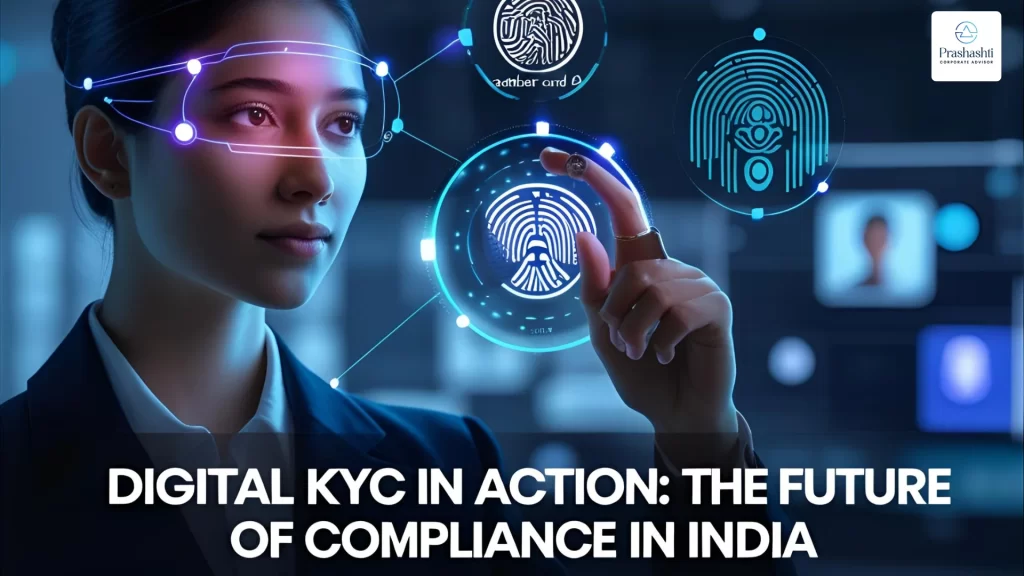
Corporate Compliance Made Easy: Digital KYC Trends in India 2026
Over the past year, digital KYC has moved from being a tech buzzword to a business necessity. In 2026, the speed of your compliance is the speed of your business. Digital KYC has evolved from a back-office task into the frontline of corporate trust.
Simply put, the Indian government is putting a strong emphasis on digital-first compliance. This means speedier onboarding for businesses, decreased fraud risk, and easier audits. Customers benefit from less paperwork and faster service. The shift is strategic as well as regulatory. If your business still relies on traditional methods, you’re going to fall behind.
In this blog, we’ll learn what digital KYC is, its key updates, benefits, challenges, and also what lies ahead, so you’re ready to stay compliant and competitive.
What Is Digital KYC?
Traditional KYC is a manual process. You collect documents, meet the customer face-to-face, and verify their identity. It works, but it’s also slow, expensive, and prone to human error.
But Digital KYC is different. It uses technology to verify a customer’s identity remotely and quickly. Here are a few main types:
- e-KYC (Aadhaar OTP): Provides instant but provisional verification for low-risk accounts. Note that these accounts carry transaction limits and require a transition to full KYC within 12 months.
- V-CIP (Video-based Customer Identification Process): This process uses a live video call to confirm the person’s identity. This is now legally equivalent to a face-to-face visit, removing all provisional transaction limits.
- Non-face-to-face (NFTF): This method combines digital documents from trusted sources like DigiLocker with Aadhaar authentication. Therefore, no physical presence is required.
All these methods e-KYC, V-CIP, and non-face-to-face verification are legal, secure, and approved under the RBI’s Master Direction on KYC.
How Digital KYC Helps Corporates?
Advantages of digital KYC for companies are both short-term and long-term.
- Faster onboarding: Customers don’t need to visit any kind of office. Verification can be done in minutes using OTPs, video KYC, or DigiLocker.
- Lower cost, fewer mistakes: No manual document checks or data entry. This saves staff time and reduces errors like wrong names or numbers.
- Stronger fraud checks: AI and biometrics spot fake IDs, face mismatches, and unusual login behaviour that humans might miss.
- Simple re-KYC: The customers can re-verify online or through a quick video call. Even inactive accounts can be restarted without visiting a branch. For low-risk customers, the RBI has extended the current update window until June 30, 2026. A strong understanding of labour law compliance in India ensures that digital onboarding processes are supported by legally compliant HR and payroll practices.
For businesses setting up operations, ensuring compliance from the start is crucial learn more about ROC filing requirements for Private Limited Companies and how digital KYC simplifies the onboarding process.
The New Compliance Credit Score: KYC as a Business Asset
Digital KYC is evolving in 2026 it is a Compliance Credit Score” for Indian corporates like a CIBIL score which determines your personal loan eligibility, the speed and accuracy of your digital onboarding linked to the MCA V3 portal and CKYCR now act as a real-time trust signal for banks, investors, and global partners. By combining digital verifications directly into your SAP or ERP workflows, you are able to build verifiable history of transparency. Digital KYC framework ensures your business stays “audit-ready” 24/7, turning a regulatory requirement into your strongest competitive advantage.
Key Technologies Powering Digital KYC in India
Several technologies make digital KYC effective and secure.
- AI and Machine Learning: These identify and match faces, recognize abnormal patterns, and detect duplicate accounts to ensure that users don’t create multiple fake accounts.
- Biometric technology: It matches a user’s fingerprints, face, and voice to their Aadhaar or other ID. These are quick and are impossible to duplicate.
- DigiLocker and CKYCR Integration: The documents that are there in DigiLocker are checked and made sure it meets the DigiLocker’s CKYC standards. CKYC stores KYC records, making it easy to update and transfer them. List of Documents Required for Company Registration.
- Regulatory technology, or “RegTech,” is a type of service that automates workflows from user onboarding to ongoing screening by combining APIs, consent management, notification systems, and surveillance monitoring. Many firms now rely on RegTech in India for automated compliance and real-time monitoring.

Challenges of Implementing Digital KYC
Despite the progress, digital KYC isn’t always easy to implement. For instance, understanding tax audit requirements in India alongside digital KYC adoption helps companies build end-to-end compliance frameworks that are not only efficient but also legally robust.
- The Digital Personal Data Protection (DPDP) Act is a data privacy law that says you need clear consent, a limited purpose, and safe storage. Companies must make changes to their systems and procedures to stay in compliance. Any data breach or non-consensual processing can lead to penalties up to ₹250 Crore.
- Legacy infrastructure: Older systems might not work well with new tools like DigiLocker or video KYC. This leads to delays and bottlenecks.
- Some clients may not be familiar with smartphone apps, video calls, or biometric authentication. Companies need to invest money on helping and teaching their customers.
- AI is not at all perfect. It may turn down a valid customer because the lighting in a video isn’t good enough or the face recognition doesn’t match. It’s still important to keep an eye on people. Corporates must also maintain statutory records. Here’s a complete guide to statutory registers under the Companies Act, 2013 to stay audit-ready alongside digital KYC adoption.
Best Practices for Corporates Adopting Digital KYC
To maximize the benefits of digital KYC, organizations should adopt a few essential practices:
- Automate your KYC cycle according to risk. Do not treat all customers the same. Allow the system to identify who needs updates and when.
- Use multi-layer verification. Reduce risk by combining Aadhaar OTP with biometric or document checks.
- Prioritize consent and transparency. Allow customers to see how their data is used and manage who has access to it.
- Train your employees and educate your clients. Even the best technology will fail if users do not understand how to use it.
- Use BCs and rural networks to reach customers in non-digital-first areas. Combine technology with personal support when needed.
Future Trends in Digital KYC
The world of digital KYC is constantly expanding. What’s on the horizon?
- Blockchain and self-sovereign identities (SSI): These technologies could allow customers to control their own KYC data and share it only with their approval, rather than storing it centrally.
- Biometric-first systems: Some firms are transitioning to models where a fingerprint or face scan is sufficient to establish identity – no forms or documents are required.
- Voice-based onboarding: Thanks to improvements in NLP and voice recognition, customers will soon be able to verify their identity with a quick phone call.
- Global standardization: Indian law is catching up with the global standards, so KYC which is done in one place may soon be acceptable in another.
Conclusion
As compliance rules keep changing, digital KYC is no longer optional for businesses in India. It’s not enough to just check off legal boxes anymore. It’s about getting people on board faster, having fewer documents, better fraud checks, and systems that can update themselves with AI.
Change is happening all over, but it isn’t always easy to keep up. The RBI and the government change their rules quickly, and missing an update can make things take longer. That’s when good advice is important. Firms like Prashasthi Corporate work alongside businesses to align their compliance processes with current RBI and government norms, without adding friction to daily operations.
Related
Discover more from Prashasthi Corporate Advisors
Subscribe to get the latest posts sent to your email.




Pingback: Annual ROC Filing Checklist for Private Limited Companies
Pingback: How RegTech in India Is Modernizing Corporate Advisory Services