


Recently, a director who was trying to complete his ROC filing found out that his DIN had become inactive because an old KYC update was never completed. It looked like a small issue at first. But this one missed delayed filings created internal confusion, and that added pressure that could have easily been avoided.
The Ministry of Corporate Affairs is now trying to improve the governance procedures as well as increase the digital monitoring, and expects directors to be more involved in compliance matters.
These regulatory updates for directors in 2026 are transforming governance, disclosures and director obligations for companies. Whether it is a startup, private limited company, or growing business, directors are now expected to stay more aware of what is happening inside the company from a compliance point of view, especially during processes like business license registration
In this blog, we’ll break down the latest MCA updates for 2026, what they actually mean for directors, and the areas businesses should stop ignoring this year.
What Are the Key Regulatory Updates for Directors in 2026 That Companies Should Know?
The biggest areas directors should pay attention to include:
- Revised DIR-3 KYC requirements.
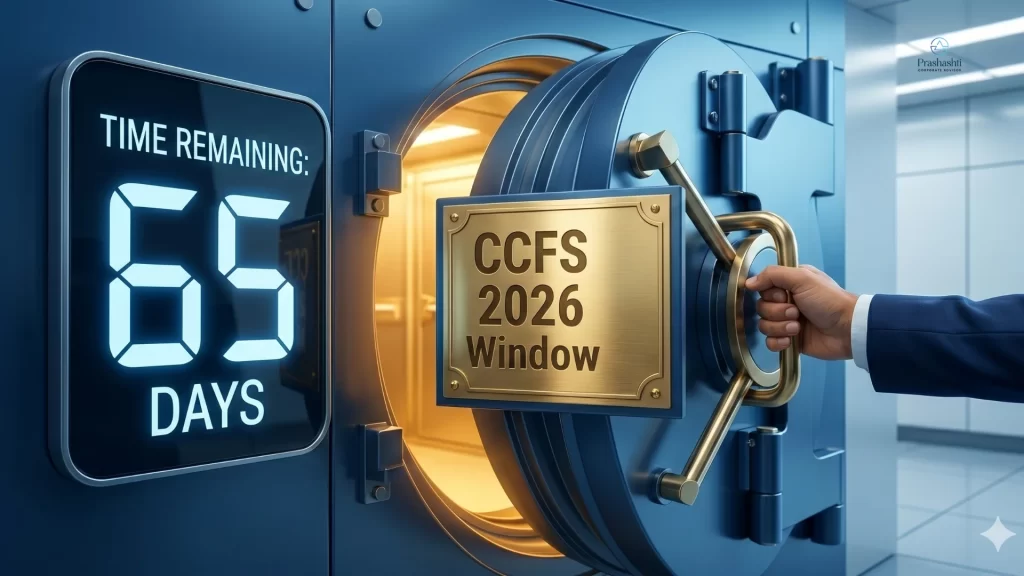
- The Companies Compliance Facilitation Scheme (CCFS-2026).
- Consolidated forms (E-CHNG and E-CON).
- Digital compliance monitoring via MCA21 V3.
- ESG and CSR governance focus.
- Tighter scrutiny of board meeting documentation.
Why MCA Regulatory Updates Matter for Directors in 2026?
The MCA has always regulated companies, but compliance monitoring has changed a lot in recent years. Everything is becoming more digital, connected, and easier to track through MCA21 V3 systems.
Because of that, directors can no longer rely completely on accountants or consultants without understanding what is being filed in the company’s name. Earlier, many businesses only focused on annual filings unless a serious issue appeared. But now, it’s different.
These recent MCA regulatory updates affect:
- managing directors
- independent directors
- whole-time directors
- startup founders
- nominee directors
The latest director compliance updates in India in 2026 also show that filing gaps, inactive DINs, and disclosure problems are being detected faster through digital verification tools.
Important MCA Regulatory Updates for Directors in 2026
MCA has made a few compliance and governance improvements that directors should not at all ignore in 2026.
1. Revised Director KYC & DIN Compliance Rules
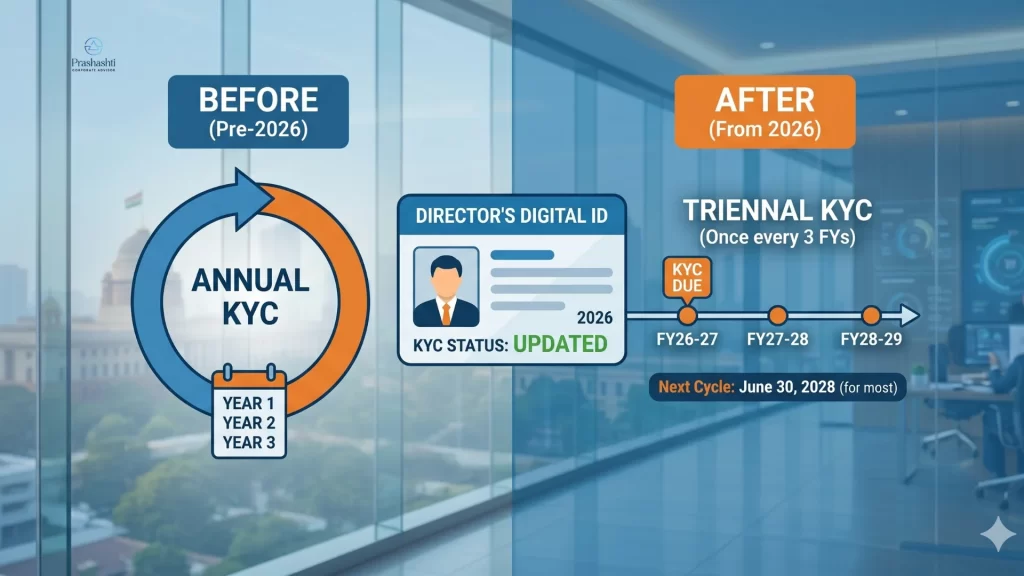
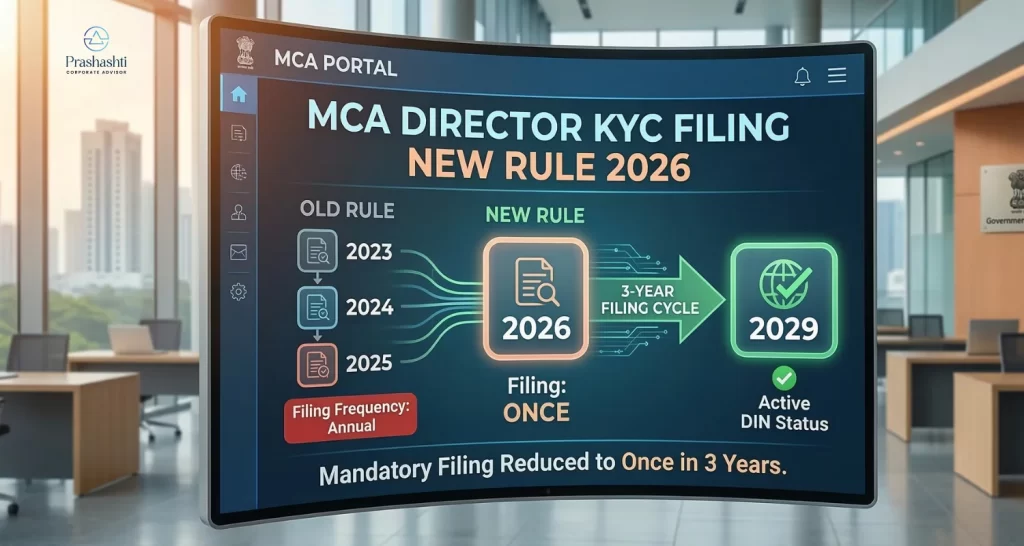
The MCA has brought in major changes to the KYC cycle from March 31, 2026. The DIR-3 KYC is no longer an annual requirement for Directors.
The filing frequency may have changed, but directors still need to update their details whenever there is a change in:
- mobile number
- email ID
- residential address
That is why the MCA director KYC new rule in 2026 is still important.
MCA has also upgraded the Aadhaar and PAN verification processes. This means that the old KYC documents can very soon cause problems during approvals and ROC filings.
On the other hand, a big obstacle has been removed from the incorporation process. Earlier, the maximum allotment of DINs was 3 in the SPICe+ (INC-32) form, but the Companies (Incorporation) Amendment Rules, 2026, now allow the founders to make a single integrated filing for DINs for up to 5 proposed directors.
The New Rule: KYC to be required once in every 3 consecutive financial years. Most active directors have until June 30, 2028, for this next cycle.
2. Companies Compliance Facilitation Scheme (CCFS-2026) Updates
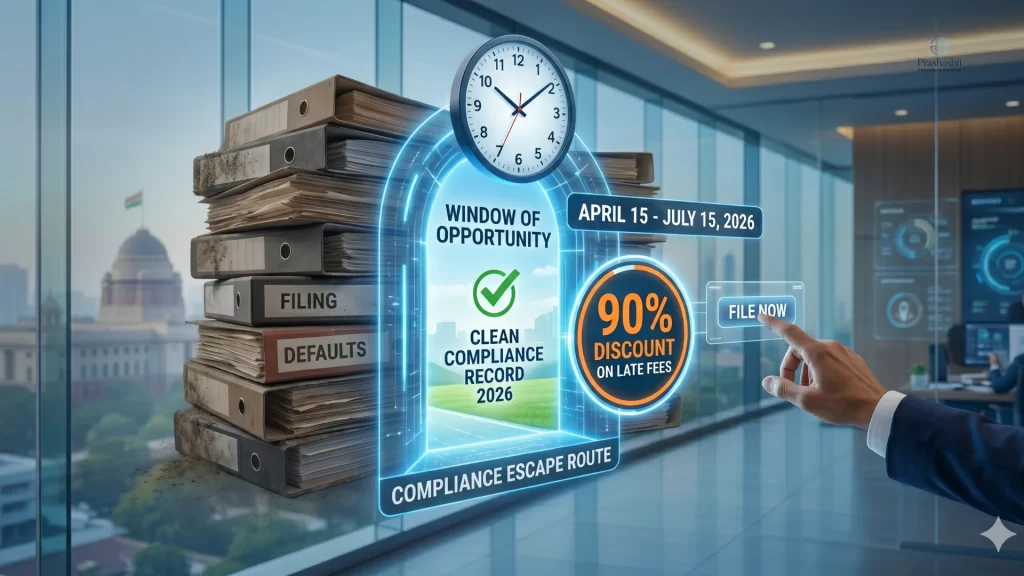
The MCA introduced the CCFS through General Circular No. 01/2026, is a one-time window for businesses that have not filed. This plan is from April 15, 2026, to July 15, 2026, and offers businesses a chance to catch up on late compliance for a fraction of the cost.
Businesses are able to:
- file pending MGT-7 and AOC-4 forms.
- pay only 10% of the additional late fees.
- Apply for dormant status at concessional fees.
- Strike off inactive companies at reduced cost.
Expert Insight:
Do not wait until June 30, 2028: The CCFS-2026 window ends on July 15, 2026, but the new KYC period gives you three years. If your business has past errors, waiting could mean 10 times more in fines when the scheme ends.
3. Stricter Board Meeting & Documentation Compliance
MCA and governance professionals are paying closer attention to:
- board meeting records
- attendance tracking
- meeting resolutions
- digital documentation
- properly maintained minutes
Smaller businesses, especially, tend to postpone documentation work until later. Sometimes, resolutions are prepared long after meetings are completed just to finish compliance.
That creates unnecessary risk. The latest board meeting compliance updates suggest that governance documentation is becoming important even for companies that are not publicly listed.
Poor records can cause problems in:
- Audits.
- Investor due diligence.
- Legal disputes.
- Regulatory reviews.
4. Form Consolidation Under E-CHNG and E-CON
The MCA wants to ease the process of filing for companies with the proposed Companies (Incorporation) Amendment Rules, 2026. The proposal would condense 9 different forms relating to incorporation into 2 forms:
- E-CHNG for company changes like registered office address, company name, status change.
- E-CON for entity conversions and filings on approval.
The concept is simple: cut down on filing work that is repetitive and cut down on manual entry errors. The new forms are planned to draw corporate master data straight from the MCA V3 portal, which will speed up filings and improve the accuracy of filings.
5. CSR & ESG Compliance Updates
A few years ago, many companies treated CSR compliance like something to deal with at the end of the year. Finish the paperwork, submit the report, and move on. That mindset is slowly changing in 2026. Now, MCA is giving more emphasis on:
- CSR implementation records
- spending disclosures
- sustainability reporting
- governance transparency
These 2026 compliance requirements are also tied to broader ESG conversations taking place across a lot of companies.
What Should Directors Include in Their MCA Compliance Checklist for 2026?
This simple MCA compliance checklist can help directors avoid the unwanted filing problems, such as:
Compliance Area | Key Requirement | Due Frequency |
DIR-3 KYC | Update KYC and contact details | Every 3 years (unless changes occur) |
Board Meetings | Proper documentation and minutes | Quarterly |
Disclosures | Conflict & RPT reporting | Event-based |
CCFS-2026 | Regularize old defaults at 90% discount | One-time window |
CSR Reporting | CSR committee reporting | Annual |
ROC Filings | MCA filing compliance | As applicable |
Common Compliance Mistakes Directors Must Avoid
Some common mistakes still seen in 2026 are:
- Ignoring KYC updates.
- Missing the deadlines for filing.
- Incomplete documentation.
- Weak disclosure practices.
- Depending only on consultants.
- Poor governance monitoring.
How Can Directors Stay Compliant With Regulatory Updates in 2026?
Directors need to maintain:
- Compliance calendars.
- Quarterly internal reviews.
- Organized digital records.
- Proper governance documentation.
Moreover, regular discussions with company secretaries as well as legal professionals can also reduce the compliance risks.
How Is MCA Using AI To Track Director Compliance in 2026?
MCA21 V3 is not merely a location for filing anymore. By 2026, it’s more of a digital surveillance system that examines directors’ data across numerous different government sites. The approach of tracking compliance is now known as the “digital twin” method.
Before filing, leaders should ensure these records are properly aligned:
Tax Returns & MCA Files
Mismatches between MGT-7 and ITR regarding director compensation or sitting fees can trigger further investigation.
Matching GST Address with DIN Address
In the case of consulting or sole-proprietorship companies, directors may face compliance issues if the addresses in GST records and DIR-3 KYC do not match.
Accountability of the Board and DPDP Act
Boards are to closely monitor the effectiveness of client data protection under the DPDP framework. Companies handling sensitive data should now be appropriately documenting discussions of privacy and risk in board minutes.
Future Outlook: What Directors Should Expect Beyond 2026?
Based on the Ministry of Corporate Affairs’ latest notifications, the corporate compliance in India is gradually moving in towards:
- AI-driven monitoring.
- Automated scrutiny systems.
- Real-time governance tracking.
- Stronger ESG accountability.
- Integrated digital compliance systems.
Regulatory Updates for Directors 2026: What Directors Should Keep in Mind?
The one important message in these regulatory updates for directors in 2026 is: compliance is not something directors can put off until tomorrow. The MCA is going towards stricter checks, improved digital tracking, and greater accountability. The lesson here is that tiny mistakes in KYC, disclosure, or board records can now lead to greater problems in future. A steady compliance process is now part of good governance.
For companies that wish to stay prepared and avoid last-minute problems, companies like Prashasthi Corporate can be a helpful resource for you.

Pingback: Top 10 Virtual Office in Bangalore for Company Registration 2026