


Starting an NGO is one thing. Building one that earns trust, funding, and legal credibility is another. That’s where section 8 company registration in India comes in; it gives your non-profit a proper legal identity, tax benefits, and stronger recognition under Indian law.
If you want to run a welfare campaign, an education project, or a social business, becoming a Section 8 company can help you grow faster and stay in line.
However, this is where things get tricky. Most people get lost between paperwork, confusing forms, and changing rules. This blog breaks it all down: what a Section 8 company really is, how to register it online, what it costs, and what to do after registration so your NGO stays
What is a Section 8 Company?
A Section 8 company is a form of non‐profit entity defined under the Companies Act, 2013 of India. Its purpose must be charitable, social welfare, education, sports, science, religion, research, environment or similar. The idea is that any profit or income earned must be used only to further its objectives and cannot be distributed as dividends to its members.
Because it is incorporated as a company (rather than just a trust or society), a Section 8 company enjoys limited liability for members, a separate legal identity, and stronger governance standards. If you’re also exploring alternative structures for your non-profit or small business, you may find this comparison useful on the advantages and disadvantages of an LLP in India.
Section 8 Company/NGO Registration in Bangalore
The Section 8 Company Registration Process Online in India

With the MCA’s SPICe+ site, most of the work that needs to be done to register a Section 8 company in India can now be done online. This is a full explanation of how Section 8 company registration online works.
1. Get your DSC and DINs
A Digital Signature Certificate (DSC) and a Director Identification Number (DIN) is required for the director. These two must be filled out because all filings are done online at the Ministry of Corporate Affairs (MCA) site.
A DSC is like an online signature that makes sure your papers are legit. You can get it from places like e-Mudhra or Sify that are authorized by the government. The DIN, on the other hand, is a unique number for directors that you can get by filling out the SPICe+ form.
2. Name Approval
Your company name should reflect your non-profit goal, something that shows social purpose. Words like Foundation, Trust, Association, or Forum help MCA identify your intent.
You need to apply for the name approval using the RUN (Reserve Unique Name) or SPICe+ Part A on the MCA portal. After that, you will receive a reservation letter, once the name is approved ,and it will be valid for 20 days. Before choosing a name, it helps to understand what MCA considers acceptable. You can read this detailed guide on company name approval in India for clarity.
3. Prepare MoA, AoA, and Supporting Documents
The next thing you need to do is apply for your Memorandum of Association (MoA) and Articles of Association (AoA). Your MoA spells out the goals of your business. This is where you make it clear what your group is trying to do (e.g., education, healthcare, the environment, etc.). On the other hand, the AoA spells out the internal rules of government, the powers of the board, and the process for making decisions.
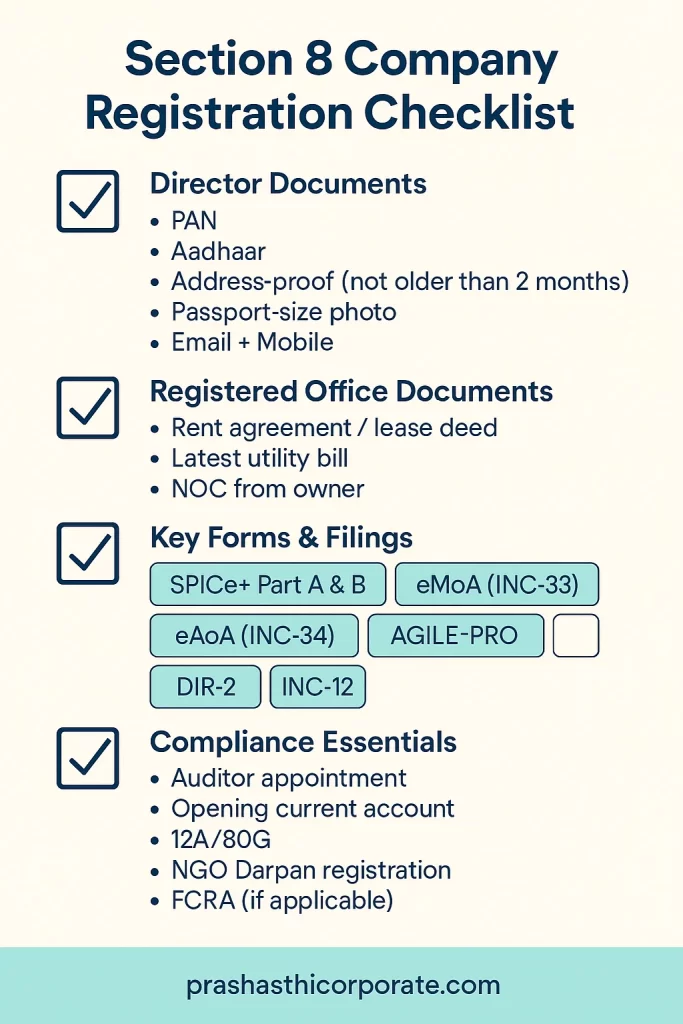
At this stage, you’ll also need to collect and upload key papers such as: Identity and address proof of directors and members.
- Proof of registered office (rent agreement or utility bill).
- Passport-size photos and DSCs.
- Consent letters from directors (Form DIR-2).
Keep everything well-organised; any mismatch or missing proof often causes delays. If you’re unsure about how MoA and AoA differ or what each document controls, you can read our detailed breakdown of the key differences between MoA and AoA.
4. Apply for License under Section 8 + File for Incorporation
There is a license under Section 8 of the Companies Act that must first be applied for in order to proceed with a Section 8 company registration in India.
You will need to send in Form INC-12 (or the most recent version, depending on MCA standards) together with your MoA, AoA, and statements from directors affirming your philanthropic goals. You can file your incorporation papers once the MCA has looked over and approved your license.
After you get your license, you will need to fill out SPICe+ Part B, e-MoA (INC-33), e-AoA (INC-34), and AGILE-PRO forms. These include registering a business, getting a PAN, TAN, EPFO, and even a GST if you need one.
5. Get the Certificate of Incorporation
Once the Registrar of Companies (ROC) verify and approves your application, you’ll then receive the Certificate of Incorporation (COI) with a unique Corporate Identification Number (CIN).
This is your legal birth certificate, and your company now officially exists under the Indian law. You can now open a current bank account in the company’s name, start operations, as well as apply for tax exemptions such as 12A and 80G.
6. Post-Incorporation Compliance
A lot of people don’t pay attention to this part, but it’s important. A Section 8 company must do the following after it is formed:
- Apply for PAN and TAN (done automatically via SPICe+ in most cases).
- Appoint a statutory auditor within 30 days.
- Maintain books of accounts and hold regular board meetings.
- File annual returns (Form AOC-4 and MGT-7) and financial statements every year.
- Register under NGO Darpan if you want to access the CSR or government funds.
If you want to accept foreign contributions or donations from abroad, you’ll also need to follow the Foreign Contribution (Regulation) Act, 2010 (FCRA). Applications and renewals are handled through the FCRA online portal.
If you want to explore mistakes founders commonly make during business incorporation in general, check out our in-depth article on the top 7 mistakes in company registration in Bangalore.
Section 8 Company Registration Cost in India
When you decide on your Section 8 company registration cost, remember that there are several components: government fees, stamp duty (varies by state), professional fees, DSC/DIN fees, as well as any extra fees for state-specific legal steps.
- DSC & DIN for directors: approx. ₹3,000 total.
- Name reservation: approx. ₹1,000.
- MoA/AoA + government fees + incorporation: approx. ₹6,000-8,000*.
- Notary/stamp duty: approx. ₹2,000 (varies by state).
- Professional/legal consultant fees (for drafting, filing) can be ₹8,000-10,000 or more.
For comparison, you can also check our detailed guide on OPC registration cost in Bangalore, which breaks down incorporation fees for another business structure.
Section 8 Registration – Cost Comparison
| Cost Component | Estimated Cost (₹) | Notes |
|---|---|---|
| DSC + DIN | 3,000 | Mandatory |
| Name Reservation | 1,000 | RUN/SPICe+ |
| Government Fees | 6,000–8,000 | Varies by state |
| Notary/Stamp Duty | ~2,000 | State-wise variation |
| Professional Fees | 8,000–10,000 | Depends on consultant |
Donor & Grant Readiness Checklist
A quick reality check: people who give money and make grants love it when you are clear and ready. If you want to get funds quickly following your Section 8 company registration in India, you should have the following items ready from the start:
- MoA & AoA: clearly define your objectives and how funds will be used.
- Financials: audited statements or neat internal accounts for at least one year (even if small).
- Board details: list of directors and minutes of your first board meeting.
- Core documents: PAN, TAN, Certificate of Incorporation, and a recent bank statement.
- 12A/80G registration: or proof that you’ve applied, if you’re seeking domestic donations.
- FCRA registration: or an application plan, if you’re targeting foreign contributions.
- Project proposal: a simple one-page concept note with a clear budget and outcomes.
Being donor-ready saves you weeks of back-and-forth. Many new NGOs wait for funders to ask for these, and that’s exactly what slows them down. Many registration delays happen because founders underestimate procedural challenges. Here’s a helpful breakdown of the common challenges to register a business in Bangalore.

Compliance & Penalties for Section 8 Companies
- All income and donations must be used only for charitable objectives mentioned in the MoA.
- Annual ROC Filings In order to maintain legal compliance, Forms AOC-4 and MGT-7 must be filed annually.
- ROC penalties Failure to Comply. In addition to penalties of ₹100 per day, late filings may result in the director’s disqualification.
- Reduction in Tax Exemption. Donor confidence may be diminished if noncompliance results in cancellation by the Income Tax Department.
- FCRA Penalties The Ministry of Home Affairs may suspend licenses, freeze accounts, or cancel them for violations.
- Penalties for ROC Non-Compliance. Late filings attract ₹100 per day penalties and may lead to director disqualification.
Important Updates on Section 8 Company Registration in India
A few things have changed recently. Here’s what you should know before registering or fundraising:
- The SPICe+ form is now needed for all company formations, even Section 8 filings. The MCA site has a single form that can be used for name reservations, incorporation, and tax registrations.
- FCRA rules are under tighter watch. The MHA has been changing the rules for renewals and making checks more strict, especially for NGOs that are connected to publications or international activities. Always verify the latest notifications on fcraonline.nic.in.
- Income-tax updates: The 12AB and 80G registration process, along with the list of approved institutions, is frequently refreshed on the Income Tax Department’s site. Apply early; it helps donors get tax benefits and boosts your credibility.
Making Section 8 Company Registration Simple
Starting a non-profit is about doing good, but to run it smoothly, you need the right setup. Section 8 company registration in India gives your company a legal identity, builds your trust with the investors, and helps you get tax and various government approvals.
The process may seem difficult at first, but once your papers, licence, as well as the compliance steps are over, you can focus only on your cause.
If you need help registering a Section 8 company or with the process, Prashasthi Corporate can guide you step by step, from documentation to registration, so you can start your organisation with confidence and ease.
FAQs
How long does registration take?
If all documents are correct, online incorporation via SPICe+ can be completed in about 2–4 weeks. Complex cases take longer.
Can a foreign national be a director?
Yes, but the company must have at least one resident Indian director. Also, check foreign director rules and disclosures.
How do I get 12A/80G?
Apply to the Income Tax Department after incorporation; the process and list of exempted institutions are on the Income Tax portal.
What about FCRA?
If you plan to receive foreign funds, register with the FCRA portal and track recent MHA notices, rules and renewals that have changed in 2024-25.
Related
Discover more from Prashasthi Corporate Advisors
Subscribe to get the latest posts sent to your email.