


Knowing if you are eligible for PF registration is useful for anyone looking to understand how PF works in India. The Employees’ Provident Fund functions as a long-term safety net, but eligibility is not automatic and not every employer is obligated to register. Understanding PF registration eligibility is essential for employers who want to stay compliant with the EPF Act.
As long as the employer knows the rules, they can avoid fines, lengthy delays, and numerous complications and for employees, PF registration eligibility brings the assurance of knowing their savings are protected by an organized government-covered system.
PF Registration Eligibility: Complete Rules, Requirements & Employer Guidelines
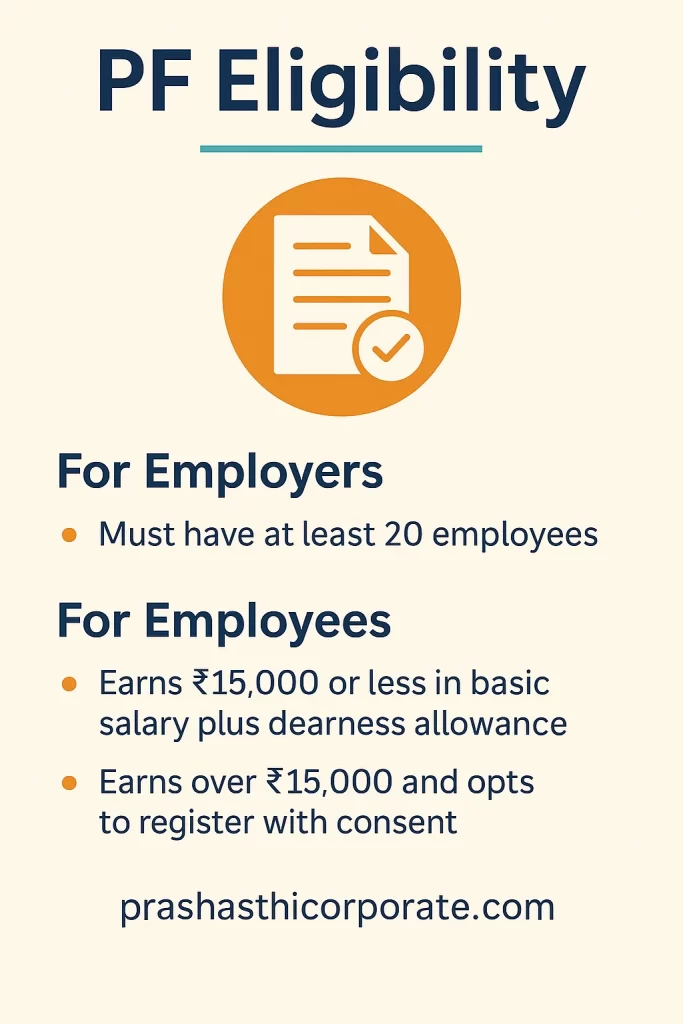
One of the main questions that businesses often pose is when they are officially under the PF system. The rule is simple: when a company reaches 20 employees, the PF registration is mandatory and the employer is given one month after which the registration should be done. This is applicable in the manufacturing units, individual companies, partnership structures as well as most other establishments included in Schedule I of the EPF Act.
PF coverage has been expanding at a rapid pace in recent years. In 2019-20, only 1,17,063 new establishments were registered with EPFO. As of 2023-24, that number has already risen to 294,256, and indicates how many businesses have transitioned into formal compliance.
Nevertheless, pf registration eligibility is not applicable in all industries in the same manner. There are certain categories of exemptions and other organizations related to the government not included in the mandatory list.
Conversely, smaller businesses with fewer than 20 employees may opt for volunteer registration in case they wish their staff to be covered by PF benefits. Voluntary registration implies that they will comply with all PF regulations henceforth, like bigger employers.

Who Must Register for PF? Mandatory Eligibility Explained
To qualify for the Employees Provident Fund registration criteria, salary is the primary consideration. If an employee earns ₹15,000 or less in basic salary plus dearness allowance, they must be enrolled in the PF scheme. Employers cannot opt out of enrolling anyone who falls below this limit.
If an employee earns over ₹15,000, they are eligible to register for PF in the scheme, but it requires written consent, approved by the Assistant PF Commissioner. The important provision to note is that once someone becomes a PF member, they will remain a member regardless of whether their salary exceeds the eligibility limit afterwards.
One sizable change is apparent in the age group entering PF. In December 2024, workers aged 18–25 were 57.29% of all new PF subscribers. This indicates a consistent trend of younger workers entering formal employment and having access to the benefits, like the PF scheme over informal employment. Understanding the distinction between corporate advisors vs finance advisors helps companies choose the right partner when navigating PF laws.
What Are the Key Eligibility Requirements for Employers?
The PF registration rules for employers clearly define the requirements that the business should comply with. The following are the requirements for your business to fulfill:
- Number of employees: Your establishment must have a staff headcount of at least 20 employees. This headcount includes every type of worker: permanent, temporary, contract, or part-time workers. When you have reached 20 or more employees, your registration is legally required.
- Classification of Industry: Your industry must fall under the given distinct categories. This means that factories and establishments carrying out operations that are covered under Schedule I of the EPF Act must be registered mandatorily. Some examples of industries that are covered mandatorily are manufacturing operations, service industries, construction and trading industries.
- Timeline for registration: You are required to complete the PF registration requirements in India once you are eligible to register, within 30 days. Usually, processing times can take anywhere from 7 to 15 working days from the filing of the documentation. If registration is taking longer, your business could incur interest and penalties on unpaid contributions
- Who is eligible for PF registration also includes organizations that are eligible to register voluntarily with fewer than 20 employees. Voluntary registration, a more complex process, once commenced, requires the organization to adhere to all the provisions under the PF Act as if the organization registered with 20 or more employees.
Understanding Contribution Responsibilities & Financial Implications
PF is the contribution shared by employees and employers. The employees contribute 12% of their basic salary plus DA amount, which is debited every month and deposited in the PF account.
On the side of the employer, the split is more elaborate. The overall effective contribution is 13.61 % since it comprises several components:
- 3.67% toward PF
- 8.33 % into the Employee Pension Scheme, limited to 1250 for higher salaries.
- 0.5% under EDLI
- 1.1% for administrative charges
- 0.01% for EDLI administration
These payments should be made by the 15th of the next month. Otherwise, there are penalties and interest payments, and delays are expensive. PF contributions are part of payroll and impact your total business expenses. For tax-related calculations, here’s a guide on business income tax calculation in India.
PF Eligibility Case Studies: Compliance Success vs Penalty Risks
MetroLine Facility Services is a small facility management company.
There are 23 employees.
Problem: After surpassing the 20-employee threshold, I failed to register for PF within the legally mandated 30 days.
What Went Wrong:
HR believed that temporary employees were not included in the PF headcount.
For ten months, payroll did not deduct PF contributions.
Inconsistencies in attendance logs and wage registers were found during an EPFO inspection.
Result:
All employees’ retrospective PF contributions, including arrears, were evaluated by EPFO.
The business paid:
PF that was backdated dues
Section 7Q interest of 12%
Section 14B penalties of up to 100%
Cash flow was impacted by the total liability of ₹9.8 lakh.
Learning: Preventive compliance is far less expensive than penalties because even inadvertent non-registration results in retroactive financial liability.
Many businesses confuse bookkeeping tasks with accounting responsibilities, which leads to compliance errors. To avoid this, here’s a detailed guide explaining the difference between bookkeeping and accounting.

Who Cannot Benefit from PF Registration?
Certain groups are not subject to PF registration eligibility although their organizations are. The employees in the government operate under other provident fund systems. Employees earning more than 15,000 rupees but who have not signed a written approval are also exempted.
Other categories that are excluded are:
- People with exemptions under Section 16 of the EPF Act.
- Other schemes in which government employees are covered.
- Some foreign nationals, on social security agreements.
- Self-employed workers.
The knowledge of these exclusions is useful in preventing erroneous assumptions during the onboarding process. RegTech tools are reshaping how businesses manage statutory obligations. Learn how these innovations support PF and other regulatory processes in our guide on RegTech in India and modern corporate advisory.
Mandatory vs Voluntary PF Registration: Eligibility Comparison
| Category | Mandatory PF Registration | Voluntary PF Registration |
|---|---|---|
| Employee Count Requirement | 20 or more employees | Less than 20 employees |
| Legal Requirement | Compulsory under EPF Act | Optional, based on employer’s decision |
| Approval Needed? | No approval needed | Requires approval from the EPFO |
| Compliance Obligations | Full PF compliance required | Same level of compliance as mandatory |
| Employee Coverage | All eligible employees must be enrolled | All employees must be covered after opting in |
| Exit Option | Cannot opt out from PF | Cannot withdraw voluntary status once approved |
| Financial Liability | Standard monthly contributions | Same rates and obligations apply |
How to Ensure Compliance with PF Registration Rules?
Once a company qualifies under the EPF registration eligibility requirement, the next step in compliance is registration through the EPFO portal. For EPFO registration, the employer will need to provide certain documentation, including PAN, incorporation certificates, bank details, and employee information. Companies preparing documents for PF registration should maintain updated incorporation papers such as MOA and AOA. If you want a deeper understanding, here’s a detailed guide on the key differences between MOA and AOA.
When maintaining payroll records, it is best practice to clearly identify the basic salary portion and dearness allowance portion of the employee’s wage to calculate correct PF deductions.
Every month, the employer is required to fulfill their compliance obligations through an electronic challan-cum-return (ECR). Contribution must be deposited before the due dates as mentioned above for compliance purposes, and the employer should store the receipt of the deposited contributions in an electronic format for recordkeeping purposes.
The employer must also update the member profiles when there are any salary or designation changes for the employee.
Failure to comply with the required compliance obligations can set off serious consequences. Failure to pay on time can result in interest charges, and an employer who completely fails to register a member will incur penalties up to 100% of the amounts owed.
In even more serious cases, employers can face legal proceedings. According to the EPFO reports, there were 17.89 lakh net new members added to the EPFO system in January 2025. There is an increase in members and, therefore, an equal number of employers who are following and complying with these requirements. Just as deal structuring becomes more profitable with expert advisory, PF compliance decisions also benefit from strategic guidance. Here’s how corporate advisors make deal structuring profitable.
Conclusion
Proper interpretation of PF registration eligibility will enable companies to remain legal and, at the same time, provide employees with necessary benefits. Regardless of whether your business is expanding into the 20-employee range or is in the established industry, awareness of these regulations eliminates any form of confusion and keeps both the employer and employees safe. Expert corporate advisors streamline PF registration and compliance while reducing legal risk. Here are the key benefits of corporate advisory services in India.
Prashasthi Corporate can provide complete support to you in the registration process as well as in the monthly compliance that can be done with no stress. Our team facilitates the smooth operation of the process through eligibility checks and filings up to continuous PF management.
Related
Discover more from Prashasthi Corporate Advisors
Subscribe to get the latest posts sent to your email.




Pingback: How to Apply for PF Registration Online – EPFO Step-by-Step Guide 2026
Pingback: ESI Registration Online India – Steps, Documents, Compliance
Pingback: Labour Law Compliance in India 2026: New Labour Codes Guide
Pingback: PF Contribution of Employer: Rules, Split & Updates 2026