

The registration process for the Employee State Insurance (ESI) is a vital responsibility for all employers. With the ESI protecting employees, maintaining compliance for an organisation and providing a platform for the employer’s ongoing operational continuity, this process must be handled carefully. This post outlines the steps involved in completing an ESI registration online, allowing employers to complete the steps easily.
Why ESI Registration Is Essential for Employers in India?
The need for ESI registration online has increased sharply in recent years. ESIC’s own June 2025 records show that 19.37 lakh workers were added to the ESI system in a single month, along with 34,762 new establishments joining the scheme. With compliance awareness rising, ESI has become a basic requirement for most organised-sector employers.
Your organisation must register when you employ 10 or more workers (some states require 20) and any employee earns up to ₹21,000 per month (or ₹25,000 for employees with disabilities).
The coverage of the ESI programme now extends to almost all regions of the country, with a total insured population of over 3.42 Crores, 3.05 Crores of active workers, and 13.30 Crores of family members of the insured (as on March 2023). This reflects rising compliance, similar to PF registration trends if your business is new, you may also find it useful to check PF registration requirements.
Who Qualifies for ESI Coverage?
To be eligible for the ESI registration process, it is necessary to confirm eligibility first. The ESI scheme encompasses many different types of establishments, including factories, shops, educational institutions that are privately owned, hotels, transport via roadways, cinemas and many other types of businesses and services.
Currently, over 668 districts and 36 ESTs are being covered by the ESI scheme. Therefore, ESI is now easily available to almost anyone who lives in India.
In July of 2019, a reduction in contribution rates from 6.5% to 4% took place; at this time, the employer contributed 3.25%, and the employee contributed 0.75%. The reduction in contribution rates resulted in a reduction in payroll cost and in addition, will also help to increase compliance with the ESI scheme.
Therefore, over 3.6 crore individuals and 12.85 lakh employers are expected to be aided as a result of this change to ESI contributions. If you are checking eligibility for PF as well, refer to Eligibility and Rules Explained.
ESI Registration Process Online: Step-by-Step Guide for Employers

The ESI registration procedure is now fully online and made as easy and efficient as possible for employers. Here are the steps to get registered:
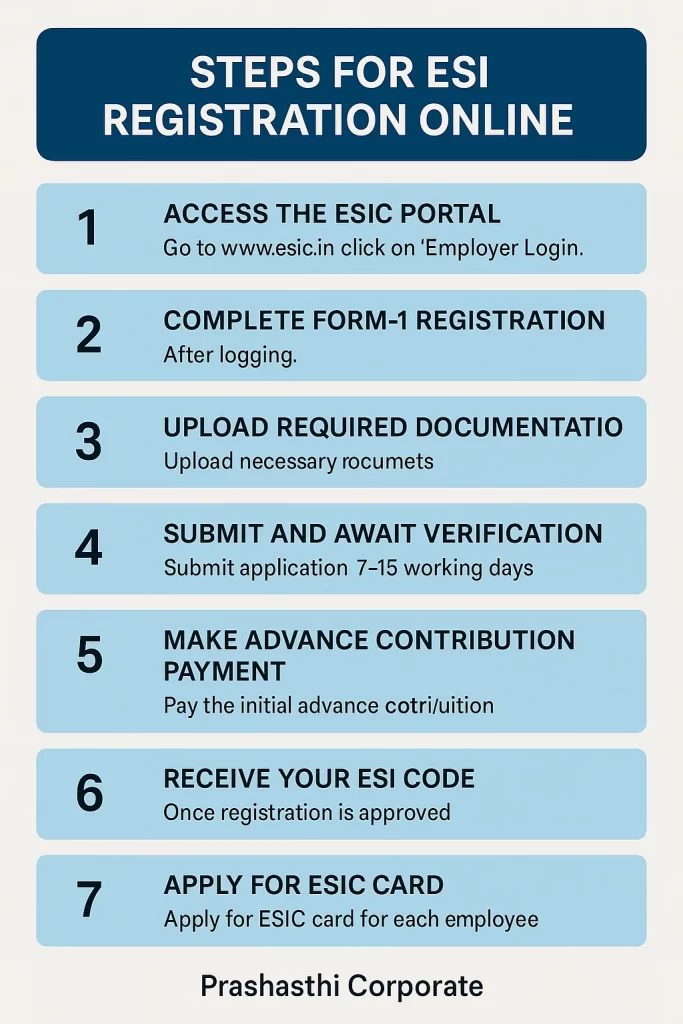
Step 1 – Create Employer Account on ESIC Portal
Go to www.esic.in and click on ‘Employer Login’. If you are a first-time user, click on ‘Sign Up’ to create an account by entering the basic information for your business, including the name, address, state/region and email address. [An email will be instantly sent to you containing your login credentials for the ESIC Portal after registration.] If your business is still in its early registration phase, ensure your company name is approved correctly using this guide: Company Name Approval Guide: Rules, Tips, and Common Pitfalls.
Step 2 – Fill ESIC Form-1 with Establishment Details
After login, complete Form-1 to register your establishment as the employer of your employees who meet the eligibility criteria for ESI.
- The address of the establishment
- The type of establishment
- The number of employees that ESI will cover
- The nature of the work of the establishment
- The pay scales
Once all information entered on Form-1 is verified and confirmed by ESIC, it will form the basis of your ESI profile and will require you to be accurate when entering the information.
Step 3 – Upload Mandatory Documents for ESIC Registration
Keep all documents ready before uploading:
- PAN of the company
- Registration certificate (Shops Act / Factories Act)
- GST certificate
- Company bank account details
- Memorandum and Articles (for companies/LLPs)
- Employee list with Aadhaar, DOB and salary
- Address proof of the workplace
Organised documentation makes the ESI registration online flow much smoother. Proper documentation also speeds up ROC filing and compliance.
Step 4 – Submit Application & Wait for ESIC Verification
Once documents are uploaded, review everything and submit. Normally, the ESIC office takes 7–15 working days to verify and approve the application.
Step 5 – Pay Initial ESI Contribution Online
Upon submission of Form-1, employers are instructed on how to make payment of the initial advance contribution for ESI for their business and when this is paid, the business is confirmed as registered with ESIC.
Step 6 – Receive Your 17-Digit ESIC Registration Code
Once your establishment is approved, you will be assigned a unique 17-digit number (ESI code) which will become your permanent identification number for use in all future dealings with ESI.
If you’re still evaluating how to register your entity, here’s a detailed breakdown of the company registration process in Bangalore.
How to Apply for ESIC Card (Form-6) for Each Employee?
Once the employer is registered, each employee must have an individual ESI number. This is where how to apply for an esic card comes in.
Employees must complete Form-6 and submit documents including:
- Full name
- Parent/guardian details
- DOB and address
- Aadhaar or voter ID
- Bank details
- Joining date
After uploading through the employer portal, workers receive their unique insurance number, enabling access to ESI medical facilities.
Corporate Advisory Services in India
Understanding ESI Benefits and When to Use Them
Once employees file claims for ESI, they become eligible to utilize ESI benefits as soon as they have been covered. Therefore, understanding how to claim ESI is a key aspect to obtaining ESI Benefits.
The Key Benefits of ESI:
- Medical Benefits: Employees have access to 1,450+ Dispensaries, 151 Hospitals, 95 Clinics, and 188 AYUSH Units with no additional charge.
- Sickness Benefits: Employees will receive 70% of their wages for up to 91 days per calendar year.
- Maternity Benefits: Female employees receive 26 weeks of Paid Leave.
- Disability Benefits: Temporary disability will be compensated at 90% of the employee’s wages until recovery; Permanent disability will be paid at 90% every month for the rest of the employee’s life.
Dependent Benefits: If an employee dies because of an injury at work, their dependents will continue to receive a monthly stipend.
Key Documents Needed for Registration
Before registration for EPSI is conducted online, the following list of items must be prepared:
- PAN & GST certificates
- Establishment proof
- Bank Account details
- Employee information
- Registration under local authorities
- Title or tenancy documents
Complete documentation will ensure there are no delays in the registration process. For companies and LLPs, the Memorandum and Articles of Association are essential for ESIC verification. If you’re unsure about which document serves which purpose, this guide explains the key differences between MOA and AOA in a simple, practical way.
What Happens After Registration: Compliance Requirements?
After ESI registration online, the employers should:
- File half-yearly ESI returns
- Make contributions on time.
- Keep proper salary and attendance records.
- Interest on delays is 12 per annum and this would require uniformity in compliance.
Any delay in compliance will incur interest at 12% per annum.
Common ESIC Portal Errors and How to Fix Them
1) Deal with Mismatch
Problem: GST, Shops Act, lease, and utility bills all have different establishment addresses.
Fix: Add an address clarification letter or upload related documents.
2) Inaccurate Employee Information
Problem: Employee records that don’t match Aadhaar, DOB, or name.
Fix: Reupload a clean employee list and update HR records.
3) The wrong NIC code or business category
Problem: Selecting the incorrect industry causes delays in verification.
Fix: Make sure your company registration documents contain the correct NIC code.
4) Errors in Document Upload
Problem: The file is too big, unclear, or not in PDF format.
Fix: Upload PDFs under 2 MB that are clear and scanned.
5) No Reflection of Payment
Problem: The portal does not display the advance contribution.
Fix: Create a ticket with a payment reference after waiting a full day.
6) Rejection of Generic Applications
Problem: Rejected without explanation.
Fix: Add a brief note of clarification and reupload all documents in a clear manner.
7) Issues with Logins
Problem: After signing up, the employer login does not function.
Fix: Use “Forgot Password” to reset your password or clear the cache in your browser.
If you’re also completing other registrations for your business, this guide on common mistakes during company registration in Bangalore can help you avoid similar issues.
Why Choose Professional ESI Registration Support?
While it appears easy to register online, many employers face difficulties with mismatched documents, portal issues, or processing delays. Therefore, it is advisable to seek professional assistance.
PrashasthiCorporate.com assists employers with:
- Fast handling of documentation.
- Streamlined end-to-end ESI registration online.
- Clarification of rules
- Compliance maintenance
- Employee onboarding for ESI
Their experience guarantees a fast and without any additional complexity of the process. Here’s a practical guide on how to choose the right corporate advisory partner in Bangalore.
Conclusion
ESI registration protects employees and reinforces a company’s commitment to welfare. The ESI registration online structure is designed to make compliance straightforward, but it requires attention to detail at every stage.
Regardless of whether you are starting a new business or a bigger establishment, having completed ESI registration in time will make sure that your team is insured and that your organisation remains in compliance. The process will be even easier with the help of a professional, so you will be sure that each step was taken the right way.
If you’re looking for expert support specifically for business setup and compliance, you may also find this resource helpful: a curated list of the top company registration consultants in Bangalore, who specialize in documentation, registrations, and statutory processes.
Related
Discover more from Prashasthi Corporate Advisors
Subscribe to get the latest posts sent to your email.




Pingback: PF Contribution of Employer: Rules, Split & Updates 2026
Pingback: What is the Minimum Capital Required for Company Registration?