

Have you ever thought about why some small businesses always have their finances in order while others have a hard time? Not only does hard work pay off, but knowing the difference between accounting and bookkeeping is also very important. A lot of people use these words to mean the same thing, but they mean very different things. Accounting takes the numbers from bookkeeping and turns them into insights that help people make smart choices.
We’ll talk about what bookkeeping and accounting are, how they differ, and what their jobs, tasks, and tools are. This blog will also help you decide which one your business really needs.
What Is Bookkeeping?
Bookkeeping is the process of keeping day-to-day financial records. A bookkeeper’s main task is to record every transaction that takes place in the business. This can include sales, purchases, bills, receipts, payments, as well as bank transactions.
The focus is on accuracy and routine. A bookkeeper does not analyze the numbers deeply. Instead, they make sure that every rupee or dollar that comes in and goes out is recorded in the right place. For example, when a café sells a coffee, the bookkeeper records it as income. When the café pays for milk, it is recorded as an expense.
Bookkeeping can be done manually using ledgers, but today most people use cloud-based tools like QuickBooks, Zoho Books, or Xero. These tools make it easier to categorize the expenses, reconcile bank accounts, as well as generate simple reports.
What Is Accounting?
Accounting starts where the bookkeeping ends. Once the records are ready, an accountant comes in to analyse, interpret, and make sense of those numbers. Accounting involves preparing financial statements such as profit and loss accounts, balance sheets, as well as cash flow statements.
Additionally, an accountant does more than just prepare reports. They provide insights into the financial health of the business. For example, they can look at a company’s rising costs and then suggest ways to save.
They also help with long-term planning, tax compliance, and tax planning. Accounting is different from bookkeeping in that it needs more education and training. A lot of accountants have professional designations like the CPA or CA.
What Is the Difference Between Bookkeeping and Accounting?
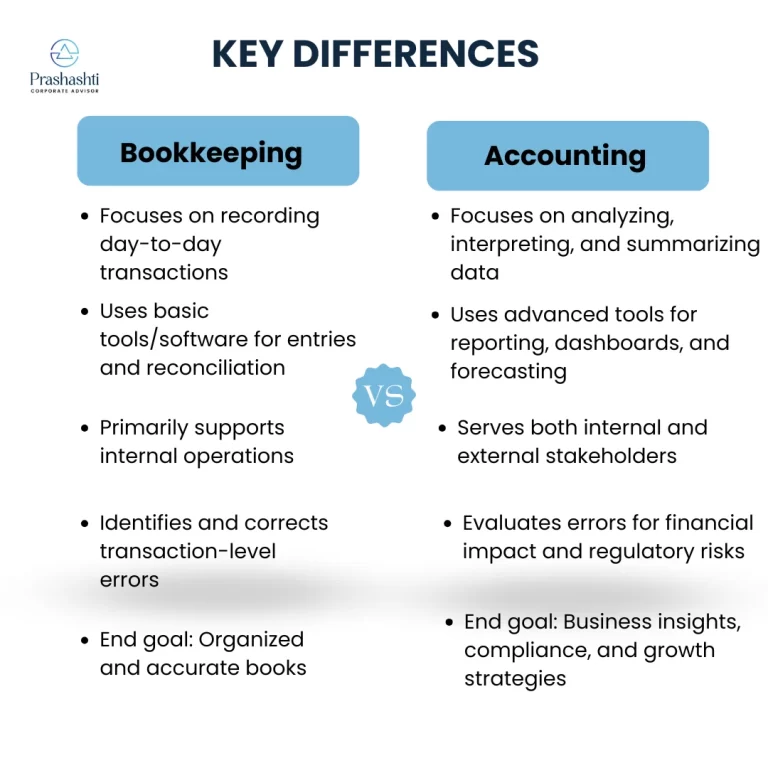
The simplest way to explain it is that bookkeeping is about recording, and accounting is about interpreting. Bookkeeping tracks what is happening in your business daily, whereas accounting looks at the bigger picture and helps you make decisions.
If you are still wondering what is the difference between bookkeeping and accounting, think of it this way: bookkeeping answers “What happened with the money?” while accounting answers “What does this mean, and what should we do next?”
For example, when a company pays employee salaries (bookkeeping entry), an accountant uses those numbers to prepare payroll tax reports (accounting task). These bookkeeping vs accounting examples make it easier to see how the two roles connect.
Tasks Handled by Bookkeepers vs Accountants
| Function | Bookkeeper’s Role | Accountant’s Role |
|---|---|---|
| Daily Transactions | Records sales, purchases, payments | Uses records to prepare financial statements |
| Bank Reconciliation | Matches bank statements with books | Reviews reconciled data for accuracy |
| Tax Preparation | Organizes receipts & records for taxes | Files taxes, ensures compliance |
| Advisory | Not applicable | Provides business, tax, and growth advice |
Detailed Comparison
To understand better, let us go through the 10 differences between bookkeeping and accounting explained in simple points:
- Nature of Work: Bookkeeping is routine and clerical, whereas accounting is analytical and judgment-based.
- Purpose: Bookkeeping ensures that the records are accurate, and accounting ensures that those records are useful for decisions.
- Tasks: Bookkeepers record transactions while accountants prepare the financial statements and give advice.
- Skills: Bookkeepers need to have attention to detail, whereas an accountant needs to have technical knowledge and problem-solving skills.
- Reports: Bookkeepers maintain ledgers as well as journals. Accountants create profit and loss statements, balance sheets and tax reports.
- Timeframe: Bookkeeping is done daily or weekly. Accounting is done monthly, quarterly, or annually.
- Decision-Making: Bookkeepers rarely make decisions, and an accountant directly supports the decision-making.
- Cost: Bookkeeping services are generally cheaper, whereas in accounting it costs more because it adds higher value.
- Regulation: Bookkeepers may not need formal certification, but accountants often need licenses and need to follow strict standards.
- Outcome: Bookkeeping gives us clean records, and accounting gives insights and strategies for growth.
For businesses just starting, choosing the right structure is equally important. Here’s a guide to the types of company registration in India that can influence how bookkeeping and accounting are managed.
Popular Tools for Bookkeeping & Accounting
| Category | Bookkeeping Tools | Accounting Tools |
|---|---|---|
| Cloud Software | QuickBooks, Zoho Books, Tally | Zoho Finance, SAP, Oracle Netsuite |
| Free Options | Wave, GnuCash | Manager, ZipBooks |
| Automation | AI categorization of expenses | Predictive analytics, real-time dashboards |
Recent Changes in Tech and AI
In 2025, technology is reshaping both of the fields. Many bookkeeping tasks, such as entering invoices, categorizing expenses, and reconciling bank transactions, are being automated by AI. (Xero: State of the Industry Report 2025). This reduces human error and also saves time. However, accountants are still needed for interpretation, compliance, as well as giving advice.
Similarly, cloud accounting software now gives real-time dashboards so businesses do not have to wait until year-end to know their financial health. Because of this change, bookkeepers need to know how to use the program well, and accountants should focus more on giving advice than doing general work. With cloud dashboards and AI-driven insights, businesses can now plan finances in real time. If you’re setting up a new venture, don’t forget to factor in compliance costs see our company registration fees in India 2025 cost guide for a clear breakdown.
Understanding the Difference Between Bookkeeping and Accounting
Knowing the difference between bookkeeping and accounting is crucial to making informed financial decisions in any organization. Bookkeeping organizes and verifies everyday transactions, while accounting turns them into insights, predictions, and growth strategies. For startups and entrepreneurs, understanding bookkeeping vs accounting for small businesses is critical. While bookkeeping ensures accurate daily records, accounting provides the insights needed to manage growth, taxes, and investor reporting.
As a freelancer, small business owner, or even growing corporate manager, you will need a defined system. The cloud software, tools, and professional coaching make this easier than ever. For Indian firms seeking trusted support, Prashasthi Corporate provides competence in corporate advising and financial management, ensuring clean records and informed accounting decisions.
FAQs
Related
Discover more from Prashasthi Corporate Advisors
Subscribe to get the latest posts sent to your email.



Pingback: Tax Audit vs Statutory Audit: Key Differences Explained
Pingback: PF Registration Eligibility: Rules, Criteria & Employer Guidelines
Pingback: Tax Audit Requirements in India: Limits, 5% Rule & Key Mistakes