

Director KYC Filing Once in 3 Years: MCA Rule Change Explained
Every year, many company directors in India face the same small but annoying task: filing Director KYC on the MCA portal. Even when their phone number, email, and address had not been changed, the form still had to be submitted again. For those who are handling multiple companies, this became a repetitive compliance that took time but added very little value.
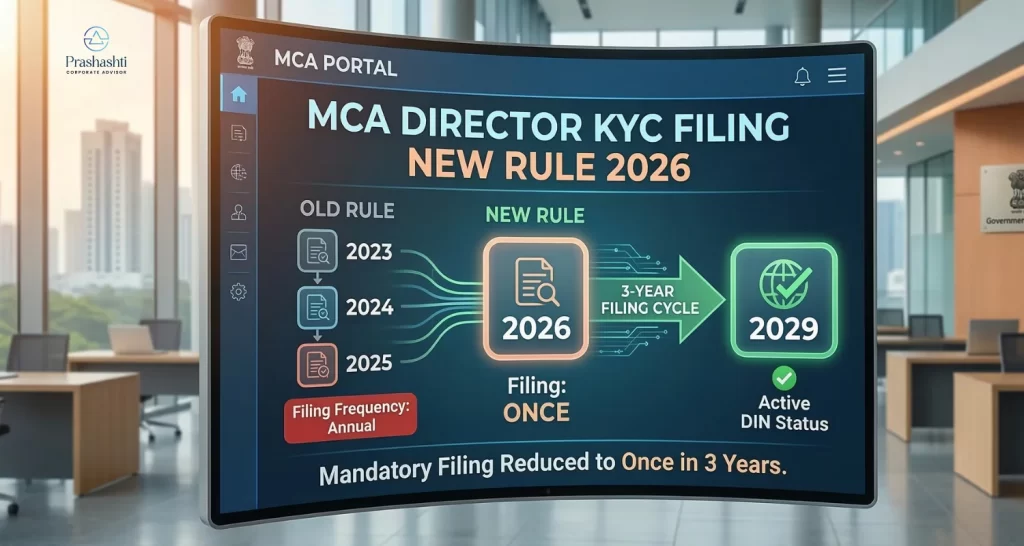
But now, the rule has changed. The government has reduced the filing requirement under the MCA Director KYC new rule 2026. Directors will now complete KYC once every three years instead of doing it every year.
Official Update: The Ministry of Corporate Affairs (MCA) notified this change via G.S.R. 943(E) dated 31st December 2025. This change is a part of the Companies (Appointment and Qualification of Directors) Amendment Rules, 2025, which aims to reduce the compliance load on Indian enterprises.
What Is a Director KYC?
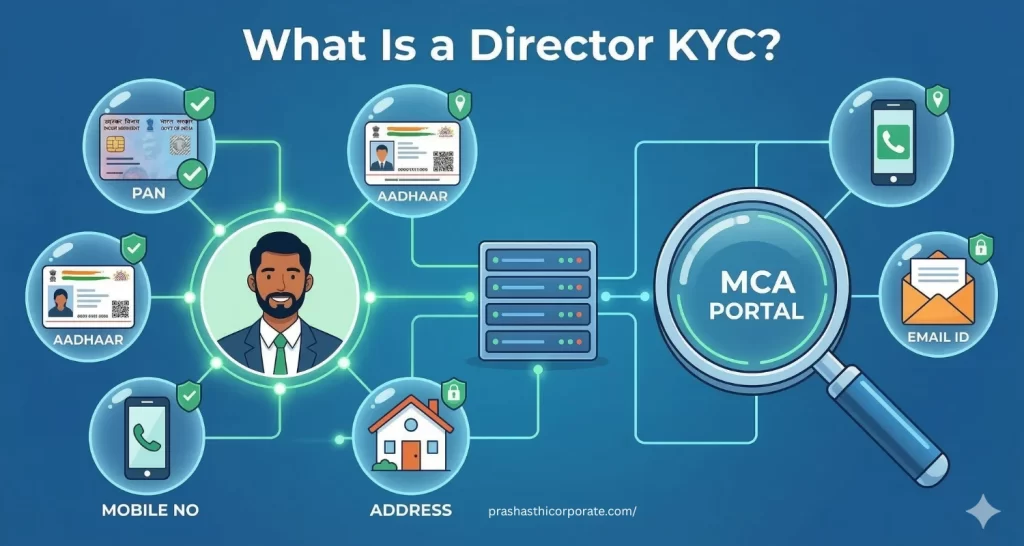
Director KYC is a process run by the Ministry of Corporate Affairs for Verification of identity and contact details of the directors of a company. In India, a person must obtain a Director Identification Number (DIN) to serve as a company director. This is part of the process under the MCA Director KYC new rule 2026, which modifies the frequency of the verification.
To keep the information connected to the DIN accurate, the details of directors are required to be verified through the DIR-3 KYC form on the MCA portal.
The following details are confirmed during this process:
- PAN number
- Aadhaar number
- Mobile number
- Email address
- Residential address
The MCA records are updated after the form is checked. This system is kept up to date to make sure that everything is clear and to lower the risk of identity theft in the management of the company. Along with Director KYC verification, companies must also maintain statutory records such as registers of directors and members as required under the statutory registers under the Companies Act, 2013.
What Was the Old Rule for Director KYC?
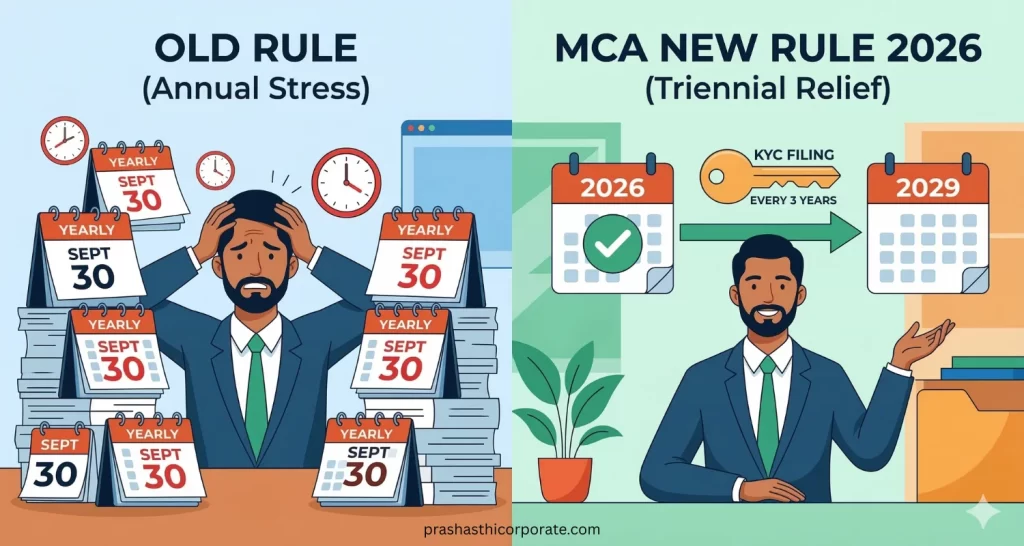
Before the recent amendment and the introduction of the DIR-3 KYC new rule 2026, the Director KYC had to be filed every year. Any person holding a DIN as of 31 March of a financial year was required to submit the DIR-3 KYC form within the prescribed deadline.
In most cases, the filing had to be completed by 30 September of the following financial year, even when no personal details had changed.
If the KYC was not filed on time, certain consequences were faced:
- The DIN could be marked as “Deactivated due to non-filing of KYC.”
- Company filings could not be signed by the director.
- Reactivation was allowed only after KYC was submitted.
- A late fee of ₹5,000 was required to be paid.
MCA Director KYC New Rule 2026: Filing Now Required Once in 3 Years
Annual KYC filing was seen as repetitive compliance for many directors. Because of this, Rule 12A of the Companies (Appointment and Qualification of Directors) Rules was amended by the Ministry of Corporate Affairs. Under the MCA Director KYC new rule in 2026, the filing frequency has been reduced.
Instead of filing KYC every year, Director KYC filing will now be done every 3 years.
Under the new rule:
- Director KYC filing is now required once every three financial years.
- The amendment was notified on 31 December 2025.
- The rule becomes effective from 31 March 2026.
- The filing must be done through the DIR-3 KYC Web.
The government introduced this change mainly to reduce unnecessary compliance requirements for directors and companies.
Pro Tip: If you completed your KYC in 2025, your next mandatory “periodic” filing will not be due until 30 June 2028.
Register Your Business in India With Us!
New Director KYC Compliance Timeline (2026 Rule)
Even though the filing frequency has been reduced, a compliance timeline still has to be followed. Under the MCA Director KYC update 2026, KYC must be submitted in the year when it becomes due.
Important points include:
- KYC is required once every three financial years.
- The filing deadline will generally be 30 June of the current year.
- The requirement applies to directors holding a DIN as of 31 March.
For example, if KYC is completed in 2026, the next filing will usually be required in 2029. The requirement has not been removed; it has simply been spaced out.
Important Update Under the MCA Director KYC New Rule 2026
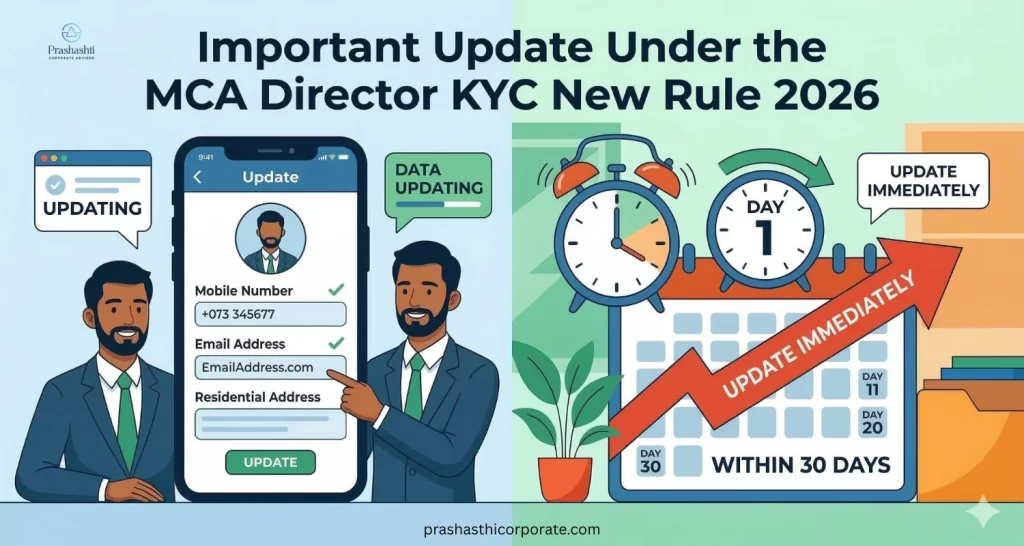
Even though the filing cycle is longer, personal details are still required to be kept updated. If any information changes, the update must be reported to the MCA through the DIR-3 KYC Web form within 30 days.
Updates are required if there is a change in:
- Mobile number
- Email address
- Residential address
This rule ensures the MCA database remains accurate. Under the Director KYC compliance MCA 2026, changes cannot be delayed until the next three-year filing cycle.
Penalty for Not Filing Director KYC
Even though the filing frequency has been reduced, compliance is still required. If the Director KYC is not filed within the deadline, certain consequences may have to be faced. Director KYC is one of several regulatory filings that directors must complete as part of the ROC filing checklist for private limited companies.
Possible outcomes include:
- The DIN may be marked as inactive due to non-filing.
- Company documents cannot be signed by the director.
- The DIN can be restored only after KYC is submitted.
- A late fee (around ₹5,000) may be required.
What Is the Difference Between the Old Director KYC Rule and the New Rule 2026?
Feature | Old Director KYC Rule (Before 2026) | MCA Director KYC New Rule in 2026 |
KYC Filing Frequency | Directors had to file KYC every year | Directors must file KYC once every 3 years |
KYC Filing Method | DIR-3 KYC e-Form or DIR-3 KYC Web | DIR-3 KYC Web through the MCA portal |
Filing Deadline | 30 September | 30 June (in the due year) |
Penalty for Late Filing | ₹5,000 late fee and DIN marked inactive | ₹5,000 late fee and DIN may be deactivated |
Professional Certification | Required annually in many cases | Required only if the director’s details change |
Expert Insight: The three-year filing relief also means more responsibility for directors. Because KYC is not filed every year, the MCA thinks the information is the same. If any update is hidden and later found, it could attract penalties under Section 448.
Your Personalized Director KYC Calendar
Based on the Companies (Appointment and Qualification of Directors) Amendment Rules, 2025, here is the timeline for your next filing:
If your last KYC was filed in | Your Next Mandatory Filing Due By |
Financial Year 2024-25 | 30 June 2028 |
Financial Year 2025-26 | 30 June 2029 |
New DIN (Allotted in 2026) | 30 June 2029 |
What Is the Impact of the MCA Director KYC New Rule 2026 on Directors and Companies?
The MCA Director KYC new rule 2026 signals a practical shift in how director compliance is handled. Filing will now happen less often, which removes a repetitive task many directors dealt with every year. Still, responsibility has not disappeared. Details must remain accurate, and timelines must be followed to avoid penalties or DIN issues.
Many companies prefer professional support for this. Firms like Prashasthi Corporate assist directors and businesses in handling MCA filings properly, including DIR-3 KYC submissions, so compliance stays smooth and records remain updated.
