
It started with one missed filing. The accountant said it could wait. Then another deadline passed. Work kept moving, but compliance didn’t. Months later, a notice came. The penalties had already piled up, and fixing it suddenly felt expensive and urgent.
This is where many companies find themselves. Not careless, just delayed.
The Companies Compliance Facilitation Scheme 2026 has been introduced for this exact situation under MCA General Circular 01/2026. It gives businesses a limited window to clear pending ROC filings by paying reduced penalties. This blog breaks down what the scheme means for ROC compliance 2026, who it applies to, and what needs to be done before the deadline closes.
What is the Companies Compliance Facilitation Scheme 2026 (CCFS 2026)?
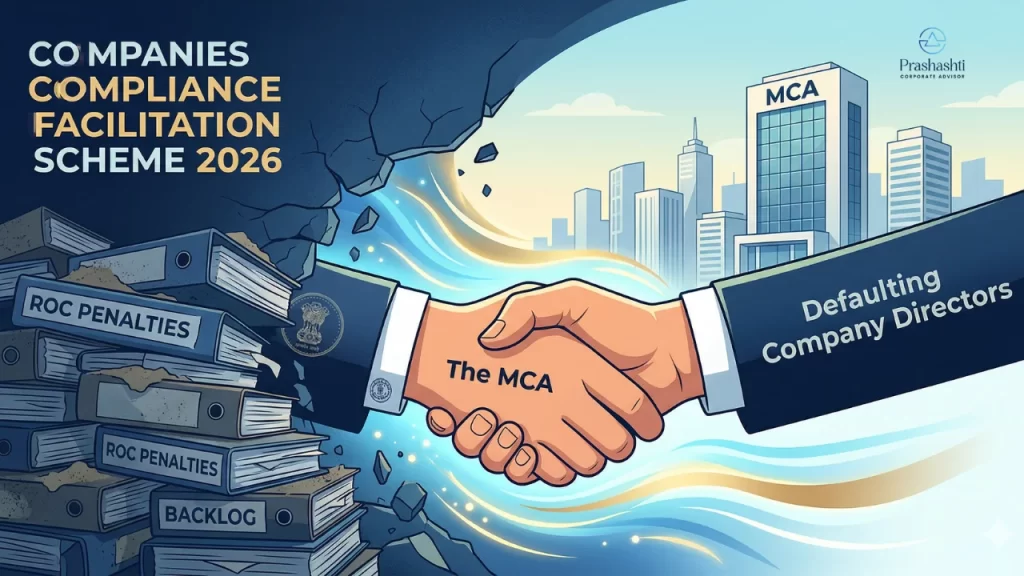
The CCFS 2026 is a short-term relief introduced by the MCA. It allows companies to clear overdue ROC filings by paying normal fees and only a small part of the penalty.
In simple words, it helps fix old compliance gaps without heavy financial pressure. This MCA compliance scheme 2026 is aimed at bringing defaulting companies back into proper records.
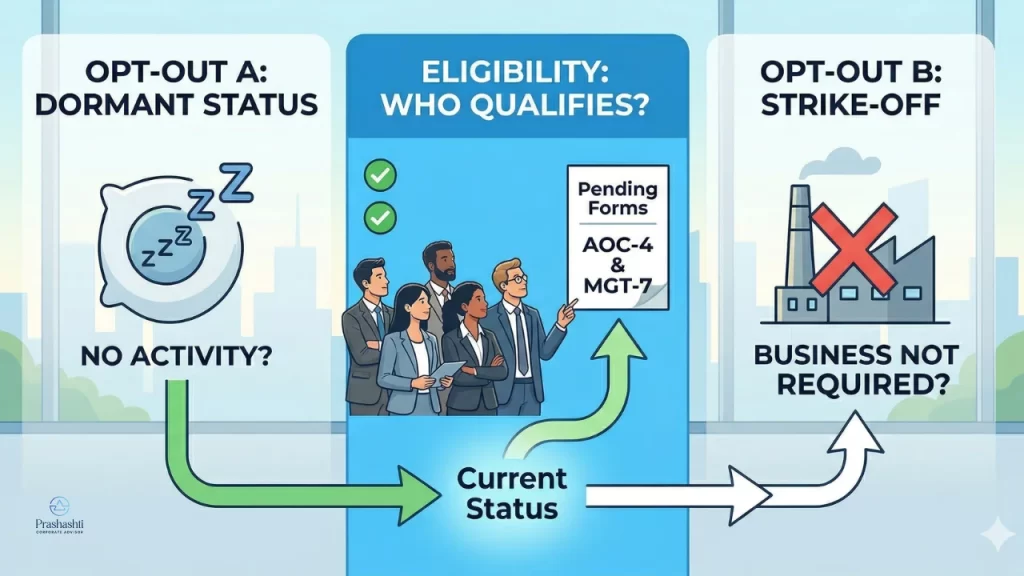
It also gives flexibility based on your situation:
- Continue operations by clearing filings.
- If there’s no activity, shift to dormant.
- Apply for a strike-off if the business is no longer required.
CCFS 2026 Overview: Key Details, Circular & Timeline
The plan is set up as a one-time compliance window with the explicit goal of cutting down on backlogs and making reports more accurate.
Particular | Details |
Details | Ministry of Corporate Affairs |
Scheme | Companies Compliance Facilitation Scheme 2026 |
Circular | MCA General Circular 01/2026 |
Effective Period | 15 April – 15 July 2026 |
Objective | Reduce compliance backlog |
MCA Update on CCFS 2026: Important Dates and Deadlines
The scheme was announced on 24 February 2026 and became effective from 15 April 2026, and it will close on 15 July 2026.
Here’s what is important:
Compliance Activity | Deadline | Why It Matters |
Scheme Start | 15 April 2026 | Filing window opens |
Last Date | 15 July 2026 | Reduced fee benefit ends |
Post Scheme | After 15 July 2026 | Normal penalties apply |
Expert Tip: Companies with multiple pending filings should begin early. MCA portal processing delays increase significantly near deadline periods.
Penalty Relief Under Companies Compliance Facilitation Scheme 2026
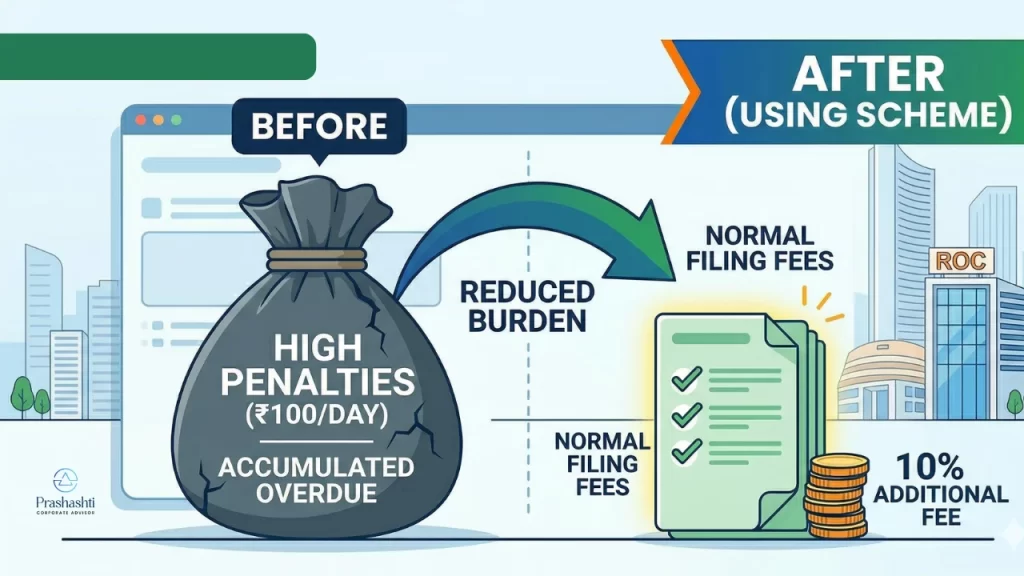
Delayed ROC filings can result in a penalty of ₹100 per day, with no upper limit. This is where most businesses get stuck. Costs keep rising, and repairing old filings becomes more difficult.
Under the CCFS 2026, the burden is reduced. Companies need to pay:
- Normal filing fees
- Only 10% of the additional fees
This is why it’s often called a late filing waiver, MCA 2026, even though it’s technically a reduction, not a full waiver.
The scheme also gives practical options:
- Apply for dormant status if the company is inactive.
- Go for a strike-off if the business is no longer needed.
Who is Eligible for CCFS 2026?
The scheme is meant for companies that have missed filing their annual returns or financial statements. If forms like AOC-4 or MGT-7 are still pending, it becomes relevant.
It can be used by:
- Private limited companies
- Small businesses
- Inactive companies
But not everyone qualifies. If a company is already in the final stage of strike-off or facing certain legal action, it may not be eligible.
So, before moving ahead, the company’s current status should be checked properly. In some cases, repeated compliance failures can even lead to complications during company setup or approvals. Issues like improper filings or documentation gaps are also a common reason behind company registration rejection in India, which are often avoidable with the right compliance approach.
Which are The Forms Covered Under the Scheme?
The scheme mainly covers common ROC filings under both the Companies Act, 2013, and some older filings under the 1956 Act.
Here’s what that includes:
- Annual returns → MGT-7 and MGT-7A (for small companies and OPCs)
- Financial statements → AOC-4 and its variants like XBRL and CFS
- Auditor appointment → ADT-1
- Foreign company filings → FC-3 and FC-4
- Older pending forms → 20B, 23AC, 23ACA
These are the filings most companies miss, so the scheme focuses on helping clear them.
Why MCA Introduced the Companies Compliance Facilitation Scheme 2026
Right now, MCA is focusing on fixing the outdated records and improving data accuracy. Many inactive or non-compliant companies are still sitting in the system, which affects tracking as well as reporting.
By offering reduced penalties now, companies are being encouraged to update their filings voluntarily. Here,
- Old records will get cleaned.
- Compliance improves.
- Future checks will become easier.
It also signals something important that once this window closes, stricter enforcement is likely to come. It also supports the government’s push for ease of doing business. Several government schemes for startups in India already promote structured compliance and growth.
Does CCFS 2026 Provide Full Penalty Waiver?
No, not completely. The Companies Compliance Facilitation Scheme 2026 reduces the financial burden, but it doesn’t remove every consequence.
- Filing before any notice → safer position
- Filing after notice → some relief may still apply
If penalties are already finalized or proceedings are advanced, they may continue. So timing matters more than anything here.
What Will Happen After 15 July 2026?
Once the scheme ends, normal rules apply again.
- Higher penalties start adding up.
- Notices from the ROC may be issued.
- Strike-off action can begin.
Directors may also face disqualification if delays continue.
Expert Insight: MCA is moving towards a more faceless and automated system. CCFS-2026 feels like the last practical chance before things get stricter. Once this phase passes, directors may be flagged for disqualification under Section 164(2), even for small compliance overlaps. Compliance Analysis, 2026.
What Should Companies Do Under CCFS 2026?
What you do next really depends on where your business stands right now.
- If the business is active, clear your pending filings and get things back on track
- If it’s paused for now, you can consider shifting to dormant status
- If there’s no plan to continue, going for a strike-off makes more sense
There’s no one-size answer here. It depends on your situation. But one thing is clear, acting within this window keeps things simple. Delaying it will only make it costlier and harder to fix later. Compliance goes beyond filings. Director KYC and identification updates are equally important. Missing them can create risks. Staying updated with MCA Director KYC rules and updates helps avoid such issues.

Companies Compliance Facilitation Scheme 2026: Final Takeaways
The Companies Compliance Facilitation Scheme 2026 is a short window, but it can make a real difference. It helps reduce penalties, clear old filings, and bring your company back on track without too much pressure.
What matters is timing. Acting now keeps things simple.
For businesses trying to handle compliance without confusion, working with experienced teams like Prashasthi Corporate can make the process smoother. They help with keeping companies compliant and avoiding unnecessary penalties through proper guidance.