

Whenever someone mentions financial terms such as “operating leverage vs financial leverage,” “operating leverage,” or “financial leverage,” many beginners respond politely, even though they may internally be thinking, “I have no idea what that means.”
And that is completely understandable.
Most people do not intuitively understand the concept of leverage from the outset. I certainly did not. It is one of those topics that appears complex until it is explained in a clear and straightforward manner.
Why This Matters to You (The Entrepreneur’s Choice): Understanding Operating Leverage vs Financial Leverage
Understanding the difference between operating and financial leverage isn’t just about passing a finance exam.
Deciding to buy high-end equipment or software? You are choosing Operating Leverage. You are betting that the efficiency of that equipment will eventually make your costs per unit drop, leading to massive profits as you scale.
Deciding to take a bank loan or line of credit? You are choosing Financial Leverage. You are betting that the return you get from that borrowed money will be significantly higher than the interest the bank is charging you.
If you miscalculate Operating Leverage, you’re stuck with expensive machines sitting idle. If you miscalculate Financial Leverage, you’re stuck with a debt collector at your door.
What is Operating Leverage?
Operating leverage measures how sensitive your profits are to changes in sales, based on how many fixed costs your business carries.
Higher fixed costs → higher operating leverage
Lower fixed costs → lower operating leverage
Another way to say it:
Operating leverage shows how your cost structure amplifies profits when sales rise… and pain when they fall.
Operating leverage is simply this:
How your profits behave when your sales change, depending on how much fixed cost you’ve burdened yourself with.
If you’ve loaded up on fixed costs, you have high operating leverage.
If most of your costs move with your sales, you have low operating leverage.
That’s all. Nothing mystical.
Operating Leverage Formula (Beginner-Friendly)
Degree of Operating Leverage (DOL) = % Change in EBIT / % Change in Sales
A simple example:
Sales increase by 10%
EBIT increases by 30%
Then:
DOL = 30% / 10% = 3
Meaning:
A 1% change in sales produces a 3% change in profit.
That’s high operating leverage.

And Financial Leverage? That’s A Different Beast.
Financial leverage has NOTHING to do with fixed or variable costs.
It has everything to do with how you pay for things.
Let’s say you take a loan to expand your café, or raise money using debt to build a new warehouse. That borrowed money becomes part of your business engine. And because debt comes with interest, it has a personality of its own:
It doesn’t care if your sales fall. It wants its money back. On time.
That’s financial leverage.
Financial Leverage Formula (DFL Explained)
Degree of Financial Leverage (DFL) = % Change in EPS / % Change in EBIT
Example:
EBIT increases 20%
But EPS increases 40%
DFL = 40% / 20% = 2
Meaning:
Debt doubles the effect of operating profit on shareholder earnings. Businesses often rely on experts to make funding choices, and understanding the role of corporate advisors becomes extremely important when evaluating debt-driven growth.
Why companies even bother with debt?
The reason is straightforward: borrowing can often be an effective means of achieving growth.
In the context of operating leverage vs financial leverage, if a business borrows money at an interest rate of 9% and then earns a return of 18%, it effectively amplifies the impact of its capital. This is the essence of financial leverage debt enables organisations to pursue opportunities that may otherwise be financially out of reach.
However, if returns decline to 5%, the borrowed funds quickly become a significant burden.
In essence, financial leverage represents a calculated decision by a business:
“I expect to earn more than the interest I am obligated to pay.”

Operating Leverage vs Financial Leverage (In One Look)
| Aspect | Operating Leverage | Financial Leverage |
|---|---|---|
| Focus | Cost structure | Funding structure |
| Question | “How fixed are my costs?” | “How much debt am I carrying?” |
| Sensitivity To | Sales changes | Interest & debt load |
| Type of Risk | Business risk | Financial risk |
Real-World Numbers: Operating Leverage vs Financial Leverage in Action
| Metric | Company A (Low Leverage) | Company B (High Leverage) |
| Initial Sales | $100,000 | $100,000 |
| Variable Costs | $70,000 (70%) | $20,000 (20%) |
| Fixed Costs | $10,000 | $60,000 |
| Initial EBIT | **$20,000** | $20,000 |
| New Sales (+10%) | $110,000 | $110,000 |
| New EBIT | **$23,000** | $28,000 |
| Profit Growth | +15% | +40% |
Takeaway: Both companies started with the same profit ($20,000), but Company B’s high fixed costs allowed it to grow profits nearly 3x faster than Company A from the exact same sales boost.
What’s the real Difference?
Most beginners confuse the two because both include the term “leverage.”
However, they are not identical.
Here is a clear and formal comparison:
Operating leverage exists within the business, it reflects how the company’s cost structure behaves.
Financial leverage, on the other hand, originates outside the business, it relates to how the organisation is funded.
Operating leverage addresses the question:
“To what extent do my costs remain constant when business conditions change?”
Financial leverage addresses the question:
“How much debt has the business taken on, and is it manageable?”
These are different questions, associated with different risks and distinct consequences. If you enjoy simplified comparisons like this, here’s another useful breakdown on the differences between MOA and AOA for new entrepreneurs.
Why Companies Choose Operating Leverage?
Sometimes, a company doesn’t “choose” it — it’s built into the industry.
If you run:
- an airline
- a telecom network
- a software-as-a-service platform
- a manufacturing plant
…it’s almost impossible to avoid high fixed costs. You need planes, towers, developers, machines. These things don’t magically shrink in cost when sales slow down.
But when sales grow?
These companies make money faster than others — because the costs are already paid for.
Why Companies Choose Financial Leverage?
Debt can help you grow faster without giving away ownership.
Industries like:
- real estate
- steel
- infrastructure
- cement
- power
lean heavily on debt because they need money upfront long before customers pay them. Debt bridges that gap.
But again:
Debt is helpful only when you stay in control of it.
Otherwise it’s like a treadmill that keeps speeding up while you’re trying not to fall. Businesses often take on leverage under expert guidance. Understanding the key benefits of corporate advisory services helps companies make safer financial choices.
Examples of Both Types of Leverage in the Real World
- Example 1: Airlines (High Operating Leverage): Aircraft → costly fixed assets → demand-driven profits soar.
- Example 2: High Operating Leverage SaaS Company: The cost of software is mostly fixed, and as the number of users increases, the margins skyrocket.
- Example 3: High Financial Leverage Real Estate Developer: Loan-funded construction results in a constant interest burden.

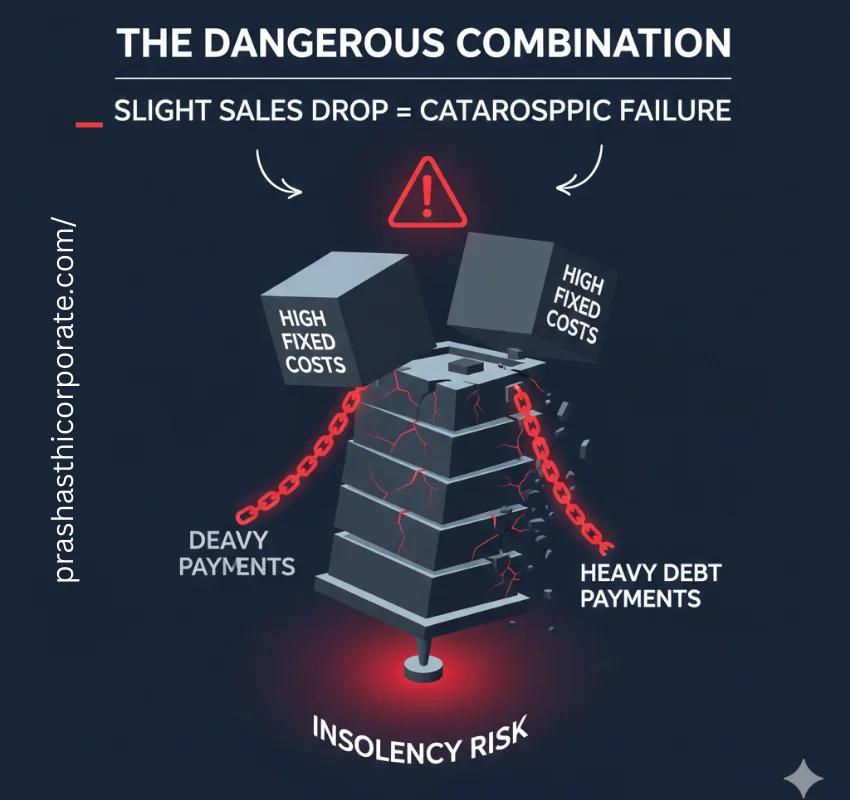
The Dangerous Combination: Both High At The Same Time
This is where companies get into trouble. When a business loads up on both:
- Heavy fixed costs
- Heavy debt
…it becomes incredibly sensitive to the slightest change in sales.
A minor dip in demand?
Suddenly:
- Fixed costs won’t budge
- Interest payments keep knocking
- Profits shrink
- Cash flow gets tight
- Panic starts
This pattern has contributed to some of the biggest business failures globally. Not because the businesses were bad, but because their leverage was. In complex financing environments, professional deal structuring becomes essential and here’s a detailed guide on how corporate advisors make deal structuring profitable
How You Can Spot Leverage (Without Spreadsheets)?
You don’t need to be a financial analyst. Just look for a few clues.
Signs Of High Operating Leverage
- Huge office or factory space
- High number of full-time staff
- Big machinery or equipment
- High rent
- High depreciation
Signs Of High Financial Leverage
- Large loans
- High interest expense in annual reports
- Debt piling up year after year
- Cash flow issues
- Dependence on refinancing
If you notice both sets of signs?
That’s when you mentally file the company under “watch carefully.” For MSMEs, leverage decisions can directly impact profitability. Here’s a detailed look at how corporate advisors help improve MSME profits.
Final Thoughts : Operating Leverage vs Financial Leverage
Understanding leverage especially the difference between operating leverage vs financial leverage is like seeing the “real personality” of a business. Two companies may have the same revenue, but one might crumble under pressure because of its cost structure, while the other might survive because it’s funded sensibly.
- Operating leverage shows how profit reacts to sales.
- Financial leverage shows how profit reacts to debt.
Both can make a business powerful.
Both can break it.
Leverage isn’t good or bad — it’s a tool.
But like any tool, it depends on how you use it.
Learn to spot it, and you’ll see behind the curtain of almost every business story. If you’re unsure whom to approach for leverage-related decisions, here’s a clear comparison of corporate advisors vs finance advisors.
Register Your Business in India With Us!
Related
Discover more from Prashasthi Corporate Advisors
Subscribe to get the latest posts sent to your email.