

A lot of rules and laws are there that you have to follow if you want to run a business in India. One important legal requirement is maintaining certain mandatory company registers in India under the Companies Act, 2013.
These are legal documents that every business needs to preserve in order to follow the rules. It helps you keep track of the people who own and run your business, the money, and other important details. It’s quite important to know how these registers work if you own or run a business.
As per the Companies Act, 2013 and recent MCA circulars, these registers are legally enforceable. Non-maintenance may invite severe penalties, including fines on both the company and its officers.
In this blog, we’ll talk about what these registers are, why they are important, and the most significant ones that every Indian business needs to have. We will also talk about how companies can keep track of these records online and how much it usually costs.
Key Compliance Shifts: 2025 vs. 2026
| Feature | Old Rule (Pre-2026) | New Rule (Post-March 31, 2026) |
| Frequency | Annual | Every 3 Years |
| Due Date | September 30 | June 30 |
| Form Used | DIR-3 KYC (e-form) or Web | DIR-3 KYC Web (Unified) |
| Event-based Change | During annual filing | Within 30 days of change |
| Late Fee | ₹5,000 | ₹5,000 (Remains the same) |
What Are Statutory Company Registers Under the Companies Act, 2013?
Think of company registers as official books that hold important information about the company. These books include who owns shares, who manages the company, any loans taken, and decisions made during meetings. These records are mandated by law and must be kept up to date on a regular basis.
Also, keeping accurate records helps businesses be open and accountable to shareholders, government agencies, and other interested parties. It also keeps the business safe from legal trouble and helps them avoid fines. If you’re new to incorporation, you may also want to understand how to choose the right company structure for your business.
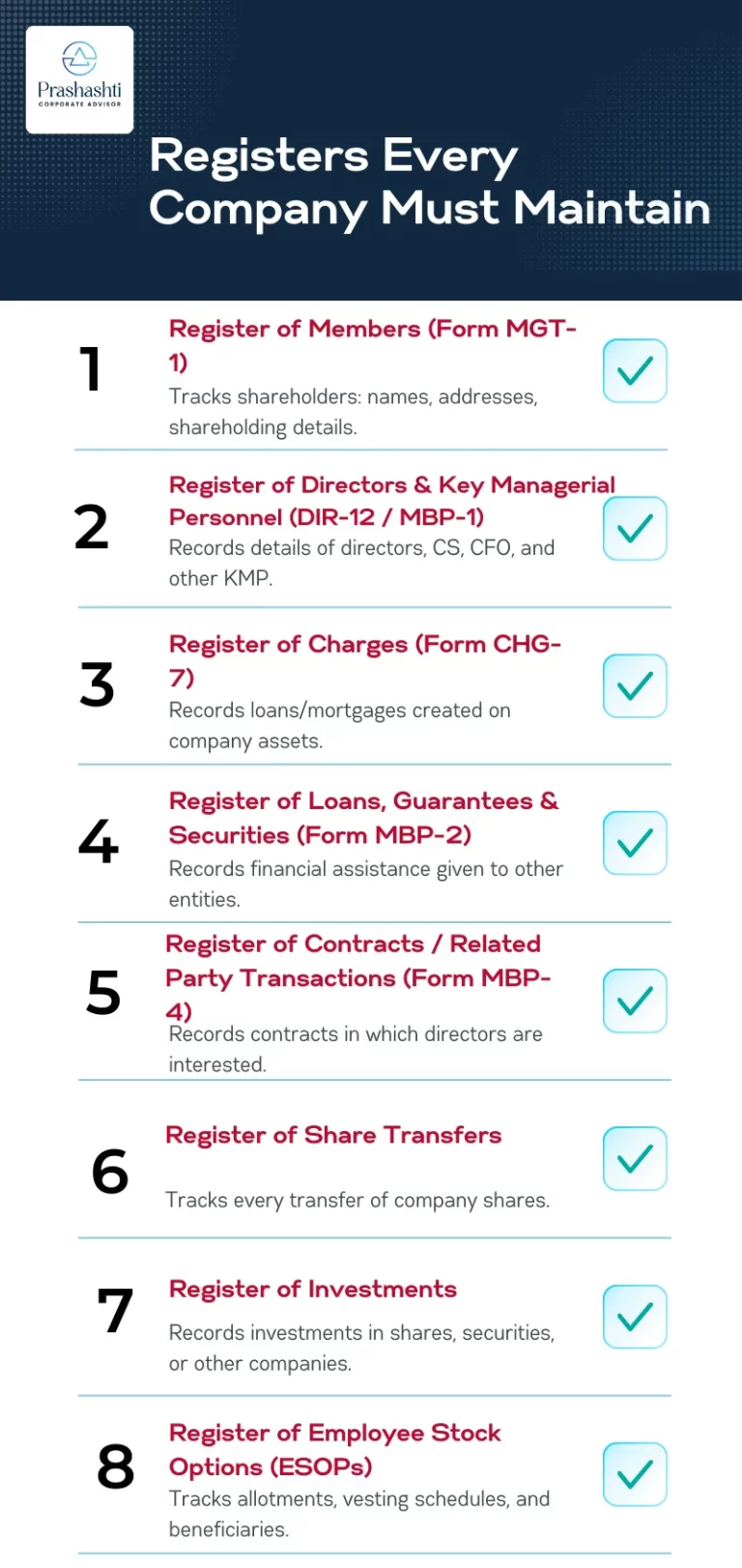
Mandatory Company Registers & Records Every Company Must Maintain
Let’s break down the important registers that every company must keep. Before diving into registers, ensure you’ve avoided the top mistakes businesses make during company registration.
1. Register of Members
This is one of the most important company registers every firm must maintain. It includes their names, addresses, occupation, and the number of shares they hold. Every company must maintain this register carefully because it shows who owns the company and the distribution of ownership.
2. Register of Directors and Key Managerial Personnel (KMP)
This registration keeps track of all the directors and KMPs in the company. It has their names, addresses, dates of appointment, and any shares they might own. As of March 31, 2026, the MCA has replaced the annual DIR-3 KYC requirement with a triennial (every 3 years) filing system.
3. Register of Charges
If the company borrows money and offers assets as security, this register records the details of those charges. It provides details about the lender, the amount borrowed, and the property that was pledged. It protects lenders by keeping the record transparent.
4. Register of Contracts or Arrangements in Which Directors Are Interested
This register keeps track of all the contracts in which leaders have a personal interest so that there are no conflicts of interest. It has information about the deal and what the director is doing.
5. Register of Debenture Holders
If the business gives out debentures, which are a type of loan certificate, this register keeps track of all the people who own them, listing their names and the amount of debentures they own.
6. Register of Deposits
When a business takes deposits from members or the public, this register lists the investors’ names, the amounts they put down, and when they are due to be paid back.
7. Register of Employee Stock Options (ESOP)
If the company offers stock options to employees as part of their compensation, this register tracks details of these options, including who received them and the terms.
8. Register of Loans, Guarantees, and Securities
This register keeps a record of given loans, guarantees provided, or securities offered by the company to other parties.
9. Register of Investments Not Held in Own Name
If investments are in the name of someone else (like a depository), this register can record such investments.
10. Register of Sweat Equity Shares
When a company issues shares to reward employees or directors for services, rather than money, this register tracks those shares.
11. Register of Renewed and Duplicate Share Certificates
If the share certificates are lost or damaged, the company issue new certificates. This register keeps track of all those replacements.
12. Minutes of Meetings
Though it is not a register in the traditional sense, maintaining proper minutes of board and shareholder meetings is mandatory. These minutes, which record decisions and discussions, are important legal documents.
13. Books of Account
This refers to the financial records of the company, which include ledgers and journals which track all money coming in and out. This is not enough, they must be maintained in software that records an unalterable history of every transaction. From April 2023, it has been mandatory for all companies using accounting software to have an Audit Trail (edit log) feature.
14. Register of Significant Beneficial Owners (SBO)
Companies must maintain a record of individuals who hold ultimate beneficial control (usually 10% or more) through complex layers of shareholding. Failing to maintain this is currently a high-alert area for RoC inspections.
Why Statutory Registers Matter for Every Business?
Companies in India must keep these registers to make sure they are run properly. By maintaining mandatory company registers in India, companies can:
- Keep track of ownership and changes in shares.
- Records who is in charge and their roles.
- Monitor the loans, charges, as well as financial transactions.
- Keeps record of all corporate meetings and decisions.
- Stay out of trouble with the law by following the rules.
In short, these records are the most important part of running a business well and following the law.
How to Maintain Company Registers Online?
With digitisation, the Ministry of Corporate Affairs (MCA) allows companies to maintain some company registers online. This makes updating and storing records easier as well as accessible. Companies can file necessary forms and returns electronically through the MCA portal. However, physical registers must still be kept handy for inspection as they are required by law.
Maintaining registers online can help improve accuracy and also reduce errors that happen in manual entries. Companies can file necessary forms and returns electronically through the MCA portal. New to incorporation? Explore our detailed guide on company registration in Bangalore to get started the right way. Also, if you are deciding on a business name, here’s a helpful resource: Guide on company name approval in India.
As of February 16, 2026, the MCA has split major RoC offices. For example, Delhi is now split into Delhi-I (South, SW, New Delhi) and Delhi-II (North, West, Central). Mumbai and Kolkata have also been bifurcated.

Government Fees and Professional Charges
There are some government fees and professional charges which are involved in maintaining registers in India. For example:
- Filing forms that are related to changes in members or directors attracts fees on the MCA portal.
- Professional fees for Company Secretaries or Chartered Accountants to update and verify records.
- Costs of printing and storing physical registers.
The exact company register fees vary depending on the company size and the changes which are being made. Small companies usually have lower costs, but compliance is mandatory for all types. To understand overall incorporation costs clearly, refer to: Company registration fees in India.
In addition to government charges, statutory registers also involve ROC filing fees and professional MCA compliance costs. These vary by company size but are unavoidable for all businesses.
Penalties for Non-Maintenance of Statutory Registers
| Non-Compliance Area | Penalty for Company | Penalty for Officers | Relevant Section |
|---|---|---|---|
| Failure to maintain registers under Sec 88 | Up to ₹3,00,000 | Up to ₹1,00,000 | Sec 88(5) |
| Non-maintenance of minutes | ₹25,000 – ₹5,00,000 | ₹5,000 – ₹1,00,000 | Sec 118 |
| Incorrect or misleading entries in registers | ₹1,00,000 – ₹5,00,000 | Imprisonment up to 6 months or fine | Sec 448/449 |
| Non-maintenance of Books of Accounts | ₹50,000 – ₹5,00,000 | Same | Sec 128 |
| Failure to record charges | ₹1,00,000 – ₹10,00,000 | ₹10,000 – ₹1,00,000 | Sec 86 |
Mandatory Company Registers India: Practical Next Steps
Keeping up with mandatory company registers in India isn’t simply something that needs to be done; it’s the law, according to the Companies Act, 2013. Recent MCA updates have made compliance stricter.
Here’s what you need to know:
- Higher penalties: If records go missing or are wrong, the company could be fined up to ₹3,000,000, and each officer could be fined ₹50,000.
- E-registers are allowed: Registers can be kept electronically, but they must be available for review at any time.
- Tighter deadlines: forms like MGT-7 and AOC-4 now have strict due dates for filing, and people who send them in late will have to pay large late fees.
For businesses, this means that compliance isn’t just about filling out forms; it’s also about keeping processes running smoothly and avoiding fines that can be very expensive.
If you want to get reliable advice on how to start a business and keep your business register up to date, Prashasthi Corporate is a good choice. Making sure you keep good records helps your business stay organized and focused on growth.
FAQs
Related
Discover more from Prashasthi Corporate Advisors
Subscribe to get the latest posts sent to your email.




Pingback: Digital KYC for Indian Corporates: Compliance, Onboarding & Future Trends
Pingback: Challenges of Registering a Business in Bangalore | Startup Guide 2025
Pingback: Company Name Approval in India | MCA Rules, ROC Process & Mistakes
Pingback: Tax Audit vs Statutory Audit: Key Differences Explained
Pingback: Why Businesses in India Need Virtual CFO Services?
Pingback: OPC Registration in Bangalore (2025) | Complete Cost Breakdown
Pingback: 12A and 80G Registration for Section 8 Companies (2026 Guide)
Pingback: How Much Does it Cost to Register a Company in India? (2026 Guide)
Pingback: Private Limited Company Compliance Checklist – Bengaluru (2026)