

If you work in India and are part of the formal workforce, chances are you have heard of ESIC. Many employees see a small deduction in their salary under “ESI” but don’t really know what they are getting in return. Some even think it’s just another tax.
It’s not.
ESIC benefits are meant to protect employees when life doesn’t go as planned, illness, maternity, workplace injury, disability, or even death. It is a social security system that helps the employee and their family.
This blog offers a clear explanation of ESIC, focusing on eligibility, coverage, and how employees benefit from the scheme in real working life.
What Is ESIC and Why ESIC Matters for Employees in India?
Before understanding the benefits in detail, let’s first understand what ESIC is and its benefits in simple terms.
ESIC stands for Employees’ State Insurance Corporation. It is a government body under the Ministry of Labour and Employment. It runs the Employees’ State Insurance (ESI) scheme, which is a social insurance scheme designed for workers.
Under this system, both the employer and employee contribute a small percentage of wages every month. More specifically, employees contribute just 0.75% of their wages while employers contribute 3.25%, making the total contribution 4% of wages each month. In exchange, the employee gets access to medical care, income support during sickness, maternity support, disability benefits, and protection for dependents.
You can also learn more about employer contributions in this guide to PF contribution of employer.

ESIC Benefits Eligibility: Who Can Claim These Benefits?
Not every worker is automatically covered under the scheme. Employees’ State Insurance Corporation applies to factories, shops, hotels, offices, and other establishments once they employ the minimum number of workers required by law. Employees whose monthly wage does not exceed the wage ceiling, currently ₹21,000 (or ₹25,000 for persons with disability), qualify for coverage.
Registration is done by the employer, who contributes a larger share, while the employee contributes a small part. Eligible employees can use the ESIC portal to get to know their insurance number after registering. This helps them make sure they can get their entitled benefits. If they have any problems, they can contact HR for help.
A recent update from 2025 shows that in July alone, ESIC added about 20.36 lakh new employees to its coverage. This shows that the scheme is becoming more popular. If you’re an employer or HR professional setting up ESIC for the first time, this step-by-step guide on ESI registration online will simplify the entire process.
Complete List of ESIC Benefits for Employees and Their Families
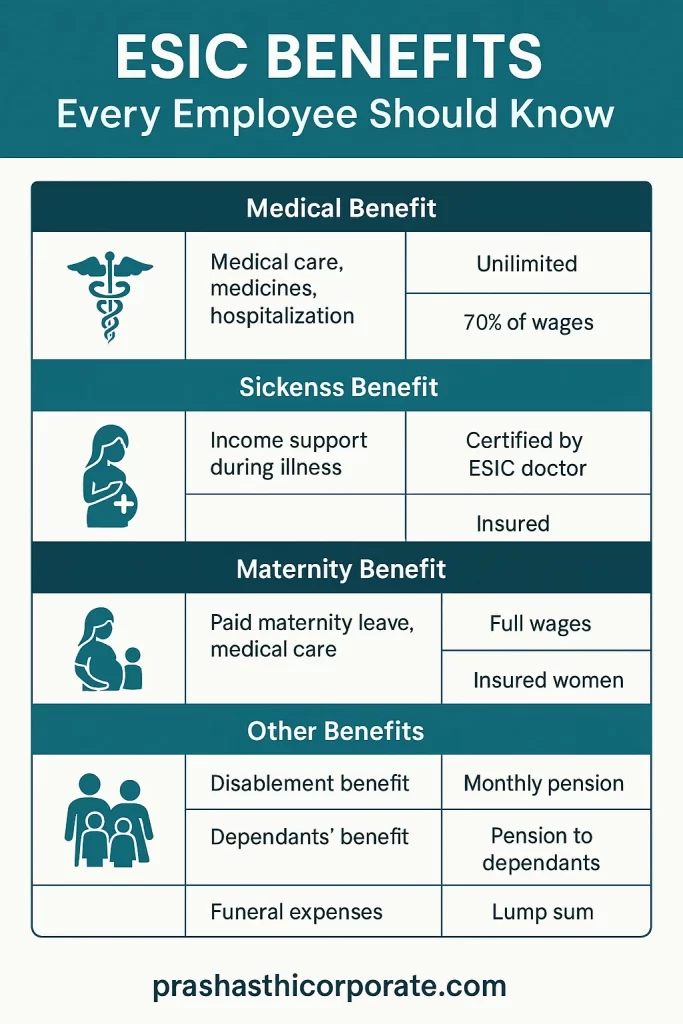
When the regular income is affected, the ESIC benefits act as a protective net. They cover everything like medical care, maternity leave, income replacement, and family security. Below are the benefits:
Medical Benefit: Healthcare Without Financial Stress
Medical benefit is the backbone of the ESIC scheme. From the first day of joining, an insured employee becomes eligible for medical care through ESIC.
This includes outpatient consultations, diagnostic tests, medicines, and hospitalisation through ESIC hospitals and approved private hospitals where applicable.
It’s not just the employees. The spouse, children, and sometimes parents are also covered. For major illnesses or surgeries, this benefit is especially useful because treatment costs are unlimited.
Even after retirement due to permanent disability, or after leaving a job in specific situations, ESIC benefits may still include access to medical care by paying a small annual contribution.
Sickness Benefit: Income Support During Illness
When illness prevents an employee from working, ESIC provides income support in the form of sickness benefit.
If an ESIC doctor certifies the employee, they will get cash compensation equal to a certain percentage of their wages for a certain number of days during the benefit period.
If you have a serious or long-term medical condition that is listed under ESIC rules, you may also be able to get extended sickness benefit. This makes sure that the workers don’t lose their pay while they’re sick.
Maternity Benefit: Support for Working Women
Maternity benefits are one of the most important benefits for women employees.
Under ESIC benefits for maternity, insured women are entitled to get paid maternity leave at the full wage rate, subject to contribution conditions. It also covers medical care related to pregnancy, delivery, and post-natal treatment.
If there aren’t any ESIC medical facilities nearby, you may be able to get your confinement costs back according to the rules. This benefit helps women keep their jobs and income stable while they are pregnant. If you’re unsure whether your company qualifies, this explainer clarifies PF registration eligibility in India.
Disablement Benefit: Protection Against Work-Related Injury
If you get hurt on the job or get a disease because of your work, ESIC will help you financially.
A disabled person temporarily gets cash for the whole recovery period and gets full medical care. If someone becomes permanently disabled, ESIC will give them a monthly payment for the rest of their life. The amount is based on how much the person would have earned if they were not disabled.
Dependants’ Benefit: Financial Security for the Family
When an employee dies, ESIC benefits provide the employee’s dependents with ongoing financial support.
This includes regular payments to the spouse, children, and other dependents who are in the family. The benefit helps families pay for basic needs after the main earner dies.
Funeral and Other Support Benefits
ESIC also gives families a funeral expense benefit to help them pay for things right away after an employee dies.
It also helps people with permanent disabilities get back to work by providing vocational rehabilitation and skill training. In some cases of involuntary job loss, limited unemployment benefits may also be available, but only if ESIC rules allow it.
Want to learn how to sign up for ESIC and start getting these benefits? This step-by-step guide will help you register for ESI online.
ESIC vs Private Health Insurance
| Feature | ESIC | Private Health Insurance |
|---|---|---|
| Cost to Employee | Very low (0.75% of wages) | Medium to high premiums |
| Coverage Limit | Unlimited medical coverage | Limited by policy sum insured |
| Family Coverage | Immediate dependants included | Depends on plan and premium |
| Income Support | Yes — sickness, maternity, disablement | No income replacement benefits |
| Pension for Family | Yes (dependants’ benefit) | No |
| Eligibility | Salary ≤ ₹21,000 | Open to all (higher cost) |
| Hospitals | ESIC + approved hospitals | All partnered hospitals |
| Extra Support | Funeral expenses, rehab, unemployment allowance | Not included |
To understand the wider value corporate advisory brings to Indian businesses, this guide covers the key benefits of corporate advisory services.
Final Thoughts: Making the Most of ESIC as an Employee
When you look at the big picture, ESIC benefits aren’t just about getting money back on your paychecks. They are about getting help when things don’t go as planned. It gives employees peace of mind. It’s an important duty for employers to follow the rules. The real value of ESIC comes from knowing how to use it correctly and understanding it well.
Companies like Prashasthi Corporate often help businesses understand these kinds of laws so that employees get what the law says they should get. When done right, ESIC is less of a hassle and more of a protection that works quietly.



Pingback: What is the Minimum Capital Required for Company Registration?
Pingback: Labour Law Compliance in India 2026: New Labour Codes Guide