


 1. Differences in Scope of Services
Discussing on differences between corporate advisors & finance advisors.
Corporate Advisors provide long-term strategy guidance for corporations. They back solid restructuring, mergers and acquisitions, government, and succession planning. These professionals lead businesses through challenging changes, turnarounds, growth, and entering new markets.
However, Finance Advisors focus on company operations and finances. Cash flow, budgeting, projections, investment planning, and risk management are their services. They help executives and business owners make choices based on accurate financial information.
2. Key Differentiator – Strategic & Financial Focus
Corporate Advisors advise CEOs on long-term decisions, including market positioning, business model changes, and strategic collaborations. Their advice enables companies to find strategic opportunities, match their operations with their vision and mission, and lower their increasing or changing risk profiles.
When it comes to money, however, financial advisers pay close attention to the specifics. Their attention is on the measures and numbers that support the organization’s day-to-day work and long-term ability to stay financially stable. They look at financial records, make budgets, and give advice on how to cut costs, improve cash flow, and get better returns on investments.
3. Business Lifecycle Engagement
Companies in trouble engage corporate advisors. Their involvement is frequently tied to important events like launching a firm, preparing for an IPO, buying or merging, or exiting. These events significantly alter a business’s organization, ownership, or market position.
Finance Advisors work with businesses throughout their lifespans. From early-stage companies needing financial modelling to mature organizations with complex cash flows and investments, Finance Advisors are always available.
4. Industry and Market Analysis
To guide their strategic decisions, corporate advisers frequently study the outer world. This entails investigating issues including changes in the company, rules and regulations, competitiveness, and market trends. Their task is to search for opportunities to expand, create fresh ideas, or modify their approach to competitiveness.
Finance Advisors, on the other hand, look at internal info more. They look at important financial statistics, keep an eye on cash flows, track return on investment (ROI), and judge how well the budget is working. Their research helps ensure that resources are used well and that goals for money are met.
Looking to start your business in Bangalore? Check out our in-depth guide on company registration in Bangalore to understand the legal process, timelines, and expert tips.
5. Stakeholder Interaction: Corporate vs Finance Advisors
Corporate Advisors maintain tight relationships with firm leaders, board members, and investors.
Their advice often influences mergers, acquisitions, and governance policies. Making sure that what businesses do aligns with their long-term corporate objectives and the best interests of their shareholders depends critically on them.
Conversely, finance advisors deal largely with internal finance teams, accountants, and company owners. Their main focus is on budgeting, financial planning, and financial reports.
They make sure that all departments know how much money they have, which helps management make good choices about how to run the business.
6. Regulatory and Compliance Roles of Both Advisors
Corporate Advisors are crucial for ensuring that a company stays in line with corporate laws and foreign rules during important business changes. They advise on things like corporate governance, doing your research before a merger or purchase, restructuring, and how to legally set up a business.
Finance Advisors, on the other hand, make sure that your finances are in order. One of their jobs is ensuring that a business follows tax rules, accounting standards (like GAAP or IFRS), and its internal financial policies. They put together financial records that have to meet audit and government rules. This makes sure that everything is clear and correct.
7. Revenue Generation vs Cost Control
Corporate Advisors usually want businesses to grow. They look for ways to make money through strategic moves like entering new markets, combining with other companies, or forming relationships. Their job is to raise the market worth and competitiveness of the company. They usually do this by finding new markets or investment opportunities that fit with the company’s long-term goals. Here’s how corporate advisors make deal structuring profitable.
Finance Advisors pay more attention to the internal financial environment, trying to keep costs down and make operations run more smoothly. Their main job is to keep costs down, create budgets, and decide how to use resources. They make the business more profitable and long-lasting by improving financial practices and cutting down on wasteful spending.
This is one of the key differences between corporate advisors & finance advisors.
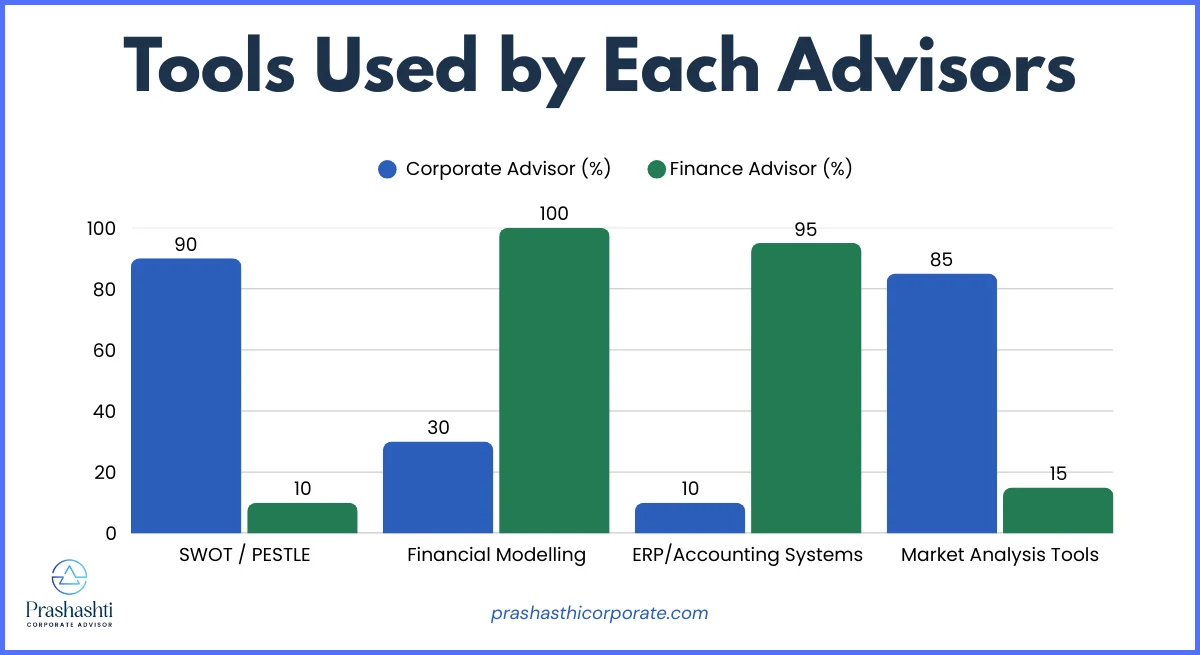
8. Advisory Style and Tools of Corporate & Financial Advisors
These tools assist corporate counsel to plan strategically and assess the market. This comprises SWOT, PESTLE, Porter’s Five Forces, business intelligence, and market mapping software. These tools help you see the world and plan for business growth and a competitive edge.
Finance advisors employ quantitative tools, including financial modelling, budgeting, investment calculators, and ERP systems. These tools let you analyse past results, predict future outcomes, and manage your funds. Their style is based on numbers and measurable results, which makes strategy decisions easier to understand. Understand key benefits of corporate advisory services in India to see how expert guidance can fuel your company’s sustainable growth.
Discover more from Prashasthi Corporate Advisors
Subscribe to get the latest posts sent to your email.




Pingback: How MAT Impacts a Growing Startup in India (2025 Guide)
Pingback: PF Registration Eligibility: Rules, Criteria & Employer Guidelines
Pingback: Operating Leverage vs Financial Leverage: Real Difference Explained
Pingback: PF Registration Eligibility: Rules, Criteria & Guidelines