


Starting your own company in 2026? This is an exciting plan, but don’t be shocked by the hidden price.
But before you fill out a single form, make sure you understand what you’re signing up for. Company registration fees in India can vary greatly based on the type of business and how it is registered.
Whether you’re going solo with an OPC, collaborating with a Private Limited, or keeping things flexible with an LLP, we’ll walk you through every cost that matters.
The Discount Registration Trap: A 2026 Reality Check
Before we start, lets understand by taking an example: An entrepreneur named Aarav decided to start a manufacturing company in food-tech. He saw an online ad for company registration at ₹4,999. Without much serious thought, he immediately signed up, thinking he was actually saving money.
To keep costs low, the service used a generic business activity template and the minimum authorized capital. What he didn’t realize was that this template listed his business activity as general trading rather than Manufacturing and Food Processing. Later, when he applied for a business loan, his application was rejected because his legal documents didn’t match his actual business operations. This forced him to pay ₹15,000 in repair fees to the ROC and cost him two months of growth.
Lesson: In 2026, a cheap setup often becomes your most expensive mistake. It is better to budget for a correct setup than to pay for a correction later.
Company Registration Cost Breakdown by Entity Type (2026)
In India, the costs to register a company can take many forms. Those vary with the business structure you choose to establish. Let me tell you what’s in store:
Private Limited Company Registration Fees in India
This is the most common way for small businesses and startups to set up, but it’s not cheap. The price goes up because there are more DSCs, DINs, higher ROC charges, and compliance requirements.
OPC (One Person Company) Registration Fees in India
Costs around ₹9,000 to ₹23,000. Since there’s only one director, expenses like DSCs and DINs are fewer. The structure is lighter than a Pvt Ltd, though it still carries some of the same compliance rules. Good for solo founders who want limited liability without a partner.
LLP (Limited Liability Partnership) Registration Fees in India
The most affordable option, ranging from ₹6,000 to ₹15,000. LLPs have lower ROC fees, simpler paperwork, and fewer compliance obligations. This makes them popular with professionals, consultants, and small service firms.
Public Limited Company Registration Fees in India
Public Limited Company starts from ₹50,000 and above. The costs are steep because you’ll need more directors, higher authorised capital, and heavy documentation. Public Ltds are built for companies planning to raise funds from the public, not for small setups.
Quick Cost Comparison of Company Registration in India (2026)
Entity type | Approx. registration fees | Compliance Level | Best for |
Private Limited (Pvt. Ltd) | Rs.12,000 – Rs.30000 | High | Startups, SMEs |
One Person Company (OPC) | Rs.9000 – Rs.23000 | Medium | Solo founders |
Limited Liability Partnership (LLP) | Rs.6000 – Rs.15000 | Low | Professional, small firms |
Public Limited Company | Rs.50000+ | Very high | Large businesses |
Remember that these are only estimates. Your real cost will depend on your capital, state of registration, and the professional services you need. To avoid this mistake, it is vital to understand the minimum capital required for company registration before you begin
Hidden & Post-Registration Costs You Must Consider
Registering your company in India is just the beginning. There are ongoing costs you should plan for:
Annual Compliance Fees
Every registered company must file annual returns with the ROC. This often requires specialist assistance and costs between ₹5,000 to ₹15,000 each year.
Tax Returns and Audit Fees
Depending on your revenue and structure, you may be required to file income tax returns, GST forms, and perhaps be audited. These services are charged separately.
Other Mandatory Registrations (GST, MSME, IEC)
You may have to register for:
- GST (free, although expert assistance may cost ₹1,000-₹3,000).
- MSME (normally free, however expect ₹500-₹1,000 if done through an agency)
- Import Export Code (IEC): ₹500 government fee and service expenses.
Penalties & Late Filing Charges
Missing deadlines for annual reports or taxes can cost up to ₹100 per day. It quickly adds up, so being compliant is vital. Properly maintaining statutory registers under the Companies Act 2013 is a mandatory requirement that carries heavy penalties if ignored.
Company Registration in Bangalore – Quick & Reliable
Types of Business Entities & Why Costs Differ?
Companies and registration fees are not all the same. Here’s a basic overview of the most popular types of entities in India:
Private Limited Company (Pvt Ltd)
A Private Limited Company is the most popular choice for startups and small businesses. It requires at least two directors and imposes tighter compliance standards. Company registration fees for this structure are typically higher, owing to the extensive documentation and obligatory filings.
One-Person Company (OPC)
If you’re a single founder looking for limited liability without a partner, an OPC is perfect for you. It has a similar structure to a Private Limited, but with lower fees and continuing compliance. Learn more in OPC Registration Cost in Bangalore.
Limited Liability Partnerships (LLP)
An LLP combines the elements of a partnership and a business. It has flexible management, fewer regulatory constraints, and lower total costs. It is best suited to professionals and small firms that do not require capital.
Public Limited Company
This form is typically used for larger businesses seeking to obtain funds from the public. The documentation and cost required to register a company in India are significantly higher. As a result, the majority of small enterprises avoid this. For challenges and considerations, see Challenges to Register Business in Bangalore.
Essential Pre-Registration Components: Your Before-You-Begin Checklist (2026)
Before you jump into the application, you are required prepare well with the pre-registration components. This will save 7-10 days of processing time.
- Digital Signature Certificate (DSC) :Now your physical signatures don’t work, you need to have a Class 3 DSC. It is valid for 2 years and may cost ₹1,500 – ₹2,500 per person.
- Director Identification Number (DIN): Every person intending to be a director must have a DIN.
- Company Name Reservation: Use Reserve Unique Name service first. It gives you two chances to get your name approved before you file the full registration and it costs ₹1,000.
- Registered Office Proof : Even if your business is completely report, you are required to provide a physical address in India. You will need Notarized Rent Agreement and a No Objection Certificate (NOC) from the landlord. Utility bill not older than two months in the name of the owner.
Key Factors That Affect Company Registration Fees in India
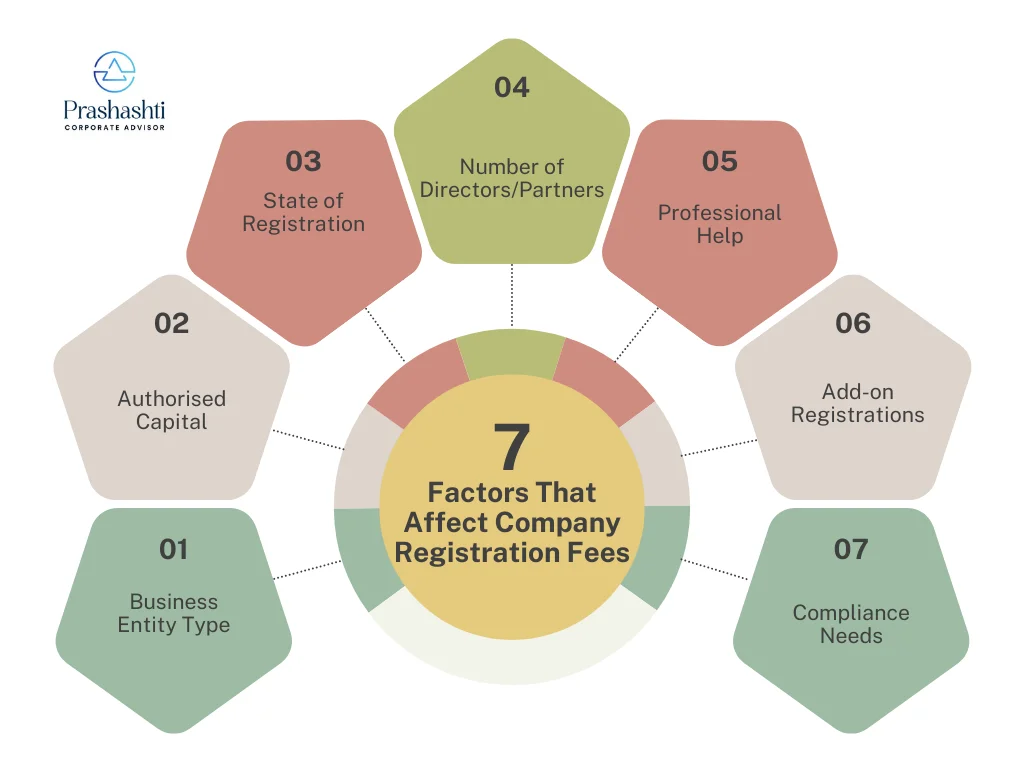
Company registration India isn’t fixed. They shift based on a few things that directly impact your budget:
1. Type of Business Entity
The structure you pick, Pvt Ltd, OPC, LLP, or Public Ltd is the biggest factor. A Pvt Ltd has stricter compliance and more paperwork, which means higher fees compared to an LLP. If you’re unsure which structure suits your business best, check out our detailed guide on how to choose the right company structure for your business.
2. Authorized Capital & Stamp Duty
Your declared authorized capital is directly related to the registration fees as well as stamp duty. The expenditures will go down if you start little, but they will go up if you raise money later.
3. State of Registration
Stamp duty varies by state. For example, forming the same company in Karnataka might cost differently than in Delhi or Maharashtra.
4. Number of Directors or Partners
Each director or partner needs a DSC and DIN. More people equals higher upfront fees.
5. Professional & Legal Assistance
DIY using MCA portals is cheaper, but most people engage a CA, CS, or service provider. Their professional fees vary by setup complexity from low to high.
6. Add-on Registrations (GST, MSME, IEC)
You may need extra things like GST, MSME, or Import Export Code right away. Each one costs a little bit, but they can save you a lot of trouble with compliance later.
7. Compliance Requirements for Special Industries
If your business is in a sector that needs special licenses (food, healthcare, finance), registration will cost more because of additional documentation and approvals.
Standard Costs for All Business Structures
There are a few fixed costs that apply across all business types:
Digital signature certificate (DSC)
To sign digital papers, each director or partner must have a DSC. A DSC generally costs between ₹1,000 and ₹2,000 and is valid for two years.
Director Identification Number (DIN).
Each director has a unique ID. It costs approximately ₹500 per person and is only granted once.
Company Name Approval (MCA)
Before registering, you must have your company’s name approved by the Ministry of Corporate Affairs (MCA). This process costs ₹1,000 and can be completed via the SPICe+ form. Check Company Name Approval Guide, Rules & Tips.
Stamp Duty on MOA, AOA & Agreements
Stamp duty is imposed on the Memorandum of Association (MOA), Articles of Association (AOA), and LLP Agreement. This cost varies depending on the state in which your business is registered and the quantity of authorized capital. Prices typically range from ₹1000 to ₹5000. Learn the Key Differences Between MOA and AOA.
ROC (Registrar of Companies) Fees
The Registrar of Companies (ROC) charge is determined by the nature of your business and the amount of capital permitted. Private limited companies typically charge from ₹3,000 to ₹10,000. However, OPCs and LLPs have much lower rates.
PAN & TAN Application Costs
These are required for tax purposes. The total fee for PAN and TAN applications is approximately ₹150-₹200.
Professional & Incidental Charges
You will pay professional fees if you hire a business Secretary, a Chartered Accountant, or a legal service provider to assist you with the company registration process. The cost of hiring might range from ₹5,000 to ₹25,000, depending on the complexity of the business setup. These are minor but unavoidable expenses such as printing, courier, or document notarization. Budget between ₹500 and ₹2,000 for these.
Common Myths About Company Registration Costs in India (2026)
- Myth 1: “All businesses must pay a high fee for company registration.”
Reality: Not every structure is expensive. For small or lone founders, LLPs and OPCs are cost-effective. - Myth 2: “The primary expense is government fees”
Reality: Government fees are frequently surpassed by professional fees, compliance filings, and post-registration expenses. - Myth 3: “There are no additional fees after registration.”
Reality: Tax returns, annual ROC filings, and renewals are ongoing costs that need to be budgeted for. - Myth 4: “Do-it-yourself registration always saves money”
Reality: Missed compliance deadlines or form errors can result in fines that are more expensive than expert assistance. - Myth 5: “At the beginning, higher authorized capital is required”
In actuality, you can begin with little money and add more as your company expands.
How to Manage Company Registration Fees Smartly in 2026?
Starting your own business doesn’t have to be expensive. You can minimize surprises and excessive charges by planning ahead of time, choosing the suitable structure, and understanding the total cost of company registration fees.
If you’re unsure where to begin or want a smooth, affordable registration process, Prashasthi Corporate can help. They specialise in business setup services and make registration easy, transparent, and hassle-free.
With the right guidance, you can focus on building your business while they handle the paperwork.
Related
Discover more from Prashasthi Corporate Advisors
Subscribe to get the latest posts sent to your email.




Pingback: How & When to Choose Corporate Advisory Services in Bangalore
Pingback: US Company Registration in India: Legal & Compliance Guide
Pingback: Company Name Approval in India | MCA Rules, ROC Process & Mistakes
Pingback: OPC Registration in Bangalore (2026) | Complete Cost Breakdown
Pingback: Paid-Up Capital vs Authorized Capital: Key Differences Explained
Pingback: 12A and 80G Registration for Section 8 Companies (2026 Guide)
Pingback: NGO Registration Timeline in Bangalore: 2026 Timelines & Process