


How RegTech in India Is Modernizing Modern Corporate Advisory
Corporate advisory in India is no longer about filing paperwork and reacting to the rule changes after they happen. Regulations are multiplying, compliance costs are climbing, and clients are expecting faster solutions. To keep up with that, advisors are turning to technology and, more importantly, to RegTech in India.
This blog breaks down how RegTech is reshaping the advisory services, the recent changes in the Indian market, the role of key players, and what steps advisors can take to adopt these tools today.
What is RegTech & Why India Needs It Faster?
Regulatory Technology, or RegTech, refers to software, systems, as well as tools built to help businesses follow the laws, regulations, and reporting requirements. Instead of manual compliance (forms, spreadsheets, paper trails), RegTech uses automation, analytics, dashboards, AI/ML, and real-time monitoring.
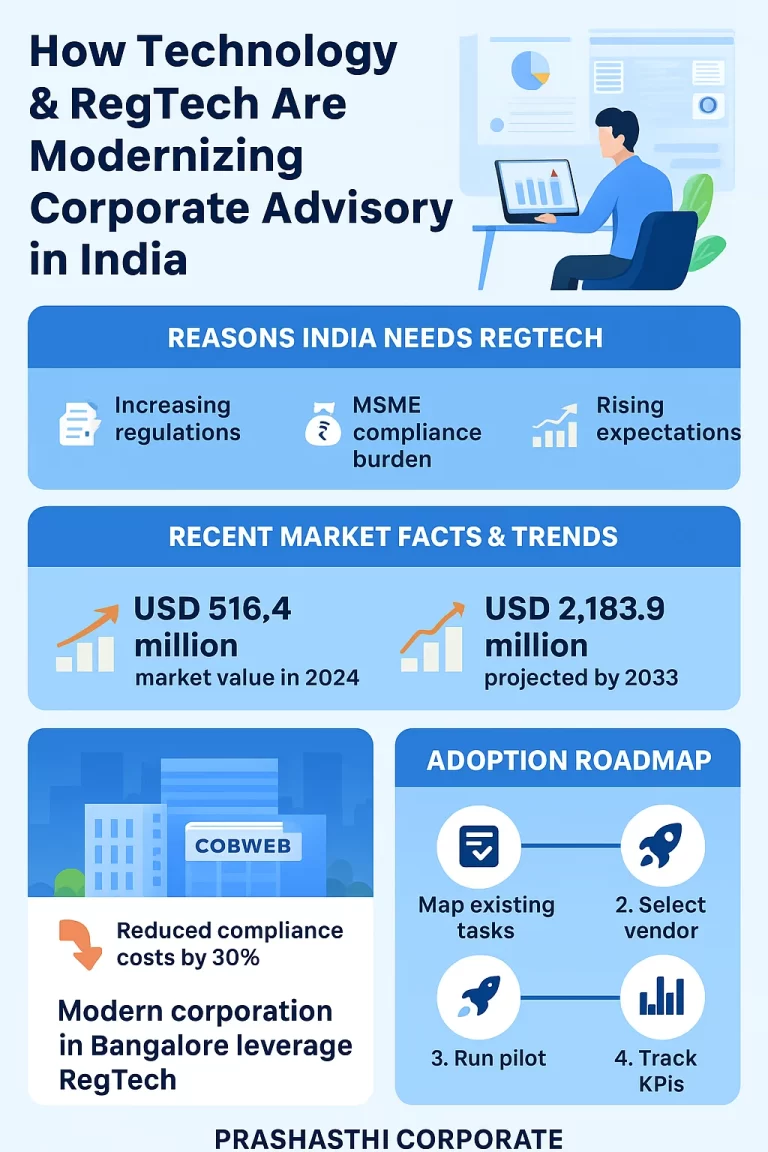
India needs RegTech now because of a few reasons:
- Regulations are increasing. The government is updating the accounting, audit, cost audit, and disclosure rules regularly. For example, in 2025, the Ministry of Corporate Affairs issued amendments to the Companies (Cost Records and Audit) Rules, updated Forms CRA-2 and CRA-4, and introduced new standards for audit and auditors.
- MSMEs are heavily burdened: A recent report by TeamLease RegTech found that manufacturing MSMEs in India face over 1,450 regulations annually, and compliance costs are between Rs 13 to 17 lakh per year. Read Here
- Businesses are also facing rising expectations from regulators in data privacy, ESG, AI regulation and others. Companies are expected not just to comply, but also to demonstrate controls, transparency and audit trail.
Recent Market Facts & Trends in RegTech in India
Here are the strong recent data points that show how fast RegTech is growing and is being adopted:
- The India RegTech market was valued at USD 516.4 million in 2024. It is projected to reach USD 2,183.9 million by 2033, growing at a Compound Annual Growth Rate (CAGR) of ~17.4% from 2025 to 2033.
- Another forecast (BlueWeave Consulting) expects the market to grow even faster, with India’s RegTech market growing at ~36% CAGR during 2025-2031, reaching ~USD 2,602 million by 2031.
In 2025, corporate law changes include digital filing updates, audit rules, and cost audit amendments. For example, amendments to Indian Accounting Standards and Companies (Accounts) Rules have been notified.
How RegTech & Technology Are Changing Corporate Advisory in Practice?
Advisors are using RegTech in India to change their way of working. The change is visible in these areas:
Automated and real-time compliance monitoring
Instead of monthly or quarterly checks, companies are now using software that tracks the compliance continuously. These systems send alerts when a compliance slip is about to happen: missing filing deadlines, audit issues, as well internal control failures.
Faster identity verification and fraud detection
KYC / KYB / AML processes are long. By using AI/ML tools, document verification, and cross-database checks, firms reduce time and manual errors. False positives (incorrect alerts) decline, which means fewer wasted hours.
Adapting to regulatory changes quickly
When MCA or SEBI change rules, the RegTech tools can update workflows or templates. Meaning, you don’t manually adjust everything. This reduces the risk of non-compliance.
Due diligence & risk scoring
In M&A, advisory work, counterparty assessments, and legal and financial document reviews are required. In addition, RegTech tools can scan many contracts, identify problem clauses, check litigation history, and rank counterparty risk. It makes due diligence faster and much more accurate.
Support for MSMEs and smaller firms
MSMEs don’t always have big law and compliance teams inside the company. But the RegTech gives them digital dashboards, guided processes, checklists, as well as tools that aren’t too expensive. This helps them follow the rules without spending a lot of money. Recent sources say that there are over 1,450 rules and that it costs between 13 and 17 lakh rupees a year.
For deeper insights into deal structuring and profitability, see our blog on How Corporate Advisors Make Deal Structuring Profitable
Regulatory Updates & Government Moves in RegTech in India – Recent Changes Advisors Should Know
- In May 2025, the MCA issued Companies (Accounts) Amendment Rules, 2025 and related rules for audit, auditor and cost audit. Forms like CRA-2 and CRA-4 were revised.
- SEBI relaxed the timelines for Alternative Investment Funds (AIFs) and to hold investments in dematerialised (“demat”) form. This reduces some procedural compliance burdens.
- The MCA also updated accounting standards; changes to Ind AS 21 (Effects of Changes in Foreign Exchange Rates) to handle non-exchangeable currency issues.
- Regulatory bodies are pushing for tighter data privacy laws (Digital Personal Data Protection Bill) and increased scrutiny of ESG and AI regulation. And firms are expected to prepare.
Case Studies & Market Leaders: RegTech in India
- IDfy Expanding Identity Verification and KYC: IDfy is an expert in risk scoring, document verification, and digital KYC. With revenues of ₹188 Cr in FY25, it has grown quickly and demonstrated a high demand for compliance automation.
- Startup Ecosystem for RegTech: More than 365 RegTech companies in India are tackling compliance issues (IndiaFintech Substack). Forecasts from BlueWeave and IMARC support growth, demonstrating that this is a long-term shift.
Businesses considering professional guidance can also review our Guide to How & When to Choose Corporate Advisory Services in Bangalore.
Practical Playbook for Advisors
If you are doing corporate advisory and want to adopt RegTech in India, here is the roadmap:
- Start by mapping out all of the existing compliance tasks. Which ones take long, which ones cause the errors? Estimate their cost and time.
- Look for a vendor that fits your needs, ie, good security, ease of integration, up-to-date with the latest rules (MCA, SEBI, etc.), as well as cost-efficient.
- Run a pilot on one function, maybe KYC or audit report workflows. Measure the time before vs after, the number of errors, and the number of manual interventions.
- Use metrics (KPIs) like cost per compliance task, time per filing, number of regulatory issues, client satisfaction as well as speed of audit readiness.
- Train your staff. Technology changes everyday, and it requires people who understand both compliance and the new tools.
Keep one eye on risks like data privacy, regulation changes, vendor risk, as well as over-automation.
RegTech in India: A New Era for Modern Corporate Advisory Services
RegTech in India is changing the way experts do their jobs by speeding up compliance, lowering the chance of mistakes, and letting them get better insights. Tech-savvy businesses will be ahead of the curve as rules get tighter. It might fall behind if it doesn’t.
Reporting is no longer the only thing that advisory does; it’s also about using the right tools to guide strategy. At Prashasthi Corporate, we help businesses adopt RegTech in India for faster compliance, reduced costs, and future-ready advisory. Connect with us today to explore tailored RegTech solutions for your business.
It’s clear what the future holds: business advisory in India is going digital, getting more done, and planning for the future.
FAQs
Related
Discover more from Prashasthi Corporate Advisors
Subscribe to get the latest posts sent to your email.




Pingback: Digital KYC for Indian Corporates: Compliance, Onboarding & Future Trends
Pingback: PF Registration Eligibility: Rules, Criteria & Employer Guidelines
Pingback: How to Apply for PF Registration Online – EPFO Step-by-Step Guide 2026
Pingback: PF Contribution of Employer: Rules, Split & Updates 2026