


A founder can register a company in Bangalore pretty quickly. That part may look simple. The harder questions usually come after. Rent feels expensive. Hiring is not cheap. Compliance starts showing up. And many founders begin wondering if choosing Bangalore was the right move.
Even so, Bangalore still has things many cities are trying to build: investors, tech talent, mentors, incubators, and a startup network that is already active. That is why many founders still look at startup registration in Karnataka through Bangalore.
The point is not to follow the crowd. It is to see what fits your business.
In this blog, we’ll look at whether Bangalore still makes sense, how it compares with other Karnataka cities, what it may cost, and who it may suit.
Why Karnataka Still Leads in Startup Registrations?
As of early 2026, Karnataka has over 21,000 DPIIT-recognised startups and remains one of India’s top startup states. But the bigger point is not the number alone. Founders look at Karnataka because there is already support around them, policy programs, incubators, innovation networks, and people they can learn from. That often matters as much as registration itself.
In addition, Karnataka’s Startup Policy 2025-2030 has also pushed focus toward funding support, market access, and startup growth beyond Bengaluru.
Some of that support shows up, and they are:
- Startup and incubation programs.
- Access to mentoring and investor networks.
- Innovation-led policy support.
- Growing infrastructure across multiple cities.
Still weighing cost vs opportunity?
Why Is Startup Registration Karnataka Still Centered Around Bangalore?
Bangalore’s strength is the crowd that has built over the years. Founders, investors, engineers, product teams, and startup communities are already close to each other. That makes the early stage a little less lonely and a little less slow. That makes the early stage a little less lonely and a little less slow, especially when the setup itself is aligned properly through the company registration process in Bangalore.
This shows up in practical ways:
- Easier access to tech and product talent.
- More active angel and venture capital circles.
- Strong founder communities and startup events.
- Better chances of meeting partners, mentors, or early customers.
The city also has tech companies, global capability centres, and old startups. People learn there, move out, join new companies, or start something of their own. That steady movement of talent and ideas is why Bangalore still matters for many tech startups in Karnataka.
Expert Insight: According to the Tracxn India Tech Annual Funding Report 2026, Bangalore has solidified its status as India’s “Acquisition Capital.” Despite a global funding slowdown, the city recorded 34 major startup exits in the last year alone. For a founder, this means Bangalore isn’t just a place to start; it’s the most likely place in India to successfully sell your company or go public.

What Does Startup Registration in Karnataka Look Like in 2026?
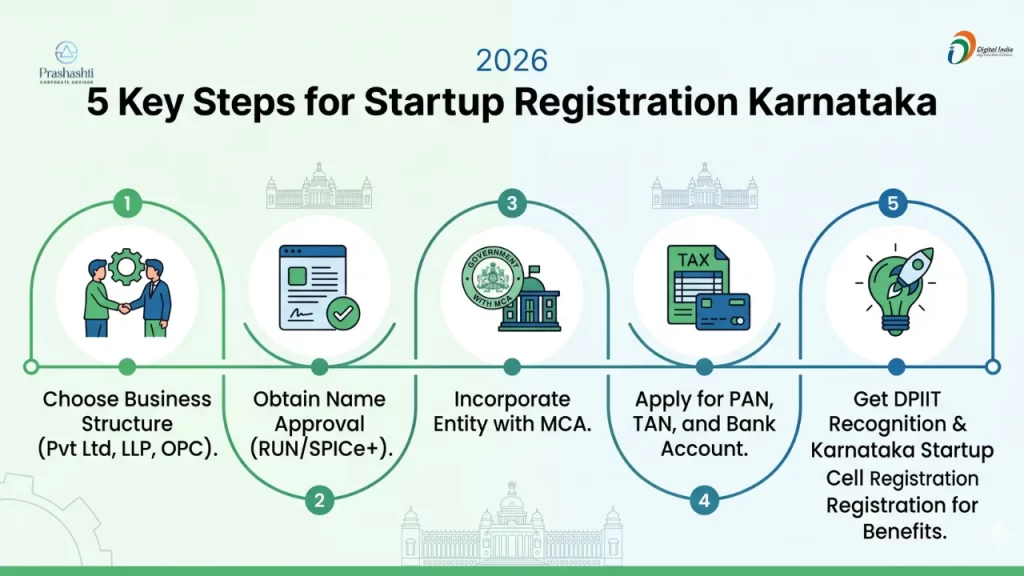
The process itself is not as complicated as many founders assume. It usually starts with picking the business structure that fits what you want to build.
Most founders look at:
- Private Limited if growth or funding is the goal
- LLP if the business is meant to stay lean
- OPC, if you are starting alone
After that, it usually moves through name approval, incorporation filing, PAN, TAN, and other registrations, where needed. It usually starts with picking the business structure that fits what you want to build, and the differences between them are explained in this types of company registration in India guide.
Which Cities Beyond Bangalore Are Growing for Startup Registration in Karnataka?
Bangalore still gets most of the attention. That has not changed. But some founders have started looking at other cities too, mostly because costs are lower and not every startup needs a Bangalore base anymore.
A few places keep coming up:
- Mysuru is being talked about more for IT, electronics, and cybersecurity.
- Hubballi-Dharwad has also come into the conversation, especially around agri-tech.
- Mangaluru is getting noticed too, particularly for fintech and tech services. The port advantage gets mentioned often.
- Belagavi, Tumakuru, and Shivamogga are still early, but people are watching them. The GCC push could change things there over time.
Expert Insight: Some founders may register in Bangalore for investor access, but keep operations or R&D in a lower-cost city like Belagavi or Tumakuru. That kind of split setup can make practical sense.

What is The Startup Registration Cost in Bangalore vs Other Cities?
Cost is usually where founders stop and think twice. And honestly, they should.
A lot of people look only at registration fees, but that is only one part of the spend. The cost of starting a business in Bangalore can feel higher because expenses show up in layers.
Government fees are mostly the same across Karnataka. Where costs start changing are professional charges and running the business after registration.
- Bangalore: A basic Pvt Ltd setup may cost around ₹15,000-₹25,000 with professional fees. Then you look at office rent in areas like HSR Layout or Indiranagar, which can start around ₹80-₹120 per sq. ft. That is where costs start adding up.
Tier-2 Cities: Professional fees may be somewhat lower, but the bigger difference is often in operating costs. In some cases, they can be close to 40% lower than Bangalore. Another factor founders often consider early is funding structure, and understanding the minimum capital required for company registration can help avoid confusion later.
Who Should Still Choose Bangalore for Startup Registration?
Bangalore can still make sense if your business needs the kind of things a bigger startup city offers. Not every founder needs that, but some do, especially when the setup is already structured properly with the right documentation, as outlined in documents required for company registration in Bangalore.
You may want Bangalore if you are building:
- A SaaS or tech-driven business.
- An AI, fintech, or deeptech startup.
- A startup that may raise funding later.
- A company that depends on strong product or engineering talent.
In these cases, being in Bangalore can help because the talent pool is deeper, investor access is easier, and the startup network is already there.
Why Do Government Incentives Matter for Startups Registration in Karnataka?
Many founders look only at registration, but incentives can matter just as much. That is where the benefits of the Karnataka startup policy often come into the picture. Support may include:
- Innovation and incubation support.
- Funding access for eligible startups.
- Ecosystem and market-development programs.
This also connects to a point many founders miss. Being eligible to incorporate and being eligible for startup incentives are not always the same. Incentive access may depend on factors like entity age, turnover, and innovation criteria.
Is Bangalore Becoming Too Expensive for Early-Stage Startups?
Common concerns include:
- Higher operating expenses.
- Rising salary expectations.
- Infrastructure and traffic strain.
- Heavy competition in some sectors.
For bootstrapped or cost-sensitive startups, these can be real issues. That is why Bangalore may not suit every business.
What New Karnataka Startup Incentives Are Available in 2026?
In 2026, startup registration in Karnataka is not only about incorporation or tax benefits. A bigger shift is market access. The state is trying to support startups not just as a regulator, but in some cases as an early customer too. That changes things for founders. That changes things for founders, especially when compliance readiness is already in place through frameworks like the Companies Compliance Facilitation Scheme.
Government as a First Customer
Some Karnataka startups may benefit from public procurement support, especially in civic, agri, and governance solutions. For early-stage B2G ventures, this can help build credibility.
DeepTech Support Through Elevate NxT
If you are building in AI or deeptech, the new ₹600 crore fund has made this worth looking at. Grants can go up to ₹1 crore under Elevate NxT, which is a bigger jump than earlier support. For early-stage founders, that can make a real difference.
Beyond Bengaluru Incentives
Founders choosing cities like Mysuru or Hubballi may also have an advantage. The SGST reimbursement support can lower costs in the first few years, which matters when cash flow is tight.
Founder’s Tip: If you want to apply for these incentives, make sure your DPIIT recognition and Karnataka registration match. Even small paperwork gaps can slow things down. If needed, firms like Prashasthi Corporate can help you check whether your setup is ready before you apply.
Startup Registration in Karnataka: Final Thoughts from Prashasthi Corporate
Bangalore may still be the right choice for many founders, but it should not be chosen just because others do. What matters is whether it fits your business. Some startups need investor access and talent. Others may care more about keeping costs low. That is why the decision should be practical, not automatic.
For many founders, startup registration in Karnataka still makes sense because the state offers a solid base to start and grow. If you are trying to understand the compliance side before making a move, you can also look through the insights shared by Prashasthi Corporate to get more clarity.




Pingback: MAT for Startups in India: Key Tax Planning Insights for Founders
Pingback: Top 10 Virtual Office in Bangalore for Company Registration 2026